What Is Beneficial Ownership in Music Rights?
Beneficial ownership can exist even when legal title to a copyright sits elsewhere. Explore how retained royalty interests, transfers, and divided rights affect ownership.

Introduction
Ownership records do not always identify every party with a continuing financial interest in a song or recording. A songwriter, artist, producer, or other creator may transfer legal title to a copyright while retaining the right to receive royalties from its exploitation. In certain circumstances, that retained interest may make the creator a beneficial owner under U.S. copyright law.
The term has a specific legal meaning. Legislative guidance describes a beneficial owner as someone who has transferred legal title in exchange for percentage royalties based on sales or licensing. U.S. copyright law also recognizes that a beneficial owner of an exclusive right may bring an action for infringement of that right, subject to the applicable legal requirements.
Beneficial ownership can arise in arrangements involving musical compositions and sound recordings, but a continuing payment alone does not settle the question. Royalty participants, administrators, licensees, and collection agents may all receive income or exercise limited authority without holding the same legal position. The language of the transfer, the interest retained, and the particular copyright right involved must be considered together.
This guide explains how beneficial ownership arises, how it differs from legal title and contractual royalty participation, what authority may accompany the interest, and which records can help establish a claim. It also examines the practical issues that emerge when agreements, registrations, royalty accounts, and later transfers present different versions of the ownership position.
Learning Objectives
By the end of this guide, readers will be able to:
- Define beneficial ownership within the context of U.S. copyright law
- Distinguish beneficial ownership from legal title, administration rights, licensing authority, and royalty participation
- Identify how a beneficial interest may arise when a copyright is transferred
- Recognize how beneficial ownership can apply to musical compositions and sound recordings
- Evaluate whether a retained economic interest may support beneficial-owner status
- Understand the rights and limitations that may accompany beneficial ownership
- Identify the agreements, registrations, royalty records, and transfer documents relevant to an ownership claim
- Recognize common conflicts involving legal owners, beneficial owners, and other parties with financial interests
- Ask focused questions when the beneficial ownership of a music right is unclear
Overview
In many publishing arrangements, a songwriter may transfer legal title to a music publisher while retaining a right to percentage-based royalties. This separation of interests, which can also occur with sound recordings when a creator exchanges copyright ownership for a continuing economic stake, is specifically recognized under U.S. law. Such structures result in a division where one party holds the transferred right while the creator remains a beneficial owner due to their retained financial interest.
Merely identifying the names associated with a musical work is often insufficient to determine the full ownership position. While registrations and society databases facilitate licensing and royalty administration, they may not reflect the nuances of the underlying agreement. To establish the nature of the interest, one must examine the language of the transfer, the specific rights retained, and the calculation of payments. Furthermore, catalog transactions, reversions, and subsequent amendments can significantly alter the ownership landscape over time.
It is important to distinguish beneficial owners from other royalty participants who receive income without holding a similar legal status. For instance, producers receiving points, administrators collecting commissions, or distributors deducting fees all have financial interests, yet these do not necessarily constitute beneficial ownership. The status is fundamentally defined by the relationship between a copyright transfer and the interest kept by the transferor, requiring that payment entitlements be evaluated within the context of the original rights transaction.
As a result, legal title, licensing authority, and economic benefits may be distributed across multiple parties. A beneficial owner may have authority to bring an infringement action under certain conditions, but this interest does not convey absolute control over every aspect of the copyright. Determining who possesses the authority to license, enforce, or transfer a right requires a comprehensive review of both the governing agreements and the relevant ownership records.
Table of Contents
What Is Beneficial Ownership in Music Rights?
Beneficial ownership in music rights refers to an interest retained by a creator who has transferred legal title to an exclusive copyright right in exchange for continuing royalties based on the work’s sales or licensing. The U.S. Copyright Office’s guide to the Copyright Act uses this transfer-and-retained-royalty arrangement to explain the term and its connection to a creator’s continuing economic interest.
A claim of beneficial ownership commonly involves three connected elements:
The claimant previously held legal title to an exclusive right under the copyright.
Legal title to that right was transferred to another party.
The claimant retained percentage-based royalties tied to sales or licensing of the copyright.
Suppose a songwriter transfers the copyright in a composition to a publisher and receives an agreed percentage of the publisher’s licensing income. The publisher holds the transferred legal title, but the songwriter may remain a beneficial owner because the continuing payment formed part of the exchange for that title. The same analysis may apply when the copyright in a sound recording is transferred under an agreement that preserves a qualifying royalty interest for its creator.
The music industry also uses “ownership” more loosely when discussing royalty shares, catalog participation, collection accounts, and business entities. Those arrangements cannot be treated as beneficial ownership without examining how the interest arose. A producer paid points for services, an administrator collecting for a commission, or an investor receiving a share of revenue may have valuable contractual rights while lacking the transferor relationship associated with beneficial ownership under copyright law.
Because copyright is divisible, the analysis must identify the particular exclusive right involved. A person claiming a beneficial interest in reproduction income does not necessarily hold the same position for distribution, public performance, adaptation, or another right included within the copyright. Territory, duration, and the scope of the original transfer may narrow the interest further.
The Copyright-Law Meaning of a Beneficial Owner
Section 501(b) of the Copyright Act identifies two categories of parties that may pursue infringement involving an exclusive copyright right:
“The legal or beneficial owner of an exclusive right under a copyright…”
The statute leaves “beneficial owner” undefined. Its legislative history supplies the commonly cited explanation: a person who transferred legal title in exchange for percentage royalties based on sales or license fees. Congress included beneficial owners within its enforcement framework so that a creator who retained this economic interest would not necessarily lose the ability to protect the relevant copyright right after title passed to another party.
Three boundaries appear in that framework:
Beneficial ownership is connected to an exclusive right under copyright, such as reproduction, distribution, public performance, public display, or preparation of derivative works.
The interest follows a transfer of legal title, rather than arising solely because someone receives income from the work.
The retained royalties are based on the sales or licensing activity associated with the transferred copyright interest.
Copyright divisibility adds another layer. Legal title to separate exclusive rights can be transferred to different parties, and a transfer can also be limited by territory or duration. Someone may therefore hold a beneficial interest related to one exclusive right, market, or contractual period without having the same position across the entire copyright.
The term should also remain separate from corporate beneficial ownership. Business and financial regulations may use “beneficial owner” to identify the individuals who ultimately own or control a company. In copyright law, the relevant inquiry concerns beneficial ownership of an exclusive copyright right, so owning an artist company, publishing entity, label, or catalog-holding vehicle raises a different legal question.
Whether a particular music agreement creates beneficial ownership ultimately depends on its language and the circumstances of the transfer. The statute recognizes the interest, while the agreement establishes what changed hands and what economic interest remained.
Beneficial Ownership vs. Legal Title
Consider a songwriter who owns the copyright in a composition and signs an agreement assigning it to a publisher. Before the agreement, the songwriter holds legal title and receives the financial benefit generated by the song. Once the assignment takes effect, the publisher receives the title described in the grant. The songwriter continues earning a negotiated percentage of sales or license fees under the royalty provision. Two interests that originally belonged to the same person now sit on opposite sides of the transaction.
The publisher’s name may then appear as the copyright owner in registrations and recorded transfers. Licensing requests may also go through the publisher because the agreement gives it authority to exploit the composition. Meanwhile, royalty statements continue going to the songwriter, whose retained income depends on the publisher’s use of the transferred copyright. Beneficial ownership describes the songwriter’s position only if the retained interest meets the applicable legal standard; appearing as a payee does not settle that question.
No single document necessarily contains the entire arrangement:
The assignment identifies the copyright interest transferred to the legal owner.
The royalty provision records the financial interest retained by the transferor.
The licensing and approval clauses divide authority over later uses.
The accounting provisions determine how earnings are reported and paid.
The copyright registration and recorded transfers provide a public record of claims and changes in title.
Reading only the assignment could conceal the creator’s continuing economic interest. Reading only a royalty statement could make a contractual payee appear to hold more authority than the agreement provides. Legal title answers who received the transferred copyright interest; beneficial ownership concerns what qualifying interest remained with the person who gave up that title.
Does a Royalty Interest Create Beneficial Ownership?
Receiving royalties does not automatically make someone a beneficial owner. The payment must be connected to a proprietary interest in the copyright, most commonly where an author transfers legal title and keeps percentage royalties from sales or licensing.
Take a simplified publishing provision.
The songwriter assigns the copyright in the composition to the publisher and will receive 50% of the publisher’s net receipts from exploitation of the composition.
Here, the songwriter owned the composition before assigning the copyright to the publisher. The continuing royalty formed part of the exchange for legal title and remains tied to exploitation of the transferred work. This arrangement follows the example of beneficial ownership described in the Copyright Act’s legislative history.
Now place it beside a producer compensation provision.
The producer will receive three points from the artist’s royalty for producing the master recording.
The producer has a continuing payment right, but the provision does not identify any copyright previously owned by the producer or transferred to another party. Producer points may be calculated from the artist royalty, net receipts, distributor income, or another agreed pool. Beneficial ownership would depend on separate language showing that the producer held a copyright interest and retained a qualifying economic interest when title moved.
Work-made-for-hire arrangements begin from another ownership position. When a work legally qualifies as made for hire, the employer or commissioning party is treated as the author and initial copyright owner. The creator may receive a salary, fee, royalties, or profit participation without ever owning the copyright. In Moran v. London Records, profit participation did not establish beneficial ownership because the work was created within employment and ownership began with the employer.
Determining which position applies requires tracing the agreement in order. Initial ownership comes first. The review then follows any assignment, exclusive transfer, inheritance, or trust relationship through which legal title reached its current holder. Royalty provisions show what the claimant retained or received, while the definition of covered income reveals whether payment comes from exploitation of the copyright or from services, employment, administration, or another commercial relationship.
Percentage royalties based on sales or license fees provide the strongest support when they were retained in exchange for legal title. A flat fee, salary, administration commission, producer royalty, profit share, or payment direction may be enforceable under contract while establishing a different relationship to the copyright. Labels such as “royalty,” “participation,” and “ownership share” cannot resolve the issue without the operative grant and compensation language.
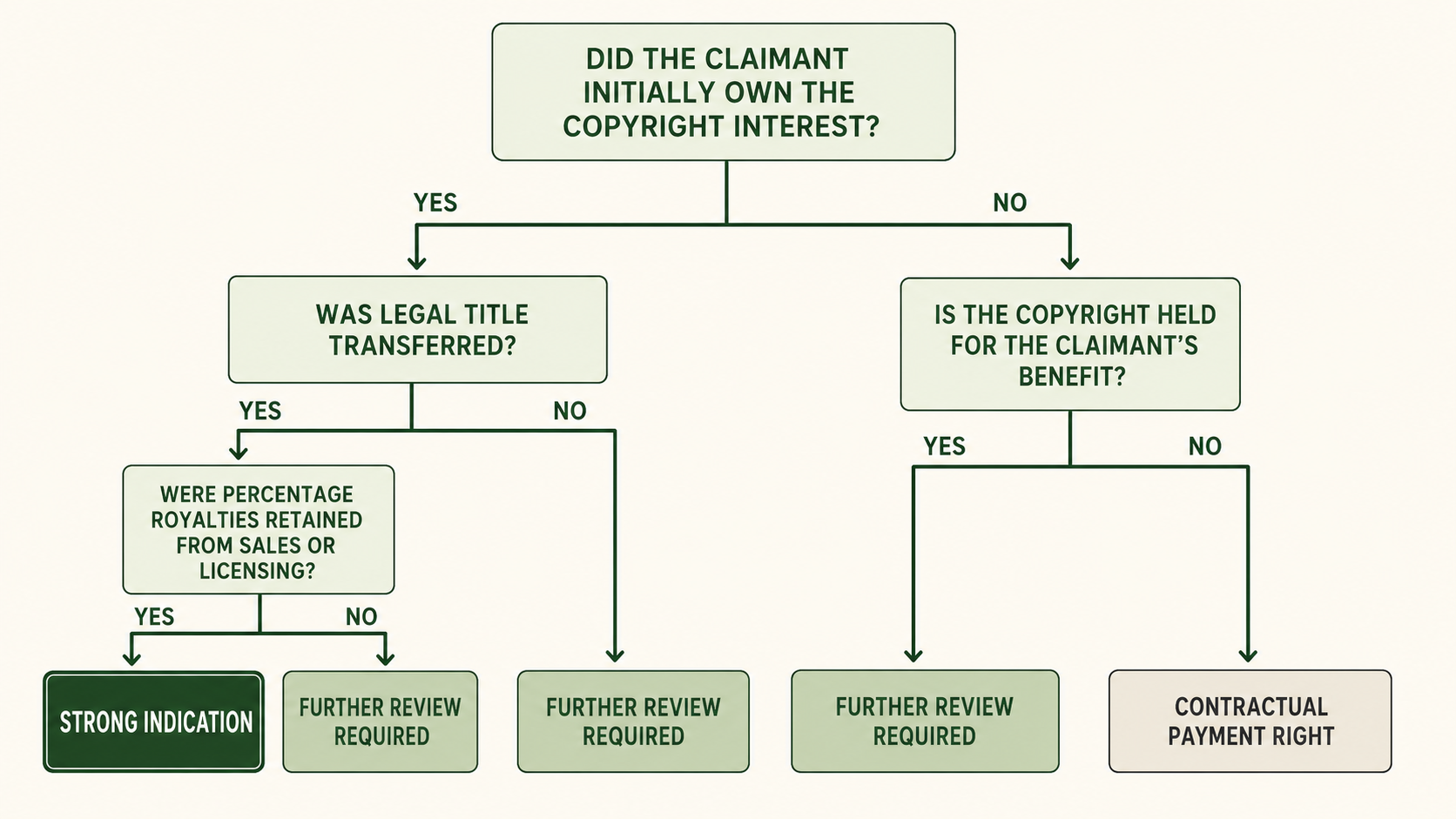
The complete paper trail must connect the claimant’s income to the ownership transaction. A songwriter who assigns a composition for percentage royalties occupies a different legal position from a producer paid points for services, an employee promised profit participation, or an administrator collecting a commission. Each may be entitled to payment, but only the underlying ownership arrangement can establish whether beneficial ownership is involved.
Copyright Transfers and Retained Interests
A beneficial interest can develop when a copyright owner transfers legal title but keeps a continuing economic stake in the rights transferred. The separation is usually created within the same agreement, with the grant moving ownership to one party and the compensation terms preserving royalties for the other.
Copyright may be transferred in whole or in part under Section 201(d) of the Copyright Act. One transaction might cover the entire copyright, while another conveys only the reproduction and distribution rights. Territory and duration can also narrow the grant. Someone who retains an economic interest connected to one transferred right may occupy a different position for uses that fall outside the agreement.
Written documentation becomes especially important because Section 204(a) generally requires a transfer of copyright ownership to be in writing and signed by the owner of the rights conveyed or an authorized agent. The grant should identify the works and rights being transferred, along with any limits on term, territory, or use.
An agreement might assign all right, title, and interest in a group of compositions to a publisher for a defined term. A separate royalty provision could require the publisher to pay the songwriter a percentage of receipts earned from licensing those compositions. Reading the provisions together reveals the division. The publisher receives legal title under the grant, while the songwriter keeps an economic interest tied to the transferred copyright.
Payment definitions shape the value and reach of the retained interest. Gross receipts, net receipts, license fees, sales income, and other royalty bases can produce different results. Deductions may reduce the amount payable, and accounting provisions determine when statements and payments become due. These terms affect the economic benefit without necessarily changing who holds legal title.
An exclusive license may qualify as a transfer of copyright ownership under the statutory definition, even when it covers only one exclusive right or a limited territory. A nonexclusive license allows use without transferring ownership. The form of the transaction therefore matters alongside the royalty language.
Later events may change either side of the arrangement. A creator could sell the retained royalty stream, renegotiate the percentage, recover the copyright through reversion, or pass the interest through an estate. The legal owner could transfer its position to a catalog buyer or another rights company. Amendments, assumption agreements, notices of assignment, and estate documents may be needed to understand whether payment duties and retained interests continued after each change.
Placing the documents in chronological order provides the clearest account of the ownership history. The original grant shows when title moved, the compensation provisions establish what remained, and later records reveal whether either interest was transferred, modified, or ended.
Beneficial Ownership in Musical Compositions
Beneficial ownership of a musical composition must be assessed against the interest held by each songwriter. When several writers create a song together, each owns a share determined by their agreement or, when no agreement exists, the applicable copyright rules. Every writer can then make separate arrangements for the portion they control.
A beneficial interest may remain when a writer transfers legal title to their composition share in exchange for continuing percentage royalties. The publisher receives the interest covered by the grant, while the writer keeps an economic stake in the income generated through its exploitation. Because the transfer applies only to that writer’s share, the other collaborators retain their existing ownership unless they enter agreements of their own.
Royalty classifications can make the resulting structure look simpler than it is. Writer share and publisher share help performing rights organizations allocate performance income, but those categories do not provide a complete record of copyright title. The applicable publishing agreement must still show whether the writer assigned ownership, granted limited rights, or retained the copyright.
A publishing administration agreement produces a different result. The songwriter usually keeps legal title while authorizing an administrator to register works, collect royalties, manage ownership data, and perform other agreed services. Although the administrator may appear in databases and payment records, its commission comes from providing those services rather than from a copyright interest retained after transferring title.
A common co-writing scenario demonstrates how these positions can exist within one song. Suppose three songwriters agree to divide a composition 50%, 25%, and 25%. Each initially holds legal title to their respective share.
The writer with the 50% interest later assigns that share to a publisher. Under the same agreement, the publisher must pay the writer a percentage of income earned from licensing and exploiting the transferred interest. Legal title to the 50% share now belongs to the publisher, while the writer may retain beneficial ownership through the continuing royalty arrangement.
Meanwhile, the second writer appoints an administrator for their 25% share without transferring ownership. The writer remains the legal owner, and the administrator collects income for an agreed fee. The third writer keeps the remaining 25% and handles its administration independently.
As a result, the composition has one publisher holding legal title to 50%, two writers retaining legal title to 25% each, one administrator managing a share it does not own, and one writer who may remain the beneficial owner of the transferred interest. Registrations and society records may display all of these parties, but their names alone cannot explain the legal relationships behind them.
A later catalog sale could add another layer. If the publisher sells its 50% interest, the buyer may become the new legal owner. The first writer’s continuing royalty entitlement would then depend on the original publishing agreement, the sale documents, and any obligations assumed by the buyer.
Following the composition share by share prevents one party’s arrangement from being applied to every collaborator. Beneficial ownership belongs to a particular claimant, interest, and transaction, even when several parties administer or receive income from the same song.
Beneficial Ownership in Sound Recordings
Initial ownership of a sound recording resides with the individuals or entities that directed the performance and production. Because their artistic input defines the sounds captured in the master, the U.S. Copyright Office recognizes performers and producers as potential authors. However, through work-made-for-hire provisions or formal assignments, legal title often shifts to record labels, production companies, or artist-controlled entities.
Public credits on a release are not dispositive of legal title. While an artist or producer credit denotes contribution, and a copyright notice names the current registrant, beneficial ownership is determined by the specific contractual language linking these parties to the recording. Determining the nature of the interest requires a thorough review of the underlying rights agreements.
The relevant evidence is typically found across several distinct documents:
- Recording contracts may specify that a label owns the master from inception or acquires it via assignment. Beneficial ownership may arise if an artist, originally holding title, transferred the copyright while retaining a right to percentage-based royalties.
- Producer agreements frequently combine flat fees with producer points and work-made-for-hire clauses. Although points provide a continuing economic stake, they do not inherently prove that the producer previously held or transferred a copyright interest.
- Featured artist deals may involve royalties or net receipt shares. These financial entitlements are contractually significant but do not necessarily equate to legal title or beneficial ownership of the master recording.
- Distribution contracts facilitate the monetization of recordings. While distributors collect income and deduct commissions, the underlying copyright remains with the label or artist throughout the term of the arrangement.
- Split letters and payment instructions serve to divide revenue among contributors. These records focus on the distribution of funds rather than documenting the legal chain of title for the copyright itself.
Statutory digital performance royalties represent a separate category. Under the statutory framework, performers may receive payments for noninteractive digital uses, but these allocated funds do not establish beneficial ownership of the master, as the right to receive them is granted by law rather than a retained interest in a transferred copyright.
The specific phrasing in label contracts is critical. A work-made-for-hire clause establishes initial ownership with the employer, whereas an assignment involves a creator transferring an interest they already possessed. Because some agreements use both frameworks, the operative path of ownership must be identified before beneficial status can be confirmed.
An artist’s royalty interest might support a beneficial-owner claim if it was kept as part of a formal assignment of the master. To verify this, the royalty provision must be aligned with the grant of rights and the specific income sources included in the calculation. Revenue from ancillary sources like touring or merchandise does not create a copyright interest merely by being part of the same deal.
Independent recording projects may result in different structures. Contributors might co-own the master legally or assign their interests to a shared business entity. While co-owners possess legal title, collaborators with only a percentage of income hold contractual rights. Beneficial ownership only becomes relevant where the record shows a title transfer coupled with a retained royalty stake.
Examining the history of a master from its creation distinguishes authors and legal owners from beneficial owners and royalty participants. While credits and payment logs identify the parties, the governing ownership clauses define the actual rights and authority held by each claimant.
Partial Transfers and Divided Copyright Interests
Section 201(d) of the Copyright Act allows a copyright owner to transfer the copyright in whole or in part. The exclusive rights within a copyright can be separated, and ownership can also be limited by percentage, territory, or duration. Beneficial ownership follows the interest involved in the transaction rather than extending automatically across the entire work.
Several of these limits may appear in the same agreement.
The owner grants the publisher the exclusive reproduction and distribution rights in the owner’s 50% interest in the composition for the United States and Canada. The grant will continue for five years. The publisher will pay the owner 40% of revenue earned from the transferred rights. All other rights are reserved.
During the Five-Year Term
- The publisher holds legal title to the reproduction and distribution rights covered by the grant.
- Its interest applies only to the owner’s 50% share.
- The stated territory limits the transfer to the United States and Canada.
- The original owner may retain a beneficial interest through the 40% royalty.
- Public performance, synchronization, and other reserved rights remain legally owned by the original owner.
- Rights outside the stated territories are unaffected by this agreement.
The original owner now occupies two positions within the same composition. They remain the legal owner of the reserved rights while potentially holding beneficial ownership in the rights transferred to the publisher. Neither position applies to the other 50% of the composition, which follows its own ownership history.
After the Five-Year Term
- The transferred rights may return to the original owner under the agreement’s reversion language.
- The publisher may continue collecting income earned while its grant was active.
- Late royalty payments can arrive after legal title has returned.
- A renewal, extension, or later assignment may create a new ownership period.
Post-term collection should therefore be separated from post-term ownership. A publisher receiving royalties after expiration may be processing income generated during its term rather than continuing to own the rights.
No single ownership label captures the complete arrangement. The correct answer changes according to the exclusive right, ownership percentage, territory, and period under review.
What Rights Can a Beneficial Owner Exercise?
Beneficial ownership does not provide the entire bundle of powers held by the legal owner. Copyright law recognizes a specific enforcement right, while payment, approval, accounting, and other protections usually depend on the governing agreement.
A beneficial owner may have the right to:
Receive percentage royalties - The retained economic interest usually entitles the beneficial owner to a defined share of sales, license fees, or other income covered by the transfer agreement. Royalty definitions, deductions, accounting periods, and payment conditions determine the amount payable.
Bring an infringement claim - A beneficial owner may pursue infringement of the particular exclusive right connected to the interest when the infringement occurred during the period of beneficial ownership. Registration and other procedural requirements still apply.
Protect the retained economic interest - Unauthorized exploitation can reduce the income generated by the copyright. The ability to pursue infringement gives the beneficial owner a way to protect the royalty interest from uses by outside parties that may dilute its value.
Receive royalty statements and accountings - Access to statements usually comes from the contract. The agreement may require the legal owner, publisher, label, or another accounting party to report revenue, deductions, licenses, and the resulting royalty balance.
Audit the accounting party - Audit rights exist only when provided by the agreement or applicable law. Contract terms commonly limit how often an audit may occur, how far back it can examine, who may conduct it, and how discrepancies are handled.
Share in infringement recoveries - Some agreements include damages, settlements, and other infringement proceeds within the royalty base. Others use a separate provision that determines how legal costs and recoveries are allocated.
Receive notice of proceedings affecting the interest - A court may require notice to parties whose interests could be affected by an infringement decision. The legal owner or another interested party may also be permitted or required to join the action.
Several powers remain outside beneficial ownership unless the agreement expressly provides them:
- Approving or rejecting licenses
- Negotiating license fees
- Granting sublicenses
- Assigning the legal owner’s copyright interest
- Authorizing derivative works
- Appointing or replacing an administrator
- Controlling release or distribution decisions
- Exercising approval rights over sync uses
- Reclaiming legal title before a contractual or statutory reversion
- Using the copyrighted work in a manner reserved to the legal owner
A beneficial owner who exercises powers already transferred to the legal owner may exceed the retained interest. The ownership documents must therefore be checked before the beneficial owner licenses, distributes, reproduces, adapts, or otherwise authorizes use of the work.
Can a Beneficial Owner Bring an Infringement Claim?
A beneficial owner may bring a copyright infringement claim, but the claim must concern the specific exclusive right in which that person retains a beneficial interest. It must also arise from infringement committed while that interest was held. An economic stake in one part of a copyright does not create authority to enforce every other right associated with the work.
Before filing, the claimant must be able to establish:
- Prior ownership of the relevant copyright interest
- A transfer of legal title to another party
- A qualifying economic interest retained after the transfer
- Infringement of the particular right connected to that interest
- Ownership of the beneficial interest when the infringement occurred
- Compliance with the applicable copyright-registration requirements
The underlying documents determine the boundaries of the claim. If a songwriter transferred reproduction and distribution rights in a composition while retaining royalties from those uses, unauthorized copying or distribution during the agreement could support an infringement action. The same songwriter would not automatically have a claim based on an unauthorized use of the sound recording, which is a separate copyrighted work.
A royalty dispute also needs to be distinguished from copyright infringement. When the legal owner licenses a work properly but fails to calculate or pay the agreed royalties, the disagreement may concern breach of contract, accounting, or audit rights. The missed payment does not by itself mean that an exclusive copyright right was infringed.
Other parties with an interest in the copyright may become involved once litigation begins. Under the Copyright Act, a court may require notice to affected parties, allow them to intervene, or require their participation in the case. A beneficial owner may therefore have the right to initiate a claim without being the only party whose interests must be considered.
Limits on a Beneficial Owner’s Authority
Beneficial ownership preserves a defined interest after legal title has moved elsewhere. It does not undo the transfer or give the beneficial owner control over the copyright as a whole. Any authority must be traced to the retained interest, an express contractual right, or the ability to enforce the beneficially owned right.
Enforcement Is Not the Same as Control
The ability to pursue infringement does not automatically include the power to license the work, approve new uses, assign the copyright, or appoint an administrator. Those decisions ordinarily remain with the legal owner when the relevant rights were included in the transfer.
A songwriter who retains royalties after assigning a composition may be able to protect that continuing interest against infringement. Unless the agreement says otherwise, the songwriter cannot grant a competing synchronization license or redirect the publisher’s administration rights.
Approval Rights Depend on the Agreement
Some transfers reserve consent or consultation rights for the original owner. A recording agreement might require an artist’s approval before the master is licensed for advertising, while a publishing agreement may limit how the songwriter’s name or work can be used.
Such provisions can restrict the legal owner’s freedom to act, but they do not necessarily divide copyright ownership. Their wording determines whether they create approval authority, a contractual remedy if consent is ignored, or a retained copyright interest.
The Limits May Differ Across Rights and Uses
A beneficial interest can be narrower than the copyright from which it arose. It may apply only to particular rights, territories, revenue sources, or periods. The same person could therefore hold a beneficial interest in domestic reproduction income without having authority over foreign licensing, public performance, or derivative works.
Actions taken beyond those boundaries may interfere with rights already transferred to the legal owner. Before approving a use, issuing a license, making an ownership claim, or directing a third party, the beneficial owner must confirm that the governing documents actually preserve that authority.
Identifying Beneficial Ownership in Agreements and Royalty Records
Beneficial ownership rarely appears as a single entry labeled “beneficial owner.” It is usually reconstructed from documents showing what the claimant owned, what was transferred, and what economic interest remained after the transfer.
Begin with the document that transferred legal title, not the latest royalty statement. Read the grant together with the compensation clause, then incorporate every amendment, side letter, extension, and reversion document that changed the deal. Royalty reports belong later in the review because they show how the agreement was administered, not what legal interest originally created the payment.
Suppose a statement lists a 25% “writer royalty.” That entry confirms an accounting position, but the agreement must supply the missing legal context. The record should connect the payment to:
- A copyright interest previously held by the claimant
- A transfer of that interest to the current legal owner
- A retained percentage tied to exploitation of the transferred rights
- The works, uses, territory, and period covered by the arrangement
Without those links, terms such as “writer royalty,” “producer royalty,” “profit participation,” and “net receipts” remain accounting descriptions. They may represent compensation for services, a share of profits, or another contractual payment right rather than beneficial ownership.
The documents should then be placed in chronological order. An amendment may replace the original royalty formula, an expired term may end the relevant interest, or a reversion may return legal title to the claimant. That timeline determines which agreement governs each use and accounting period. If the records point in different directions, return to the ownership transaction and test the later statements, licenses, registrations, and payment history against its terms.
Ownership Beyond Registration Records
Copyright registration captures information supplied for a particular work at a particular point in time. It may identify the author, the claimant, and how the claimant acquired the copyright, but it is not a complete ledger of every agreement, retained royalty interest, or later change affecting ownership.
Consider a composition registered in the publisher’s name after the songwriter assigns the copyright. The public record may correctly identify the publisher as the claimant, while the private agreement entitles the songwriter to a percentage of licensing income. Nothing on the registration necessarily reveals that continuing economic interest.
The apparent ownership position can also change without the original registration changing with it. Rights may be reassigned, divided by territory, inherited, returned through a contractual reversion, or altered by an amendment. Some of those transactions may appear in recorded documents; others may be visible only in agreements, estate records, royalty files, or later correspondence.
Timing can explain many discrepancies. A registration may accurately describe ownership when the application was filed but no longer reflect the current position. Conversely, a recent royalty statement may show who is being paid today without establishing who held the relevant interest when an earlier infringement or licensing dispute arose.
Registration records should therefore be used to establish the public-facing claim and locate relevant parties. The ownership analysis must continue through recorded transfers, governing agreements, amendments, payment records, and documents showing any later return or redistribution of rights.
How Beneficial Ownership Changes
Beneficial ownership can expand, narrow, move to another party, or end altogether. The event affecting it may also change legal title, although the two do not necessarily move together.
- New transfer or assignment — A copyright owner may transfer legal title while retaining royalties tied to the rights conveyed, creating a new beneficial interest. A later assignment may divide those rights again by use, territory, or duration.
- Amendment or buyout — The parties may increase, reduce, replace, or eliminate a retained royalty interest. A lump-sum buyout can end future participation without otherwise changing ownership of the copyright.
- Expiration or contractual reversion — When a grant expires or its reversion conditions are met, legal title may return to the original owner. The former separation between legal and beneficial ownership can then disappear because the interests are reunited.
- Statutory termination — Certain grants made by authors can be terminated under U.S. copyright law if the eligibility, timing, notice, and recordation requirements are satisfied. When the termination becomes effective, the covered rights revert to the author or the people who hold the termination interest. Statutory termination follows its own rules and does not apply to every work or transfer.
- Inheritance — A beneficial interest may pass under a will or the applicable inheritance laws. Estate documents must be read with the original copyright agreement to determine what the deceased owner held and whether the interest continues after death.
- Transfer of the beneficial interest — A person receiving retained royalties may attempt to sell or assign that interest separately. Whether the transfer is effective depends on the agreement, the nature of the interest, and any consent or anti-assignment provisions.
- Settlement or court order — Competing claims may be resolved by reallocating royalties, confirming ownership percentages, or directing future payments. The settlement or order must be incorporated into the ownership timeline rather than treated as a correction to every earlier period.
Each change should be tied to an effective date and the rights it affects. The original agreement, later amendments, notices, estate records, assignments, and royalty statements must show who held the interest before the event, what changed, and who held it afterward.
Common Beneficial Ownership Disputes
Most disputes begin with records that appear consistent on their own but tell different stories when placed together. The agreement may describe one ownership structure, the royalty statements another, and the public records only part of either.
- A broad grant transfers “all right, title, and interest,” while a separate clause reserves royalties from only certain uses. The disagreement then concerns whether the retained interest follows the entire copyright or only the income connected to those specified rights.
- Payment is often mistaken for ownership. An artist may receive a percentage of master revenue and describe it as ownership of the recording. If the artist did not own the master before entering the deal, however, the royalty may be compensation rather than an interest retained from a transfer.
- Musical compositions and sound recordings are sometimes combined in the same ownership claim. A songwriter may hold an interest in the composition performed on a track without holding any interest in the master recording. Income from one copyright does not establish ownership of the other.
- Amendments can create conflict without expressly replacing the original terms. One document changes the royalty rate, another extends the term, and neither says whether the earlier approval or reversion provisions remain in effect. The answer depends on how the documents operate together, not simply which one was signed most recently.
- A royalty statement may continue using an outdated payee name after rights have been assigned, inherited, or reverted. Continued payment can support the history of an arrangement, but it does not necessarily determine who currently owns the interest.
- Territorial and time limits produce disputes when revenue crosses contractual boundaries. A retained interest covering U.S. licensing during a fixed term may not extend to foreign income or exploitation occurring after the rights have reverted.
- Conflicting transfers become especially difficult when the same interest appears to have been granted more than once. Execution dates, the rights described, notice of the earlier transaction, and any recorded documents may all affect which claim prevails.
- Death can divide a beneficial interest among an estate, heirs, or other successors. The person receiving royalty payments may not be the only person entitled to the underlying interest, particularly while the estate is still being administered.
A dispute should be narrowed to the precise work, copyright, exclusive right, revenue source, territory, and period involved. Once those elements are separated, the apparent ownership conflict may turn out to be an accounting error, a contract-interpretation problem, or a genuine competing claim to the copyright interest.
When Beneficial Ownership Is Unclear
Ownership becomes difficult to read when the records describe different layers of the same deal. A registration names the publisher, royalty statements pay the songwriter, an amendment changes the percentage, and later correspondence suggests that some rights have reverted. The task is not to choose one document and disregard the others. It is to reconstruct a single ownership history that explains what each record represents.
1. Define the exact interest under review
Separate the composition from the sound recording and identify the exclusive right connected to the claim. Fix the relevant territory and period as well. “Ownership of the song” is too broad when the dispute may concern only U.S. synchronization income earned during a five-year publishing term.
2. Reconstruct the transaction
Identify the original owner and locate the document that transferred legal title. The grant should reveal which rights moved and which remained outside the deal. Read it together with the royalty, approval, and reversion provisions so the economic interest is not separated from the transaction that created it.
3. Test the payment history against the agreement
Royalty statements should be used to verify how the arrangement operated. Check whether the reported percentage, revenue source, deductions, works, and accounting periods match the governing terms. If the agreement describes service compensation but the statements use an ownership-related label, the agreement supplies the more important context.
4. Bring the chain forward
Add every event that could have changed the position after the original transfer. Amendments may replace earlier terms, rights may revert when a grant expires, and a beneficial interest may pass through an assignment, inheritance, settlement, or buyout. Each event needs an effective date so the ownership position can be determined for the specific use in dispute.
A completed review should make it possible to state the result precisely. The claimant transferred the identified right in the specified work, retained a defined economic interest for a limited period and territory, and continued to hold that interest when the disputed use occurred.
If the documents cannot support a statement at that level of detail, the gap itself shows what must be resolved.
Frequently Asked Questions
Does receiving royalties make someone a beneficial owner?
Not by itself. The payment must be connected to a copyright interest that the recipient previously owned and retained after transferring legal title, or to another arrangement recognized as beneficial ownership. Royalties paid for services, administration, or profit participation may create contractual rights without creating an ownership interest.
Can a producer with points be a beneficial owner of a sound recording?
Producer points usually compensate the producer for services and do not establish beneficial ownership on their own. The position may be different if the producer initially owned part of the sound recording copyright, transferred that interest, and retained royalties tied to the rights conveyed. The recording agreement and producer agreement must be read together.
Can the legal owner and beneficial owner be different people?
Yes. A publisher or record company may hold legal title while the songwriter, artist, or another transferor retains a qualifying economic interest. Their authority will not necessarily be equal because legal control and beneficial ownership serve different functions.
Does a copyright registration identify every beneficial owner?
Registration records may identify the author and copyright claimant, but they do not necessarily disclose retained royalties, approval provisions, private amendments, or other economic interests. Agreements and royalty records are needed to complete the ownership picture.
Can a beneficial owner license the music?
Only when that authority was retained or separately granted. The right to receive royalties or pursue infringement does not automatically include the power to issue licenses, approve uses, or transfer the legal owner’s rights.
Can a beneficial owner sue for copyright infringement?
A beneficial owner may be able to bring a claim involving the particular exclusive right connected to the beneficial interest. The infringement must have occurred while that interest was held, and the applicable registration and procedural requirements must also be satisfied.
What happens when the copyright reverts?
Once legal title returns, the former beneficial owner may become the legal owner of the reverted rights. The earlier separation between title and economic interest can end, although existing licenses, derivative works, unpaid royalties, and rights outside the reversion may still require separate analysis.
Can beneficial ownership be inherited?
A beneficial interest may pass through a will or under the applicable inheritance laws. The successor receives only the interest the deceased person actually held, subject to the original agreement and any restrictions affecting transfer or duration.
How is beneficial ownership proved?
Start with the signed document that transferred the copyright. Then add the compensation terms, amendments, royalty statements, recorded transfers, reversion notices, estate documents, and other records needed to trace the interest through the relevant period.
Is an unpaid royalty automatically a copyright infringement claim?
No. A failure to report or pay royalties may amount to a contract, accounting, or audit dispute. Copyright infringement requires an unauthorized exercise of an exclusive right, not merely a failure to make a payment required by an agreement.
Key Takeaways
- Beneficial ownership can arise when a copyright owner transfers legal title but retains a qualifying economic interest in the rights transferred.
- A royalty payment does not prove ownership by itself. Its legal basis must be found in the transaction, not inferred from the wording on a statement.
- Musical compositions and sound recordings have separate copyrights. An interest in one does not create an interest in the other.
- The scope of beneficial ownership follows the agreement. Rights, works, territory, term, and revenue source may all limit the interest.
- Enforcement rights do not automatically include licensing, assignment, approval, or administrative authority.
- Copyright registrations and recorded transfers help establish the public chain of title, but private agreements may contain retained interests that those records do not show.
- Amendments, reversions, inheritance, buyouts, later transfers, and settlements can change or end beneficial ownership.
- Agreements and royalty records must be read together. The agreement explains why payment is owed, while the accounting history shows how the arrangement was implemented.
- When a claim is unclear, narrow it to the specific work, copyright, exclusive right, territory, and period involved.
- A royalty underpayment may create a contract or accounting dispute without amounting to copyright infringement.
Practical Resource
The Beneficial Ownership Evidence Map organizes the documents behind a claimed interest into one dated ownership chain. It tracks the initial owner, transfer of legal title, retained royalties or authority, and any later amendment, assignment, inheritance, or reversion.
Complete a separate map for each composition or sound recording. The finished worksheet will show who holds legal title, who may hold a beneficial interest, what evidence supports each conclusion, and where documents or facts are still missing.
Beneficial Ownership Evidence Map
References
Passman, Donald S. All You Need to Know About the Music Business. 11th ed. Simon & Schuster.
U.S. Copyright Office. Copyright Law of the United States, Chapter 1: Subject Matter and Scope of Copyright. Sections 101, 106, and 114.
https://www.copyright.gov/title17/92chap1.html
U.S. Copyright Office. Copyright Law of the United States, Chapter 2: Copyright Ownership and Transfer. Sections 201 and 203–205.
https://www.copyright.gov/title17/92chap2.html
U.S. Copyright Office. Copyright Law of the United States, Chapter 4: Copyright Notice, Deposit, and Registration. Section 411.
https://www.copyright.gov/title17/92chap4.html
U.S. Copyright Office. Copyright Law of the United States, Chapter 5: Copyright Infringement and Remedies. Section 501.
https://www.copyright.gov/title17/92chap5.html
U.S. House of Representatives. Copyright Law Revision, H.R. Rep. No. 94-1476. 94th Congress, 2nd Session, 1976.
https://www.copyright.gov/history/law/clrev_94-1476.pdf
U.S. Copyright Office. General Guide to the Copyright Act of 1976.
https://www.copyright.gov/reports/guide-to-copyright.pdf
U.S. Copyright Office. Works Made for Hire. Circular 30. Revised August 2024.
https://www.copyright.gov/circs/circ30.pdf
U.S. Copyright Office. Copyright Registration of Musical Compositions and Sound Recordings. Circular 56A. Revised March 2021.
https://www.copyright.gov/circs/circ56a.pdf
U.S. Copyright Office. Recordation Overview.
https://www.copyright.gov/recordation/
U.S. Copyright Office. Notices of Termination.
https://www.copyright.gov/recordation/termination.html
U.S. Court of Appeals for the Seventh Circuit. Moran v. London Records, Ltd., 827 F.2d 180 (1987).
https://www.courtlistener.com/opinion/493293/larry-moran-v-london-records-ltd/