What Is a Publishing Administration Deal?
A practical guide to co-publishing agreements covering rights ownership, income splits, publishing services, advances, and how these deals compare with other publishing models.

Introduction
A publishing administration deal lets a songwriter, publisher, estate, or catalog owner keep ownership of the composition while hiring an administrator to handle the business work around it. The administrator may register songs, collect royalties, issue certain licenses, manage claims, process statements, and help income reach the right account.
The main difference is ownership. In a publishing administration deal, the administrator is usually paid through a fee or commission, rather than receiving part of the copyright or a co-publishing share. The rights holder keeps the publishing interest, but gives the administrator authority to manage specific rights, territories, income sources, or collection tasks under the agreement.
That structure can be useful when the rights holder needs professional administration without giving up long-term participation in the songs. It can also be risky if the agreement gives the administrator broad control, long post-term collection rights, unclear deductions, or weak reporting obligations.
This guide explains how publishing administration deals work, what rights the owner usually keeps, what authority the administrator may receive, how fees and accounting are handled, and which terms should be reviewed before signing.
Learning Objectives
By the end of this guide, you should be able to:
- Understand how a publishing administration deal works
- See the difference between ownership and administration authority
- Identify what rights a songwriter, publisher, estate, or catalog owner usually keeps
- Understand what an administrator may handle across registration, licensing, collection, claims, and accounting
- Review administration fees, commissions, deductions, and royalty statement terms
- Understand how term, territory, and post-term collection language can affect the deal
- Compare an administration deal with a co-publishing deal without confusing the two structures
- Spot common red flags before signing a publishing administration agreement
Overview
A publishing administration deal is built around service and authority, not a transfer of ownership. The rights holder keeps the composition interest and appoints an administrator to manage defined publishing tasks. Those tasks may include registering works, collecting royalties, issuing licenses, handling society relationships, resolving claims, and accounting back to the owner.
The agreement should explain exactly what the administrator is allowed to do. Some deals cover worldwide administration across many income sources. Others apply only to certain territories, royalty types, catalogs, or collection channels. The scope matters because administration rights can still be broad even when ownership stays with the songwriter, publisher, estate, or catalog owner.
Payment usually comes through an administration fee or commission. The administrator collects income, deducts the agreed fee and any allowed expenses, then pays the balance to the rights holder according to the accounting terms. If an advance is included, the contract should also explain how the advance is recovered and which income can be applied against it.
The cleanest administration deals separate ownership, authority, fee structure, territory, term, post-term collection, reporting, audit rights, and termination language. A rights holder may keep the copyright but still give an administrator meaningful control over how the catalog is registered, licensed, collected, and reported. That is why the contract should be reviewed around both economics and control.
Table of Contents
Publishing Administration as an Admin-Only Deal
A publishing administration deal gives an administrator permission to manage publishing rights without turning that administrator into a co-owner of the composition. The rights holder keeps the copyright interest. The administrator receives authority to perform agreed publishing tasks and is usually paid through a commission, fee, or share of collected income.
The agreement should describe the administrator’s authority with precision. Broad language can give the administrator control over more than the rights holder expects, especially if the deal covers worldwide collection, direct licensing, sync approvals, claims, sub-publishing, neighboring territories, or post-term income.
An admin-only structure often covers tasks such as:
- registering compositions with societies, CMOs, and licensing bodies
- collecting mechanical, performance, sync, print, lyric, or other publishing income
- issuing or managing certain licenses
- tracking income by source and territory
- resolving duplicate registrations, unmatched royalties, or ownership conflicts
- coordinating with sub-publishers or local collection partners
- accounting to the songwriter, publisher, estate, or catalog owner
The rights holder should still understand what “administration” includes in the contract. One agreement may focus mostly on registration and royalty collection. Another may include licensing authority, sync representation, claim management, international administration, and the right to appoint sub-publishers.
Admin-only does not automatically mean low control. The administrator may not own the composition, but it can still have practical control over registrations, collections, claims, and licensing during the term. The agreement should make clear where the administrator’s authority starts, where it ends, and which decisions still require the owner’s approval.
Ownership vs. Administration Rights
Ownership and administration rights should be kept separate in a publishing administration deal. The owner controls the underlying composition interest. The administrator receives permission to manage certain business functions connected to that interest.
A rights holder can keep ownership while giving the administrator meaningful authority. The agreement may allow the administrator to register works, collect royalties, issue licenses, manage disputes, appoint sub-publishers, or receive income from societies and licensing bodies. Those powers can affect how the catalog is handled, even without a transfer of copyright.
The contract should avoid vague phrases that blur the line between owning, controlling, administering, and collecting. “Exclusive administration,” “right to collect,” “right to license,” “right to retain post-term income,” and “power to appoint sub-publishers” can each have different consequences.
Approval language should name the decisions reserved for the rights holder: sync placements, sensitive brand uses, political uses, settlements, catalog transfers, and claim resolutions that affect ownership shares. Routine registration and collection can sit with the administrator, but decisions that change control, reputation, disputed income, or long-term rights should require written consent.
A clean publishing administration agreement should answer four questions clearly:
- Who owns the composition?
- What rights can the administrator exercise?
- Which decisions require owner approval?
- What happens to the administrator’s authority after the term ends?
The safer structure keeps copyright ownership with the rights holder while limiting the administrator’s authority to the services, territories, income categories, and time periods actually needed for the deal.
The Administrator’s Role in Registration, Licensing, and Collection
Publishing administration is the day-to-day business work behind composition income. In practice, it is a form of rights management focused on keeping registrations, licenses, claims, royalty records, and payee information organized enough for income to be collected and accounted for.
Registration
The administrator may register songs with PROs, CMOs, mechanical licensing bodies, local societies, and other collection partners. Registration work can include song titles, alternate titles, writer names, publisher names, ownership shares, territory information, ISWCs, and society account details.
Accurate registration helps connect usage to the correct work and rightsholder. Missing titles, incomplete splits, wrong publisher names, or outdated administrator details can delay collection or create unmatched income.
Licensing
Some administration deals give the administrator authority to issue or manage licenses. The scope can be narrow or broad, depending on the agreement.
Licensing work may include:
- mechanical licenses
- sync licenses
- lyric licenses
- print licenses
- micro-sync uses
- direct licenses
- catalog licensing requests
The contract should separate routine licenses from uses that need owner approval. Sync placements, brand uses, political uses, sensitive media, and licenses that affect ownership disputes should be handled according to the approval language in the agreement.
Collection
The administrator collects publishing income from the sources covered by the deal. That may include mechanical royalties, performance royalties, sync income, print income, lyric income, international collections, and other composition-related revenue.
Collection work often involves more than receiving money. The administrator may need to track sources, match income to works, follow up on missing royalties, coordinate with sub-publishers, review society records, and correct registration issues that block payment.
Claims and Conflicts
Administration also includes claim support when income is missing, misdirected, disputed, or held. Duplicate work records, conflicting publisher claims, missing shares, territory gaps, and catalog transfers can all require follow-up.
The agreement should explain how much responsibility the administrator has for resolving these issues. A rights holder should know whether claim work is included in the administration fee, charged separately, limited to certain territories, or excluded from the service scope.
Accounting
After income is collected, the administrator should account to the rights holder. Statements should show where the income came from, which works earned it, what deductions were taken, what fee was applied, and what amount is payable.
Good administration makes the catalog easier to track. The owner should be able to see which songs are registered, which sources are paying, which territories are active, which claims are pending, and which royalties still need follow-up.
Rights Retained by the Owner
In a publishing administration deal, the songwriter, publisher, estate, or catalog owner should retain the underlying publishing interest unless the contract clearly says otherwise. The administrator manages defined tasks, while the owner keeps the long-term value of the compositions.
The rights holder commonly keeps:
- Copyright ownership - The composition interest should remain with the owner. The administrator may register, collect, license, or account for income, but administration authority should not become an ownership transfer.
- Writer share - Songwriters usually keep their writer share. The agreement should confirm whether the administrator has any authority over writer-share income or whether that income continues to be paid directly through the relevant PRO, CMO, or society.
- Publisher share - The publisher share should remain with the rights holder, subject to the administrator’s fee or commission. The agreement should avoid language that gives the administrator a co-publishing share unless that is the intended deal.
- Approval over sensitive uses - The owner may reserve approval rights over sync placements, political uses, brand uses, lyric changes, samples, adaptations, or other uses that affect reputation, control, or long-term value.
- Control after the term - Once the administration term ends, the owner should understand which rights return immediately and which income the administrator may continue collecting. Post-term collection language can affect royalties earned before, during, or after the deal period.
- Right to review statements - The owner should receive accounting that is detailed enough to review income sources, deductions, fees, reserves, exchange rates, and payable amounts.
- Audit rights - The contract should allow the owner to inspect records if statements appear incomplete, late, or inconsistent. Audit language should cover timing, lookback periods, notice requirements, and what happens if an underpayment is found.
- Rights outside the agreement scope - If the deal is limited by territory, catalog, term, or income type, anything outside that scope should remain with the owner. A limited administration deal should not quietly expand into worldwide control or all-income administration through broad wording.
The owner should read the agreement for both what it grants and what it reserves. A clean administration deal makes the administrator’s role useful without giving away more control than the services require.
Administration Fees and Royalty Accounting
Publishing administrators are usually paid through a fee or commission taken from the income they collect. The fee should be clear in the agreement, including the percentage, the income categories it applies to, and whether any other deductions can be taken before the owner is paid.
Administration Fees
An administration fee may apply to publishing income collected during the term. Some deals use one percentage across all income. Others apply different rates for domestic royalties, foreign income, sync income, direct licenses, or special collection work.
The agreement should state:
- the administrator’s fee or commission percentage
- whether the fee applies to gross income or net income
- which royalty categories are covered
- whether sub-publisher fees or society deductions come out first
- whether sync income has a separate commission
- whether claim recovery work has a separate charge
- whether expenses can be deducted
- whether the fee continues during any post-term collection period
Small wording differences can change the amount paid to the owner. A 15% fee on gross income will not produce the same result as 15% after foreign deductions, sub-publisher commissions, or local society charges.
Royalty Accounting
Royalty accounting should show how the administrator handled the income. A useful statement identifies the songs that earned, the source of the money, the territory, the royalty type, the deductions taken, the administration fee, and the net amount payable.
A publishing administration statement should ideally include:
- song title and work identifier
- income source
- royalty type
- territory
- reporting period
- gross amount received
- local society or sub-publisher deductions
- administration fee
- currency conversion
- tax withholding, if any
- adjustments or reserves
- net amount payable
- payment date or ending balance
Advances and Recoupment
Some administration deals include an advance, although advances are usually more common in co-publishing or full publishing deals. When an advance appears in an administration agreement, the contract should explain how it is recovered.
Review whether recoupment applies only to income collected under the administration deal or whether the language reaches other works, catalogs, territories, or income categories. The statement should also show the opening balance, new income, amount applied to recoupment, payment made, and remaining balance.
Audit and Review Rights
Statement language should give the owner a way to verify the accounting. Audit rights, objection deadlines, supporting record requirements, and payment timing all affect how much visibility the owner has after income is collected.
A clean administration deal should make accounting easy to follow. The owner should be able to see what was collected, what was deducted, what was paid, what remains pending, and which income still needs follow-up.
Term, Territory, and Post-Term Collection
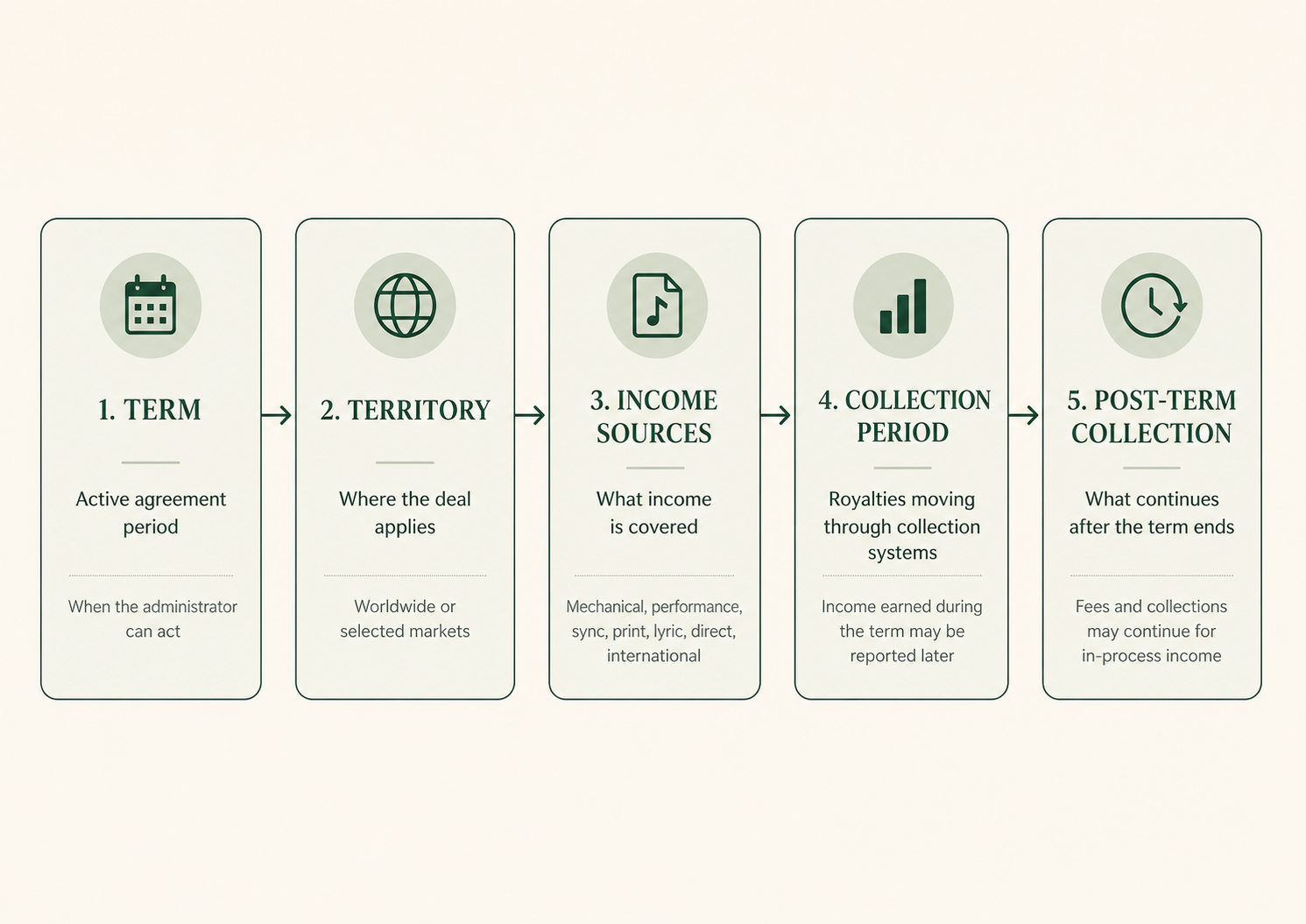
Term, territory, and post-term collection control the practical reach of a publishing administration deal. Even when the owner keeps the copyright, the agreement can still give the administrator authority over specific songs, markets, income streams, claims, registrations, and payment periods.
Term
The term sets the active period of the agreement. During that period, the administrator may register works, collect royalties, manage licenses, handle claims, coordinate with societies or sub-publishers, and account to the owner.
The contract should state the start date, end date, renewal language, option periods, and termination rights. Automatic extensions need careful review because they can keep the administrator in place longer than the owner expects.
Territory
Territory language defines where the administrator can act. A worldwide deal may fit an administrator with strong international systems, society relationships, and sub-publisher coverage. A narrower territory may work better when the owner already has partners in certain markets or only needs help in specific regions.
The territory grant should match the administrator’s actual reach. Broad worldwide language has limited value if the administrator does not have the network, reporting process, or follow-up capacity to manage those markets properly.
Income Sources Covered
The agreement should identify the income categories included in the administration grant. Mechanical royalties, performance royalties, sync income, print income, lyric income, micro-sync income, direct licenses, international collections, and recovered royalties may each need separate treatment.
A limited deal should stay limited in the language. If the owner only wants help with certain income streams, the contract should not give the administrator authority over all publishing income by default.
Post-Term Collection
Post-term collection explains what the administrator can still collect after the active term ends. This clause often matters because royalties may be earned, processed, matched, reported, and paid on different timelines.
The agreement should separate income earned during the term from income generated after the term. It should also explain whether the administrator can keep collecting from licenses it issued, claims it recovered, territories it administered, or royalties already in process before the deal ended.
The owner should check:
- how long post-term collection lasts
- which income remains collectible after the term
- whether the administrator’s fee continues post-term
- whether post-term rights apply to all income or only income already in process
- when registrations, accounts, claims, and collection authority transfer back
- what reporting the administrator must provide after the term ends
A short administration term can still create a long collection tail. The owner may retain copyright ownership, but broad territory language, all-income collection rights, automatic renewals, and post-term authority can keep the administrator involved in the catalog’s income for much longer than the headline term suggests.
How Admin Deals Differ From Co-Publishing Deals
Publishing administration and co-publishing can involve similar work: registration, royalty collection, licensing support, claims, and accounting. The difference is what the rights holder gives the company in return.
In an administration deal, the rights holder usually keeps the publishing interest and pays the administrator a fee or commission. In a co-publishing deal, the publisher usually receives part of the publisher share, which gives it a deeper economic interest in the covered songs.
An administration deal is usually the lighter structure. It can work well when the rights holder already owns or controls the catalog and mainly needs professional collection, registration, licensing support, and accounting.
A co-publishing deal gives the publisher more upside. That can make sense when the publisher is providing an advance, creative access, sync pitching, song placement support, and a higher level of involvement. The trade-off is that the publisher may keep part of the publishing income for much longer than a standard administration fee would last.
The label on the agreement is not enough. A deal called “administration” can still contain broad licensing authority, long post-term collection, high commissions, or worldwide control. A deal called “co-publishing” can vary by split, term, territory, recoupment language, approval rights, and reversion terms. The contract has to be reviewed by what it actually grants, not by the title on the first page.
Deal Terms That Can Change the Economics
The headline administration fee only tells part of the deal. A 10%, 15%, or 20% commission can produce very different results depending on how the contract defines income, deductions, territory, collection rights, and post-term payments.
Key terms to review include:
- Fee base - Check whether the administrator’s percentage is taken from gross income, net income, or income after third-party deductions. A fee on gross receipts is usually more expensive than a fee applied after society, sub-publisher, withholding, or collection deductions.
- Income categories covered - Mechanical royalties, performance royalties, sync income, lyric income, print income, direct licenses, and recovered royalties may not all need the same treatment. The agreement should say which categories are included and whether any category carries a separate fee.
- Foreign collection costs - International income may pass through local societies, CMOs, sub-publishers, or collection partners before it reaches the administrator. Those deductions can reduce the amount available before the administrator applies its own fee.
- Sync and direct licensing commissions - Sync income can be handled differently from routine royalty collection. Some administrators charge the standard admin fee. Others take a separate commission if they source, negotiate, or manage the placement. Approval rights and fee splits need to be clear before a license is issued.
- Expenses - The agreement may allow certain expenses to be deducted from income. Review whether expenses need prior approval, whether there is a cap, and whether ordinary overhead can be passed on to the owner.
- Advances - If the administrator pays an advance, the contract needs a clear recovery structure. The owner should know which income can be applied to the balance, whether the advance is cross-collateralized across works, and whether any unpaid balance survives after the agreement ends.
- Post-term collection - A short term can still carry a long payment tail. If the administrator keeps collecting income after the active period, the contract should identify which royalties are covered, how long collection lasts, and whether the same fee continues.
- Minimum fees or payment thresholds - Some agreements include minimum charges, account thresholds, or payment rules that affect when money is released. These details can matter for smaller catalogs or slower-earning works.
- Currency conversion and withholding - Foreign income may be affected by exchange rates, tax withholding, bank charges, or local processing rules. The statement should show how those amounts were handled before the owner’s share was calculated.
- Statement detail - A low fee is less useful if the accounting is hard to review. Statements should identify the song, source, territory, royalty type, gross income, deductions, admin fee, adjustments, and net payable amount.
- Audit rights - The owner needs a practical way to verify the numbers. Audit language should cover notice requirements, lookback periods, access to records, audit costs, and what happens if an underpayment is found.
- Termination and transition language - The end of the deal should not leave registrations, claims, accounts, or collection authority in limbo. The contract should explain how records are transferred, how pending income is handled, and when the administrator’s authority ends.
The economics of an administration deal come from the full structure, not the commission rate alone. Fee base, deductions, foreign collection, post-term rights, advances, accounting, and audit access all affect the amount the owner actually receives.
Why Rights Holders Use Publishing Administration Deals
Publishing administration deals are often used by rights holders who want help with registration, collection, licensing support, claims, and accounting while keeping the underlying publishing interest. The reason for using an administrator can vary depending on who controls the songs and what kind of support the catalog needs.
Songwriters
Songwriters may use publishing administration when they want to keep their publishing ownership but need help managing the business side of their songs. An administrator can register works, collect publishing royalties, track income sources, handle certain licenses, and help reduce missed or delayed income.
This structure can be useful for writers who already control their songs and do not want to give away a publisher share. It may also fit writers who have released music independently, started earning across multiple platforms or territories, or need help making sure their compositions are properly registered and collected.
Independent Publishers
Independent publishers may use administration deals to support back-office work without selling or sharing ownership in their catalog. The administrator may handle registrations, society relationships, royalty processing, international collection, licensing requests, and statement preparation.
This can help a small publisher operate with more infrastructure while keeping control of its publishing interest. It may also be useful when the publisher owns or controls songs across several writers, territories, income sources, or legacy agreements.
Estates
Estates may need publishing administration when rights pass to heirs, beneficiaries, trusts, or estate representatives. Older catalogs can carry incomplete records, outdated payee details, title variations, missing splits, or unclear society information, especially when the songs have been earning for many years.
An administrator can help organize the catalog, update registrations, collect ongoing royalties, coordinate payee information, and support claims for income that may have been missed or held. Estate administration often depends on clean documentation, so contracts, probate records, chain of title files, tax forms, and beneficiary information should be kept together.
Catalog Owners
Catalog owners may use publishing administration after acquiring songs, buying income streams, inheriting rights, or consolidating older works. The goal is usually to keep the catalog organized, collected, and visible across income sources.
Administration can support catalog diligence, registration cleanup, royalty tracking, territory review, claim follow-up, and ongoing accounting. For owners managing larger or acquired catalogs, the administrator’s role may be less about creative support and more about making sure the rights data, collection paths, and statements line up with the ownership records.
Rights Holders With Existing Leverage
Some rights holders already have strong songs, clear ownership, reliable income, or professional representation. For them, administration may be more practical than a co-publishing structure because they need collection support rather than a publisher taking a long-term share.
In that situation, the deal should be measured by service quality: how well the administrator registers works, collects income, resolves issues, reports royalties, and communicates about the catalog. A lower fee is useful only if the administration work is accurate, active, and transparent.
Common Red Flags in Publishing Administration Agreements
A publishing administration agreement should give the administrator enough authority to do the job without quietly expanding into ownership, long-term control, or unclear deductions. Watch for terms that make the deal broader, more expensive, or harder to exit than expected.
- Ownership language inside an admin deal - Administration should not turn into a transfer of copyright or a co-publishing interest unless that is the intended structure. Words like “assign,” “transfer,” “grant,” “convey,” or “exclusive ownership” should be reviewed carefully.
- Broad rights beyond the service scope - A contract may say “administration,” but still give the administrator wide licensing power, worldwide authority, settlement control, sub-publishing rights, or approval over claims. The grant should match the services actually being provided.
- Unclear fee base - The agreement should explain whether the fee is taken from gross income, net income, or income after third-party deductions. Without that detail, the owner may not know how the administrator’s commission will be calculated.
- Extra deductions with no approval process - Expenses, legal fees, claim costs, sub-publisher fees, sync commissions, currency charges, and recovery costs should be defined. The owner should know which costs need approval and which can be deducted automatically.
- Long post-term collection rights - Post-term collection can be reasonable for income earned during the term and paid later. It becomes risky when the administrator can keep collecting broad categories of future income long after the active deal ends.
- Automatic renewals or difficult termination language - Renewal clauses, notice windows, cure periods, and termination restrictions can keep a deal active longer than expected. The owner should know exactly how and when the agreement can end.
- Weak reporting requirements - Statements should show enough detail to review income by song, source, territory, royalty type, deductions, fees, and payable amount. Thin reporting makes it harder to identify missing income or incorrect deductions.
- Limited audit rights - Audit language should give the owner a realistic way to inspect records. Short lookback periods, high audit costs, narrow access, or strict objection deadlines can reduce accountability.
- Unclear sync approval rights - Sync uses can affect income, reputation, and control. The agreement should say which uses the administrator can approve alone and which require the owner’s written consent.
- No clear transition process after termination - The contract should explain how registrations, claims, society records, account access, pending licenses, and unpaid income will be handled when the deal ends.
- Vague service promises - If the administrator is promising registration cleanup, international collection, claim support, sync licensing, or catalog management, the agreement should describe the work clearly enough to evaluate performance.
- No practical path for unresolved claims - Duplicate work records, conflicting ownership shares, missing royalties, and suspended claims may require follow-up. The contract should identify whether that work is included, limited, or billed separately.
A strong administration agreement should be specific about authority, fees, deductions, reporting, approval rights, and exit mechanics. The owner keeps the publishing interest, but the contract still determines how much control the administrator has while the deal is active.
Frequently Asked Questions
What is a publishing administration deal?
A publishing administration deal is an agreement where a songwriter, publisher, estate, or catalog owner hires an administrator to manage publishing tasks such as registration, royalty collection, licensing support, claims, and accounting. The owner usually keeps the copyright and pays the administrator through a fee or commission.
Does a publishing administrator own the songs?
In a standard administration deal, the administrator does not own the compositions. The owner keeps the publishing interest, while the administrator receives limited authority to manage the rights covered by the agreement.
What does a publishing administrator do?
A publishing administrator may register works, collect mechanical and performance royalties, manage certain licenses, coordinate with societies or sub-publishers, review royalty statements, resolve claims, and account to the owner. The exact role depends on the contract.
How does a publishing administration deal make money for the administrator?
The administrator usually earns a percentage of the income it collects. Some agreements use one fee across all income. Others use different rates for domestic income, foreign income, sync income, direct licenses, or recovered royalties.
Is a publishing administration deal the same as a co-publishing deal?
These are different structures. In a publishing administration deal, the rights holder usually keeps the publisher share and pays an admin fee. In a co-publishing deal, the publisher usually receives part of the publisher share, giving it a deeper long-term economic interest in the songs.
Can a publishing administration deal include an advance?
Some administration deals include advances, although advances are more common in co-publishing or full publishing deals. When an advance is included, the agreement should explain which income can be used for recoupment and whether any expenses can be added to the balance.
What rights does the owner keep?
The owner should usually keep copyright ownership, the publisher share, approval over important uses, audit rights, and control over rights outside the agreement scope. The contract should identify any rights granted to the administrator and any rights reserved by the owner.
Can an administrator approve sync licenses?
Some administration deals allow the administrator to handle sync licensing, while others require owner approval before a placement is accepted. Sensitive uses, political uses, brand campaigns, lyric changes, samples, or unusual placements should be addressed clearly in the approval language.
What is post-term collection?
Post-term collection refers to the administrator’s right to keep collecting certain income after the active term ends. This may apply to royalties earned during the term but paid later, licenses issued during the term, or claims already in process. The agreement should limit how long this continues and which income remains covered.
Who uses publishing administration deals?
Songwriters, independent publishers, estates, catalog owners, and other rights holders may use administration deals when they want professional registration, collection, licensing support, and accounting without giving up publishing ownership.
What should be reviewed before signing?
Key terms include ownership language, administration authority, fee base, income categories, territory, term, post-term collection, sync approval rights, deductions, advances, recoupment, accounting detail, audit rights, and termination process.
What are common red flags?
Red flags include ownership-transfer language, broad rights that go beyond administration, unclear fees, vague deductions, long post-term collection, weak reporting, limited audit rights, automatic renewals, unclear sync approval language, and no transition process after termination.
Key Takeaways
- A publishing administration deal lets a rights holder hire an administrator to manage publishing tasks while usually keeping ownership of the composition.
- Administration authority may cover registrations, royalty collection, licensing support, claim management, society coordination, and royalty accounting.
- The administrator is usually paid through a fee or commission, rather than receiving a publisher-share ownership interest.
- Ownership language should stay separate from administration language. The contract should not quietly turn an admin deal into a co-publishing or assignment structure.
- Term, territory, income categories, and post-term collection language determine how far the administrator’s authority reaches.
- Statement detail matters because the owner needs to see income by song, source, territory, royalty type, deductions, fees, and payable amount.
- Advances can appear in administration deals, but the recoupment terms should explain which income can be used to recover the balance.
- Songwriters, independent publishers, estates, and catalog owners may use administration deals when they want professional support without giving up publishing ownership.
- Red flags include broad rights grants, unclear fees, long post-term collection, weak reporting, limited audit rights, vague service promises, and difficult termination terms.
- A strong publishing administration agreement should define what the administrator can do, what the owner keeps, how money is reported, and how the relationship ends.
Practical Resource
Publishing Administration Deal Review Worksheet
The Publishing Administration Deal Review Worksheet helps songwriters, publishers, estates, catalog owners, and other rights holders review an administration offer before signing.
[Download the Publishing Administration Deal Review Worksheet]
Use the worksheet to document the deal scope, including the songs or catalog covered, the administrator’s authority, the territory, the term, the income categories included, and any post-term collection rights. It also includes review sections for registration rights, licensing authority, sync approval, claim handling, sub-publisher rights, fees, deductions, accounting terms, audit rights, and transition requirements.
The worksheet is designed to separate ownership from administration. It helps users check whether they are keeping the publishing interest, what authority the administrator receives, how the administrator is paid, and how long that authority continues after the agreement ends.
It also includes red flag and decision sections so open questions can be organized before review with an attorney, manager, advisor, or publishing team.
References
Passman, Donald S. All You Need to Know About the Music Business. 11th ed. Simon & Schuster.
ASCAP. What’s the Deal: Understanding Co-Publishing & Admin Agreements.
https://www.ascap.com/help/career-development/whats-the-deal-michael-eames-pen-music
ASCAP. Songwriter and Music Publisher Agreements.
https://www.ascap.com/help/music-business-101/200809
BMI. FAQs: Publishing.
https://www.bmi.com/faq/category/publishing
Songtrust. Administrator.
https://www.songtrust.com/music-publishing-glossary/glossary-administrator
Songtrust. Music Publishing Administration.