What is a Music Catalog and How Is It Owned and Sold
A music catalog can represent compositions, master recordings, or both, along with the rights and income attached to them. This guide examines how catalogs are owned, monetized, valued, reviewed, and transferred in a sale.
Introduction
A music catalog is often discussed as if it were one asset, but most catalogs are really bundles of rights, recordings, songs, income streams, contracts, registrations, and claims. One catalog might include a songwriter’s compositions. Another might include master recordings controlled by a label. A larger deal might involve both sides, along with royalty statements, licenses, contracts, metadata, and administration history.
That distinction matters when a catalog is being valued, managed, inherited, financed, or sold. A buyer is not just asking whether the songs are popular. They are asking what is actually owned, who controls the rights, where the income comes from, whether the royalty history is reliable, and whether anything could interrupt future collections.
Ownership can also be less obvious than it looks from the outside. An artist may be associated with a recording without owning the master. A songwriter may have written a song but assigned part of the publishing. A company may collect royalties without owning the underlying copyright. A family member may inherit income rights but still need estate documents before transferring them. Catalog work often begins by separating those roles before anyone can understand what is available to sell.
This guide explains what a music catalog is, what it can include, how ownership is documented, how catalog income is generated, and what usually happens when a catalog is sold. It also explains why buyers review contracts, royalty statements, registrations, metadata, liens, term limits, and approval rights before closing a transaction.
Learning Objectives
By the end of this guide, you should be able to:
- Explain what a music catalog is.
- Identify the main assets that can be included in a catalog.
- Separate composition catalogs from master recording catalogs.
- Understand the difference between ownership, control, administration, and income participation.
- Recognize the documents that support catalog ownership.
- Explain how catalogs generate income.
- Distinguish a catalog sale from a license, administration deal, or distribution deal.
- Understand who has authority to sell a catalog.
- Recognize the kinds of issues buyers review before acquisition.
- Identify common problems that can affect catalog value, transfer, and post-sale administration.
Overview
A music catalog can be small, large, narrow, or mixed. It may consist of one songwriter’s compositions, a producer’s share of songs, a label’s master recordings, a publisher’s controlled works, a legacy artist’s recordings, or a company’s acquired rights across many creators. The word “catalog” usually refers to a group of music assets, but the actual contents have to be confirmed by documents.
The first question is what side of the music business the catalog lives on. A composition catalog covers songs as written: lyrics, melody, and other protected musical elements. A master catalog covers specific sound recordings. Some transactions include both. Others involve only a share of one side, such as a writer’s publishing interest, a publisher’s income stream, a label’s master rights, or a royalty participation created by contract.
The next question is whether the seller owns the rights or only controls, administers, or receives income from them. Those positions can look similar on royalty statements, but they are very different in a sale. Copyright ownership may allow a transfer of the underlying asset. Administration rights may allow a company to manage and collect during a contract term. A royalty participation may give someone income without giving them authority to sell the copyright itself.
Catalog income can come from several places. Composition income may include performance royalties, mechanical royalties, sync fees, print income, foreign collections, and other publishing revenue. Master income may include streaming revenue, download income, physical sales, neighboring rights, master use fees, and other recording-side revenue. The buyer will usually want to see how each income stream has performed, whether the collections are complete, and whether future income is likely to continue.
A catalog sale is usually built around documentation. The buyer reviews chain of title, songwriter agreements, recording agreements, assignments, licenses, administration agreements, distribution terms, royalty statements, registrations, disputes, recoupment, liens, samples, interpolations, and metadata. The goal is to confirm what the seller can transfer and what limits may follow the catalog after the sale.
Once a catalog is sold, the work does not end at signing. The parties still need a clean handoff. Registrations may need to be updated. Administrators, distributors, societies, licensees, and payors may need new payment instructions. Royalty systems may need time to redirect income. Older uses may continue paying under prior arrangements. A strong catalog transaction accounts for that transition instead of treating the sale agreement as the final admin step.
Table of Contents
What Is a Music Catalog?
A music catalog is a group of music assets that can be managed, licensed, valued, inherited, financed, or sold together. The catalog might be a songwriter’s body of compositions, a label’s collection of master recordings, a producer’s writer shares, an artist’s publishing interest, or a company’s acquired rights across many songs and recordings.
In practical terms, the word “catalog” is a starting label, not a complete description. Two people may both say they own a catalog while owning very different things. One may own copyrights in compositions. Another may own master recordings. Someone else may own only a royalty participation, an administration right, or a contractual right to receive income from certain works. The documents behind the catalog decide what the owner can actually control or sell.
Catalogs became commercially important long before streaming made the term more visible. In the sheet music era, publishers built value by controlling songs, printing them, promoting them, and getting performers to popularize them. The Library of Congress describes early twentieth-century Tin Pan Alley as a group of music publishers’ offices in New York, and notes how publishers marketed songs through vaudeville performers, sheet music covers, and arrangements for different instrumental and vocal uses.
That older publishing model is still visible in modern catalog thinking. A company’s value may come from songs that can be performed, covered, licensed, administered, synchronized, and collected across many territories and formats. The Warner/Chappell archival history at the Library of Congress also shows how catalog ownership can grow through publisher acquisitions, with the company tracing roots to Chappell & Co. in 1810 and later expanding in part through acquisitions of publishers tied to Tin Pan Alley, Broadway, film, and television.
Recorded music added another layer. A composition and a sound recording are not the same asset, even when they are tied to the same song. The U.S. Copyright Office treats musical compositions and sound recordings as distinct registration categories, with separate guidance for each. That separation is one reason catalog deals have to identify whether the transaction covers songs, recordings, or both.
Modern catalog work also includes administration data. A buyer or administrator is not only looking at titles and royalty totals. They need ownership records, metadata, identifiers, agreements, registrations, licenses, claims, payor information, and collection history. Music Admin’s rights management guide describes rights management as the connection between ownership data, licensing activity, metadata, royalty tracking, and administration across both recordings and compositions.
A clean catalog definition should answer three questions: what assets are included, what rights or income streams are attached to those assets, and who has authority to control or transfer them. Without those answers, “catalog” can sound more complete than it really is.
What a Music Catalog Can Include
When a catalog is being reviewed for management, valuation, or sale, the work usually goes far beyond naming the songs. The buyer or administrator needs to see what is owned, what is merely collected, what documents support the claim, and what information will be needed to keep income moving after the deal closes.
- Compositions - On the song side, the review starts with the musical works themselves: lyrics, melodies, writer shares, publisher shares, and any related publishing rights included in the catalog. The U.S. Copyright Office separates musical compositions from sound recordings, so a catalog schedule should not assume that owning one side means owning the other. A seller may control the full composition, only a writer share, only a publisher share, or a contractual income interest tied to certain works.
- Master recordings - The recording-side review asks which specific masters the seller can transfer or license. That may include released tracks, alternate versions, live recordings, remixes, acoustic versions, stems, or unreleased recordings. One composition can have several recordings attached to it, and each recording may carry its own ownership history, artist agreements, producer terms, distribution setup, and royalty trail.
- Royalty and income rights - Not every income stream in a catalog comes with copyright ownership behind it. A seller may receive performance income, mechanical income, sync income, streaming revenue, neighboring rights, master use fees, UGC revenue, or contractual royalty participation without owning the underlying song or recording. Before that income is valued or sold, the parties need to trace it back to the agreement, registration, or collection relationship that created the right to receive it.
- Contracts and chain-of-title documents - Royalty statements can show that money has been paid, but they do not always prove that the seller owns the asset. Buyers usually ask for the documents that explain how the rights moved from creator to current owner: songwriter agreements, publishing agreements, recording agreements, producer agreements, work-for-hire documents, assignments, prior acquisition agreements, estate documents, company transfer records, licenses, administration deals, and distribution agreements.
- Registrations and identifiers - Catalog data has to line up across systems. For compositions, that can mean work registrations, writer names, publisher names, ownership shares, society affiliations, IPI or CAE numbers, ISWC information where available, and territory details. For recordings, the review may include ISRCs, artist names, version titles, label information, release dates, distributor metadata, and delivery records. ISRC is the international identifier used for sound recordings, but the code is only useful when it matches the surrounding catalog data.
- Licensing and usage history - Past use tells part of the commercial story. Sync licenses, master use licenses, sample licenses, cover activity, film and television placements, advertising uses, video game uses, lyric licenses, brand campaigns, social media claims, and platform monetization history can all show how the catalog has already been exploited. Those same records may also reveal restrictions that follow the catalog into future deals.
- Royalty statements and collection history - A buyer will usually want to see several years of income, broken down by work, recording, territory, source, payor, and income type where possible. A total royalty number is less helpful when it cannot be connected to the assets being sold. Clean statements make it easier to see whether income is recurring, seasonal, declining, growing, tied to one placement, or dependent on a short-term license.
- Claims, disputes, and restrictions - Problem areas belong in the catalog file, not outside it. Missing splits, conflicting registrations, recoupment, liens, reversion rights, termination issues, samples, interpolations, exclusive licenses, approval rights, unpaid participants, and disputed ownership can all affect value or transferability. Some issues can be fixed before closing. Others may require exclusions, price adjustments, holdbacks, warranties, or separate approvals.
- Administration and handoff materials - After a sale, someone still has to redirect income and keep the catalog active. Payor contacts, society details, administrator information, distributor records, licensee notices, metadata exports, work lists, recording lists, claim records, statement histories, and pending registration updates can all become part of the handoff. Music Admin’s rights management guide frames this work as the connection between ownership data, licensing activity, metadata, royalty tracking, and administration across recordings and compositions.
A strong catalog schedule should make the deal concrete. It should identify the works, recordings, rights, territories, income streams, exclusions, restrictions, and supporting documents being transferred. That protects the seller from promising more than it can deliver, and it gives the buyer a clearer view of what it is actually acquiring.
Composition Catalogs vs. Master Recording Catalogs
The same track can sit inside two different catalogs at the same time. The song underneath the recording may belong to the writers and publishers, while the recording heard on a platform may belong to an artist, label, production company, or another master owner. A catalog sale has to say which side is included because the income, approvals, contracts, and transfer documents will not be the same.
A simple example shows why the distinction has to be made early. A songwriter may sell a publishing catalog made up of composition shares in songs recorded by many different artists. That sale does not automatically include the master recordings of those songs. The buyer may collect publishing income, approve certain composition-side uses, and administer the songs, but the recordings may still be controlled by labels or artists.
The reverse can also happen. A label may sell a master catalog containing recordings it owns or controls, while the compositions remain with the writers and publishers. Anyone licensing the recording for a film, advertisement, game, or trailer may still need a master use license from the master owner and a separate composition-side clearance from the publisher or songwriter side.
Some catalog transactions include both compositions and masters, especially when one company has acquired several layers of rights over time. Even then, the sale schedule should not rely on a general phrase like “all music rights.” It should identify the works, recordings, ownership percentages, territories, income streams, contracts, registrations, and exclusions attached to each side.
The cleanest catalog review keeps the two rights lanes separate before deciding how they interact. Composition ownership explains who controls the song. Master ownership explains who controls the recording. A valuable catalog may involve both, but the buyer still needs to know which asset is producing which income and which documents prove the seller has authority to transfer it.
Ownership vs. Control of a Music Catalog
In catalog diligence, “Who owns it?” is only the first question. The next question is often more important for the deal: what can the seller actually do with the rights today?
A seller may own copyright but have promised someone else the right to administer it, distribute it, approve certain uses, or collect income for a period of time. Another party may have broad control over registrations and licensing without owning the copyright. Someone else may appear on royalty statements because they receive a participation, but that income right does not always mean they can transfer the underlying song or recording.
Ownership is the asset position. On the composition side, that may mean owning a writer share, a publisher share, or an acquired copyright interest. On the master side, it may mean owning specific sound recordings. The U.S. Copyright Office treats musical compositions and sound recordings as separate copyright categories, so catalog ownership has to be reviewed on the correct side of the rights structure.
Control usually comes from contract language. A publishing administrator may have authority to register songs, collect income, manage claims, issue certain licenses, and account back to the owner while the rights holder keeps the underlying publishing interest. Music Admin’s publishing administration guide makes that distinction clear: administration is built around service and authority, not an automatic transfer of ownership.
The same issue appears on the recording side. An artist may own the masters but grant a distributor or label services company the right to deliver, monetize, and manage releases during the contract term. In a traditional record deal, the label may own the masters outright. In a licensing deal, the artist may keep ownership while the label receives temporary exploitation rights. Music Admin’s record deal guide explains how those structures can create very different ownership and control outcomes.
Buyers look closely at this distinction because a catalog can lose value if the seller cannot deliver clean control. A buyer may be willing to acquire a copyright subject to an existing administration deal, but the price, timing, and post-closing handoff may change. A buyer may also reject assets that are tied up in exclusive licenses, disputed assignments, unexpired distribution terms, third-party approval rights, or unclear estate authority.
The distinction can be seen in common catalog situations:
- A songwriter owns a publishing share, but an administrator still has exclusive collection rights for two more years.
- A label owns a master, but a distributor controls delivery and platform accounting during the current term.
- A producer receives a master royalty, but the producer does not own the recording.
- An heir receives catalog income, but the estate documents do not yet show authority to sell the rights.
- A publisher controls licensing for a work, but another writer or publisher must also approve certain uses.
None of these situations automatically prevents a deal. They do, however, change what the buyer is acquiring. The sale agreement may need exclusions, consents, notices, holdbacks, indemnities, assignment language, or a delayed transfer for rights that cannot move immediately.
A clean catalog review separates the ownership question from the control question before value is discussed too seriously. The seller needs to show what it owns, what it can transfer, who else has authority over the assets, and which contracts will continue affecting the catalog after closing. Without that separation, a buyer may think it is purchasing a catalog when it is really purchasing a limited income stream, a partially controlled asset, or rights that still depend on another party’s consent.
How Music Catalog Ownership Is Documented
By the time a buyer reaches diligence, song lists and royalty totals are usually not enough. The file has to show how each right entered the catalog, where it was registered, who signed the transfer, and what limits still follow the asset. A statement can show money arriving. It cannot, on its own, prove that the seller owns the copyright or has authority to sell it.
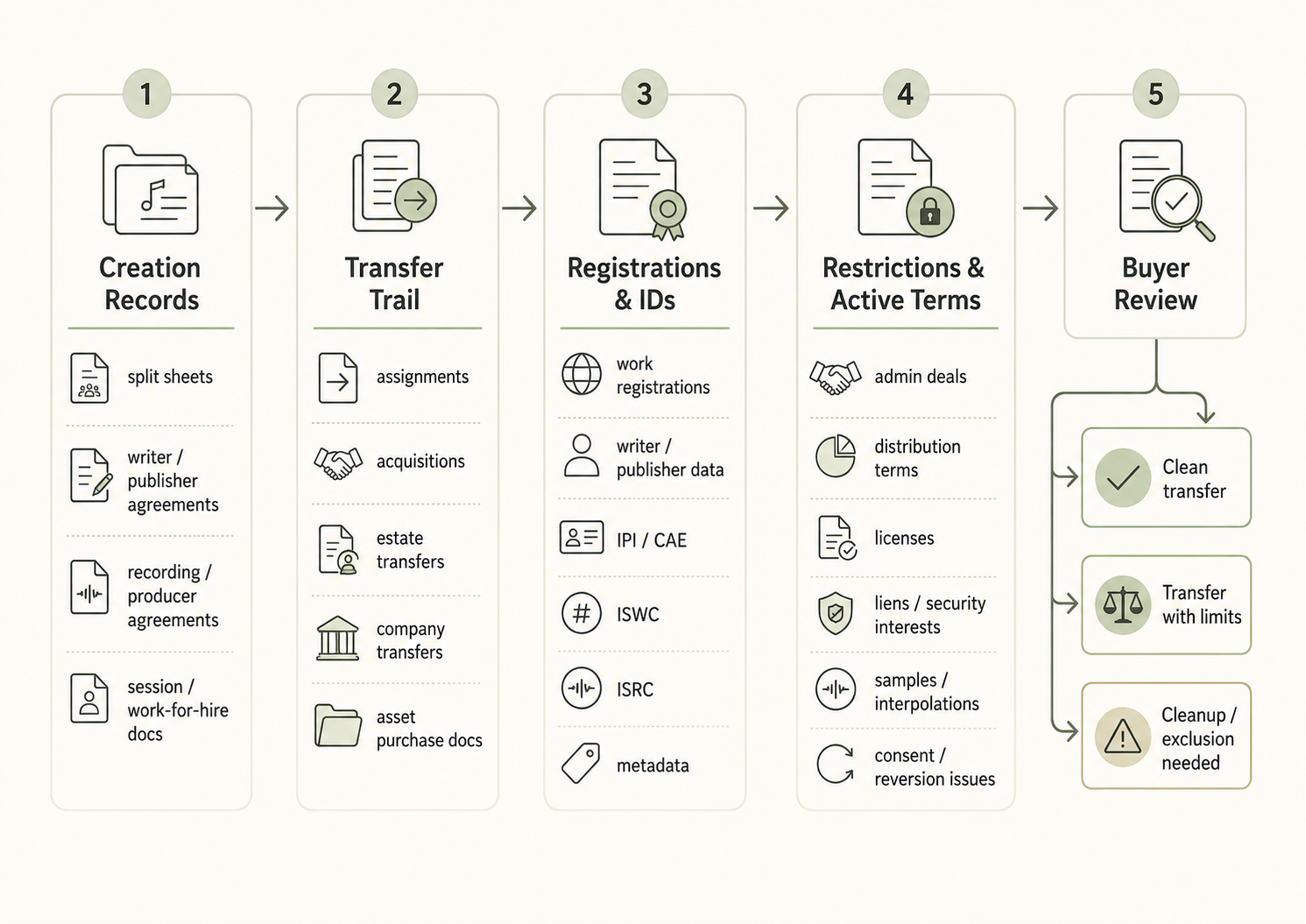
The review usually starts closest to creation. For compositions, that may mean split sheets, songwriter agreements, publishing agreements, co-publishing agreements, administration agreements, work registrations, and society records. For masters, the file may include recording agreements, producer agreements, work-for-hire language, featured artist agreements, session releases, delivery records, ISRC data, and distributor metadata. The point is to connect the asset to the people and companies that created it before following where the rights moved next.
From there, the buyer looks for the transfer trail. Catalog rights may have moved through assignments, acquisitions, company mergers, estate transfers, asset purchase agreements, settlements, secured loans, or older catalog purchases. Under U.S. copyright law, a transfer of copyright ownership generally needs a written instrument or memorandum signed by the owner of the rights being conveyed, or by the owner’s authorized agent. That is why informal emails, platform access, or royalty receipts are usually not enough for a clean sale file.
Public recordation can help support that trail, although it does not replace the underlying agreements. The U.S. Copyright Office records certain transfers and other ownership-related documents, and its materials explain that recordation may provide legal advantages such as constructive notice and priority between conflicting transfers when the statutory conditions are met.
Registrations and identifiers give the contracts something to connect to in royalty systems. A composition schedule may include writer names, publisher names, ownership shares, PRO or CMO affiliations, IPI or CAE numbers, ISWC information where available, and territory notes. A master schedule may include ISRCs, recording titles, artist names, label details, release dates, distributor records, and ownership notes. Music Admin’s rights management guide is useful background here because catalog administration depends on aligning ownership data, licensing activity, metadata, royalty tracking, and collection records across compositions and recordings.
The same file should also show anything that keeps the buyer from receiving clean rights on day one. Exclusive administration terms, distribution commitments, security interests, liens, samples, interpolations, reversion rights, termination notices, consent rights, approval rights, unpaid participants, and disputed claims can all change what is transferable. Some items may be fixed before closing. Others may need to be excluded, carved out, priced differently, or transferred only after another party approves.
A strong catalog file is organized by work, recording, share, territory, and income stream. Each asset should have a path from creation to current ownership, with the contracts, registrations, statements, identifiers, and restrictions kept close enough that another rights team can follow the story without rebuilding it from scattered inboxes and exports. That kind of documentation gives the buyer a clearer view of what can be transferred, what still needs cleanup, and what should stay outside the sale.
How Music Catalogs Generate Income
Income review is where the catalog stops being a title list and starts looking like a working asset. Buyers want to know which songs or recordings earn, where the money comes from, whether those earnings can keep arriving after the sale, and whether the seller has the right to transfer the income stream being shown.
On the composition side, income usually follows the song rather than a specific recording. A songwriter or publisher may receive performance royalties when the composition is performed, broadcast, streamed, or publicly used. Mechanical royalties may be generated when the composition is reproduced or distributed through physical formats, downloads, or certain digital uses. Sync fees can appear when the composition is licensed for film, television, advertising, games, trailers, or online video. Other publishing-side income may come from lyric uses, print rights, foreign collections, settlements, adjustments, or older licenses still producing statements.
The recording side follows the master. Streaming and download income may arrive through labels, distributors, aggregators, or other master-side payors. Physical sales, master use licenses, neighboring rights, UGC claims, soundtrack uses, and direct platform monetization may also sit in the master income history. When a buyer reviews a master catalog, it is not enough to know that a song earns. The buyer needs to know which recording earns, who controls that recording, and whether the seller can transfer the right to collect from it. Music Admin’s guide to master use licenses explains how licensing a recording is separate from licensing the underlying composition.
Many catalog files also include income that comes from contract participation rather than copyright ownership. A producer may receive points on a master. An artist may receive royalties under a record agreement. A songwriter may receive a share of publishing income while an administrator collects and accounts on their behalf. A seller in any of those positions may have valuable income, but the buyer still has to check whether the seller can sell the underlying copyright, sell only the income stream, or transfer nothing without another party’s consent.
The strongest income schedules break revenue down in ways that can be tested. A buyer may ask for income by work, recording, territory, platform, payor, royalty type, statement period, and ownership share. A single annual royalty total gives a rough commercial snapshot, but it can hide the details that affect value. Income from one sync placement is different from recurring streaming income. Domestic collections are different from foreign society income still passing through intermediaries. Revenue tied to an expiring license may not behave like revenue tied to long-term catalog consumption.
Royalty timing can also make a catalog look cleaner or messier than it really is. Statements may arrive months after the use occurred. Foreign collections can take longer to reach the right owner. Adjustments, reserves, unmatched royalties, retroactive claims, and delayed registrations can all shift income across statement periods. Music Admin’s guide to how royalties flow from DSPs to rightsholders is useful background because a single stream can move through different master-side and composition-side paths before payment reaches the final recipient.
Buyers usually treat income history as evidence to be checked, not as proof by itself. A statement may show that the seller has been paid for five years, but the supporting contracts may reveal a term limit, a recoupment position, an administration commission, a disputed share, or a license that cannot be assigned. Another catalog may show incomplete income because works were registered late, metadata was inconsistent, or money was sitting with a society or platform waiting for a corrected claim.
The better catalog file connects each income stream to the asset and document behind it. Composition income should connect back to the relevant work, writer share, publisher share, registration, and collection authority. Master income should connect back to the recording, ISRC, master owner, distributor or label agreement, and any participant shares. When that connection is clear, buyers can evaluate the catalog as a set of rights with income history rather than a pile of statements that happen to mention the same songs.
Catalog Sales vs. Licenses, Administration Deals, and Distribution Deals
Several music deals can give another company access to a catalog’s income, data, platforms, or licensing activity. That access can look like ownership from the outside, especially when the company is collecting royalties or handling approvals. The contract has to show whether the rights were actually sold, temporarily licensed, administered, distributed, or only routed through a payment system.
In a sale, the buyer is acquiring whatever the agreement actually transfers: full copyrights, partial shares, master rights, publishing interests, income streams, or a defined group of assets with exclusions. The schedule should make that transfer concrete by listing the works, recordings, shares, territories, contracts, income sources, and rights being conveyed.
A license can create real commercial value without moving ownership. Film uses, brand campaigns, samples, master uses, territory-specific deals, and platform licenses may all generate catalog income while the original rights holder keeps the underlying song or recording. The scope still needs close review because a long exclusive term, broad territory, sublicensing language, or wide media grant can make the license operate much more broadly than expected.
With administration, the outside party may be handling registrations, royalty collection, claims, licensing support, and accounting while the catalog owner keeps the rights. That can give the administrator significant day-to-day authority during the term, especially if the agreement is exclusive or worldwide. The ownership question still comes back to the contract: who owns the catalog, who can collect, who can approve uses, and when the authority ends.
On the distribution side, the company may control delivery, DSP access, release metadata, takedowns, reporting, and platform payments for recordings. That kind of operational control can look like master ownership from the outside, but it may only be a service or exploitation right for a defined period. The catalog owner still needs to check whether the distributor has exclusivity, post-term rights, recoupment rights, or restrictions that follow the recordings into a sale.
The label on the agreement should never carry the review by itself. A document called a license may contain long-term exclusive rights. A distribution agreement may affect income after the term. An administration agreement may give broad collection and licensing authority without transferring copyright. For a catalog transaction, the cleaner question is what was assigned, what was licensed, what was administered, what was distributed, and what was reserved.
Once those categories are separated, the buyer can see what it is purchasing, and the seller can see what it is giving up.
Who Can Sell a Music Catalog?
A catalog can only be sold by someone with the authority to transfer the rights or income interest being offered. That may sound obvious, but catalog income often passes through people and companies that do not own the underlying asset. A seller might receive statements, manage registrations, control an account, or collect royalties without having the right to sell the copyright itself.
The authority question should be answered before valuation goes too far. Buyers usually need to know who owns the asset, who can sign for it, whether anyone else must consent, and whether the seller is transferring full rights, partial rights, or only an income stream.
Common sellers include:
- Songwriters and composers - A songwriter may be able to sell a writer share, publisher share, or other copyright interest if the songwriter still owns it and has not assigned it elsewhere. Existing publishing, co-publishing, administration, or prior sale agreements may limit what can be transferred.
- Publishers and publishing companies - A publisher may sell the shares it owns or controls, depending on how the rights were acquired and what the songwriter agreement allows. If the publisher only administers the catalog, the administrator may have collection authority without ownership authority.
- Recording artists and master owners - An artist can sell master rights only if the artist owns or controls the recordings being sold. If a label, production company, investor, or distributor has rights in the masters, the sale may need consent, exclusions, or a narrower transfer.
- Record labels and production companies - Labels and production companies often sell master catalogs, but the buyer still has to review recording agreements, producer terms, featured artist agreements, samples, distribution restrictions, and participant royalty obligations. Master ownership does not erase the contracts attached to the recordings.
- Estates, heirs, and trusts - A catalog may pass to heirs, an estate, or a trust after a creator dies. The person receiving royalty income is not always the person with authority to sell. Buyers usually need estate documents, probate records, trust documents, executor authority, or other proof that the signer can transfer the rights.
- Catalog companies and prior buyers - A company that previously acquired a catalog can sell what it actually bought, subject to the original acquisition documents and any continuing restrictions. If the earlier deal excluded certain territories, income streams, works, recordings, or rights, the later seller cannot quietly add them back into a new sale.
- Royalty participants - Producers, artists, investors, collaborators, or other participants may receive royalty income under contract. That income can sometimes be sold or assigned if the contract allows it, but the participant may not own the song or recording itself. The buyer needs to know whether it is purchasing copyright ownership or only a right to receive payments.
- Companies with secured interests or liens - A lender or creditor may have rights tied to a catalog if the catalog was used as collateral. That does not automatically make the lender the catalog owner, but it can affect whether the catalog can be sold cleanly. A buyer may need payoff letters, lien releases, consents, or closing instructions before taking the asset.
The safest review starts with the signer. A buyer should be able to trace why that person or company has authority to transfer the catalog, whether the authority covers every asset listed in the schedule, and whether another party can object, approve, reclaim, or restrict the sale.
A seller who cannot transfer the full catalog may still have something valuable to sell. The deal may be narrowed to a partial share, a royalty stream, a territory, a limited group of works, or assets that are free of restrictions. What matters is that the agreement reflects the seller’s real position instead of treating catalog income as proof of catalog ownership.
What Buyers Review Before Acquiring a Catalog
Before a price means much, the buyer has to test whether the catalog on the spreadsheet matches the rights the seller can actually transfer. A high-earning song list can lose value quickly if the ownership trail is incomplete, the income depends on a short-term license, or another party still has approval rights over important uses.
Catalog diligence usually looks at several layers at once:
- Asset schedule - The schedule should identify the works, recordings, shares, territories, versions, and income streams included in the deal. Vague language like “all songs” or “all catalog rights” leaves too much room for disagreement, especially when the seller owns only partial shares or only one side of the rights.
- Chain of title - The buyer will want to see how the rights moved from the original creator to the current seller. Split sheets, songwriter agreements, recording agreements, assignments, acquisition documents, estate records, company transfer documents, and prior sale schedules all help show whether the seller’s ownership claim is supported.
- Authority to sign - The person signing may be an individual creator, company officer, executor, trustee, manager, administrator, or representative. The review needs to confirm that the signer has authority over the specific assets being sold, not just access to statements or accounts connected to the catalog.
- Royalty history - Statements are usually reviewed by work, recording, payor, territory, income type, and period. A buyer may compare recent earnings against older periods to see whether income is recurring, declining, seasonal, tied to a one-time sync, or dependent on a license that may not continue.
- Registrations and metadata - Work registrations, writer shares, publisher information, society affiliations, ISRCs, ISWCs, IPI or CAE numbers, distributor metadata, title variations, and payor records should line up as much as possible. Small mismatches can create payment delays, claim conflicts, or cleanup work after closing.
- Existing contracts - Administration agreements, distribution agreements, record deals, publishing deals, producer agreements, licenses, co-publishing arrangements, and participation agreements can all affect what the buyer receives. Some contracts continue after the sale, which means the buyer may acquire the catalog subject to terms already in place.
- Third-party rights and approvals - Samples, interpolations, featured artist terms, producer claims, unpaid participants, co-writer approvals, publisher consents, and master-side restrictions can affect licensing or transfer. These issues may not stop a sale, but they usually need to be disclosed and handled before closing.
- Recoupment, liens, and financial claims - A catalog may have income attached to it while still carrying advances, recoupable balances, secured loans, liens, unpaid royalties, reserves, or audit claims. Those obligations can change the net value of the catalog and may require payoff instructions, holdbacks, indemnities, or exclusions.
- Territory, term, and reversion limits - Rights may be owned worldwide or only in certain territories. They may be permanent, time-limited, subject to reversion, or affected by termination rights. A buyer needs to know whether the catalog income being valued is tied to rights that will continue or rights that may narrow over time.
- Pending disputes or corrections - Conflicting registrations, missing splits, ownership claims, takedown disputes, account conflicts, unprocessed amendments, and unresolved royalty claims can all follow the catalog after sale. Some can be cleaned up during diligence. Others may need a price adjustment or a specific carveout.
- Post-sale handoff - The closing package should give the buyer enough information to keep the catalog earning without rebuilding the admin file from scratch. Payor contacts, society accounts, administrator notices, distributor information, metadata exports, royalty portals, licensee records, and pending claim notes can be just as important as the signed agreement.
A buyer is not only trying to confirm whether the catalog has earned money. The review is trying to show whether the income belongs to the assets being sold, whether the seller can transfer those assets, and whether anything in the file could interrupt collection after closing.
For the seller, the same review can be useful before going to market. Cleaning up schedules, contracts, registrations, statements, and unresolved claims early can make the catalog easier to price, easier to explain, and less vulnerable to last-minute reductions.
How Music Catalog Value Is Usually Considered
Catalog value usually starts with income history, but the final number depends on how dependable that income looks once the buyer reviews the rights behind it. A catalog earning steady royalties from many works, territories, and sources will usually be viewed differently from one that depends on one recent sync placement, one viral recording, one short-term license, or one platform account with incomplete ownership support.
Buyers often look at several years of statements before making a serious offer. They may review gross income, net income, income by work, income by recording, payor history, territory performance, royalty type, and whether the seller is showing full ownership income or only a partial share. The same royalty total can mean different things if one catalog owns 100% of the relevant rights and another owns only a narrow participation.
The review usually focuses on questions like these:
- How much income is recurring? - Streaming activity, consistent performance income, ongoing mechanical collections, and repeat licensing patterns can help show whether the catalog has a continuing earnings base. One-time fees may still add value, but buyers will usually separate them from income that appears likely to repeat.
- Where does the money come from? - A catalog earning across multiple songs, recordings, platforms, territories, and royalty types may look more stable than a catalog tied to one hit or one income source. Concentration can raise risk because a change in one song’s popularity, one license, or one platform can affect the whole valuation.
- What share is actually being sold? - A seller may own a full copyright, a partial writer share, a publisher share, a master interest, or only a contractual income stream. Value depends on the rights being transferred, not just the song’s total earnings in the marketplace.
- How clean is the ownership record? - Missing assignments, unresolved splits, unclear estate authority, conflicting registrations, samples, liens, or unexpired exclusive deals can reduce certainty. Some problems can be fixed before closing, while others may lead to a lower price, holdback, exclusion, or delayed transfer.
- How long can the buyer expect to collect? - Rights with long-term ownership value are treated differently from income limited by contract term, territory, license period, reversion, or termination risk. A buyer may still pay for limited rights, but the expected collection window affects the price.
- How much work is needed after closing? - A catalog with organized schedules, clean metadata, current registrations, reliable statements, and clear payor contacts is easier to transfer and administer. A messy catalog may still be valuable, but the cleanup burden can affect the buyer’s offer.
Buyers may use a multiple of historical earnings as one part of the valuation process, but that multiple is not a magic number. It can move depending on catalog quality, income stability, rights clarity, market demand, age of the works, cultural relevance, licensing potential, territory coverage, growth trend, and the buyer’s own strategy. Two catalogs with the same recent income can receive very different offers if one has cleaner rights and stronger long-term collection prospects.
The seller’s expectations also need to be tied to the asset being sold. A famous song may have cultural value, but the seller may own only a small share. A master may have strong streaming history, but a distribution term or participant obligation may affect net income. A publishing catalog may have years of income, but registrations or society claims may need cleanup before a buyer feels comfortable paying for future collections.
Catalog value is usually clearest when income, ownership, and transferability are reviewed together. The income history shows what the catalog has done. The ownership file shows whether the seller can transfer what is being valued. The deal terms show what the buyer will actually receive after closing.
Key Terms in a Catalog Sale Agreement
By the time the parties move from diligence into sale documents, the main question is no longer whether the catalog has value. The agreement has to translate that value into a clear transfer: which assets move, which rights stay behind, what income follows the buyer, what promises the seller is making, and what happens if the file later turns out to be incomplete.
A catalog sale agreement usually needs close attention to these terms:
- Purchased assets - The agreement should identify the works, recordings, shares, income streams, territories, contracts, claims, and related rights being sold. A schedule of assets is usually where the deal becomes specific. Without one, both sides may be relying on broad language that does not match the catalog file.
- Excluded assets - Some songs, recordings, territories, income streams, versions, licenses, claims, or receivables may be left out of the deal. Exclusions need to be listed clearly because anything vague can create conflict after closing, especially when a royalty statement includes both sold and unsold assets.
- Assignment language - The transfer clause should say what is being assigned and whether the assignment covers copyright ownership, partial interests, royalty rights, claims, contracts, or other catalog assets. If the seller is transferring only an income stream, the agreement should not make it sound like full copyright ownership is moving.
- Purchase price and payment timing - The agreement should explain the price, deposit, closing payment, payment method, currency, taxes, and any holdback or escrow. A holdback may be used when certain consents, lien releases, registration updates, or claim corrections still need to be completed.
- Income cutoff date - Catalog income often arrives long after the use that generated it. The contract should say which party receives income earned before closing, income received after closing, retroactive payments, audit recoveries, reserves, adjustments, and late society or distributor payments.
- Representations and warranties - The seller is usually asked to make promises about ownership, authority, chain of title, encumbrances, litigation, prior transfers, liens, licenses, samples, unpaid participants, and accuracy of the materials provided. These promises help the buyer rely on the catalog file, but they should match what the seller can actually stand behind.
- Consents and approvals - Some rights cannot move cleanly without a publisher, co-owner, estate representative, lender, distributor, administrator, licensee, or other third party signing off. The agreement should state which consents are required before closing and what happens if one is delayed or refused.
- Existing contracts and restrictions - Administration deals, distribution terms, exclusive licenses, co-publishing agreements, producer royalty obligations, artist agreements, sample licenses, recoupment positions, and approval rights may continue after the sale. The buyer needs to know which obligations it is taking subject to and which remain with the seller.
- Liens, loans, and security interests - If the catalog has been used as collateral or is tied to a financial claim, the closing process may require payoff letters, releases, lender consents, or escrow instructions. Buyers usually want confirmation that the assets will not arrive with undisclosed claims attached.
- Post-closing handoff - The sale document should cover delivery of contracts, schedules, metadata, royalty statements, registration records, portal access, payor contacts, license files, notices, and pending claim information. A signed assignment has limited practical value if the buyer cannot redirect income or administer the catalog after closing.
- Indemnity and remedies - If a missing writer, conflicting transfer, undisclosed lien, uncleared sample, or inaccurate statement causes loss after closing, the agreement should explain who bears responsibility. Indemnity language, claim procedures, caps, baskets, survival periods, and offsets can become important when problems surface months or years later.
- Further assurances - Catalog transfers often need cleanup after signing. The seller may need to sign additional forms, notify payors, help correct registrations, confirm chain-of-title questions, or assist with society and distributor updates. Further-assurances language keeps that cooperation from depending only on goodwill.
The agreement should not rely on the word “catalog” to do too much work. A good sale file names the assets, tracks the rights, handles old and future income, discloses limits, and gives the buyer enough authority to administer what it bought. When those pieces are missing, the transaction may still close, but the administrative problems usually reappear when someone tries to register, license, collect, or resell the catalog.
What Happens After a Catalog Is Sold
Once the assignment is signed and the purchase price is paid, the catalog still has to be moved into the buyer’s operating system. Royalties may keep arriving under the seller’s name for months, registrations may still show old publisher data, licensees may have old notices on file, and distributors or societies may need their own forms before they update accounts.
A clean post-sale handoff usually covers:
- The catalog file moves first - The buyer needs the asset schedules, signed agreements, amendments, royalty statements, metadata exports, registrations, license files, claim notes, payor contacts, and any pending correction history. For compositions, that may include writer and publisher data, split records, society information, IPI or CAE numbers, and ISWC details where available. For masters, it may include ISRCs, release metadata, artist agreements, producer terms, distributor records, neighboring rights information, and label or platform statements.
- Payors and administrators need notice - Publishers, administrators, distributors, labels, societies, neighboring rights organizations, licensees, and business managers may all need to be told where the rights now sit and where future payments should go. Some will accept a notice and assignment. Others may ask for tax forms, bank forms, letters of direction, account updates, or confirmation from both sides.
- Old income and new income have to be separated - Royalty systems rarely line up neatly with the closing date. A payment received after closing may relate to streams, performances, licenses, or sales from before closing. The sale agreement should already say who keeps pre-closing income, who receives post-closing income, and what happens if money lands in the wrong account.
- Registrations and metadata may need cleanup - Ownership can move on paper before databases catch up. A composition may still show the prior publisher. A recording may still be tied to an old distributor. A title variation, ISRC, ISWC, writer share, label name, or administrator field may need to be corrected before collections move cleanly.
- Existing licenses keep their own timelines - A film placement, brand campaign, sample license, game use, platform deal, or territory license may continue after the catalog changes hands. The buyer needs to know which uses remain active, who has already paid, who still owes money, and whether the license income belongs to the buyer or seller under the cutoff language.
- Unresolved issues follow the file unless handled at closing - Missing splits, unpaid participants, liens, samples, interpolations, recoupment questions, claim conflicts, or disputed registrations do not disappear because the catalog was sold. They may be handled through exclusions, holdbacks, indemnities, post-closing cooperation, or specific correction deadlines.
- The seller may still have work to do - Further-assurances language often requires the seller to sign additional forms, help notify payors, correct registrations, forward misdirected royalties, or answer chain-of-title questions after closing. That cooperation can be the difference between a clean transfer and a buyer spending months chasing missing admin pieces.
The sale moves the rights between the parties. The handoff moves the catalog through the systems that actually pay, license, register, and track those rights.
Common Catalog Ownership and Sale Issues
Catalog problems often come from a gap between what the income history appears to show and what the documents actually support. A song may be earning, a recording may be active on platforms, or a seller may have years of statements, but the sale still depends on whether the rights can be traced, transferred, and administered without unexpected limits.
- The ownership trail is incomplete - A buyer may see royalty statements without seeing the signed path from creator to current owner. Missing assignments, unsigned amendments, incomplete schedules, old company transfers, or gaps in estate paperwork can make a catalog harder to sell cleanly. The problem is not always that the seller does not own the rights; sometimes the file simply does not prove it well enough.
- Partial rights are presented like full ownership - A seller may own 25% of a composition, a publisher share only, a specific master interest, or a royalty participation tied to one agreement. If the sale materials describe the catalog too broadly, the buyer may think it is acquiring more than the seller can transfer. This can lead to price changes, exclusions, or revised schedules once diligence catches the mismatch.
- Composition rights and master rights are blended together - Songs and recordings often travel together commercially, but they are still separate assets. A seller may own the publishing side without owning the masters, or own recordings without controlling the underlying compositions. When the catalog schedule does not separate those lanes, licensing approvals, income projections, and transfer documents can become confused.
- Older contracts still control part of the catalog - Administration deals, distribution agreements, exclusive licenses, co-publishing terms, record agreements, producer provisions, and prior acquisition documents can continue affecting the catalog after a sale. A buyer may still proceed, but the deal may need notices, consents, exclusions, or language explaining which obligations carry forward.
- Samples and interpolations were never fully cleared - A catalog may include songs built around earlier works, borrowed melodies, reused lyrics, samples, loops, or interpolations. If those approvals were never finished or were documented loosely, the buyer may inherit a licensing problem instead of a clean asset. Even where the song has already been released, uncleared or partly cleared material can affect future syncs, claims, and resale value.
- Registrations and metadata do not match the deal file - A work may show different writer shares at different societies. A master may have an ISRC tied to an old label or distributor. A title may appear under several variations, or a publisher name may not match the agreement. These inconsistencies can usually be corrected, but they slow the transfer and may delay income redirection after closing.
- The signer’s authority is unclear - Estate, trust, band, company, and partnership catalogs often require extra review because the person receiving income may not be the person authorized to sell. Buyers may need corporate approvals, probate documents, trustee authority, member consents, board resolutions, or other proof that the signer can bind the rights being transferred.
- Financial claims follow the catalog - Advances, recoupment balances, liens, secured loans, unpaid royalties, participant claims, reserves, audit disputes, and settlement obligations can affect what the buyer receives. The catalog may still have value, but those claims need to be priced, paid off, disclosed, held back, or excluded before closing.
- The income stream does not match the asset being sold - Statements can include money from works, recordings, territories, licenses, or accounts that are outside the proposed sale. A buyer may ask for income to be separated by asset and right type so the valuation reflects only what is actually being transferred. Without that separation, the purchase price can be based on revenue the buyer will not receive.
- The post-sale handoff is too thin - A signed agreement does not give the buyer everything needed to operate the catalog. Missing payor contacts, metadata exports, registration records, license files, claim notes, portal access, or statement history can turn a completed sale into months of cleanup. Good closing materials reduce the chance that income keeps flowing to old accounts or remains stuck while the buyer rebuilds the file.
Frequently Asked Questions
What is a music catalog?
A music catalog is a group of music assets managed or valued together. It may include compositions, master recordings, royalty income streams, contracts, registrations, metadata, licensing history, or acquired rights across multiple songs and recordings.
Is a catalog the same as a list of songs?
No. A song list may identify what appears in the catalog, but the catalog file has to show what rights are attached to those songs. The buyer or administrator still needs to know who owns each share, which recordings are included, where income comes from, and what contracts or restrictions affect the assets.
Can someone sell only part of a music catalog?
Yes. A seller may transfer a partial writer share, publisher share, master interest, royalty stream, territory, income source, or selected group of works. The sale documents should make the limits clear so the buyer does not think it is acquiring more than the seller can transfer.
What is the difference between selling publishing and selling masters?
Publishing relates to the composition, meaning the song as written. Masters relate to specific recorded versions of that song. A seller may own one side without owning the other, so a catalog sale has to identify whether the transaction includes compositions, recordings, or both.
Does royalty income prove catalog ownership?
Royalty income helps show that money has been paid, but it does not prove ownership by itself. The seller still needs contracts, assignments, registrations, estate documents, corporate records, or other materials showing why the seller has the right to transfer the catalog.
Who can sell a music catalog?
The seller must have authority to transfer the rights or income interest being sold. That may be a songwriter, publisher, master owner, label, catalog company, estate, trust, or royalty participant, depending on the asset. Access to a royalty account or statement is not enough if the signer does not control the rights.
How are music catalogs valued?
Buyers usually review income history, rights ownership, income stability, catalog age, concentration risk, territory coverage, licensing potential, metadata quality, and transfer restrictions. Historical earnings may be used as part of the valuation, but the final price depends on how reliable and transferable the income appears after diligence.
What can reduce the value of a catalog?
Unclear ownership, missing assignments, disputed splits, partial rights, uncleared samples, liens, recoupment balances, expiring licenses, poor metadata, and income that cannot be tied to the assets being sold can all affect value. Some issues can be corrected before sale, while others may change the price or scope of the deal.
What happens to royalties after a catalog is sold?
Royalties may not redirect immediately. Payors, societies, administrators, distributors, and licensees may need notices, forms, banking details, tax information, or copies of transfer documents before payments move to the buyer. The sale agreement should explain how pre-closing and post-closing income will be handled.
Does a catalog sale end the seller’s involvement?
Not always. The seller may still need to sign additional documents, help notify payors, correct registrations, forward misdirected royalties, answer chain-of-title questions, or assist with post-closing updates. Those obligations are often handled through further-assurances and handoff language in the sale agreement.
Key Takeaways
- A music catalog is more than a list of songs. It may include compositions, master recordings, partial shares, income rights, contracts, registrations, metadata, claims, licenses, and royalty history.
- Composition catalogs and master recording catalogs need separate review. The composition covers the song as written. The master side covers specific recordings of that song. A seller may own one side, both sides, or only a share of either side.
- Royalty income can show that money has been paid, but it does not prove ownership by itself. Contracts, assignments, registrations, estate records, company records, and chain-of-title documents still have to support the seller’s position.
- Ownership, control, administration, distribution, and income participation are not the same thing. A party may collect royalties, manage registrations, distribute recordings, or receive a contractual share without owning the copyright being discussed.
- A catalog file should trace each asset from creation to current ownership. Split sheets, songwriter agreements, publishing agreements, recording agreements, producer terms, assignments, sale documents, estate documents, registrations, identifiers, and royalty statements all help build that trail.
- Catalog income can come from many sources, including performance royalties, mechanical royalties, sync fees, streaming revenue, master use fees, neighboring rights, UGC claims, foreign collections, and contractual royalty participations.
- A catalog sale should be separated from a license, administration deal, or distribution deal. The review should ask what was assigned, what was licensed, what was administered, what was distributed, what was collected, and what stayed reserved.
- Only someone with authority over the rights or income interest can sell it. Songwriters, publishers, labels, master owners, estates, trusts, catalog companies, and royalty participants may all have sellable interests, but the documents decide what each can transfer.
- Buyers usually review asset schedules, chain of title, signer authority, income history, registrations, metadata, existing contracts, approvals, liens, recoupment, disputes, territory limits, term limits, and post-sale handoff materials before acquiring a catalog.
- Catalog value is tied to income history, but the quality of that income changes the valuation. Recurring earnings, clean ownership, broad territory coverage, reliable metadata, multiple income sources, and clear transfer rights usually support a stronger file than income that depends on one short-term use or an uncertain ownership claim.
- A sale agreement should identify the purchased assets, excluded assets, assignment language, purchase price, income cutoff date, consents, restrictions, liens, post-closing duties, warranties, indemnities, and handoff obligations.
- After closing, the catalog still has to move through payors, societies, administrators, distributors, licensees, metadata systems, royalty accounts, and claim processes. The signed agreement transfers rights between the parties, but the handoff is what helps the buyer actually operate the catalog.
- Common catalog problems include incomplete ownership trails, partial rights being treated as full rights, composition and master rights being mixed together, old contracts still controlling assets, uncleared samples, conflicting registrations, unclear signer authority, financial claims, mismatched income, and thin post-sale files.
Practical Resource
Music Catalog Sale Readiness Map
Use this map before a catalog is priced, listed, reviewed, or moved into buyer diligence. The goal is to organize the file around what can actually be transferred: the assets, ownership proof, income history, restrictions, signer authority, and post-sale handoff materials.
[Download the Music Catalog Sale Readiness Map]
References
U.S. Copyright Office. Copyright Registration of Musical Compositions and Sound Recordings.
https://www.copyright.gov/register/pa-sr.html
U.S. Copyright Office. Copyright Registration for Musical Compositions. Circular 50.
https://www.copyright.gov/circs/circ50.pdf
U.S. Copyright Office. Copyright Registration for Sound Recordings. Circular 56.
https://www.copyright.gov/circs/circ56.pdf
U.S. Copyright Office. Copyright Law of the United States, Chapter 2: Copyright Ownership and Transfer.
https://www.copyright.gov/title17/92chap2.html
U.S. Copyright Office. Recordation of Transfers and Other Documents.
https://www.copyright.gov/recordation/documents/
IFPI. ISRC Standard.
https://isrc.ifpi.org/isrc-standard
CISAC. Interested Party Information.
https://www.cisac.org/services/information-services/ipi
CISAC. International Identifiers.
https://www.cisac.org/services/information-services/international-identifiers
Library of Congress. Vaudeville: Bob Hope and American Variety.
https://www.loc.gov/exhibits/bobhope/vaude.html
Library of Congress. Warner/Chappell Collection.