How Do Music Royalties Flow From DSPs to Rightsholders
DSP royalty flow involves more than one payment path. This guide explains how master royalties, mechanical royalties, performance royalties, and international collections move from platforms to rightsholders.
Every DSP play creates activity across more than one rights system. Spotify, Apple Music, YouTube Music, Amazon Music, and other services may deliver the listening experience in one place, but the royalties connected to that play can move through separate master-side and composition-side channels before reaching the people or companies entitled to payment.
The sound recording is usually handled through a label, distributor, label services company, or master owner. The composition may involve songwriters, publishers, administrators, PROs, CMOs, mechanical licensing bodies, and local societies. Each side depends on different identifiers, registrations, ownership records, licenses, statements, and payment rules.
Royalty flow becomes difficult to trace when those systems do not line up cleanly. A recording may have a valid ISRC while the underlying composition is missing writer splits. A song may be streamed globally while registrations are incomplete in certain territories. A publisher may be collecting in one market while another society is holding unmatched income somewhere else. Income may exist, but the path from platform usage to final rightsholder payment still depends on the data and relationships behind the work.
This guide explains how royalties flow from DSPs to rightsholders across the full music rights ecosystem, including master royalties, composition royalties, mechanical royalties, performance royalties, intermediaries, international collection, payment delays, and the metadata issues that can disrupt the process.
Learning Objectives
By the end of this guide, you should be able to:
- Understand why one stream can trigger multiple royalty paths
- Separate master-side royalties from composition-side royalties
- Follow the general flow from DSP usage to label, distributor, publisher, society, administrator, or rightsholder payment
- Understand where mechanical and performance royalties fit into interactive streaming
- Recognize the roles of labels, distributors, publishers, PROs, CMOs, administrators, and the MLC
- See why international royalties may move through additional collection layers
- Identify common reasons royalties are delayed, incomplete, unmatched, or misdirected
- Understand why identifiers, splits, ownership records, and registrations affect royalty flow
Overview
Music royalty flow starts with usage data. When a track is played on a DSP, the platform records information about the stream, the recording, the territory, the account type, the revenue pool, and the licensing framework connected to that use. From there, the income does not move through one single pipeline.
The master side usually flows through the party that delivered or controls the sound recording. That may be a distributor, record label, label services company, or master owner. The recording identifier, commonly the ISRC, helps connect DSP usage to the correct recording as reporting moves through the system.
The composition side follows a separate path because the song underneath the recording has its own copyright interests. Songwriters and publishers may receive income through publishers, administrators, performance rights organizations, collective management organizations, mechanical licensing bodies, or local societies. Composition identifiers such as ISWCs, along with clean writer and publisher splits, help the system match usage to the correct musical work.
Interactive streaming creates more than one type of composition royalty. Mechanical royalties may be generated by the reproduction or distribution activity tied to on-demand streaming, while performance royalties may arise from the public performance of the composition. In the United States, the Music Modernization Act changed the mechanical licensing path for eligible interactive streaming services, with the MLC administering the blanket mechanical license for covered uses.
The ecosystem becomes more complex when royalties move across borders. A DSP may operate in many territories, but local licensing rules, society relationships, sub-publishing arrangements, exchange timing, tax withholding, and repertoire matching can all affect how long money takes to arrive and whether it reaches the correct party.
A clean royalty flow depends on more than the fact that a song is available on a platform. The recording must be delivered properly, the composition must be registered accurately, ownership must be clear, identifiers must be connected, splits must be correct, and conflicts must be resolved when more than one party claims the same work. Without that operational layer, royalties can be earned while still sitting in unmatched, suspended, delayed, or misallocated pools.
Table of Contents
The Two Rights Behind Every Stream
A DSP stream touches two separate copyrights: the sound recording and the musical composition. The listener hears one track, but the royalty system treats the recording and the underlying song as different rights with different owners, licenses, identifiers, and collection paths.
The sound recording, often called the master, is the specific recorded version being streamed. Master-side income may be paid to a record label, distributor, label services company, independent artist, or catalog owner, depending on who controls the recording and who delivered it to the DSP. The ISRC helps identify that particular recording as usage is reported across platforms and royalty systems.
The musical composition is the song underneath the recording: melody, lyrics, and musical work. Composition-side income may flow to songwriters, publishers, publishing administrators, PROs, CMOs, mechanical licensing bodies, or local societies. The ISWC, along with accurate writer shares and publisher information, helps connect DSP activity to the correct composition.
A single recording can also contain multiple composition interests. Co-writers may have different publishers. A sample may introduce another work. A remix, cover, translation, or alternate version can add more rights data to the chain. When any part of that information is missing or disputed, the master-side payment may still move while composition-side income gets delayed, held, or matched incorrectly.
The split between master and composition rights is the foundation of DSP royalty flow. Once those two sides are separated, the rest of the ecosystem becomes easier to follow: one path starts with the recording owner or distributor, while another moves through publishing, performance, mechanical, and society systems.
What Happens When Music Is Played on a DSP
When a listener plays a track on a DSP, several things begin happening behind the platform interface. The exact process varies by service, territory, and license structure, but the general flow usually looks like this:
- The DSP logs the play - The platform records usage data tied to the track. This may include the track title, artist name, ISRC, territory, date, service tier, stream count, revenue pool, and other platform-specific reporting details.
- The recording is connected to the master-side account - The DSP identifies the sound recording through delivery data, distributor information, label information, catalog data, and the ISRC. Master-side income is then routed toward the party licensed to receive it, such as a distributor, label, label services company, independent artist, or master owner.
- The composition has to be matched separately - The song underneath the recording may need to be matched to its writers, publishers, administrators, societies, or mechanical licensing bodies. ISWCs, writer splits, publisher shares, work registrations, and local society records can all affect whether the composition-side income is matched cleanly.
- The DSP calculates the royalty pool or payable amount - Subscription revenue, advertising revenue, territory, user plan, currency conversion, market share, platform deductions, and license terms can affect the amount available for payment. A stream does not carry the same value in every country, service tier, or royalty category.
- Payments and reports move through different channels - Master-side reports may go to a label, distributor, or recording owner. Composition-side reports may move through publishers, administrators, PROs, CMOs, the MLC, or local societies, depending on the royalty type and territory.
- Intermediaries process ownership, splits, and deductions - Each party in the chain may apply its own contracts, commission, administration fee, exchange timing, tax withholding, statement period, or payment threshold before money reaches the final rightsholder.
- Rightsholders receive statements and payments - Artists, songwriters, producers, labels, publishers, catalog owners, and other rightsholders may receive money at different times because their royalties travel through different systems. One side of the royalty flow may pay out before the other, even when both were triggered by the same stream.
Clean data keeps the process moving. If the recording has the wrong ISRC, the composition is not registered, writer shares are missing, or ownership conflicts exist, the DSP may still record the usage while some of the resulting income becomes delayed, unmatched, suspended, or misdirected.
Master-Side Royalty Flow
Master-side royalties come from the sound recording. On a DSP, that means the specific recording being streamed, identified through delivery data and usually tied to an ISRC.
The master-side path often starts before the song ever appears on the platform. A label, distributor, label services company, or independent rights holder delivers the recording to the DSP with metadata, artwork, release dates, territory rules, ownership information, and payment details. Once the track is live, the DSP reports usage back through the party it has a licensing or delivery relationship with.
A common master-side flow looks like this:
- The recording is delivered to the DSP - The distributor, label, or rights holder sends the sound recording and metadata to the platform. Delivery data usually includes the ISRC, artist name, release title, track title, ownership details, territories, and release timing.
- The DSP tracks usage of the recording - Streams, downloads, territory activity, service tier, and revenue information are recorded by the platform.
- The DSP pays the licensed master-side partner - Payment usually goes to the distributor, label, label services company, or other party that controls or represents the recording in the DSP relationship.
- The intermediary applies its deal terms - A distributor may deduct a distribution fee. A label may apply artist royalty terms, recoupment, reserves, producer royalties, featured artist payments, or other contract provisions. A label services company may deduct service fees or campaign costs if the agreement allows it.
- The master owner or artist receives a statement and payment - The final payment depends on the contract between the artist or rights holder and the party receiving DSP income. An independent artist using a distributor may receive net revenue after distribution fees. An artist signed to a label may receive artist royalties after the label applies the recording agreement.
The master-side flow is usually more direct than the composition-side flow, but it can still become complicated. A recording may have multiple owners, producer royalty obligations, featured artist participation, label splits, recoupment balances, or territory-specific distribution arrangements. If the ISRC is wrong, ownership is unclear, or the recording was delivered through the wrong account, the money can move to the wrong place before anyone notices.
Music distribution sits near the front of this pathway because delivery determines how the recording enters the DSP system. Clean release metadata, accurate ISRCs, clear ownership, and proper account setup make master-side reporting easier to trace after the royalties come back.
Composition-Side Royalty Flow
Composition-side royalties follow the song underneath the recording. Before money can reach a songwriter or publisher, the system has to identify the musical work, connect it to the correct writers and publishers, apply the right royalty type, and route payment through the proper licensing or collection path.
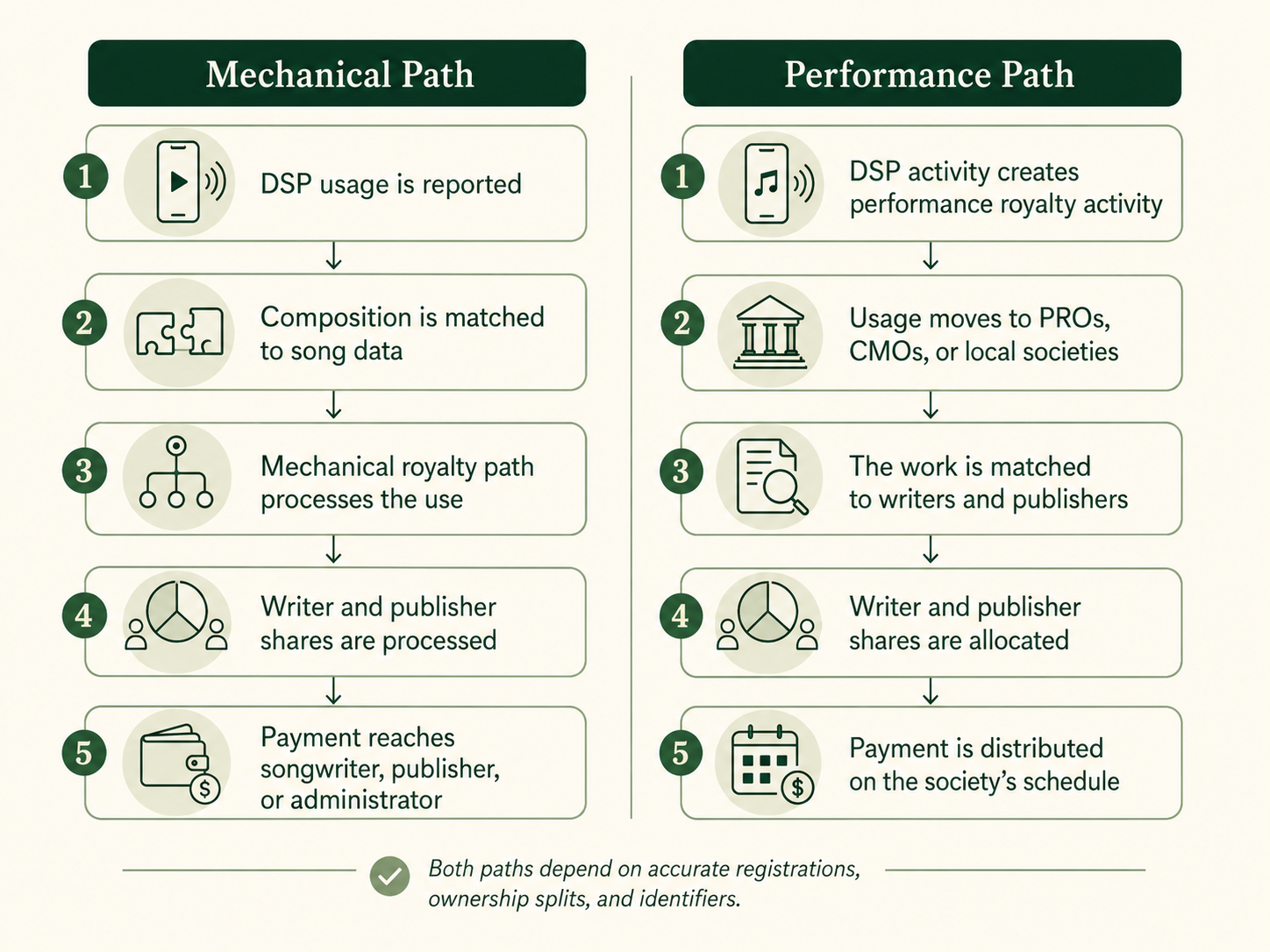
Unlike the master side, composition income from DSP activity can move through more than one channel. Interactive streams may generate both mechanical and performance royalties for the composition, and different organizations often handle those payments.
Mechanical Royalties From Interactive Streaming
Mechanical royalties from interactive streaming belong to the composition side of the royalty flow. They are connected to the use of the underlying song when a listener chooses a specific track on demand through a DSP.
In the United States, this part of the system is shaped by the Music Modernization Act. The law created a blanket mechanical licensing framework for eligible interactive streaming uses, with the MLC administering that license and processing covered mechanical royalties. That U.S. pathway is only one part of the wider royalty ecosystem, since mechanical collection can work differently across other territories.
The operational issue is matching. A DSP may have usage data for a recording, but the mechanical royalty still has to be connected to the correct composition, writers, publishers, shares, and administrators. ISRCs can help identify the recording, while composition data, work registrations, titles, writer names, publisher names, and ISWCs help identify the song underneath that recording.
Mechanical royalty flow can break down when the composition record is incomplete. Missing writer shares, delayed registrations, conflicting publisher claims, alternate titles, unmatched recordings, or poor metadata can leave income waiting for correction before it reaches the right party.
Outside the U.S., the mechanical path may involve different organizations and licensing structures. Publishers, administrators, mechanical rights organizations, CMOs, and local societies may all play a role depending on the territory. That is why a song can appear to be earning globally while certain mechanical royalties take longer to locate, match, and distribute.
Performance Royalties From Streaming
Performance royalties from streaming belong to the composition side as well, but they follow a different collection path from mechanical royalties. They relate to the public performance of the song, which is why PROs, CMOs, and local societies are involved.
A DSP stream may generate performance royalty activity when the underlying composition is made available and played to listeners. The platform’s usage data then needs to connect to the correct work registration, writer shares, publisher shares, territory, and society affiliations.
Performance royalties are commonly split between writer and publisher shares. A songwriter may receive their writer share through a PRO or society, while the publisher share may flow to a publisher, administrator, or publishing rights holder. The exact path depends on the territory, affiliation, repertoire coverage, and local collection rules.
These payments often arrive on a different timeline from master-side income. Master royalties may move from the DSP to a distributor or label through one reporting cycle, while performance royalties may pass through society processing, work matching, distribution schedules, and international collection layers before reaching the writer or publisher.
SoundExchange sits in a separate part of the royalty map. It is connected to certain U.S. sound recording performance royalties for non-interactive digital uses, not the ordinary master-side payment path for on-demand DSP streams. That distinction matters because interactive streaming, non-interactive streaming, master royalties, and composition royalties do not all use the same collection system.
Performance royalty delays often come from registration and matching issues. Alternate titles, missing writer shares, incorrect publisher information, society conflicts, delayed registrations, and incomplete territory coverage can all prevent income from moving cleanly to the right parties.
How Royalties Move Through Intermediaries
Royalty income from a DSP usually does not travel straight from the platform to the final rightsholder. Between the moment a stream is reported and the moment a payment is received, the money may pass through several companies or collection bodies, each handling a different part of the rights chain.
On the master side, the DSP often pays the party that delivered or controls the recording, such as a distributor, label, label services company, or master owner. That party may then apply its own contract terms before passing income forward. Distribution fees, label royalty calculations, recoupment, producer participation, featured artist payments, reserves, and territory-specific arrangements can all affect what reaches the next level.
On the composition side, the route can be even more layered. A publisher may collect directly in one market, use an administrator in another, and rely on local societies or CMOs elsewhere. Mechanical and performance royalties may also move through different systems, which means part of the income may clear sooner than the rest even when it came from the same DSP activity.
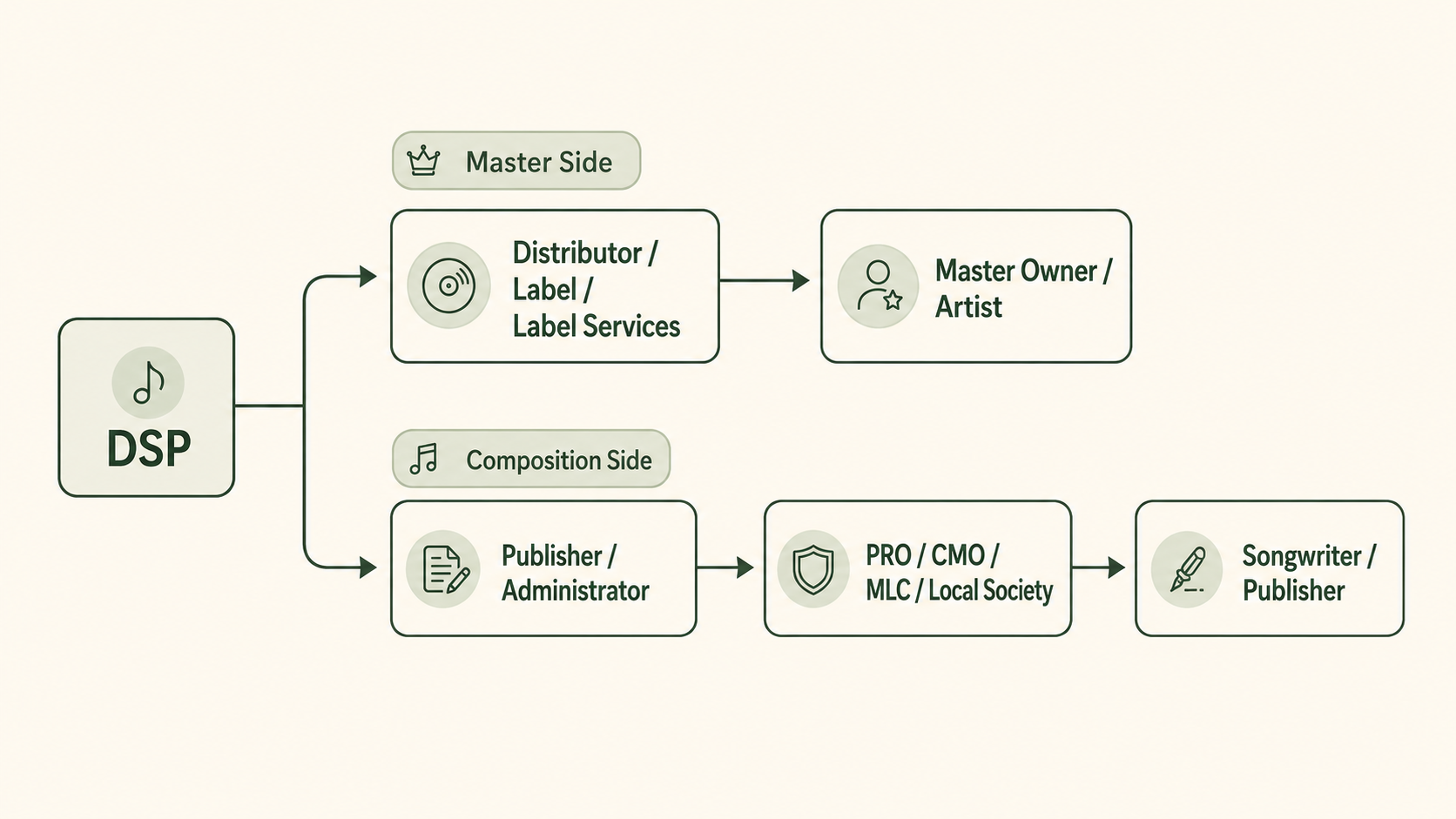
The point of the pathway is not that every song follows the exact same route. Different deals, territories, and royalty types create different chains. Some creators collect more directly because they control their own rights. Others work through several intermediaries because their recordings, compositions, or territories are handled by different partners. What stays consistent is that each intermediary depends on accurate ownership, identifiers, registrations, and agreements before the money can keep moving.
This is also why statement timing can feel uneven. A rightsholder may receive master-side DSP income from a distributor on one schedule, performance royalties from a PRO on another, and mechanical income through a publisher, administrator, or society at a different time altogether. Understanding the intermediary layer helps explain why one stream can result in several separate payments instead of one simple payout.
Where Labels, Distributors, Publishers, PROs, CMOs, and the MLC Fit In
Each organization in the royalty chain handles a different part of the rights picture. Some work on the recording side, some work on the composition side, and some only apply in certain territories or royalty categories.
Labels
A label may own or control the master recording, deliver releases through a distributor, receive master-side income from DSPs, and account to artists or other participants under the recording agreement. Before payments move from the label to the artist, the label may apply royalty rates, recoupment, producer royalties, featured artist shares, reserves, and other contract terms.
Distributors
Distributors sit near the front of the master-side flow because they deliver recordings and metadata to DSPs. After the platform reports usage and pays master-side revenue, the distributor processes the income according to its agreement with the label, artist, or rights holder. Some distributors only deduct a distribution fee. Others may also handle marketing services, advances, playlist support, or label services arrangements that affect the final payout.
Publishers
Publishers control or administer composition rights. Their role may include registering works, collecting publishing income, licensing uses, managing writer and publisher shares, resolving conflicts, and accounting to songwriters or catalog owners. In DSP royalty flow, publishers may be involved in mechanical royalties, performance royalties, sync-related income, and international collections depending on the agreement and territory.
Publishing Administrators
A publishing administrator may handle registration, collection, claiming, and royalty processing without owning the copyright. This role is especially important when a songwriter, publisher, or catalog owner needs works registered across multiple societies and territories. Clean administration helps connect DSP usage to the correct composition, writer shares, publisher shares, and payment accounts.
PROs
Performance rights organizations handle public performance royalties for compositions. For streaming, PROs may receive usage data, match that activity to registered works, apply writer and publisher shares, and distribute payments according to their schedules. Songwriters usually receive their writer share directly through their PRO, while publisher shares may go to a publisher or publishing administrator.
CMOs and Local Societies
Collective management organizations and local societies operate in different territories and may collect mechanical royalties, performance royalties, or both, depending on local rules. International royalty flow can involve several of these organizations before payment reaches the final rightsholder. Their records, matching systems, deductions, and distribution schedules can affect how quickly income moves.
The MLC
In the United States, the MLC administers the blanket mechanical license for eligible interactive streaming services under the Music Modernization Act. Its role is specific to covered U.S. digital mechanical royalties, so it should not be confused with PROs, labels, distributors, or SoundExchange. The MLC needs accurate work registrations, writer shares, publisher data, and matching information to connect DSP usage to the correct composition rightsholders.
Artists, Songwriters, and Other Rightsholders
Artists, songwriters, producers, publishers, labels, catalog owners, estates, funds, and other rightsholders may all receive income from different points in the chain. The payment path depends on which rights they control, which agreements they signed, where the income was generated, and whether the data attached to the work is complete.
A royalty flow map is only useful when the roles are clear. One stream may create income for the master owner, the artist, the songwriter, the publisher, and other participants, but those payments may not come from the same organization or arrive on the same schedule.
International Royalty Flow and Collection Gaps
International royalty flow adds another layer to DSP reporting because music is licensed, matched, collected, and paid under different local systems. A song may be available globally through one platform interface, while the royalty paths behind that activity move through separate societies, publishers, administrators, distributors, tax rules, and payment schedules.
On the master side, a distributor or label may receive DSP income across multiple territories through its platform agreements. The reporting may still need to account for territory-level revenue, currency conversion, local deductions, withholding, reserves, and any territory-specific distribution arrangements.
The composition side often has more collection points. A publisher may collect directly in some territories, appoint a sub-publisher in others, or rely on local societies and CMOs to collect mechanical and performance royalties. If the work is not registered properly in a territory, income may sit unmatched or move slowly through society systems until the ownership record is corrected.
Collection gaps can appear in several places:
- Missing local registrations - A composition may be registered in one country but absent or incomplete in another.
- Conflicting ownership claims - Societies may hold income when two or more parties claim the same share.
- Incomplete writer or publisher shares - Missing splits can prevent the full work from matching cleanly.
- Territory-specific society rules - Local distribution practices, documentation requirements, and claim windows can affect payment timing.
- Currency conversion and withholding - International income may be reduced or delayed by exchange rates, bank timing, tax withholding, and local processing.
- Sub-publishing and administration layers - Money may pass through additional partners before reaching the original publisher, songwriter, or catalog owner.
- Unmatched usage data - DSP usage may exist without enough work-level information to connect the stream to the correct composition rightsholders.
Global availability does not guarantee global collection. Rights teams still need to confirm where the recordings were delivered, where the compositions were registered, which societies or administrators are responsible for each territory, and whether statements show income by source and region.
This is where rights management becomes part of the royalty flow itself. Clean ownership records, complete identifiers, territory-aware registrations, and active conflict resolution help reduce the distance between worldwide usage and actual payment.
Why Royalty Payments Can Be Delayed or Incomplete
Royalty payments can fall behind for reasons that have little to do with whether the music is being played. A DSP may have recorded the usage, but the income still has to pass through licensing rules, matching systems, ownership records, contracts, statement cycles, and payment thresholds before it reaches the rightsholder.
Common reasons include:
- Reporting cycles - DSPs, distributors, labels, publishers, PROs, CMOs, the MLC, and local societies do not all report on the same schedule. One royalty type may appear months before another.
- Incomplete metadata - Missing ISRCs, ISWCs, writer names, publisher names, splits, performer details, or territory information can slow matching and payment.
- Unregistered or late-registered works - Composition-side income may be held if the underlying work has not been registered with the relevant publisher, administrator, PRO, CMO, the MLC, or local society.
- Ownership conflicts - When two parties claim the same share, income may be suspended until the conflict is resolved.
- Unmatched usage - A DSP report may contain usage that cannot be confidently connected to a registered work or rightsholder account.
- Contract deductions and recoupment - Master-side income may be reduced by distribution fees, label terms, reserves, producer royalties, featured artist participation, or recoupment before reaching the artist or master owner.
- International processing - Foreign collections may involve local society schedules, sub-publishers, currency conversion, tax withholding, exchange timing, and additional administration layers.
- Payment thresholds - Some organizations hold payments until the amount due reaches a minimum threshold.
- Account setup issues - Missing tax forms, incorrect banking details, outdated payee information, or incomplete onboarding can delay payment even after royalties have been processed.
- Platform or catalog changes - Takedowns, redeliveries, catalog transfers, distributor changes, label acquisitions, publisher changes, or rights reversions can interrupt reporting if the transition is not handled cleanly.
A delayed payment is not always a lost royalty, but it should still be investigated. The useful question is where the royalty stopped moving: at the DSP report, the distributor or label statement, the publisher account, the society record, the matching system, the payee setup, or the ownership claim.
Common Metadata and Ownership Issues That Disrupt Royalty Flow
Metadata and ownership issues create problems when the systems handling royalties cannot confidently connect usage to the correct recording, composition, rightsholder, or payee. The DSP may have reported the stream, but every party after that still needs enough clean information to route the money.
Recording-Level Issues
On the master side, the ISRC should identify the exact sound recording being used. Problems begin when an ISRC is missing, duplicated, reused for a different version, assigned to the wrong track, or changed during a redelivery.
Version control can also create confusion. A clean version, explicit version, remix, acoustic version, live version, sped-up version, or remaster may need its own recording data. When those versions are not separated properly, reporting can become difficult to trace across distributors, labels, and DSP accounts.
Composition-Level Issues
The composition record needs accurate song titles, writer names, publisher information, administrator details, and splits. If a song is released before the composition is registered, the master-side income may begin moving while mechanical and performance royalties remain unmatched.
ISWCs can help connect usage to the correct musical work, but the identifier is only useful when it is connected to the right title, writers, publishers, and shares. Alternate titles, spelling differences, translations, remixes, and cover versions can all create matching problems if the work data is incomplete.
Split and Ownership Conflicts
Royalty systems depend on percentages adding up cleanly. Missing writer shares, disputed producer contributions, uncleared samples, unconfirmed interpolations, or conflicting publisher claims can stop income from moving even when the song is active on DSPs.
Collaboration issues often appear after release because the song moves faster than the paperwork. A track may already be generating usage while the writers, producers, publishers, and administrators are still correcting splits or confirming ownership.
Catalog Transfer Issues
Catalogs can move between distributors, labels, publishers, administrators, investors, estates, or acquisition partners. If the transfer does not include clean ownership records, identifiers, payee details, territory rules, and effective dates, income may continue going to an old account or sit unresolved during the handoff.
Rights reversions and distributor changes create similar risks. The same recording or composition may appear under a new administrator while older claims, deliveries, or registrations remain active somewhere else.
Payee and Account Issues
Even correctly matched royalties can be delayed by incomplete payee setup. Missing tax forms, outdated banking details, inactive accounts, wrong legal names, incorrect publisher accounts, or missing estate documentation can block payment after the royalty has already been allocated.
These issues are less visible than a rights conflict, but they still affect cash flow. The royalty may be ready to pay, while the account information needed to release it is not.
Metadata work is not separate from royalty collection. It is part of the collection process. Clean identifiers, complete registrations, confirmed splits, current ownership records, and accurate payee details give each party in the chain a clearer path from DSP usage to rightsholder payment.
Frequently Asked Questions
Do DSPs pay artists directly?
Sometimes, but often the payment goes through another party first. Independent artists may receive master-side income through a distributor, while signed artists may be paid by a label according to their recording agreement. Songwriters and publishers usually receive composition-side income through publishers, administrators, PROs, CMOs, the MLC, or local societies.
Why does one stream create more than one royalty?
A stream involves the sound recording and the musical composition. The recording side may generate master-side income for the label, distributor, artist, or master owner. The composition side may generate mechanical and performance royalties for songwriters, publishers, and administrators.
What is the difference between master-side and composition-side royalties?
Master-side royalties relate to the specific sound recording being streamed. Composition-side royalties relate to the song underneath that recording, including the melody, lyrics, and musical work. Each side can have different owners, contracts, identifiers, and payment paths.
Where does the distributor fit in DSP royalty flow?
A distributor delivers recordings and metadata to DSPs, receives master-side reporting and income, applies its fees or contract terms, then pays the label, artist, or rights holder connected to the account. The distributor’s role depends on the agreement and services provided.
Where does the publisher fit in DSP royalty flow?
A publisher or publishing administrator helps manage composition rights. That may include registrations, licensing, royalty collection, writer and publisher share tracking, conflict resolution, and accounting to songwriters or catalog owners.
What does the MLC collect?
In the United States, the MLC administers the blanket mechanical license for eligible interactive streaming and digital download uses. Its role is tied to certain U.S. mechanical royalties for compositions, not master-side royalties or performance royalties.
Do PROs collect all streaming royalties?
No. PROs collect public performance royalties for compositions. They do not collect master-side DSP income, and they do not handle every type of composition royalty in every territory. Mechanical royalties, master royalties, and non-interactive sound recording performance royalties may follow different collection paths.
Why can master royalties arrive before publishing royalties?
Master-side income can move through a distributor or label on one reporting schedule, while composition-side royalties may need additional matching, registrations, society processing, publisher accounting, or international collection. The same stream can create payments that arrive at different times.
What causes royalties to become unmatched?
Unmatched royalties often come from missing registrations, incomplete writer splits, incorrect titles, missing ISWCs, poor metadata, conflicting publisher claims, or a mismatch between the sound recording and the underlying composition.
Why do international royalties take longer?
International royalties may pass through local societies, CMOs, sub-publishers, administrators, tax systems, currency conversion, and territory-specific distribution schedules. Missing local registrations or conflicting ownership data can add more delay.
Can a song earn royalties even if the rightsholder has not been paid yet?
Yes. Income can be generated and reported before it reaches the final rightsholder. Delays may come from matching, statement cycles, incomplete registrations, contract deductions, recoupment, payment thresholds, account setup, or ownership conflicts.
How can rightsholders improve royalty flow?
Clean metadata, accurate ISRCs and ISWCs, complete registrations, confirmed splits, current payee information, clear ownership records, and regular statement review all help royalties move more reliably through the system.
Key Takeaways
- One DSP stream can trigger several royalty paths because the recording and composition are separate rights.
- Master-side income usually flows through the distributor, label, label services company, or master owner connected to the recording.
- Composition-side income may move through publishers, administrators, PROs, CMOs, the MLC, mechanical rights organizations, or local societies.
- Interactive streaming can generate both mechanical and performance royalties for the composition.
- The Music Modernization Act shapes the U.S. mechanical royalty pathway for covered interactive streaming uses, but it is only one part of the wider royalty ecosystem.
- Performance royalties from streaming are handled separately from mechanical royalties and may follow different society schedules.
- SoundExchange belongs to a different part of the map for certain U.S. non-interactive digital sound recording royalties.
- International royalties can take longer because local societies, sub-publishers, administrators, taxes, currency conversion, and territory rules may be involved.
- Payment delays often come from matching issues, incomplete registrations, ownership conflicts, contract deductions, reporting schedules, or payee setup problems.
- Metadata and rights management are part of royalty collection because clean identifiers, ownership records, splits, and registrations help income reach the correct rightsholders.
Practical Resource
DSP Royalty Flow Mapping Worksheet
The DSP Royalty Flow Mapping Worksheet is designed for artists, songwriters, managers, publishers, labels, catalog owners, and rights administrators who need to trace where streaming royalties should move after usage is reported.
Use it to map the royalty path across the master side, composition side, mechanical royalties, performance royalties, international collections, and intermediary accounts. The worksheet helps identify which DSP, distributor, label, publisher, administrator, PRO, CMO, the MLC, local society, or internal owner may be responsible for each part of the flow.
[Download the DSP Royalty Flow Mapping Worksheet]
The worksheet is especially useful when payments are delayed, statements arrive from different sources, royalties appear in one territory but not another, or a work needs deeper review for missing identifiers, incomplete splits, conflicting claims, or registration gaps.
Its main purpose is to answer three practical questions: where should this royalty go, who should be collecting it, and what information is missing from the chain?
References
Passman, Donald S. All You Need to Know About the Music Business. 11th ed. Simon & Schuster.
Spotify for Artists. Royalties Guide.
https://artists.spotify.com/en/royalties-guide
U.S. Copyright Office. Music Modernization: FAQ.
https://www.copyright.gov/music-modernization/faq.html
The Mechanical Licensing Collective. The MLC.
ASCAP. Royalties and Payment.
https://www.ascap.com/help/royalties-and-payment
ASCAP. Music Licensing FAQs.
https://www.ascap.com/help/ascap-licensing
SoundExchange. Digital Performance Royalties.
https://www.soundexchange.com/digital-performance-royalties/
IFPI. International Standard Recording Code.
ISWC Network. The ISWC.