What is a Split Sheet in Music and Why Is It Important
A split sheet records how songwriting ownership is divided among collaborators. This guide covers what to include, when to complete one, and how agreed splits connect to registrations, royalties, and disputes.

Introduction
A writing session can end with a finished hook, a topline everyone likes, a beat already chosen for release, and several people assuming they understand the split. Weeks later, the song may need to be registered, pitched, cleared, uploaded, licensed, or accounted for, and the casual session understanding may no longer be enough.
A split sheet turns that ownership conversation into a written record. It identifies the writers, confirms each writer’s share of the composition, lists publisher or administrator details where available, and gives future teams the information needed to register and manage the song. The form may be simple, but the timing is what gives it value. When collaborators document the split while the session is still fresh, they reduce the chance that memory, leverage, or later success changes the conversation.
The guide is about split documentation as a real-world admin practice. Songwriting splits connect to royalty collection, publishing administration, licensing, and disputes, but the focus here stays on the source document collaborators use to confirm ownership. Master ownership, producer points, featured artist shares, session fees, and distributor split tools may come up for comparison because they are often confused with split sheets, although they belong to different parts of the rights and payment structure.
Clear split documentation will not replace every agreement around a release. Producers, featured artists, labels, publishers, administrators, session musicians, and master owners may still need separate contracts. The split sheet gives the composition side a cleaner starting point before the song moves into registration, collection, licensing, or review.
Learning Objectives
By the end of this guide, you should be able to:
- Explain what a split sheet records.
- Identify when collaborators should complete one.
- Separate songwriting splits from master splits, producer points, royalty payment splits, and distributor split tools.
- Recognize the information that belongs on a split sheet.
- Understand how writer percentages are confirmed.
- See how split sheets support registrations, metadata, licensing, and royalty collection.
- Recognize the problems that can appear when no split sheet exists.
- Know when a split sheet needs support from a fuller agreement.
Overview
In the life of a song, split documentation belongs near the beginning. The best time to handle it is usually after a writing session, topline session, production session, beat collaboration, or other creative meeting where more than one person contributed to the composition. Waiting until a release is scheduled, a publisher asks for details, or a sync opportunity arrives can make a straightforward admin step feel like a negotiation.
Most split sheets focus on the composition. They name the writers and assign each person a percentage of the song, with the shares adding up to 100%. A stronger split sheet also includes legal names, professional names, contact details, PRO or CMO affiliation, IPI or CAE numbers, publisher information, administrator details, signatures, and dates. If the song includes a sample, interpolation, disputed claim, or pending clearance, the document can note that the split may need further review.
The practical value comes from having one reference point before registrations and royalty systems start relying on the information. A publisher, administrator, PRO, mechanical licensing partner, sync team, label, or lawyer may later need to know who controls the composition and how each share should be represented. A signed split sheet gives those teams something more reliable than a text thread or someone’s memory of what happened in the room.
Split sheets also help keep different rights from getting mixed together. Someone may have produced the beat, performed on the master, funded the recording, uploaded the release, or helped promote the track without automatically owning part of the composition. Another person may own part of the song without owning the master recording. Documenting the songwriting split early makes it easier to separate those conversations before registrations, payments, and approvals become tangled.
A completed split sheet gives collaborators, publishers, administrators, and rights teams a cleaner starting record. It shows who participated in the composition, what share each writer controls, who represents those shares, and whether any information still needs to be confirmed before the song is exploited.
Table of Contents
What Is a Split Sheet in Music?
After more than one person contributes to a song, the split sheet records how the writers have agreed to divide ownership of the composition. It names the writers, assigns each person a percentage, and gives publishers, administrators, collection societies, licensing teams, and rights teams the information they need to manage the song later.
The document normally covers the underlying composition, including lyrics, melody, chords, topline, beat elements, or other songwriting contributions the collaborators agree should count toward ownership. A producer who helped create the song may appear as a writer. A producer receiving only master-side producer points would need separate producer documentation. Featured artists, session musicians, mixers, engineers, investors, and other contributors may also have payment rights or credits without appearing on the composition split.
Percentages alone are rarely enough for administration. A workable split sheet connects each share to the person or entity behind it through legal names, professional names, publisher details, administrator details, PRO or CMO affiliation, IPI or CAE numbers, contact information, signatures, and dates. Those details make the document easier to use when the song is registered, pitched, licensed, or reviewed by another team.
Timing affects how useful the document becomes. Collaborators usually have the clearest memory of contributions right after the session, before the song is released, placed, monetized, or tied to outside leverage. Handling the split conversation early gives everyone a cleaner record before publishers, managers, labels, administrators, or licensing teams begin relying on the information.
A signed split sheet gives the collaborators something stronger than a text thread, studio assumption, or verbal understanding. The document does not handle every master-side deal, publishing administration term, producer royalty, featured artist payment, sample clearance, or label agreement. Its role is to confirm composition shares before the rest of the rights workflow starts depending on them.
Key Information Included in a Split Sheet
A split sheet needs enough detail for the song to be identified, registered, administered, licensed, and accounted for without relying on follow-up messages from everyone in the session. The exact format can vary, but the strongest versions usually cover the song, the writers, the ownership percentages, and the people or companies that represent each share.
Song Details
Start with the information that identifies the work:
- Song title
- Alternate titles, if any
- Date of creation or session date
- Recording artist or project name, if known
- Studio, producer, or session reference, when useful
- Demo, master, or work tape reference, if there are multiple versions
These details help avoid confusion when a song changes title, moves between artists, or exists in several demo versions before release.
Writer Details
Each writer should be identified in a way that publishers, administrators, PROs, CMOs, and licensing teams can use later. Stage names alone can cause problems if the registration team cannot connect the writer to the correct legal identity or society account.
Useful writer information includes:
- Legal name
- Professional or stage name
- Email address and phone number
- IPI or CAE number, if available
- PRO or CMO affiliation
- Publisher name, if the writer has one
- Publishing administrator, if applicable
- Manager, lawyer, or business representative, where relevant
For newer writers who do not yet have a publisher, administrator, or IPI number, the split sheet can still be completed. Missing details can be added later, but the ownership shares should not be left open just because administrative accounts are still being set up.
Writer Percentages
The core of the split sheet is the percentage assigned to each writer. The total should add up to 100% of the composition. If the collaborators agreed to equal shares, the document should still show the actual percentages instead of relying on a phrase like “split evenly.”
For example, a four-writer song might show each writer at 25%. Another song might list 50% for the producer-writer, 25% for the topliner, and 25% for the lyricist. The split does not have to follow a fixed formula. It should reflect what the collaborators actually agreed.
Publishing and Administration Details
Publishing information helps connect the writer’s share to the party that controls, represents, or administers it. A writer may be self-published, signed to a publisher, represented by a publishing administrator, or part of a co-publishing arrangement.
The split sheet can include:
- Writer share
- Publisher share, if applicable
- Publisher or administrator name
- Publisher IPI number, if available
- Contact person for licensing or administration
- Notes on whether the writer is self-published or represented
This information becomes especially useful when the song is registered, licensed, pitched for sync, or reviewed for ownership confirmation.
Signatures and Date
Signatures give the split sheet its practical weight. Each writer should sign and date the document, either physically or through an accepted electronic signature process. The signed date can help show when the ownership shares were confirmed, which can matter if questions come up later.
If one writer signs on behalf of a company, publisher, or production entity, the signature block should make that role clear. The document should show whether the person is signing as an individual writer, a representative of a publishing entity, or both.
Notes on Unresolved Issues
Some songs need extra notes because the split is connected to a pending clearance or outside claim. Samples, interpolations, beat licenses, pre-existing works, disputed contributions, or writers who still need to be confirmed should not be hidden from the document.
A notes field can flag issues such as:
- Sample clearance pending
- Interpolation approval needed
- Beat license terms still under review
- Publisher details to be confirmed
- Writer IPI number pending
- Split subject to final clearance
- Additional agreement required
The notes section should be specific enough to alert the next person handling the song. A vague note like “to be confirmed” may not tell a publisher, administrator, label, or sync team what actually needs attention.
Contact and Delivery Details
Split sheets often become useful months or years after the session, when someone needs to clear a license, correct a registration, resolve a claim, or confirm a writer’s share. Current contact information makes that process much easier.
At minimum, the document should give future teams a way to reach each writer or representative. For songs involving several writers, producers, publishers, or managers, one designated contact can also help coordinate updates if the split sheet needs to be completed, corrected, or supplemented by another agreement.
When a Split Sheet Should Be Completed
Split conversations are easiest while the session is still fresh and everyone can remember what happened in the room. The cleanest practice is to confirm the shares before the song is registered, pitched, released, licensed, or delivered to anyone who will rely on the ownership information.
For many collaborations, the right moment is near the end of the writing session or shortly afterward. The writers may already know whether the song will be split equally, whether one person contributed a pre-existing beat, whether a topliner added melody and lyrics, or whether a producer’s contribution also counts as songwriting. Putting those details in writing early avoids turning a short admin step into a later negotiation.
Some teams wait until the song is selected for release, which can still work if everyone responds quickly and the ownership conversation is straightforward. Waiting becomes riskier once a label, publisher, administrator, distributor, manager, sync team, or outside artist needs the information. At that point, missing splits can slow registration, delay payment setup, hold up clearances, or create uncertainty around who can approve the song.
Split sheets are especially important before any use that depends on ownership approval. A sync pitch, sample clearance, artist feature, catalog acquisition, publishing administration deal, or third-party release may require confirmation of who controls the composition. If the ownership record is still informal, the song can become harder to license even when the creative side is already finished.
Earlier documentation also protects relationships. Writers may remember contributions differently after time passes, especially if the song starts gaining attention. A collaborator who was easy to reach during the session may be harder to contact months later. Managers, publishers, or lawyers may also enter the conversation after the fact and review the split differently from the people who were actually in the room.
For songs with unresolved issues, the split sheet can still be started instead of postponed entirely. The document can record the agreed shares among confirmed writers while noting pending samples, interpolations, missing publisher details, unconfirmed IPI numbers, or additional agreements that still need to be completed. Leaving every field blank until the song is perfect often creates more confusion than documenting what is already known.
The practical rule is to complete the split sheet before the song leaves the private collaboration stage. Once the song moves toward release, registration, pitching, licensing, or monetization, the ownership record should be ready for the teams expected to administer it.
Songwriting Splits vs. Master Splits vs. Payment Splits
People use the word “split” in different ways during sessions, release planning, and royalty setup. One conversation may be about who wrote the song. Another may be about who owns or shares in the recording. A third may only be about where collected money should be sent. Because all three can involve percentages, they can sound like the same issue even when they belong to different documents.
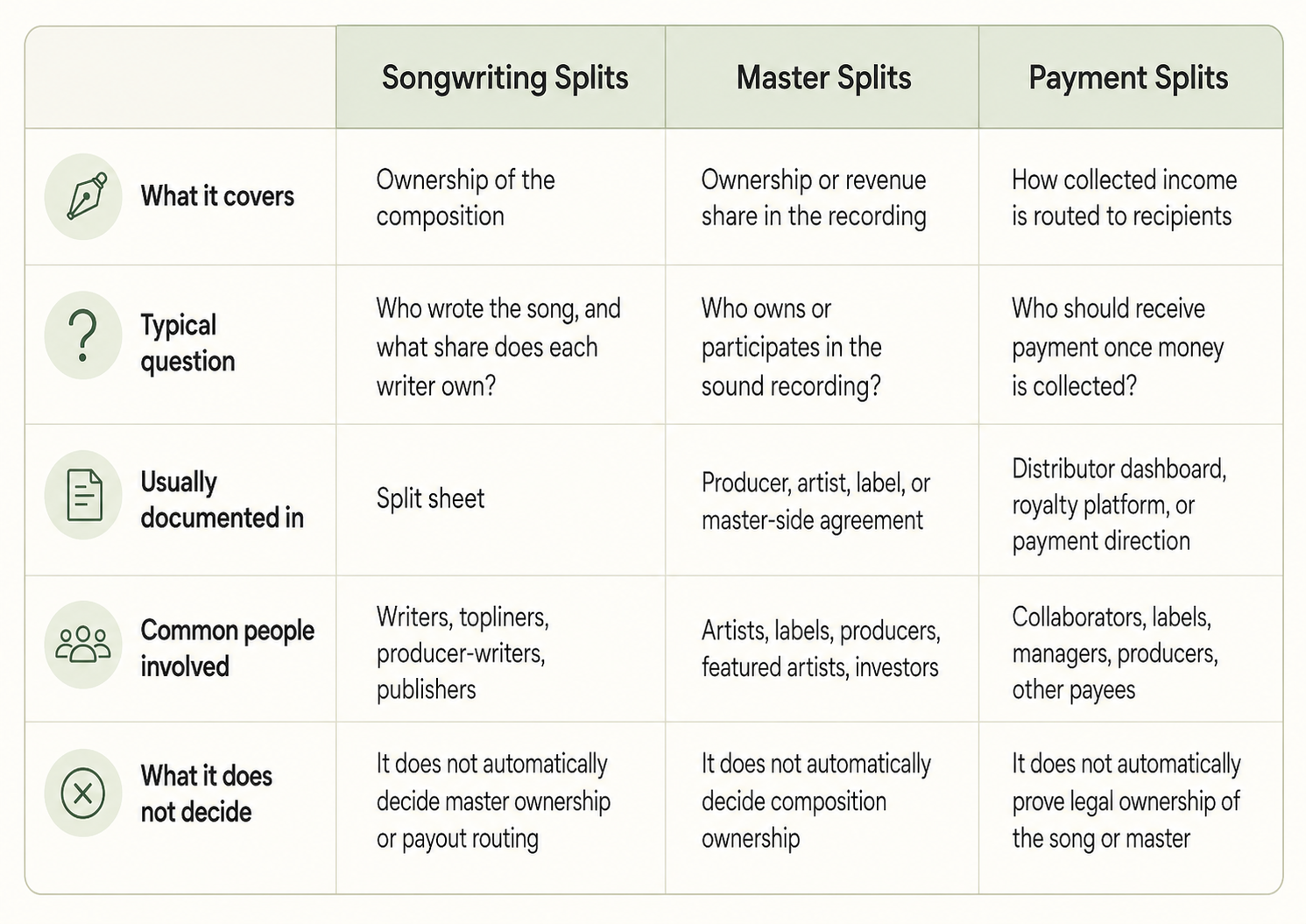
A traditional split sheet records ownership of the composition: the song underneath the recording. Lyrics, melody, topline, beat elements, chord progressions, and other agreed songwriting contributions can all be reflected there. Once those shares are signed, publishers, administrators, PROs, CMOs, licensing teams, and lawyers have a clearer record for registration and collection.
Master-side participation has to be handled separately. A released recording may involve a label, artist, producer, featured artist, mixer, engineer, investor, distributor, or production company, and their payment rights may come from recording agreements, producer agreements, featured artist agreements, work-for-hire terms, master ownership documents, or royalty provisions. The same person can appear in more than one place. A producer who helped write the song may be listed on the split sheet and also receive producer points on the master. Another producer may receive only master-side compensation because the contribution did not include songwriting.
Distributor or platform payment splits come later in the workflow. A dashboard percentage can route money to collaborators, producers, labels, managers, or other recipients, but the tool is only following payment instructions. It can make payouts easier after income is collected, but it does not create the underlying ownership record by itself. If the song split or master-side deal is unclear, entering percentages into a payment system may only carry the confusion into accounting.
Before anyone writes down a percentage, the better question is what the percentage is meant to represent. Writer shares belong on the split sheet. Master ownership, master royalties, producer points, and featured artist compensation need recording-side documentation. Payment routing should match the agreements behind the song and recording instead of replacing them.
Why Split Sheets Matter for Royalty Collection
Royalty collection depends on matching the song to the right writers, publishers, administrators, and ownership percentages. When that information is missing or inconsistent, income can be delayed, misdirected, disputed, or left unmatched while the parties try to confirm who controls each share.
A signed split sheet gives the administration team a starting record before the song enters registration systems. The writer names, share percentages, PRO or CMO affiliations, IPI or CAE numbers, publisher details, and contact information help connect the composition to the people and companies entitled to collect from it. Even when some details need to be updated later, the agreed ownership percentages give the song a clearer foundation.
Registrations can become difficult when each collaborator submits different information. One writer may register an equal split, another may claim a larger percentage, and a third may have no publisher information attached at all. Those conflicts can create delays because societies, administrators, publishers, and licensing teams may need to pause or correct the registration before income can be paid cleanly.
Split documentation also helps when royalties come from different sources. Performance income, mechanical income, sync licensing income, print income, foreign collections, and other composition-side revenue may involve different systems and timelines. The same song can pass through several organizations before money reaches the correct parties, so the ownership record needs to stay consistent across registrations and claims.
A split sheet can also help resolve questions before they become payment disputes. If a publisher, administrator, label, manager, or licensing team asks who owns the composition, the signed document gives everyone something concrete to review. That does not guarantee every royalty issue will be solved immediately, especially if there are missing writers, samples, interpolations, or conflicting agreements, but it reduces the need to rebuild the ownership story from scattered messages and memories.
The strongest royalty collection process starts before the first statement arrives. Once income is already being held, corrected, or contested, the split conversation becomes harder. Completing the split sheet early gives the song a better chance of moving through registration, collection, and payment with fewer avoidable interruptions.
How Writer Percentages Are Usually Confirmed
Writer percentages come from agreement between the collaborators. There is no automatic rule that says the person who started the beat gets one amount, the person who wrote the hook gets another, or everyone in the room receives the same share. The split depends on what the writers decide after looking at who contributed to the composition and how they want to treat those contributions.
That conversation works best while the session is still close enough for people to remember what actually happened. Someone may have brought in a beat before the session began. Someone may have written the chorus months earlier. Another person may have changed the melody, added lyrics, built the topline, or shaped the musical idea enough that everyone agrees the contribution belongs in the song. Those details are easier to sort out before the track is released, pitched, or attached to outside money.
Some collaborators choose equal shares because the song came together as a group effort or because they prefer a simple working practice. That can be perfectly valid when everyone agrees to it. The split sheet still needs the actual numbers. “Equal” may seem obvious in the room, but registration systems, administrators, and publishers need percentages that add up cleanly.
Other sessions lead to uneven shares. A writer who brought in a mostly finished composition may keep a larger share while new collaborators receive percentages for the parts they added. A producer-writer may receive a writer share for contributing musical elements to the composition, while a producer who only worked on the recording may be handled through producer compensation instead. The same person can have both roles, but the paperwork needs to separate them.
Older material can make the split more complicated. A sample, interpolation, pre-existing chorus, reused beat, or earlier co-writer may mean the final song includes people who were not in the latest session. In that situation, the split sheet should not be treated as if the song started with the people in the room that day. The confirmed writers can document what they know, then flag the parts that still need clearance or approval.
Once the percentages are agreed, the signed split sheet becomes the record everyone can use for registration and administration. Changes can still happen if a missing writer is added, a clearance changes the ownership, or all parties agree to revise the split. Those changes need the same care as the original document because every later registration, license, royalty claim, or dispute may rely on the updated version.
What Happens When There Is No Split Sheet?
Missing split documentation may sit unnoticed while everyone is still excited about the song. The problem usually appears later, when the track needs to be registered, licensed, released, corrected, sold, or paid. At that point, a conversation that would have been easier in the room has to be rebuilt through memory, messages, old files, and people who may no longer agree on what happened.
- Registrations can conflict - One collaborator may submit a 50/50 split while another submits a different version. A publisher or administrator may then have to pause the registration, request confirmation, or correct the work after conflicting claims appear. Even when the disagreement is unintentional, mismatched registrations can slow down collection.
- Royalties may be delayed or held - Collection systems need writer names, shares, affiliations, and publisher information to route money properly. If those details are missing or disputed, income may sit unpaid while the parties confirm the ownership record. The song may be earning, but the money cannot move cleanly until the split is clear.
- Licensing approvals become harder - Sync teams, publishers, labels, and music supervisors often need to know who can approve a use before moving forward. A song with unclear writer shares may be harder to clear, especially when a placement has a deadline. Uncertainty around one share can be enough to slow or lose an opportunity.
- People may remember the session differently - A writer who viewed the song as an equal collaboration may later hear that another person considered the beat, hook, or topline mostly finished before the session. Someone who gave a small lyrical change may believe it counted as songwriting, while another person may remember it as general feedback. The longer the delay, the harder it becomes to separate contribution, memory, and leverage.
- Publishers and administrators may request more proof - A publisher, administrator, or rights team may accept a signed split sheet as a starting record. Without one, they may ask for emails, session notes, draft files, voice notes, registration history, or written confirmations from every contributor. That extra review takes time and may still leave gaps.
- Later success can change the conversation - Splits that felt casual before release may become contested after streaming numbers rise, an artist cut happens, a sync offer arrives, or a label gets involved. The lack of a signed record leaves more room for people to reinterpret what was agreed when the song had little or no commercial value.
- Disputes become harder to resolve cleanly - When there is no shared document, the dispute may turn into a broader review of who contributed, what was agreed, who was present, what earlier material existed, and whether any messages support one version over another. A split sheet will not prevent every disagreement, but it gives everyone a clearer starting point than trying to reconstruct the session after the fact.
A missing split sheet does not mean the song cannot be fixed, registered, or licensed. It means the parties may need to spend more time confirming the ownership record before the song can move through administration with confidence. The earlier that record is created, the less likely the split conversation is to become tied to money, leverage, or urgency.
Common Split Sheet Mistakes
Split sheet problems usually come from trying to fix the paperwork after the song has already moved into release, registration, licensing, or payment setup. The document is simple, but small gaps can create bigger admin issues later.
- Waiting until the song has leverage - A split conversation feels easier to postpone when the track is still a demo. Once an artist cut, release date, sync pitch, label interest, or streaming activity appears, the same conversation can become much more sensitive. People may remember the session differently once there is money or visibility attached to the song.
- Writing down percentages without identifying the writers properly - A split sheet with only first names, nicknames, or Instagram handles may not be enough for registration or administration. Legal names, professional names, PRO or CMO affiliations, IPI or CAE numbers, publisher details, and contact information help future teams connect each share to the right person or entity.
- Using “equal split” instead of actual numbers - Equal shares still need to be written as percentages. A three-writer song may be 33.33% each, or the parties may agree to handle rounding in a specific way. Registration systems and administrators need a clean total, not just a phrase everyone understood during the session.
- Mixing up song splits with master-side payments - A split sheet confirms composition shares. It does not automatically decide producer points, featured artist royalties, master ownership, session fees, distributor split tools, or label-side accounting. Those recording-side payments need their own support, especially when the same person contributed as both a writer and a producer. For the master-side distinction, see how recording royalties are split between contributors.
- Leaving out pre-existing material - A beat, sample, interpolation, melody idea, lyric, or earlier version of the song may already involve another writer or rights holder. A split sheet based only on the people in the latest session can be incomplete if older material was brought into the room.
- Treating a distributor payment setup as the ownership record - Dashboard splits can route money after income is collected, but they do not replace the signed document behind the song. If the underlying writer shares are wrong, the payment setup only carries that mistake into accounting.
- Forgetting publisher and administrator details - A writer’s share may be controlled, represented, or administered by someone else. Missing publisher or administrator information can slow registration, licensing, and royalty collection, even when the writer percentages themselves are correct.
- Failing to flag pending clearances - Samples, interpolations, beat license restrictions, disputed contributions, or unconfirmed writers need to be visible somewhere. A notes field is useful because it tells the next person handling the song that the listed split may depend on another approval.
- Letting one person fill it out without confirmation from everyone - A split sheet is strongest when every writer has reviewed and signed the same version. If one person enters the percentages from memory and circulates the document only after registration, other collaborators may challenge the record later.
- Updating the split informally - Changes happen. A missing writer may be added, a clearance may reduce available shares, or collaborators may agree to revise the percentages. The updated version needs signatures and dates, not just a new message thread or spreadsheet edit.
A good split sheet does not need to be complicated. It needs to be complete enough that the next person handling the song can understand who wrote it, who controls each share, who represents each writer, and which issues still need attention.
Split Sheets, Registrations, and Metadata
Once a song moves beyond the writing room, the split sheet becomes part of the information trail that other systems depend on. Publishers, administrators, PROs, CMOs, mechanical licensing partners, labels, distributors, and licensing teams may all need writer names, shares, affiliations, identifiers, and contact details to connect the composition to the correct people.
Registration work often starts with the same details captured on the split sheet. The song title, alternate titles, writer names, publisher names, ownership percentages, PRO or CMO affiliations, IPI or CAE numbers, and administrator details help determine how the work is entered into collection systems. If one writer registers a different title, another uses a stage name, and a third leaves publisher information blank, the song may become harder to match across societies and royalty sources.
Metadata creates the bridge between the creative work and the systems that track it. The recording may have an ISRC, artist name, version title, featured artist credit, release date, and distributor metadata. The composition may have writer shares, publisher shares, society affiliations, and eventually an ISWC or other work identifier. Those two sides need to connect, but they are not the same record. A clean split sheet gives the composition side a stronger chance of matching the recording once the song begins circulating through platforms, licenses, and collection systems.
Publishing administrators often rely on split documentation when they register works, manage claims, coordinate with societies, review conflicting data, or collect composition-side royalties. If a songwriter later signs an administration agreement, the split sheet helps show what the administrator is being asked to manage. For more on that role, see what a publishing administration deal covers.
Small inconsistencies can cause real delays. A writer’s legal name may differ from the name used in the studio. A producer may be credited on the master but also need to be listed as a writer for the composition. A publisher may control only part of a writer’s share. A song may be registered under a working title while the release uses a final title. None of these issues is unusual, but they become harder to resolve when there is no signed source document behind the data.
The split sheet should travel with the song’s admin materials. When the release is prepared, the team handling registration, distribution, licensing, or royalty collection should be working from the same writer-share record rather than recreating the information separately for each platform or organization. The fewer competing versions of the song data, the easier it becomes to correct claims, confirm approvals, and keep income from being delayed by avoidable mismatches.
How Split Sheets Help Prevent Ownership Disputes
Ownership disputes often start with uncertainty rather than open conflict. A song moves from a private session into release planning, then someone realizes the writers never signed the same version of the split. One person remembers an equal agreement. Another believes a pre-existing hook or beat justified a larger share. A publisher may have a different registration on file. By the time the question surfaces, the song may already have outside interest, deadlines, or income attached to it.
A signed split sheet gives everyone a common record before those pressures appear. It shows who was recognized as a writer, which percentages were accepted, when the shares were confirmed, and whether any issue was left pending. When a later question comes up, the conversation can begin with a document the collaborators already approved instead of starting from memory.
Disputes become harder when several versions of the song exist. A demo may have one title, the final release another. A beat may have been created earlier. A chorus may have come from a separate session. A producer may also be a writer. A featured artist may add lyrics after the first split conversation. The split sheet helps track which composition is being documented and who is included in that version of the song.
The document also creates a cleaner handoff between creative and administrative teams. Publishers, administrators, labels, managers, lawyers, and licensing teams can review the same writer-share record instead of collecting separate statements from every contributor. If the split sheet includes notes about samples, interpolations, pending publisher details, or missing identifiers, the next person handling the song can see where the ownership record is complete and where more work is needed.
Split sheets can reduce disputes around approvals as well. A sync license, sample clearance, catalog sale, artist cut, publishing administration deal, or release correction may require confirmation of who controls the composition. When ownership shares are documented, the team can identify the parties who need to approve or be contacted. Without that record, one missing writer or conflicting claim can delay the entire use.
A split sheet also helps separate real ownership questions from payment or credit expectations. Someone may be credited on the recording, paid a session fee, receive producer compensation, or participate in master income without owning part of the composition. Another person may own a writer share without appearing as a performer on the released master. Keeping those categories separate from the beginning makes later disagreements easier to narrow.
The document will not fix every dispute on its own. A missing writer, invalid signature, uncleared sample, disputed contribution, or later revision may still require additional agreements or legal review. Even then, the split sheet gives the parties a starting record: the version everyone signed, the shares they accepted, and the information available at the time. That record is often the difference between correcting a documentation issue and rebuilding the entire ownership history from scratch.
When a Split Sheet Is Not Enough
A signed split sheet can confirm who shares in the composition, but songs often carry other rights issues that need their own paperwork. The problem usually appears when the split sheet is treated as the master document for everything connected to the track. It can support registration and administration, but it was not designed to cover every clearance, payment, approval, or ownership issue around a release.
Outside material is one of the first places where a split sheet reaches its limit. A sample, interpolation, reused melody, borrowed lyric, or pre-existing beat may bring another writer, publisher, label, or master owner into the picture. The collaborators in the room can agree on their own shares, but they cannot finalize the entire ownership structure if an earlier work still needs approval. Clearance terms may change the final percentages, require a fee, add a new rights holder, or limit how the song can be used.
Producer situations can also need more than one document. A producer who helps write the song may belong on the split sheet. The same producer may also need a producer agreement, beat license, work-for-hire agreement, or master royalty provision depending on how the recording is being used. For example, an artist may agree that the producer owns 25% of the composition because of the beat and hook contribution, while the beat license separately controls exclusivity, master use, producer credit, and any producer royalty.
The master recording sits in a different rights lane. Writers may divide the composition evenly while the recording is owned or controlled by the artist, a label, a production company, or the party that funded and commissioned the master. Featured artist compensation, session musician payments, investor participation, producer points, mixer fees, and label royalties need documents that speak to the recording side. Placing those terms inside a basic song split sheet can make the paperwork harder to rely on later.
Publishing and administration details can be listed on the split sheet, but the authority behind those details comes from separate relationships. A writer may be self-published, signed to a publisher, covered by a co-publishing deal, or represented by a publishing administrator. The split sheet can identify who represents each share. It does not, by itself, give an administrator or publisher the authority to register, license, collect, or account for that share unless the writer has granted that authority elsewhere.
Some uses require approval rules that a basic split sheet rarely covers. Sync pitches, artist cuts, brand campaigns, catalog sales, sample licenses, and major release placements may involve deadlines, approval chains, fee splits, third-party deductions, and clearance conditions. Writer percentages help identify who needs to be contacted, but a more detailed agreement may be needed to explain how approvals work and how income will be handled after the use is confirmed.
Revisions need proper documentation as well. A missing writer may come forward, a publisher may identify an older registration, a clearance may change the available share, or collaborators may agree to revise the percentages after the first version was signed. Updating a dashboard, spreadsheet, or group chat does not create the same record as an amended split sheet signed by the relevant parties.
Writing camps, band projects, label-arranged sessions, producer collectives, company-owned works, minor writers, estate-controlled shares, and work-for-hire arrangements can add another layer because the person in the room may not be the only party with authority to sign. In those situations, the split sheet should be checked against the agreements that control the writer, publisher, company, estate, or project.
The safer approach is to treat the split sheet as the composition ownership record, then place the other rights documents beside it. If the song involves outside material, master-side compensation, publisher authority, complex approvals, disputed contributors, or company-controlled rights, the split sheet should lead to the next document rather than carry the entire deal alone.
Frequently Asked Questions
What is the purpose of a split sheet?
The purpose is to create a written record of who owns what share of the composition. It helps writers, publishers, administrators, and licensing teams work from the same information when the song is registered, collected, cleared, or reviewed later.
Is a split sheet only for songwriters?
Most split sheets are focused on songwriters because they document ownership of the composition. Producers, artists, topliners, beatmakers, and band members may sign one if they contributed to the songwriting. Someone who only performed, engineered, mixed, funded, or promoted the recording may need a different agreement instead.
When should a split sheet be signed?
The best time is during or shortly after the session, before the song is released, registered, pitched, licensed, or monetized. Waiting until there is a deadline or money attached to the song makes the conversation harder than it needs to be.
Does a split sheet cover the master recording?
Usually, no. A standard split sheet covers the composition, not ownership of the sound recording. Master ownership, producer royalties, featured artist payments, session fees, and distributor payment splits should be handled separately.
Can a producer be listed on a split sheet?
Yes, if the producer contributed to the composition and the collaborators agree that the contribution earns a writer share. If the producer is only being paid for producing the master, the paperwork should point to a producer agreement, beat license, work-for-hire agreement, or master royalty arrangement.
What happens if the percentages do not add up to 100%?
The split should be corrected before the song is registered or used. Percentages that add up to more or less than 100% can create registration problems, payment delays, and conflicting claims. If rounding is needed, the final numbers should still total 100%.
Can a split sheet be changed after everyone signs?
It can be changed if the relevant parties agree and the revision is documented properly. That may happen when a missing writer is added, a clearance changes the available shares, or the collaborators correct an error. The updated version should be signed and dated so there is a clear record of the change.
Is an email or text message enough?
An email or text thread may help show what people discussed, but it is usually weaker than a signed split sheet with complete writer, publisher, administrator, and percentage information. Informal messages can also be hard to interpret if the wording is incomplete or the thread does not include every contributor.
Do split sheets matter if the song is not released yet?
Yes. Unreleased songs can still be pitched, registered, placed on hold, shared with artists, used in writing camps, or revisited later. Confirming the split early protects the song before people forget details or the track gains value.
What if one collaborator refuses to sign?
The song should be treated carefully until the disagreement is resolved. A publisher, administrator, label, distributor, or licensing team may hesitate to move forward if one claimed writer has not confirmed the ownership record. The next step may be direct confirmation, an amended document, representative review, or legal advice depending on the dispute.
Does a split sheet replace a publishing agreement?
No. The split sheet can identify the writer shares and list publisher or administrator details, but it does not replace the agreement that gives a publisher or administrator authority to manage a share. Those rights come from a separate publishing, co-publishing, or administration agreement.
Do samples and interpolations belong on the split sheet?
They should at least be flagged. If the song uses outside material, the final split may depend on clearance from the original rights holders. The split sheet can document the confirmed collaborators’ shares, but the notes should make clear that the song still has a sample, interpolation, or other approval issue to resolve.
Key Takeaways
A split sheet is one of the simplest documents in music administration, but it can affect registration, licensing, royalty collection, and dispute review long after the session ends.
- It records the agreed ownership shares in the composition.
- The best time to complete it is during or shortly after the writing session, before the song has release plans, outside interest, or income attached to it.
- Names and percentages are only the starting point. A useful split sheet should also include writer identifiers, society affiliations, publisher or administrator details, contact information, signatures, dates, and notes on unresolved issues.
- “Equal split” should still be written as actual numbers that add up to 100%.
- Songwriting splits, master ownership, producer points, featured artist royalties, session fees, and distributor payment splits should not be treated as the same thing.
- Producers, topliners, beatmakers, artists, and band members can appear on a split sheet when their contribution counts as songwriting.
- Samples, interpolations, pre-existing beats, older lyrics, and earlier versions of a song may require additional clearances or amended splits.
- A signed split sheet will not solve every rights issue, but it gives collaborators and rights teams a cleaner starting record than memory, text messages, or informal assumptions.
- When the split changes later, the update should be documented with the same care as the original version.
The goal is not to make the writing process feel legalistic. It is to protect the song before registrations, payments, licensing opportunities, and ownership questions start depending on the details.
Practical Resource
Use this template during or shortly after a writing session to confirm the composition split before the song moves into registration, licensing, release planning, or royalty collection.
Song Details
Writer Split Summary
Contact and Representation Details
Rights and Clearance Notes
Use this section to flag anything that may affect the final split, registration, or licensing process.
- Sample used or possibly used:
- Interpolation or borrowed composition element:
- Pre-existing beat, loop, topline, lyric, or melody:
- Writer, publisher, administrator, or identifier still pending:
- Clearance, license, approval, or amended split needed:
- Company, estate, minor writer, or representative signature may be needed:
Writer Signatures
Before You Sign
- Do the writer percentages total 100%?
- Are legal names included, not only stage names?
- Are PRO/CMO, IPI/CAE, publisher, and administrator details listed where available?
- Are samples, interpolations, older material, or missing parties flagged?
- Has every writer reviewed and signed the same version?
This template is a practical starting point for composition split documentation. Songs involving outside material, master-side compensation, disputed contributors, company-owned rights, or complex approvals may still need additional agreements or legal review.
References
Passman, Donald S. All You Need to Know About the Music Business. 11th ed. Simon & Schuster.
U.S. Copyright Office. Copyright Registration for Musical Compositions. Circular 50.
https://www.copyright.gov/circs/circ50.pdf
U.S. Copyright Office. Copyright Registration for Sound Recordings. Circular 56.
https://www.copyright.gov/circs/circ56.pdf
U.S. Copyright Office. Works Made for Hire. Circular 30.
https://www.copyright.gov/circs/circ30.pdf
U.S. Copyright Office. Copyright Registration of Musical Compositions and Sound Recordings.
https://www.copyright.gov/register/pa-sr.html
The Mechanical Licensing Collective. How to Register Works with The MLC.
https://help.themlc.com/en/support/how-to-register-works-in-the-mlc-portal
The Mechanical Licensing Collective. New Member Checklist: Registering Works with The MLC.
https://help.themlc.com/en/support/new-member-registering-works-within-the-mlc-member-portal
CISAC. Interested Party Information.
https://www.cisac.org/services/information-services/ipi
CISAC. International Identifiers.
https://www.cisac.org/services/information-services/international-identifiers
ASCAP. Songwriter and Music Publisher Agreements.
https://www.ascap.com/help/music-business-101/200809
BMI. FAQs: Publishing.