How Are Recording Royalties Split Between Contributors
Recording royalties rarely go to one person. Explore how labels, featured artists, producers, collaborators, and distributors share master recording income.

Introduction
Recording royalties are paid from the sound recording, often called the master. When a track earns money from streaming, downloads, physical sales, licenses, or other master-side uses, that income may need to be divided among several parties before anyone receives a final payment.
Those parties may include a label, distributor, artist, featured artist, producer, production company, mixer, engineer, session musician, or other contributor. Some contributors receive a royalty share. Others are paid a flat fee, a work-for-hire payment, or a session fee with no ongoing participation. The split depends on the agreements, the ownership of the master, the royalty base, and any recoupment or deductions that apply.
Recording royalty splits should also be kept separate from songwriting and publishing splits. A person may contribute to the recording without owning part of the composition, and a songwriter may earn publishing income without receiving master-side royalties. Confusing those two sides can create registration problems, payment disputes, and unclear royalty accounting.
This guide explains how recording royalties are split between contributors, how different roles are usually treated, and what terms should be reviewed before master income is distributed.
Learning Objectives
By the end of this guide, you should be able to:
- Explain what recording royalties are and how they differ from publishing royalties.
- Identify the parties that may receive income from a sound recording.
- Understand how master income may flow through labels, distributors, artists, and other rights holders.
- Distinguish royalty participants from contributors who are paid flat fees or session payments.
- Review how artist, featured artist, producer, and collaborator splits may be structured.
- Recognize how recoupment, deductions, and payment directions affect contributor payments.
- Identify common documentation issues that can lead to recording royalty disputes.
Overview
Recording royalties do not usually move from a platform directly to every person who worked on a track. The money first follows the rights structure around the master. A label, distributor, artist-owned company, production company, or other master owner may receive the income before contributor shares are calculated.
The split depends on what each person is entitled to receive. An artist may have a royalty under a recording agreement. A featured artist may have a negotiated share or a one-time fee. A producer may receive points, a percentage of net receipts, or only an upfront payment. Musicians, mixers, engineers, and other studio contributors may be paid as session workers unless their agreements provide continuing participation.
Gross revenue is rarely the final number used for payment. Distributor fees, label deductions, recording costs, advances, reserves, sample costs, featured artist payments, and other approved charges may come out before a contributor’s share is calculated. The same percentage can lead to different results depending on whether it applies to gross receipts, net receipts, the artist royalty, or another defined pool.
The master side also needs to stay separate from the composition side. Recording royalties relate to the sound recording. Publishing royalties relate to the underlying song, including writer share, publisher share, mechanical royalties, performance royalties, and other composition income. Music Admin’s guide on how music royalties flow from DSPs to rightsholders explains how different royalty streams can move through separate collection paths.
Table of Contents
What Are Recording Royalties?
Recording royalties are income tied to the sound recording, also called the master. When a specific recorded version of a song is streamed, downloaded, sold, licensed, or otherwise exploited, the master-side income is paid to the party that owns or controls that recording, then distributed according to the relevant agreements.
This is different from publishing income. A song can have one underlying composition but several sound recordings. For example, the original studio recording, a live version, an acoustic version, and a remix may all use the same composition, but each version can have its own master. Recording royalties follow the master that was actually used.
Master-side income may come from several sources, including streaming revenue, download sales, physical sales, master-use licenses, synchronization uses involving the recording, neighboring rights income where applicable, and certain platform or content monetization payments. Each source may be reported on a different timeline and may pass through different parties before the final royalty split is calculated.
The person who worked on the recording is not automatically entitled to recording royalties. A contributor’s share depends on the contract. The master owner may agree to pay an artist royalty, featured artist royalty, producer points, a net receipts share, or another form of participation. Other contributors may receive a flat fee, session payment, or work-for-hire payment with no ongoing royalty rights.
The key issue is not only who contributed to the recording, but what the documents say about ownership, payment, accounting, and deductions. Recording royalties are split through agreements, not simply by dividing income among everyone who appeared in the session.
Recording Royalties vs. Publishing Royalties
A recording can generate income on two separate rights at the same time. The sound recording, or master, creates recording royalties. The underlying song, or composition, creates publishing royalties. The same stream, download, license, or public use may involve both rights, but the money does not always travel through the same parties or reach the same contributors.
Recording royalties are tied to the specific recorded version that was used. If a platform streams the studio master, the recording-side income follows that master. If a sync license uses a live version or remix, the recording-side income belongs to the master that appears in the use. The master owner, label, distributor, artist-owned company, or other controller may receive that income first, then account to artists, featured artists, producers, or other royalty participants according to their agreements.
Publishing royalties are tied to the song itself. The writer share, publisher share, mechanical royalties, performance royalties, and other composition-side income may be collected or administered through publishers, publishing administrators, PROs, mechanical licensing partners, or direct licensees. A person can be entitled to publishing income without receiving recording royalties, and a person can receive recording royalties without owning any part of the composition.
This distinction matters when contributors are credited, registered, and paid. A producer may have points on the master but no writer share. A songwriter may earn publishing royalties from the composition without participating in the master. A featured artist may receive a recording royalty under a feature agreement but may not own part of the song unless they also contributed to the composition.
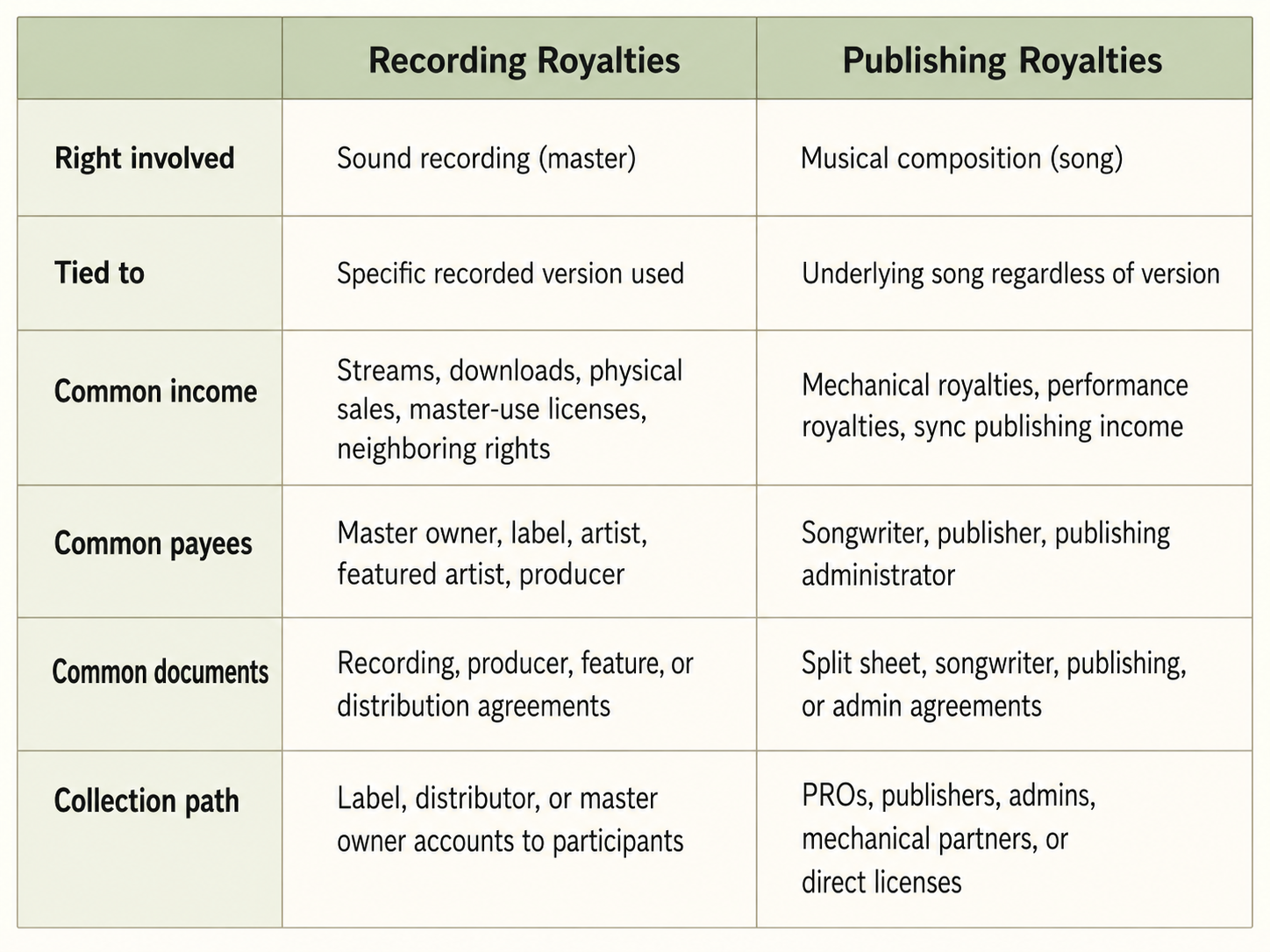
Recording royalties come from the sound recording, while publishing royalties come from the underlying composition. A contributor’s role in one right does not automatically create participation in the other.
Who Can Receive Recording Royalties?
Recording royalties are paid to people or entities with a contractual right to share in master income. A contributor’s role in the studio may support that right, but the right itself usually comes from an agreement, payment direction, royalty clause, label contract, distribution arrangement, or ownership interest in the master.
The main participants can include:
- Master owner or label - The master owner controls the recording and is usually the first party entitled to receive recording-side income. In a label deal, the label may own or control the master and account to the artist under the recording agreement. In an independent release, the artist, artist-owned company, production company, or another rights holder may receive the income first.
- Primary artist - The primary artist may receive a royalty from the label, a share of net receipts from an independent release, or direct income as the master owner. The structure depends on whether the artist signed a recording agreement, distribution deal, license agreement, joint venture, or self-release arrangement.
- Featured artist - A featured artist may receive a negotiated royalty, flat fee, advance, or other compensation for appearing on the recording. The feature agreement should explain whether the featured artist participates in master income, whether the payment is recoupable, and whether the featured artist is paid by the label, primary artist, production company, or another party.
- Producer - A producer may receive points, a share of net receipts, a recoupable advance, or only an upfront fee. Producer participation depends on the producer agreement and the royalty base used for the points.
- Production company - A production company may finance, coordinate, or deliver the recording and receive income from the master before paying artists, producers, or other participants. These structures need clear accounting language because the production company may sit between the party exploiting the master and the contributors expecting payment.
- Mixer, engineer, or studio contributor - Mixers, engineers, vocal producers, programmers, and other studio contributors are often paid a flat fee or session fee. Ongoing royalty participation is not automatic. If any of these contributors receives points, net receipts participation, or another royalty share, that right should be written into the agreement.
- Session musicians and background vocalists - Session musicians and background vocalists are commonly paid session fees, union scale payments, or work-for-hire compensation. In some cases, additional payments, neighboring rights income, or royalty participation may apply depending on the territory, union rules, agreement, or performer status. The release documentation should make clear whether the contributor is receiving only an upfront payment or any continuing participation.
- Collaborators on independent releases - Independent tracks may involve several collaborators splitting master income by agreement. Two artists might share net receipts. A producer-artist team might divide distributor income. A collective or production group might agree to internal percentages. These arrangements can work, but they require written terms covering the royalty base, deductions, recoupment, payment schedule, and what happens if the track moves to another distributor or label.
The safest approach is to identify every participant before release and separate their role from their payment right. Credit, contribution, ownership, and royalty participation are related, but they are not the same. A person may be credited without receiving royalties, paid without owning the master, or entitled to a royalty without controlling the recording.
How Master Income Flows Before Splits Are Paid
Master income usually passes through one controlling party before contributor shares are calculated. In a label deal, that party is often the label. In an independent release, it may be the artist, artist-owned company, distributor account holder, production company, or another master owner.
A DSP, licensee, or platform may report income to the label, distributor, or master owner first. From there, the money is sorted through the agreements attached to the recording. One contributor may be paid from the artist royalty. Another may be paid from net receipts. A third may have no royalty participation at all because the agreement only provides a flat fee or session payment.
The order matters because the first amount received is not always the amount available for splits. Distributor fees, label deductions, reserves, recording costs, sample costs, featured artist payments, advances, and other approved charges may be applied before certain participants are paid. A contributor’s percentage only has meaning after the agreement identifies the income pool used for that calculation.
For DSP income, the path can be especially layered. Streaming activity may generate master-side income for the recording and separate publishing-side income for the composition. The master-side share may move through a distributor or label before reaching the artist or other recording participants. The publishing-side share may move through publishers, administrators, PROs, mechanical licensing partners, or societies. For a broader look at that payment path, see how music royalties flow from DSPs to rightsholders.
A clean split process identifies the payer, the royalty base, the deduction rules, the accounting schedule, and the documents that authorize payment to each participant. Without that structure, contributors may know they are owed a share but not know which party is supposed to calculate it, what income is included, or when payment should arrive.
Artist and Label Royalty Splits
Artist and label royalty splits depend on who owns or controls the master. In a traditional label deal, the label may finance the recording, control the master, collect master income, and account to the artist under the recording agreement. The artist’s share is usually calculated through that agreement rather than through a simple split of gross revenue.
A label royalty can be affected by several contract terms before the artist receives payment. The artist’s royalty rate, recoupable recording costs, advances, reserves, distribution expenses, packaging or format adjustments, and other deductions may all affect the final amount. The artist may have a royalty percentage on paper while still receiving no current payment if the account is unrecouped.
Independent releases work differently. When the artist owns or controls the master, income may come through a distributor or direct licensing arrangement. The artist may keep the remaining receipts after distributor fees and approved costs, then pay producers, featured artists, collaborators, or other contributors from that amount. In this structure, the artist often acts as both master owner and royalty payer.
A joint venture or profit-split arrangement may sit between those two models. The artist and label, distributor, investor, or production company may agree to share profits after approved costs are recovered. These deals can be more transparent than a traditional royalty formula, but the result still depends on how profit is defined, what costs come out first, and who controls the accounting.
Artist and label splits should be reviewed before contributor shares are added on top. A producer point, featured artist royalty, or collaborator percentage may be paid from the artist’s share, from the label’s obligation, from net receipts, or from another defined pool. If the artist-label split is unclear, every downstream contributor split becomes harder to calculate.
Featured Artist Royalty Splits
Featured artist payments depend on the feature agreement, not only the fact that the artist appears on the recording. A featured artist may receive a flat fee, an advance, a royalty share, a share of net receipts, or some combination of upfront and back-end compensation.
A major-label feature may be handled through the label, with the featured artist’s royalty charged to the primary artist’s account or treated as a separate approved cost. On an independent release, the primary artist or master owner may be responsible for paying the featured artist directly from distributor receipts or other master income. The agreement should identify the payer because the credit line alone does not show who has the accounting obligation.
The royalty base needs the same attention as the percentage. A featured artist might receive a percentage of the artist royalty, a percentage of net receipts, or a percentage of income from specific uses of the master. Those structures do not produce the same result. If the featured artist is paid only on certain income sources, such as streaming and downloads but not sync fees or physical sales, the exclusions should be stated directly.
Recoupment can also affect feature payments. A featured artist advance may be recoupable from that artist’s future royalties, or it may be treated as a non-recoupable fee for the performance. If the advance is recoupable, the featured artist may earn royalties on paper while receiving no additional payment until the advance has been recovered.
Release permissions and approvals should be resolved before distribution. The feature agreement may need to address use of the featured artist’s name, likeness, credit, artist approvals, label approvals, marketing materials, music videos, remixes, and alternate versions. When the featured artist is signed to a label, the primary artist may also need clearance from that label before the recording can be released.
A clear feature agreement separates the performance fee, royalty share, credit, approvals, and payment path. Without that separation, a featured artist may be visible on the release but have unclear rights to income, statements, or approval over how the recording is used.
Producer Points and Producer Royalty Splits
Producer royalties are one of the most common ways master income is shared with a non-artist contributor. A producer may receive points, a percentage of net receipts, a recoupable advance against royalties, or only an upfront fee with no continuing participation.
Producer points are tied to the sound recording, not the underlying composition. The percentage may be calculated from the artist royalty, net receipts, distributor income, or another defined master-side revenue pool. A producer with three points is not automatically receiving three percent of every dollar earned by the track.
All-in language affects where the producer share comes from. In many label deals, producer points are included within the artist royalty, which means the producer’s share may reduce the artist-side royalty pool rather than increase the label’s total royalty obligation. In other arrangements, the producer may be paid separately by the master owner, artist, production company, or distributor account holder.
Producer participation should be documented separately from songwriting and publishing splits. A producer may receive master royalties without owning part of the composition. If the producer also contributed to lyrics, melody, a hook, or another protectable part of the song, that contribution should be handled through split and publishing documentation, not only through the producer royalty clause.
Session Musicians, Mixers, Engineers, and Work-for-Hire Payments
Not every contributor who helps create a recording receives ongoing royalties. Many studio contributors are paid through session fees, flat fees, union payments, work-for-hire arrangements, or service agreements that compensate them for their work without giving them a continuing share of master income.
Session musicians and background vocalists are often hired to perform on a recording for an agreed fee. The payment may cover the performance, the recording session, and the right to use that performance in the released master. Depending on the territory, union status, agreement, and type of use, additional payments or neighboring rights income may also come into play. The key point is that a session performance does not automatically create a royalty split unless the agreement provides one.
Mixers, engineers, editors, programmers, vocal producers, and other studio contributors can be handled in different ways. A mixer might receive a flat fee only, a fee plus points, or another negotiated participation. An engineer might be paid for the session with no back-end. A programmer or beatmaker may need a separate agreement if their contribution includes original production elements, samples, loops, or material that affects ownership or clearance.
Work-for-hire language is often used when the hiring party wants to confirm that the contributor’s work is being created for the project and that the necessary rights in the contribution will belong to the artist, label, production company, or master owner. Some agreements also include assignment language as backup. These provisions should match the actual work being done, especially when the contributor brings in pre-existing material.
Clear documentation helps separate three different things: credit, payment, and ownership. A musician may be credited but paid only a session fee. A mixer may receive points without owning the master. An engineer may be paid for services while the master owner controls the recording. Those outcomes are all possible, but they should come from written terms rather than assumptions made after release.
Session Musicians, Mixers, Engineers, and Work-for-Hire Payments
Not every contributor who helps create a recording receives ongoing royalties. Many studio contributors are paid through session fees, flat fees, union payments, work-for-hire arrangements, or service agreements that compensate them for their work without giving them a continuing share of master income.
Session musicians and background vocalists are often hired to perform on a recording for an agreed fee. The payment may cover the performance, the recording session, and the right to use that performance in the released master. Depending on the territory, union status, agreement, and type of use, additional payments or neighboring rights income may also come into play. A session performance does not automatically create a royalty split unless the agreement provides one.
Mixers, engineers, editors, programmers, vocal producers, and other studio contributors can be handled in different ways. A mixer might receive a flat fee only, a fee plus points, or another negotiated participation. An engineer might be paid for the session with no back-end. A programmer or beatmaker may need a separate agreement if their contribution includes original production elements, samples, loops, or material that affects ownership or clearance.
Work-for-hire language is often used when the hiring party wants to confirm that the contributor’s work is being created for the project and that the necessary rights in the contribution will belong to the artist, label, production company, or master owner. Some agreements also include assignment language as backup. These provisions should match the actual work being done, especially when the contributor brings in pre-existing material.
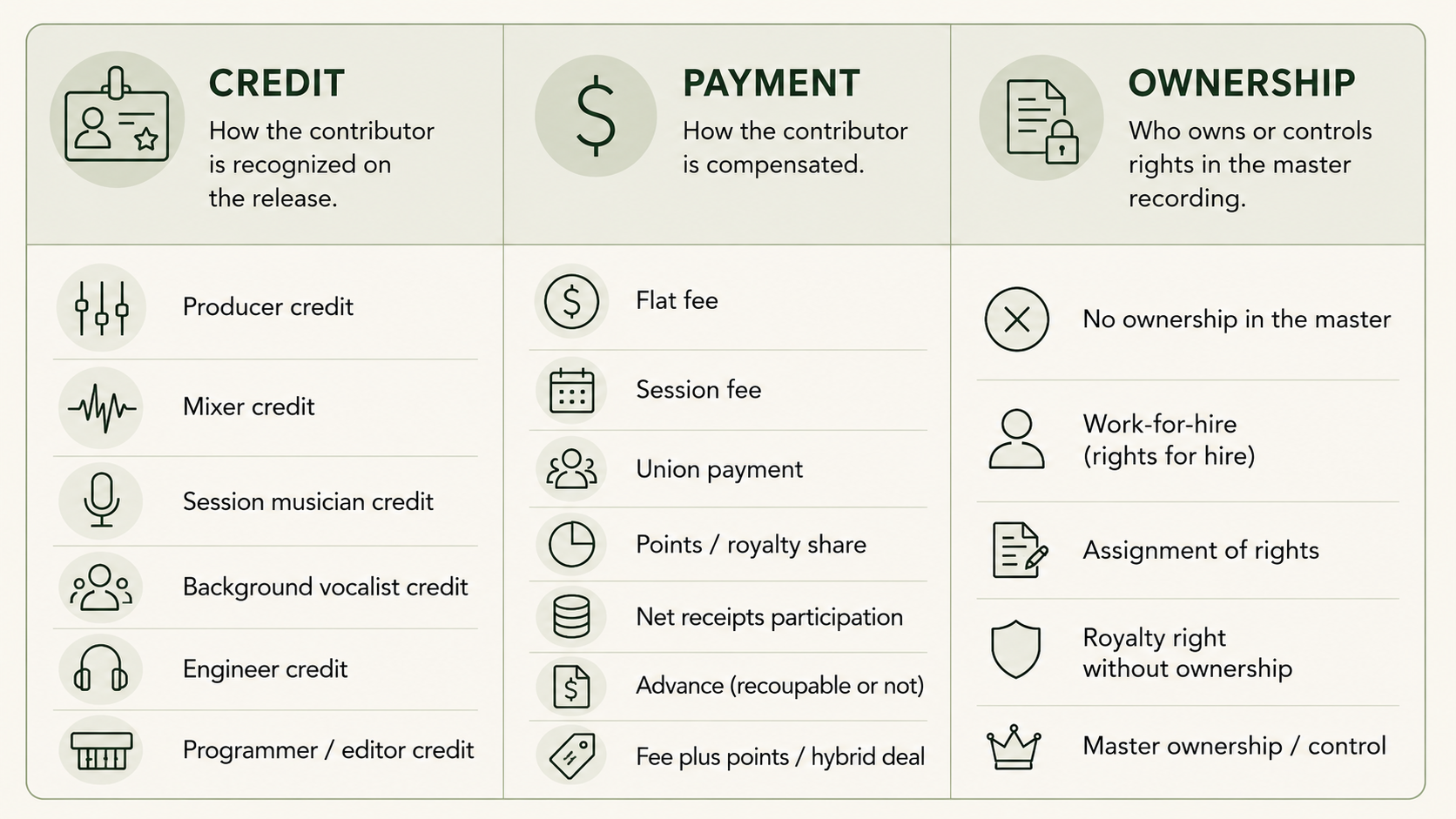
Clear documentation helps separate three different things: credit, payment, and ownership. A musician may be credited but paid only a session fee. A mixer may receive points without owning the master. An engineer may be paid for services while the master owner controls the recording. Those outcomes are all possible, but they should come from written terms rather than assumptions made after release.
Independent Release Splits Between Collaborators
Independent releases often rely on direct agreements between the people creating, financing, and distributing the recording. Without a label setting the royalty structure, the collaborators need to decide who controls the master, who receives income from the distributor, and how that income will be divided.
A split between collaborators may be based on ownership, revenue participation, or repayment of costs. Two artists may agree to share master income equally. A producer and artist may split net receipts after distributor fees. A production team may recover recording costs first, then divide the remaining income by percentage. These arrangements can be flexible, but the flexibility only works if the calculation is written clearly.
The agreement should identify the royalty base before percentages are assigned. A 50/50 split of gross receipts is different from a 50/50 split of net receipts after distributor fees, marketing costs, sample clearances, featured artist payments, or production expenses. The more costs that come out first, the more important it becomes to define and document those deductions.
Control also needs separate treatment from payment. One collaborator may own or administer the master while another receives a revenue share. The distributor account may be under one person’s name even if several contributors are entitled to income. If the track later moves to a new distributor, gets licensed to a label, or becomes part of a catalog deal, the agreement should say whether the contributor splits continue and who remains responsible for accounting.
Independent collaborator splits should also stay separate from songwriting splits. A collaborator may receive 25% of master income without owning 25% of the composition. Another collaborator may have a writer share but no master royalty. Each side needs its own documentation so the recording can be distributed, registered, licensed, and accounted for without mixing up master rights and publishing rights.
The cleanest independent split terms answer four questions before release: who controls the master, what income is being split, what costs come out first, and who will issue statements and payments.
Distributor Splits, Payment Directions, and Split Tools
Distributor split tools can make independent royalty payments easier to manage. Instead of one person receiving all distributor income and manually paying collaborators, the distributor may allow the account holder to assign percentages to different participants and route payments directly through the platform.
What Split Tools Can Do
Split tools are most useful when the contributors already agree on the payment structure. They can help divide distributor income between artists, producers, collaborators, or other participants. They may also reduce manual tracking by letting each participant receive their share through the distributor account or connected payment system.
These tools are especially helpful for independent releases where there is no label royalty department handling statements. If two artists agree to split net distributor income, or if a producer receives a fixed share of the master income paid through the distributor, the split tool can help carry out that arrangement.
What Split Tools Do Not Decide
A split tool is not the same as a full agreement. It may route money, but it does not necessarily answer who owns the master, whether a contributor has approval rights, whether costs are recoupable, whether the split applies to all income sources, or what happens if the recording is removed, transferred, licensed, or assigned.
It also may not cover income outside that distributor. A collaborator might receive a share of streaming and download income through the platform, but sync fees, neighboring rights income, direct licenses, YouTube claims, or social platform revenue may be handled somewhere else. If the written agreement does not address those categories, the distributor split may only solve part of the payment issue.
What Should Be Written Before Using Them
Before a split tool or payment direction is set up, the contributors should document the basic royalty terms. The agreement should identify who controls the master, what percentage each participant receives, whether the split applies to gross receipts or net receipts, which deductions come out first, and whether any advances or costs must be recouped before payment.
The paperwork should also account for future changes. A recording may move to another distributor, be licensed to a label, added to a catalog sale, removed from one platform, or monetized through a source that does not support automated splits. The split tool can help with payment administration, but the written agreement should remain the source for the actual rights, percentages, deductions, and continuing obligations.
Recoupment, Deductions, and When Contributors Get Paid
Recording royalty splits usually follow a payment sequence. The order matters because a contributor’s percentage is often applied after certain costs, fees, or balances have already been handled.
Step 1: Income Is Received
The label, distributor, master owner, production company, or account holder receives income from the recording. The agreement should identify whether contributor splits are based on gross receipts, net receipts, artist royalties, or another defined pool.
Step 2: Allowed Deductions Are Applied
Only deductions allowed by the agreement should reduce the royalty base. These may include distributor fees, taxes, refunds, chargebacks, reserves, sample costs, third-party royalties, approved recording costs, or other defined expenses.
Step 3: Recoupment Is Checked
Advances, recording budgets, production costs, marketing spends, or other recoupable amounts may need to be recovered before money is paid out. A contributor can earn royalties on a statement while receiving no current payment if the amount is being applied to an unrecouped balance.
Step 4: Contributor Shares Are Calculated
Once the correct royalty base is identified, each participant’s share can be calculated according to the agreement. A producer may receive points, a featured artist may receive a negotiated royalty, and collaborators may divide net receipts by agreed percentages.
Step 5: Statements and Payments Are Issued
The paying party should issue statements that show the income received, deductions applied, recoupment activity, royalty base, contributor percentage, amount earned, and amount payable. If there is no payable amount because the account remains unrecouped, the statement should still show the balance carried forward.
Royalty Statements and Contributor Accounting
Royalty statements are the record of how recording income was received, reduced, divided, and paid. For contributor splits, the statement should make the payment path visible enough for each participant to understand how their share was calculated.
A contributor statement should usually show:
Contributor accounting can become difficult when different participants are paid from different pools. A primary artist may be accounted to under a label royalty formula. A producer may be paid from the artist royalty or net receipts. A featured artist may have a separate royalty or recoupable advance. A collaborator on an independent release may receive a percentage through a distributor split tool. Each participant needs a statement that matches the payment terms that apply to their role.
The statement should also identify who is responsible for accounting. In a label release, the label may issue statements to the artist and certain royalty participants. In an independent release, the artist, production company, distributor account holder, or master owner may need to keep records and send contributor reports. If the person receiving the money is not the person who promised the split, the agreement should explain how reporting information will be shared.
Missing detail creates avoidable disputes. A contributor who receives only a lump-sum payment may not know which income was included, what deductions were taken, whether recoupment was applied, or whether the payment covers all uses of the recording. Clear statements make it easier to verify the split without reopening the entire deal every time income is reported.
Common Split Disputes and Red Flags
Recording royalty disputes often begin before the first statement is ever issued. The problem may be an unclear split, an undocumented contributor role, a missing payment direction, or a different understanding of what income is being shared.
Unclear Royalty Base
A split should say whether the percentage applies to gross receipts, net receipts, the artist royalty, distributor income, or another defined pool. “Twenty percent of the master” is not enough if the agreement does not explain what income is counted and what costs come out first.
For example, two collaborators may agree to a 50/50 split, but one person may think that means gross distributor income while the other means net receipts after marketing costs and sample clearance expenses. The percentage is the same, but the result can be very different.
Credits Treated Like Royalty Rights
A contributor can be credited on a release without receiving a royalty share. A mixer, session musician, background vocalist, or engineer may receive public credit and still be paid only through a flat fee or session payment. If credit and royalty participation are not separated in writing, the credit line can create expectations that the payment terms do not support.
Master Splits Confused With Publishing Splits
A master split does not automatically create a writer share, and a writer share does not automatically create a recording royalty. This issue often comes up in producer-driven sessions, artist collaborations, and independent releases where the same people helped shape both the track and the underlying song.
If one collaborator owns 25% of the composition, that does not necessarily mean they receive 25% of master income. If another collaborator receives 25% of net master receipts, that does not necessarily give them a 25% writer share. Both sides need separate documentation.
Missing Featured Artist Terms
Featured artist agreements should cover compensation, royalty participation, credit, approvals, and who is responsible for payment. A feature that begins informally can become difficult to release later if the featured artist, their label, or their team expects different terms.
A common issue is agreeing to a feature fee but not addressing whether the featured artist also participates in royalties. Another is clearing the performance but forgetting approval language for videos, remixes, alternate versions, or promotional uses.
Unsupported Deductions
Deductions should connect to the agreement. Distributor fees, taxes, reserves, sample costs, third-party royalties, and approved expenses may be valid if the contract allows them. Broad or unexplained deductions can create disputes because contributors cannot tell whether the royalty base was reduced correctly.
Recoupment Terms That Are Too Broad
A contributor may accept an advance or upfront payment without realizing it will delay future royalties. Recoupment should identify what amount is being recovered, which income source is used, and whether additional costs can be added to the balance.
A producer with points, for example, may see royalties earned on a statement but no payment due because the full amount is applied to an unrecouped advance. That may be expected if the agreement says so. It becomes a problem when the statement does not show the opening balance, amount recouped, and balance carried forward.
Split Tools Used Without Written Agreements
Distributor split tools can route money, but they do not replace a written agreement. They may not cover income outside the distributor, such as sync fees, neighboring rights income, YouTube claims, direct licenses, or catalog sale proceeds. They also may not resolve ownership, deductions, recoupment, or what happens if the recording moves to another distributor.
No Accounting Obligation
A split is difficult to enforce in practice if no one is responsible for statements. The agreement should identify who receives income, who calculates each share, how often statements are issued, what information appears on the statement, and when payments are due.
No Plan for Future Transfers
A recording may later be licensed, assigned, transferred to a label, moved to another distributor, included in a catalog sale, or monetized through a new platform. Contributor splits should explain whether payment obligations continue after those changes and who remains responsible for accounting.
The main red flag is any split that relies on memory, credit language, distributor settings, or informal messages instead of a written agreement. Contributor splits should be clear enough that another person could review the documents later and understand who gets paid, from what income, after which deductions, and on what schedule.
Frequently Asked Questions
What are recording royalties?
Recording royalties are income generated by a sound recording, also called the master. They may come from streaming, downloads, physical sales, master-use licenses, sync uses involving the recording, neighboring rights income where applicable, and other master-side monetization sources.
Who receives recording royalties?
Recording royalties may be paid to the master owner, label, primary artist, featured artist, producer, production company, distributor account holder, or other contributor with a contractual right to participate in master income. A person does not receive recording royalties automatically just because they worked on the track.
Are recording royalties the same as publishing royalties?
No. Recording royalties come from the sound recording. Publishing royalties come from the underlying composition. A contributor may receive master income without owning part of the song, and a songwriter may receive publishing income without sharing in the master.
Do producers always receive recording royalties?
No. Some producers receive points, a share of net receipts, or another form of back-end participation. Others are paid only an upfront fee, session payment, or flat production fee. The producer agreement determines whether the producer has continuing royalty rights.
Do session musicians receive recording royalties?
Session musicians are often paid through session fees, union payments, or work-for-hire arrangements. Ongoing royalty participation is not automatic. Additional payments, neighboring rights income, or royalty participation may apply depending on the territory, union status, performer role, and agreement.
Can featured artists receive recording royalties?
Yes. A featured artist may receive a royalty share, flat fee, advance, or other negotiated compensation. The feature agreement should explain the payment structure, royalty base, recoupment terms, credit, approvals, and who is responsible for issuing statements and payments.
What is a master split?
A master split is an agreement to divide income from the sound recording between participants. It may apply to gross receipts, net receipts, artist royalties, distributor income, or another defined pool. The agreement should state what income is included and which deductions apply before shares are calculated.
Can distributor split tools replace a written agreement?
No. Distributor split tools can help route money between collaborators, but they do not usually resolve ownership, recoupment, deductions, approval rights, publishing splits, or income earned outside that distributor. Written terms should still define the parties’ rights and payment obligations.
What deductions can reduce recording royalty splits?
Deductions may include distributor fees, taxes, refunds, chargebacks, reserves, sample clearance costs, third-party royalties, approved recording costs, marketing expenses, or other costs allowed by the agreement. The deduction language should be specific enough for contributors to understand how the royalty base is calculated.
What should a contributor royalty statement show?
A contributor statement should show the recording title, royalty period, income source, receipts received, deductions, royalty base, contributor percentage, amount earned, recoupment applied, balance carried forward, and amount payable.
Key Takeaways
- Recording royalties come from the sound recording, also called the master. They are separate from publishing royalties, which come from the underlying composition.
- Recording royalty splits depend on ownership, contracts, payment directions, distributor settings, and the royalty base used for each contributor.
- Contributors do not automatically receive recording royalties because they worked on a track. Ongoing participation must be created through an agreement, royalty clause, split document, or ownership interest.
- Primary artists, featured artists, producers, production companies, collaborators, and certain other participants may receive recording royalties if the relevant documents give them a right to share in master income.
- Session musicians, background vocalists, mixers, engineers, and other studio contributors are often paid through flat fees, session payments, union payments, or work-for-hire arrangements unless a separate agreement grants royalties.
- A master split should identify whether percentages apply to gross receipts, net receipts, artist royalties, distributor income, or another defined revenue pool.
- Deductions and recoupment can reduce or delay contributor payments. Distributor fees, sample costs, reserves, advances, approved expenses, and third-party royalties may affect the amount available for splits.
- Distributor split tools can help route payments, but they do not replace written agreements covering ownership, deductions, recoupment, income outside the distributor, or future transfers.
- Contributor statements should show the income source, deductions, royalty base, percentage, recoupment activity, balance carried forward, and amount currently payable.
- Recording-side splits and publishing-side splits should be documented separately so master income, writer shares, publisher shares, and royalty collection paths do not get confused.
Practical Resource
Recording royalty splits are easier to review when each contributor’s role, payment right, and documentation are mapped before release. A contributor may be credited on the track, paid a flat fee, receive a royalty share, or participate in master income through a separate agreement. Those outcomes should be confirmed in writing rather than assumed from the credit line alone.
Use the Recording Royalty Contributor Map to identify who controls the master, who receives income first, which contributors participate in recording royalties, and which documents support each payment path.
[Download the Recording Royalty Contributor Map]
This resource is intended as a practical planning tool for recording-side royalty splits. It should be used alongside written agreements, royalty statements, payment directions, and legal review where needed.
References
Passman, Donald S. All You Need to Know About the Music Business. 11th ed. Simon & Schuster.
U.S. Copyright Office. Copyright Registration for Sound Recordings. Circular 56.
https://www.copyright.gov/circs/circ56.pdf
U.S. Copyright Office. Copyright Registration for Musical Compositions. Circular 50.
https://www.copyright.gov/circs/circ50.pdf
SoundExchange. Frequently Asked Questions.
https://www.soundexchange.com/frequently-asked-questions/
AFM & SAG-AFTRA Intellectual Property Rights Distribution Fund. Sound Recording Distribution Guidelines.
https://afmsagaftrafund.org/Funds/SRGuidelines
AFM & SAG-AFTRA Intellectual Property Rights Distribution Fund. About The Fund.
https://afmsagaftrafund.org/AboutUs/AboutTheFund
ASCAP. Songwriter and Music Publisher Agreements.
https://www.ascap.com/help/music-business-101/200809
BMI. FAQs: Publishing.