What Happens When Music Rights Are Disputed
A music rights dispute can affect ownership, royalty payments, licensing, and the ability to clear a work for use. This guide examines where conflicts come from, what records matter, and how disputed claims move toward resolution.

Introduction
A song can be released, earning, licensed, and credited publicly while the rights behind it are still unsettled. One writer may believe they were left off the split. A publisher may claim a larger share than another party registered. A producer may argue that a beat contribution should count as authorship, while the artist’s team treats it as master-side compensation. A label may control the recording, but another party may question whether it had the right to approve a use.
These conflicts do not always begin as lawsuits. Many start inside registration systems, royalty accounts, licensing inboxes, distributor dashboards, publishing files, or old agreements that no one reviewed until money or a deadline appeared. The dispute may block income, delay a sync clearance, pause a catalog sale, trigger a takedown, or force a rights team to reconstruct how the song or recording was created.
Music rights disputes usually become harder when the parties are arguing from different records. One person has a text thread. Another has a split sheet. A publisher has a registration. A label has a recording agreement. A distributor has metadata. A royalty platform has payment instructions. None of those records can be read in isolation when the ownership, collection, or approval question depends on several rights at once.
This guide explains how music rights disputes arise, how they affect royalties and licensing, what documents are usually reviewed, and how conflicts are often resolved. It focuses on practical rights administration rather than courtroom strategy, while still showing where legal review may be needed when ownership, authorship, infringement, transfer authority, or payment obligations are genuinely contested.
Learning Objectives
By the end of this guide, you should be able to:
- Explain what a music rights dispute can involve.
- Separate composition disputes from master recording disputes.
- Recognize the difference between ownership disputes, payment disputes, registration conflicts, and licensing conflicts.
- Understand how disputed rights can delay royalties, claims, licensing approvals, and catalog transactions.
- Identify the documents usually reviewed when a conflict appears.
- See how split conflicts, missing contributors, samples, interpolations, and unauthorized uses can affect a song or recording.
- Understand the basic paths parties may use to correct, settle, amend, or escalate a dispute.
- Recognize when an issue likely needs legal review instead of routine administration.
Overview
Music rights disputes usually center on one question: who has the right to own, control, collect from, approve, or be paid for a song or recording? The answer may sit in a split sheet, copyright registration, songwriter agreement, producer agreement, master assignment, publishing contract, administration deal, distribution agreement, license, estate document, or royalty statement. When those records conflict, the systems that depend on them can slow down quickly.
Composition disputes involve the underlying song: lyrics, melody, writer shares, publisher shares, samples, interpolations, registrations, and publishing income. Master disputes involve a specific recording: ownership of the sound recording, label rights, artist royalties, producer points, featured artist terms, distributor control, neighboring rights, and master-side licensing. A single release can involve both sides at once, which is why a dispute over one asset can affect royalties or clearances connected to the other.
Not every conflict is about ownership. Sometimes the parties agree on who owns the rights but disagree about who should be paid, which statement is accurate, whether an advance has recouped, whether a participant was credited correctly, or whether money was routed through the right account. Other disputes begin because two parties registered the same work differently, claimed the same share, delivered conflicting metadata, or approved a use without confirming the full rights chain.
Royalty and licensing systems tend to react cautiously when ownership is unclear. Income may be held, redirected, paid partially, or left unmatched until the rights record is corrected. A license may pause because a music supervisor, brand, publisher, label, or administrator cannot confirm who has approval authority. A catalog buyer may delay closing if the seller cannot show clean chain of title.
Resolving a dispute usually means rebuilding the file. The parties may compare registrations, session records, split sheets, contracts, licenses, royalty statements, platform data, communications, and prior claims. Some issues can be fixed with an amended registration, corrected metadata, signed split confirmation, letter of direction, accounting correction, or written settlement. Others require lawyer involvement because the disagreement affects copyright ownership, infringement, assignment authority, termination rights, estate authority, or liability for past uses.
The practical goal is to identify the exact conflict before trying to fix it. A missing writer issue needs a different response from an unpaid royalty issue. A master ownership conflict needs different documents from a publishing registration conflict. A sample clearance problem cannot be solved the same way as a typo in metadata. The cleaner the issue is defined, the easier it becomes to decide whether the next step is administrative correction, negotiation, formal settlement, or legal action.
Table of Contents
What Is a Music Rights Dispute?
A rights dispute begins when two or more parties cannot agree on who owns, controls, collects from, approves, or should be paid for a song or recording. The disagreement may involve copyright ownership, writer shares, publisher shares, master ownership, producer royalties, featured artist participation, sample clearance, licensing approval, registration data, or unpaid royalties.
The conflict may stay administrative for a long time before it becomes legal. A publisher might reject a work registration because another party has already claimed a conflicting share. A distributor might hold payment while the master owner and artist argue over payout instructions. A sync request might stall because no one can confirm whether the publisher, label, estate, or co-owner has approval authority. The problem is still a rights dispute even if no complaint has been filed in court.
Rights disputes often look different depending on where they appear. In a publishing file, the conflict may show up as mismatched writer percentages, duplicate work registrations, missing IPI or CAE numbers, or a publisher claiming authority another party disputes. On the master side, the conflict may appear through competing distributor accounts, takedown notices, producer royalty claims, missing featured artist approvals, or uncertainty over who owns the recording.
Some disputes are about the asset itself. Two writers may disagree over authorship. A label and artist may disagree over whether the masters were assigned or only licensed. A catalog buyer may find that the seller owns only a partial share, even though the sale materials described the asset more broadly. In those situations, the parties are arguing over the underlying right.
Other disputes sit closer to payment and administration. The ownership may be clear, but the money may have been routed incorrectly, held because of conflicting data, reduced by recoupment, paid to an old administrator, or split using a dashboard setup that does not match the underlying agreement. Those issues can still stop income from moving cleanly, even when the parties are not fighting over copyright ownership.
Licensing conflicts create another layer because approval rights do not always follow the same path as payment rights. A party may receive royalties without having the authority to approve a sync. A distributor may collect master income without owning the recording. A publisher may administer a composition while another writer or publisher still needs to approve certain uses. When a clearance request arrives, those distinctions become hard to ignore.
The practical question is not just who is angry or who has been paid before. The file has to show which right is being claimed, which document supports the claim, which system is affected, and what must be corrected before royalties, licensing, registration, or transfer can move forward. Without that level of separation, a rights dispute can turn into a much broader argument than the original problem required.
Common Reasons Music Rights Are Disputed
Most rights conflicts begin with a gap in the file: a missing agreement, a different registration, an old contract term, a contribution no one documented, or money flowing through a setup that no longer matches the underlying rights. The issue may look small at first, but once royalties, licensing, takedowns, or catalog review depend on the answer, the gap becomes much harder to ignore.
- No signed split sheet or conflicting split records - Co-writers may leave a session believing they agreed on shares, only to find different percentages later in a registration, spreadsheet, email thread, or publisher file. A missing split sheet leaves everyone arguing from memory, while conflicting versions force administrators to decide which record, if any, can be relied on.
- Missing or disputed contributors - A topliner, producer-writer, band member, arranger, beatmaker, or earlier collaborator may claim they contributed to the composition after the song has already been released or registered. The question then becomes whether the contribution counted as authorship, whether it was already paid for another way, and whether the existing registration has to be amended.
- Composition and master rights getting mixed together - Someone may own part of the song without owning the recording, or receive master-side income without owning the composition. Confusion around those lanes can lead to the wrong party approving a use, claiming income, entering metadata, or offering rights in a sale.
- Producer contributions being treated differently by each side - A producer may believe the beat, hook idea, chord movement, or musical direction earned a writer share. The artist’s team may view the same work as production covered by a fee, producer points, or a beat license. When the paperwork does not separate songwriting from recording-side compensation, the disagreement can affect both credits and royalties.
- Samples, interpolations, or older material left unresolved - A new song may include a borrowed lyric, melody, loop, recording fragment, replayed part, or pre-existing beat. If the original rights holders were not cleared, or if the clearance terms were never documented properly, the dispute may appear later through a claim, takedown, blocked license, or demand for revised ownership shares.
- Conflicting registrations or metadata - Different writer shares, title variations, publisher names, ISRCs, ISWCs, IPI or CAE numbers, label names, release dates, or administrator details can make the same work look like several different assets across systems. The conflict may not come from bad intent. Even routine data mismatches can stop money from matching cleanly.
- Old contracts still giving someone control - A prior publishing deal, administration agreement, distribution term, label contract, producer agreement, license, or acquisition document may continue affecting the song or recording long after the current team assumes the rights are clear. Those older terms can decide who collects, who approves, who must be paid, or whether a transfer can happen at all.
- Royalty payment instructions not matching the real rights position - A distributor dashboard, royalty portal, letter of direction, or payment split can route money to a person who does not own the underlying copyright. Payment tools can be useful, but they cannot fix a conflict in the contracts behind the song or recording.
- Estate, company, or representative authority being unclear - Rights may sit with an estate, trust, band entity, publisher, label, production company, or catalog owner rather than the person currently answering emails. When the signer’s authority is unclear, licenses, registrations, settlements, catalog sales, and payment directions may be questioned.
- Unauthorized use of a song or recording - A track may be sampled, interpolated, uploaded, remixed, licensed, synchronized, or distributed without approval from the proper rights holders. The dispute may involve the composition, the master, or both, and the response can range from a takedown or claim correction to a negotiated license or formal legal action.
- Income shown in statements not matching the rights being claimed - Statements can include revenue from partial shares, excluded works, old licenses, unrelated accounts, foreign collections, or income collected on behalf of someone else. When the royalty history does not clearly connect to the claimed asset, a payment dispute can quickly turn into an ownership review.
These issues become easier to handle when the rights team can narrow the conflict early. A missing writer claim, an uncleared sample, a master ownership challenge, a conflicting registration, and a misrouted payment may all disrupt income, but they require different documents and different fixes.
Composition Disputes vs. Master Recording Disputes
When a release is pulled into a rights conflict, the first useful question is which asset is actually being disputed. The song and the recording may travel together on streaming platforms, in sync pitches, and on royalty statements, but the rights behind them are not identical.
A writer left off a split sheet is dealing with a different problem from a writer whose share is already confirmed but whose publisher has not updated payment details. The first file needs authorship and ownership support: session records, drafts, split confirmations, registrations, publisher correspondence, or written acknowledgments from the other writers. The second file may stay within administration and accounting, with the team checking payee setup, society data, registration fields, administrator instructions, or statement history.
On the recording side, a producer claiming ownership in the master is not making the same claim as a producer whose royalty points are documented but unpaid. A master ownership dispute may require recording agreements, assignments, work-for-hire language, label documents, delivery records, or evidence of who controlled the recording. An unpaid producer royalty issue starts with the producer agreement, royalty base, recoupment language, statement periods, deductions, and payment history.
Payment history can be useful evidence, but it should not be treated as a shortcut to ownership. Someone may have received money for years because of a letter of direction, producer participation, artist royalty, distributor split, or old account setup. That may support an income claim, but the contracts still have to explain why the payment was owed and whether the payee had any right to control, license, assign, or block use of the song or recording.
A late statement, stale payee record, incorrect deduction, or disputed recoupment balance should start with an accounting review when everyone already agrees on the rights record. Those problems can still affect real money, but they do not automatically mean the song split, master ownership, or transfer history is wrong.
The file should name the conflict before the fix begins. If the claim is about ownership, the next step is to test the rights documents. If the claim is about payment, the next step is to test the statements, deductions, payee setup, and collection path. That separation keeps a royalty correction from turning into a wider rights fight.
How Disputes Can Block Royalties
Royalty systems are built to pay the party connected to the right, share, use, and payee record. When one of those pieces is disputed, the money may keep moving through part of the chain but stop before it reaches the final account. The use happened, the platform or licensee may have reported it, and a payor may have money available, but the system cannot release it cleanly until the rights record is settled.
A conflict can interrupt payment in several ways:
- The work or recording cannot be matched confidently - A title variation, missing identifier, conflicting writer share, wrong publisher name, duplicate registration, or disputed ISRC can keep usage from attaching to the correct asset. When ownership or metadata cannot connect, income may sit in an unmatched or unpaid royalty process instead of reaching the right party.
- Two parties claim the same share - If one publisher claims 50% and another claims the same 50%, a society, administrator, or mechanical licensing system may hold the disputed portion while paying any undisputed shares. The issue may stay limited to one share, but the disputed income usually needs a corrected registration, signed confirmation, or settlement before it can move.
- A missing contributor changes the ownership record - A writer, producer-writer, estate, publisher, or earlier collaborator may appear after the song has already been registered. If the claim has support, the existing shares may need to be amended. Payments tied to the old split may pause, be adjusted later, or become part of a settlement conversation.
- The payor cannot confirm who has authority to collect - A songwriter may have changed administrators. A catalog may have been sold. A publisher may have merged, dissolved, or assigned rights to another company. An estate may need updated authority documents. Until the payor knows who controls the share and where payment should go, money can remain held even when no one disputes that the song earned income.
- Recoupment or deductions are being challenged - Artist royalties, producer points, label royalties, and some publishing arrangements may show earnings before money becomes payable. If the dispute is over whether costs were properly recouped, whether deductions were allowed, or whether the royalty base was calculated correctly, payment may depend on a statement review rather than a new ownership decision.
- A claim affects only part of the income - One writer share, one territory, one recording version, one income type, or one royalty period may be in dispute while the rest of the catalog continues paying. A careful file should isolate the affected income instead of freezing everything connected to the song or recording.
- Old payment instructions conflict with updated rights - A letter of direction, distributor split, royalty portal setup, or administrator instruction may keep sending money to a prior payee after a sale, assignment, termination, or rights change. The correction may require updated notices, tax forms, banking details, portal changes, or written confirmation from the parties.
- A takedown or ownership challenge interrupts platform income - On the master side, a competing upload, label claim, distributor conflict, or ownership challenge can affect whether the recording stays monetized. Revenue may stop, move to a different account, or remain suspended while the platform, distributor, or rights holder reviews the claim.
Blocked royalties are not always lost royalties. Some income can be released once the registration is corrected, the rightsholder is verified, the payment setup is updated, or the parties sign a settlement. Delay still has consequences. Statements become harder to follow, foreign collections may move slowly, licensees may hesitate, and older income can become more difficult to trace if the dispute sits unresolved across several accounting periods.
The admin file should show where the blockage occurred. A registration conflict needs different work from a missing tax form. A disputed writer share needs different proof from a recoupment challenge. A platform claim needs different records from a publisher account update. Once the blockage is identified, the team can focus on the document or system that is actually preventing payment.
How Disputes Affect Licensing and Clearances
A license request can expose a rights problem that royalty statements have not forced anyone to fix yet. The song may be released, streaming, and earning, but a film, advertisement, game, trailer, brand campaign, sample request, or catalog pitch needs something more specific: the parties with authority have to approve the use.
Clearance teams usually need to know which side of the rights is involved, who controls each share, and whether any approval is missing. For an audiovisual use that relies on an existing recording, the requester may need publishing-side clearance for the composition and a separate master use license for the recording. If the publisher side is clean but the master owner is disputed, the use can still stall. If the master owner approves but one writer share is blocked, the clearance is still incomplete.
Licensing pressure often brings old problems forward:
- A missing writer can stop composition clearance - A publisher or administrator may hesitate to approve a sync if another writer claims they were left off the song. Even when the use has a deadline, the approving party may need the split corrected, a waiver signed, or a written confirmation from the other contributors before the license can close.
- A master ownership conflict can block the recording side - An artist, label, production company, distributor, or prior buyer may claim control over the same recording. The requester is not only asking who gets paid. They need to know who can sign the license and whether that signature will protect the use.
- Samples and interpolations can add another approval chain - A new song may already require clearance from the owner of an older composition, an older recording, or both. If the sample or interpolation was never cleared, a new license request can trigger a larger review of who owns the borrowed material and what share or fee the original rights holder may require.
- Partial ownership can leave one share unresolved - One publisher may control 75% of a composition while another party controls the remaining 25%. A license may still be impossible to finalize if the smaller share is disputed, unresponsive, or controlled by a party whose authority is unclear.
- Old agreements may limit who can approve - A prior administration deal, exclusive license, co-publishing agreement, distribution term, label agreement, or catalog sale may give approval rights to a party outside the current creative team. A song or recording can look available until the old contract shows that someone else must consent.
- Conflicting metadata can send the request to the wrong party - A title variation, outdated publisher name, old label credit, duplicate ISRC, or incorrect administrator field can lead a clearance team to contact someone who cannot approve the use. Those mistakes waste time and can create conflicting responses if multiple parties answer as if they control the same right.
A disputed clearance does not always mean the use is impossible. The parties may correct the registration, obtain missing consent, amend the split, negotiate around a sample, replace the recording, re-record the composition, narrow the territory, or exclude a disputed share from the proposed use. The practical problem is timing. Licensing requests often move faster than rights corrections, especially when a production, campaign, trailer, release date, or buyer review is already underway.
The cleanest clearance file identifies every approval path before the request reaches negotiation. Composition approvals, master approvals, sample approvals, publisher consents, label consents, administrator authority, and co-owner approvals should be separated instead of treated as one general “music clearance.” When the dispute is narrowed to the specific missing approval, the team has a better chance of fixing the right problem without reopening parts of the file that are already settled.
What Documents Are Reviewed in a Rights Dispute
Once a claim becomes specific, the review usually moves away from general statements about fairness and into the records that can prove what happened. The useful file is the one that connects the disputed right to the song, recording, party, percentage, agreement, registration, payment path, and approval history.
- Creation and session records - Draft lyrics, topline files, beat files, voice notes, project sessions, writing camp notes, studio logs, emails, messages, and demo dates can help show who contributed and when. These materials may not decide ownership by themselves, but they can help confirm whether a claimed contribution was part of the composition, part of the recording, or only part of the session process.
- Split sheets and written confirmations - A signed split sheet gives the parties a starting record for writer shares. If the split is missing, unsigned, or disputed, the review may turn to emails, publisher confirmations, registration history, or later amendments. Informal messages can still be relevant, but they are usually harder to rely on when not every contributor was included or the percentages were never stated clearly.
- Copyright registrations and society records - Composition disputes often require work registrations, writer and publisher shares, PRO or CMO records, IPI or CAE numbers, ISWC details where available, and territory information. Master disputes may involve sound recording registrations, ISRC data, label information, release metadata, and platform records. Conflicting registrations do not automatically answer the dispute, but they show what each party claimed in the systems used for collection.
- Songwriter, publishing, and administration agreements - A writer’s personal claim may be affected by a publishing deal, co-publishing arrangement, administration agreement, assignment, or prior catalog sale. Those documents can show who owns the writer share, who controls the publisher share, who can register the work, who can license it, and who should receive income after collection.
- Recording-side agreements - Master ownership and payment disputes usually lead to recording agreements, producer agreements, featured artist agreements, session musician releases, work-for-hire language, master assignments, distribution contracts, label services agreements, and delivery records. These documents help separate ownership of the recording from royalties, credits, fees, and platform control.
- Licenses and clearance files - A dispute involving a sync, sample, interpolation, remix, cover, brand use, film placement, game placement, or advertising use may require the actual license file. The review may include the rights granted, territory, term, media, fee, royalty split, approval language, warranties, restrictions, and whether both the composition and master sides were cleared.
- Royalty statements and accounting records - Statements can show what was paid, withheld, recouped, deducted, reserved, or routed to another party. They may also show whether a disputed share has been paid consistently in the past or whether money began moving after a particular registration, letter of direction, distributor split, or catalog transfer. A statement is stronger when it can be matched to the agreement that explains why the payment was owed.
- Letters of direction and payment instructions - Payment directions, portal splits, banking updates, tax forms, administrator notices, distributor instructions, and payee changes can explain where money went. They do not always prove ownership, but they can show whether the dispute is about rights, routing, onboarding, or accounting.
- Chain-of-title and transfer documents - Assignments, acquisition agreements, estate documents, trust records, company approvals, merger records, termination notices, reversion documents, lien releases, and prior sale schedules may be needed when the dispute concerns who currently owns or can transfer the asset. These records are especially important when the person receiving income is not the original creator.
- Communications around approval or objection - Licensing emails, claim notices, takedown correspondence, publisher objections, distributor tickets, settlement discussions, and approval requests can show when the conflict surfaced and how each party responded. These records help reconstruct the timeline, especially when a use was approved before all parties had confirmed their rights.
The documents needed for a dispute should match the claim being made. A missing writer claim needs creation records, split support, and registration history. A master ownership challenge needs recording-side agreements and assignment records. A payment dispute needs statements, deductions, payee setup, and collection instructions. Pulling every possible document at once can bury the issue; the better review starts with the right being disputed and follows the records attached to that right.
Split Conflicts, Missing Contributors, and Conflicting Registrations
A registration can look complete until someone outside the filing says the song was never theirs to register at those percentages. One writer may have entered the work as an equal split, another may have signed a different version, and a producer-writer may have been left out because the artist’s team treated the beat as production rather than authorship. From the outside, the song may already be released and earning. Inside the administration file, the shares no longer line up.
Split conflicts usually require more than changing a percentage in one system. The team has to work backward through the session record, draft history, communications, publisher files, and existing registrations to see what each party agreed to and whether the claimed contribution belongs on the composition side. A hook, melody, lyric, topline, chord progression, or beat element may support a writer claim if the parties treated it as part of the song. General feedback, engineering work, funding, promotion, or performance may still matter to the project without creating a writer share.
Missing contributors can surface late for ordinary reasons. A writer may have changed managers. A producer may have sent files through someone else. A band member may have contributed before the final session. An earlier version may have included a chorus, lyric, or melodic idea that survived into the release. When the song starts earning or attracts a license request, the person who was missing from the paperwork may finally notice the registration.
Conflicting registrations create a different kind of pressure because they put inconsistent ownership records into the systems used for collection. One society may show three writers at equal shares while another file shows a publisher claiming half the work. A mechanical licensing record may carry one title, a PRO record another, and a foreign registration a different publisher or administrator. The royalties may not stop everywhere, but the disputed share can become harder to match, claim, or pay.
The review usually turns on a few questions:
- Who contributed to the composition? Session files, drafts, voice notes, lyric sheets, stems, project timestamps, and messages can help show whether the claimed contribution became part of the song as written.
- What did the writers agree to at the time? Signed split sheets, email confirmations, publisher notes, registration drafts, and later amendments can show whether the percentages were agreed, left open, or changed after the session.
- Who had authority to register or amend the work? A writer, publisher, administrator, estate representative, or catalog owner may have filed the registration, but the filing still has to match the rights they actually controlled.
- Which registrations conflict? The team may need to compare PRO or CMO records, mechanical records, publisher files, foreign society entries, ISWC data where available, and internal administration records.
- Which income is affected? A conflict may apply to one writer share, one publisher share, one territory, one income type, or one version of the song. The affected portion should be identified before the entire work is treated as disputed.
Corrections should create a record that later teams can follow. If a missing writer is added, the file should show the amended split, signatures or written confirmations, updated publisher details, registration changes, and any agreement about past royalties. If a claim is rejected, the file should still keep the correspondence and documents explaining why no ownership change was made.
The hardest split disputes are often the ones where everyone remembers part of the truth. Someone did contribute. Someone else did file the registration. A publisher may have relied on the information it received. A platform or society may have processed the claim exactly as submitted. The resolution depends on turning those scattered pieces into one rights record that can be used for collection, licensing, and future review.
Samples, Interpolations, and Unauthorized Uses
Borrowed material can pull a finished release into a dispute long after the creative team thought the track was complete. A loop, vocal phrase, melody, lyric, replayed part, drum break, beat element, or recognizable reference to an older work may require permission from one or more rights holders before the new song can be released, licensed, monetized, or sold as part of a catalog.
A sample uses part of an existing sound recording. Because the recording and the underlying composition are separate assets, the clearance may need approval from the master owner and from the composition owner. An interpolation does not usually copy the original recording, but it reuses or closely recreates a protected part of the composition, such as a melody or lyric. That may still require permission from the writers or publishers of the earlier work.
The rights file should show exactly what was borrowed and which side of the rights was cleared. A team may have permission to use a recording fragment without having the publishing clearance. Another team may have permission to replay a musical phrase but no right to sample the actual master. A clearance may cover streaming but not advertising, or one territory but not worldwide use. The dispute often starts when a later use, sync request, takedown, or catalog review exposes that the original approval was narrower than the new use requires.
The long-running “Bitter Sweet Symphony” dispute shows how one clearance gap can shape a song’s ownership and royalties for decades. The Verve’s track used an orchestral recording connected to The Rolling Stones’ “The Last Time.” The dispute became one of the best-known examples of a sample-related rights conflict, and in 2019 Mick Jagger and Keith Richards agreed to give their shares in “Bitter Sweet Symphony” to Richard Ashcroft after years of rights and royalty consequences around the song.
Unauthorized use can create several different responses depending on the asset, platform, and claim. A rights holder may send a takedown notice, file a platform claim, demand a retroactive license, ask for revised credits and splits, negotiate a settlement, block a sync clearance, or pursue legal action. In some cases, the parties agree to new ownership percentages or payment terms so the release can continue. In others, the use may have to be removed, replaced, muted, re-recorded, or excluded from a catalog transaction.
Older material becomes harder to manage when the creative team does not document how it entered the new work. A producer may bring a loop from a third-party library. A writer may reuse a melody from an unreleased session. An artist may quote a lyric without checking whether the quote is protectable or licensed. A beat may include a sample that was cleared only for non-commercial use. Each situation requires a different review because the answer depends on the source material, rights holder, license terms, and actual use.
Catalog buyers and administrators usually treat unresolved samples, interpolations, and unauthorized uses as rights issues, not just creative notes. The file may need clearance agreements, licenses, correspondence with original rights holders, revised split confirmations, fee terms, royalty terms, warranties, and proof that the permission covers the uses already made and the uses expected after transfer.
When a dispute appears, the useful first step is to identify the borrowed or unauthorized element with precision. The team needs to know whether the claim concerns the composition, the master, or both; whether the material was copied, replayed, referenced, or uploaded without authority; and whether any prior permission exists. A broad statement that the track “has a sample issue” does not give administrators, labels, publishers, lawyers, or buyers enough information to decide what can still be collected, licensed, corrected, or transferred.
What Happens When a Claim Is Disputed
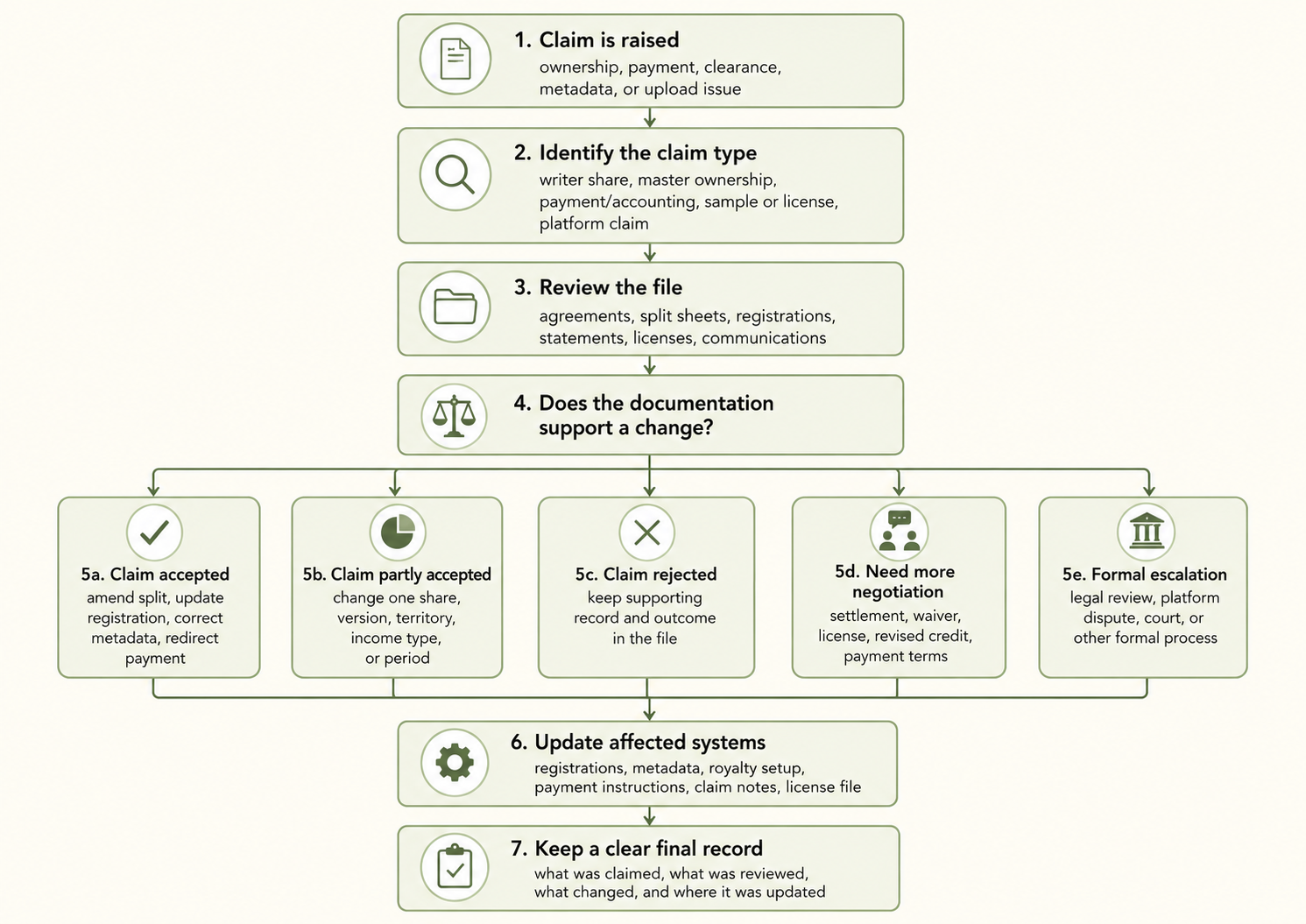
When someone challenges a claim, the file has to move from accusation to proof. The party making the claim may believe a writer was omitted, a master was uploaded without authority, a sample was used without approval, or royalties were paid to the wrong person. The party receiving the claim may disagree completely, accept part of it, or ask for documents before changing anything in the registration, payment setup, license file, or platform account.
The first response should identify what the claim is actually asking for. A writer share claim may require split support and registration review. A master ownership claim may require recording agreements, assignments, delivery records, and distributor history. A payment claim may require statements, deductions, recoupment records, payee details, and letters of direction. A takedown claim may require platform notices, ownership proof, and evidence of authorization.
Several paths can follow:
- The claim is accepted - The parties may amend the split, update registrations, correct metadata, redirect payment, revise credits, sign a license, or settle past income. The correction should be documented clearly so the same issue does not return in another system.
- The claim is partly accepted - A claimant may be added for one version, one share, one territory, one income type, or one period without changing the entire catalog file. A partial resolution needs careful language because later payors and administrators may otherwise apply the correction more broadly than intended.
- The claim is rejected - The file should keep the documents showing why no change was made. A rejected claim may still affect the song if the claimant escalates, sends notices to payors, files a platform claim, contacts licensees, or brings legal action.
- The parties negotiate a settlement - Settlement can be faster than fighting over every historical fact. The parties may agree to revised splits, a one-time payment, future royalty terms, credit changes, a retroactive license, a waiver, or a withdrawal of claims. Settlement terms need to be specific about past income, future income, registrations, approvals, confidentiality, and whether the agreement affects only one song or a broader catalog.
- A platform, society, administrator, or payor holds the disputed portion - Money may be held while the parties provide documents or resolve the conflict. Some systems can keep paying undisputed shares while holding the part under challenge. Others may require a corrected registration, joint instruction, or final decision before releasing income.
- The dispute escalates to legal review - Legal involvement becomes more likely when the conflict involves copyright ownership, authorship, infringement, transfer authority, termination, estate authority, injunctions, damages, or liability for prior uses. At that point, routine administration may pause until the parties, their lawyers, a court, or another formal process determines what should change.
The “Dark Horse” litigation shows how a disputed claim can change direction even after a major trial result. A jury found Katy Perry and other defendants liable for copyright infringement and awarded damages, but the district court later vacated the verdict, and the Ninth Circuit affirmed that ruling after finding the plaintiffs had not shown legally sufficient similarity in protectable musical expression. For rights teams, the administrative lesson is that a claim, a notice, or even an early ruling should still be tracked carefully until the final controlling outcome is clear.
Claims also need clean closure. If a registration is amended, the old version should not remain active somewhere else without explanation. If money is released, the file should show which period and share it covered. If a settlement changes future income, the payment instructions and administration records should match the settlement. If a claim is withdrawn, the withdrawal should be saved with the same care as the original notice.
A disputed claim leaves the cleanest record when the final file answers four questions: what was claimed, what documents were reviewed, what outcome was reached, and which systems were updated afterward. Without that record, the same conflict can resurface during licensing, royalty collection, catalog sale diligence, or a later ownership review.
How Music Rights Disputes Are Usually Resolved
Once the parties can see the documents behind the conflict, the next step is usually less dramatic than the word “dispute” suggests. Many rights problems are resolved through corrected records, signed confirmations, revised payment instructions, amended registrations, or a settlement that gives everyone a usable path forward.
Common resolution paths include:
- Correcting the registration or metadata - A work registration may need amended writer shares, updated publisher information, corrected society data, title changes, or a missing identifier. A recording file may need the correct ISRC, artist name, label data, distributor record, ownership note, or version title. These corrections do not replace the underlying agreement, but they help the systems that collect, match, and pay income reflect the agreed rights position.
- Signing an amended split or ownership confirmation - When the parties agree that the original split was incomplete or wrong, the cleanest fix is usually a signed update. The amendment should identify the song, the old split, the revised split, the parties approving the change, the effective date, and whether the change affects past royalties, future royalties, or both.
- Adding a missing contributor with clear terms - A late-added writer, producer-writer, publisher, estate, or earlier collaborator should not be added through a casual spreadsheet edit. The file needs to show the accepted share, who controls or administers it, how prior income will be handled, and which registrations or payment systems must be updated.
- Issuing a payment correction or letter of direction - When ownership is settled but money moved incorrectly, the fix may sit in accounting rather than copyright paperwork. A label, distributor, administrator, publisher, society, or royalty platform may need updated payee details, banking information, tax forms, payment instructions, statement corrections, or a letter of direction from the parties.
- Clearing the use retroactively - A sample, interpolation, remix, upload, sync use, or master use may be resolved through a license after the issue appears. The agreement should say what use is being approved, whether the permission is retroactive, what fee or royalty applies, whether credits or shares change, and whether the same permission covers future uses.
- Removing or replacing the disputed element - Some releases can move forward only after the disputed material is taken out. A team may replace a sample, re-record a section, use a different master, mute a platform use, withdraw a remix, or exclude a disputed track from a catalog sale. That approach does not answer every past-income question, but it can reduce future exposure.
- Withdrawing, narrowing, or rejecting the claim - After reviewing the file, a claimant may withdraw the objection, limit it to one territory or use, or accept that the documents do not support a change. The response should still be saved. A rejected or withdrawn claim can resurface later if the file does not show what was reviewed and why the record stayed the same.
- Settling the dispute in writing - Settlement may cover revised ownership shares, a one-time payment, future royalty participation, credit changes, release of past claims, confidentiality, platform actions, registration changes, or withdrawal of notices. The agreement should be precise about which song, recording, version, territory, income period, and rights are covered.
- Using mediation, arbitration, or court process - When the parties cannot agree on authorship, ownership, infringement, transfer authority, estate authority, damages, or injunctive relief, the dispute may need a formal process. A court order, arbitration award, or signed settlement can then become part of the rights file that administrators, payors, licensees, and buyers rely on later.
The resolution is only useful if the final file reaches the systems affected by the dispute. A corrected split that never reaches the publisher record can leave income blocked. A settlement that changes payment terms but never updates the distributor or administrator can keep statements wrong. A license that approves an old use but is not saved with the clearance file can cause the same question to return during a future sync request or catalog review.
A clean closeout should leave a short trail anyone can follow later: what was disputed, which documents were reviewed, what the parties agreed or decided, which income periods were affected, and which registrations, metadata records, payment instructions, licenses, claims, or platform accounts were updated afterward.
When Legal Review May Be Needed
Administrators can correct registrations, update metadata, compare statements, gather split confirmations, and help organize the rights file. A dispute moves into different territory when the next step requires someone to interpret legal rights, decide whether a transfer was valid, evaluate infringement exposure, draft settlement terms, or determine whether a party had authority to act in the first place.
Legal review is usually worth bringing in when the dispute involves:
- Authorship or ownership of the song - A missing writer claim can sometimes be handled through confirmations from the parties. The risk changes when someone says they authored part of the composition and another party denies it. Session files, drafts, registrations, credits, publishing agreements, and split sheets may help frame the issue, but the final question may involve copyright authorship rather than routine administration.
- Master ownership or assignment authority - A distributor conflict or royalty routing issue may be fixable through account records. A fight over who owns the master, whether the artist assigned it, whether a label only licensed it, or whether a production company had authority to transfer it can require contract interpretation. U.S. copyright law generally requires a transfer of copyright ownership, outside transfers by operation of law, to be in writing and signed by the owner of the rights conveyed or an authorized agent.
- Samples, interpolations, or infringement claims - An uncleared sample, replayed melody, copied lyric, disputed beat element, or alleged unauthorized upload may expose the parties to more than a metadata correction. The review may need to address whether permission was required, which rights were implicated, whether a retroactive license is possible, whether past uses created liability, and whether the work can keep being exploited.
- Termination, reversion, or recapture issues - Older grants can create questions that cannot be solved by checking the current royalty account. Termination notices, reversion clauses, statutory termination rights, and post-termination exploitation can affect who controls future uses. The Copyright Office’s termination materials describe notices under sections 203 and 304 and note that notices submitted for recordation must comply with statutory and regulatory requirements.
- Estate, trust, minor, company, or representative authority - A person may receive royalties without having power to settle a dispute, amend ownership, approve a license, or sell rights. Estate documents, probate records, trust instruments, corporate approvals, operating agreements, board resolutions, powers of attorney, or guardianship issues may need review before anyone relies on a signature.
- Conflicting transfers or recorded documents - A catalog may have passed through assignments, exclusive licenses, security interests, mergers, or prior sale agreements. Recordation can help establish a public trail for certain copyright-related documents, but the underlying agreements still need to be reviewed for scope, signatures, schedules, and conflicts. The Copyright Office describes recordation as covering certain transfers of copyright ownership and other copyright-related documents under section 205.
- Claims that could affect a catalog sale or financing - Buyer diligence may reveal a disputed work, lien, uncleared sample, missing assignment, or old license that affects the purchase price. Counsel may need to draft carveouts, holdbacks, warranties, indemnities, releases, payoff language, consents, or post-closing cooperation terms so the sale documents do not overpromise what the seller can deliver.
- Settlement language and release of claims - A rights dispute may be resolved commercially, but the settlement has to say exactly what is being resolved. The agreement may need to cover past income, future royalties, credits, registrations, territory, versions, confidentiality, withdrawals, platform notices, warranties, tax treatment, and whether the release applies only to one song or a broader catalog.
- Takedowns, platform disputes, or public claims - When a dispute reaches a platform, distributor, publisher, label, licensee, or public statement, the response can affect leverage and liability. Legal review can help decide whether to send a formal notice, respond to a claim, preserve evidence, avoid overbroad statements, or keep the dispute from spreading beyond the asset actually at issue.
- Cross-border ownership or collection issues - A song may have one ownership record in the United States and another set of registrations, society claims, sub-publishing relationships, or collection practices abroad. Foreign rights, local law, tax treatment, and territory-specific agreements can make a dispute harder to resolve through one domestic registration update.
A lawyer does not need to take over every royalty delay or registration mismatch. Many problems still begin with admin work: collect the documents, identify the affected right, separate composition from master, compare payment history, and mark the system where the conflict appears. That preparation makes legal review more useful because the question is no longer “something is wrong with this song,” but “this party claims this right, under these documents, affecting these income streams and these uses.”
The clearest handoff to counsel includes the disputed work or recording, the parties involved, the claim being made, the documents already reviewed, the registrations or statements affected, the money currently held or contested, any deadlines, and any licenses, releases, takedowns, or sale documents waiting on the outcome. A lawyer can then focus on the rights question instead of spending the first stage reconstructing the file from scattered emails, dashboard screenshots, and partial statements.
Common Mistakes That Make Disputes Harder to Resolve
Rights disputes become harder to fix when the file keeps changing while the parties are still arguing. A registration gets amended before everyone signs. A dashboard split gets updated even though the ownership claim is still contested. A licensee receives two different approval positions. By the time someone tries to clean up the record, the dispute is no longer only about the original claim.
- Arguing before identifying the right being disputed - A complaint that “my royalties are wrong” can point to several different issues. The claim may involve authorship, master ownership, payment routing, recoupment, metadata, a missing registration, or a platform conflict. If the team starts negotiating percentages before knowing which right is affected, the dispute can expand beyond what the documents actually require.
- Treating royalty payments as proof of ownership - A person may have been paid because of a producer royalty, artist royalty, letter of direction, distributor split, old account setup, or participation agreement. That payment history may support an income claim, but it does not automatically prove ownership of the song or recording. A dispute file still has to connect the payments to the contract or registration that explains why the money was owed.
- Changing registrations without written confirmation - Updating a work registration, publisher share, writer split, ISRC record, or administrator field before the parties agree can create a second conflict. One system may show the old record while another shows the new one. A later reviewer may not know whether the change was approved, temporary, disputed, or entered by mistake.
- Using a dashboard split as the settlement - A distributor or royalty portal can route money, but it should not become the only record of a rights decision. For example, an artist might add a producer to a payment split so the producer gets paid quickly, while the producer later treats that dashboard percentage as proof of ownership. If the underlying producer agreement, split sheet, or letter of direction does not match the dashboard, the quick fix can create a larger dispute.
- Freezing more income than the dispute requires - A conflict over one writer share should not automatically block unrelated master income, undisputed publishing shares, or other works in the catalog. When payors or administrators cannot see the affected share, territory, version, or period, they may take a broader hold than necessary. Narrowing the dispute early helps keep clean income moving.
- Letting several versions of the facts circulate - Managers, publishers, labels, distributors, writers, and lawyers may all receive different summaries of what happened in the session or deal. One email says the split was equal. Another says the beat was pre-existing. A third says the issue is only unpaid royalties. The file becomes harder to resolve when the parties are correcting each other’s summaries instead of reviewing the underlying documents.
- Ignoring old contracts that still control the asset - A current team may assume it can approve a license or correct a claim because it handles the release today. An older publishing agreement, distribution term, label deal, sample license, catalog sale, or administration agreement may still decide who controls the right. Missing that older document can lead to approvals, takedowns, or payment changes that another party later challenges.
- Letting deadlines drive the rights decision - A sync deadline, catalog sale, release date, or platform takedown can pressure people into accepting a temporary answer. That may be unavoidable in some situations, but the file should say whether the solution is final or only a short-term instruction. Otherwise, a rushed clearance or payment change may be treated as a permanent ownership decision later.
- Settling the dispute without updating the systems - A signed settlement will not fix the problem if the registration, metadata, payee setup, license file, platform claim, or administrator record still shows the old information. A writer can be added in the settlement but remain missing at the society. A payment correction can be agreed in writing but never reach the distributor. The closeout needs to reach every system affected by the dispute.
- Failing to save the final record - When the dispute is resolved, the file should keep the claim, documents reviewed, outcome, signatures, amended registrations, payment instructions, and correspondence showing what changed. Without that record, the same question may return during a later license, royalty audit, catalog sale, or administration handoff.
The goal is to keep the dispute narrow enough to solve. A rights team should know which asset is affected, which party is claiming what, which documents support each position, which income is blocked, and which systems need to be corrected when the issue closes.
Frequently Asked Questions
What is a music rights dispute?
A music rights dispute happens when parties disagree over ownership, control, payment, approval authority, registration data, or use of a song or recording. The conflict may involve the composition, the master recording, a royalty stream, a license, a sample, a platform claim, or a catalog transfer.
Are music rights disputes always legal disputes?
Many begin as administration problems rather than lawsuits. A registration may not match the split sheet. A distributor account may route money to the wrong party. A publisher may need confirmation before approving a license. Legal review becomes more likely when the disagreement involves authorship, copyright ownership, infringement, transfer authority, termination, estate authority, or settlement language.
What is the difference between a composition dispute and a master recording dispute?
A composition dispute involves the song as written, including writer shares, publisher shares, lyrics, melody, samples, interpolations, and publishing income. A master recording dispute involves a specific recording, including master ownership, label rights, producer royalties, featured artist terms, distributor control, neighboring rights, platform claims, and master-side licensing.
Can royalties be held while a dispute is unresolved?
Royalties can be held, delayed, paid partially, or left unmatched when the payor cannot confirm the correct rightsholder, share, registration, or payment instruction. Sometimes only the disputed share is affected. In other cases, broader payment may pause until the parties correct the record or provide written instructions.
Does being paid royalties prove ownership?
Royalty payments can show that someone has been receiving income, but the payment history still needs support from the agreement, registration, or instruction that created the right to be paid. A producer royalty, artist royalty, letter of direction, dashboard split, or old account setup may explain income without proving ownership of the copyright.
What documents are usually reviewed in a rights dispute?
The document request depends on the claim. A writer-share issue may require split sheets, session files, drafts, registrations, publisher records, and written confirmations. A master ownership issue may require recording agreements, assignments, producer agreements, work-for-hire terms, distributor records, and delivery history. A payment issue may require royalty statements, deductions, recoupment records, letters of direction, payee setup, and account history.
What happens if a writer was left off a song?
The parties usually need to review whether the claimed contribution counts as authorship of the composition. If the claim is accepted, the split may need to be amended, registrations updated, publisher information corrected, and past or future royalties addressed. If the claim is rejected, the file should still keep the documents showing why no change was made.
Can a sample or interpolation dispute affect a released song?
A released song can still face a claim if borrowed material was not cleared or if the clearance did not cover the actual use. The response may involve a retroactive license, revised splits, payment terms, takedown, replacement recording, settlement, or legal review, depending on the material used and the rights involved.
How can a dispute affect licensing?
A clearance request needs approval from the correct rights holders. If one writer share, publisher, master owner, sample owner, administrator, label, or estate representative is disputed, the license may pause until the approving parties are confirmed. A deadline for a film, ad, game, trailer, or brand use will not fix a broken rights chain.
What happens when a claim is disputed?
The team should identify the claim type, gather the supporting documents, compare the affected registrations or payment records, and decide whether the claim is accepted, partly accepted, rejected, negotiated, or escalated. Any outcome should be saved in the file and pushed into the systems affected by the dispute, including registrations, metadata, payment instructions, platform claims, or license records.
How are music rights disputes usually resolved?
Resolution may come through an amended split, corrected registration, metadata update, payment correction, letter of direction, retroactive license, revised credit, settlement agreement, claim withdrawal, court order, or arbitration award. The fix depends on whether the dispute concerns ownership, payment, clearance, platform control, infringement, or authority to sign.
When should legal review be involved?
Legal review is usually needed when the dispute involves contested authorship, copyright ownership, infringement, transfer validity, termination rights, estate authority, settlement releases, injunctions, damages, or catalog sale exposure. Administration teams can organize the records and identify the conflict, but they should not decide legal rights that require counsel.
What makes a rights dispute harder to resolve?
Disputes become harder when parties update registrations without agreement, rely on dashboard splits as ownership proof, circulate different versions of the facts, ignore old contracts, freeze more income than necessary, or settle without updating the systems that caused the problem. The cleaner file identifies the right being disputed, the documents behind each position, the affected income, and the systems that need correction.
Key Takeaways
Rights disputes become easier to manage when the team separates the asset, the claim, the documents, the affected income, and the system where the problem appeared.
- A music rights dispute may involve ownership, control, payment, approval authority, registration data, platform claims, samples, interpolations, unauthorized uses, or catalog transfer issues.
- Composition disputes and master recording disputes need separate review. A writer-share conflict affects the song as written, while a master ownership conflict affects the specific recording.
- Payment disputes should not automatically reopen ownership. A late statement, wrong payee setup, disputed recoupment balance, or outdated payment instruction may require accounting review rather than a new authorship or master ownership fight.
- Royalty payments can be delayed, held, partially paid, or left unmatched when a payor cannot confirm the correct rightsholder, share, registration, claim, or payment instruction.
- Licensing and clearance requests can expose rights problems that ordinary royalty flow has not yet forced anyone to fix. One missing approval from a writer, publisher, master owner, sample owner, estate, label, or administrator can pause the use.
- The documents reviewed should match the claim. Split disputes need split records, session materials, registrations, and publisher files. Master disputes need recording agreements, assignments, delivery records, and distributor history. Payment disputes need statements, deductions, recoupment records, letters of direction, and account setup.
- Samples and interpolations can involve the composition, the master, or both. A clearance file should show what was borrowed, who approved it, what the license covers, and whether the permission reaches the actual use.
- A disputed claim may be accepted, partly accepted, rejected, settled, held by a payor, or escalated to legal review. Each outcome needs a written record and follow-through in the affected systems.
- Resolutions can include amended splits, corrected registrations, metadata updates, payment corrections, letters of direction, retroactive licenses, revised credits, settlements, takedowns, withdrawals, arbitration awards, or court orders.
- Legal review should come in when the dispute turns on authorship, copyright ownership, infringement, transfer validity, termination rights, estate authority, settlement releases, damages, injunctions, or catalog sale exposure.
- Disputes get harder when parties change registrations without agreement, treat dashboard splits as ownership proof, circulate conflicting summaries, ignore old contracts, freeze more income than necessary, or settle without updating registrations, metadata, payment instructions, claims, and license files.
A useful dispute file should leave a clear trail: what was claimed, which rights were affected, what documents were reviewed, what outcome was reached, which income periods were involved, and which systems were corrected afterward.
Practical Resource
Music Rights Dispute Review Map
When a rights conflict appears, the fastest way to lose time is to treat it as one general dispute. A blocked royalty claim, missing writer issue, master ownership challenge, sample problem, and payment routing error may all affect money, but they point to different documents and different fixes.
[Downloadable the Music Rights Dispute Review Map]
References
Passman, Donald S. All You Need to Know About the Music Business. 11th ed. Simon & Schuster.
U.S. Copyright Office. Copyright Registration of Musical Compositions and Sound Recordings.
https://www.copyright.gov/register/pa-sr.html
U.S. Copyright Office. Copyright Registration for Musical Compositions. Circular 50.
https://www.copyright.gov/circs/circ50.pdf
U.S. Copyright Office. Copyright Registration for Sound Recordings. Circular 56.
https://www.copyright.gov/circs/circ56.pdf
U.S. Copyright Office. Copyright Law of the United States, Chapter 2: Copyright Ownership and Transfer.
https://www.copyright.gov/title17/92chap2.html
U.S. Copyright Office. Recordation of Transfers and Other Documents.
https://www.copyright.gov/recordation/documents/
U.S. Copyright Office. Notice of Termination.
https://www.copyright.gov/recordation/termination.html
The Mechanical Licensing Collective. Policies.
https://www.themlc.com/policies
The Mechanical Licensing Collective. Dispute Policy: Musical Work Ownership.
The Mechanical Licensing Collective. Overclaims + How to Use the Overclaims Tool.
Music Week. Richard Ashcroft Regains Rights to Bitter Sweet Symphony.
United States Court of Appeals for the Ninth Circuit. Gray v. Hudson, No. 20-55401.
https://cdn.ca9.uscourts.gov/datastore/opinions/2022/03/10/20-55401.pdf