What Are Derivative Works in Music Copyright
Changing existing music can raise a separate set of copyright questions. This guide covers derivative works, adaptations, permissions, ownership, royalties, and the distinction between compositions and recordings.
Introduction
A song can be reshaped in countless ways after its original release. A producer might build a remix around its melody, a songwriter may translate the lyrics into another language, or an arranger could rework the composition for an orchestra. These versions introduce new creative material while continuing to rely on music that already exists. Copyright law generally describes a work created through this kind of recasting, transformation, or adaptation as a derivative work.
The category is broader than any single music format. It can include new arrangements, lyric changes, translations, samples, interpolations, remixes, and adaptations created for stage or screen. However, using existing music does not always produce a derivative work, and adding original material does not automatically make the use lawful. The result depends on what was taken, how the protected expression was changed, and whether the person creating the new version had authority from the relevant copyright owner.
Music adds another layer because the composition and sound recording are separate copyrighted works. Reworking the melody or lyrics affects the composition, while manipulating audio from an existing track may also involve the master. Some projects therefore require permission from one rights holder, while others engage both sides of the copyright.
Understanding these distinctions helps creators and music businesses determine which rights are involved before a new version is recorded, released, licensed, or monetized. It also clarifies who may own the original contributions, how royalties can be divided, and why permission to use existing music must be secured before the adaptation reaches the market.
Learning Objectives
By the end of this guide, you will be able to:
- Explain what makes a musical adaptation a derivative work
- Distinguish derivative works from covers, technical changes, and uses of unprotected musical elements
- Identify whether an adaptation affects the composition, sound recording, or both
- Determine when direct permission is required from the relevant rights holder
- Understand how ownership, royalties, credits, and registration may apply to an authorized derivative work
- Recognize the risks of creating or releasing an adaptation without clearance
- Review a proposed use before it is recorded, distributed, or monetized
Overview
Derivative work status depends on the relationship between new creative material and a preexisting copyrighted work. Under U.S. copyright law, the new version must recast, transform, or adapt existing expression and contain enough original authorship to qualify as a work of its own. A familiar title, shared genre, production style, or general musical idea would not ordinarily establish that relationship.
Three questions shape the analysis. First, which protected elements of the earlier work appear in the new version? Second, what creative changes or additions have been made? Third, did the person making the adaptation obtain the necessary permission? These questions address different issues. A version may contain substantial new authorship and still infringe the underlying copyright if its creation was never authorized.
Authorization also determines the scope of what the derivative creator can claim. Copyright in an approved adaptation covers only the new material contributed to that version. The melody, lyrics, recording, or other expression taken from the earlier work remains subject to the original owner’s rights. Any release, licensing arrangement, or registration must preserve that distinction.
In music, the required analysis changes with the material being adapted. Rewriting lyrics or rearranging a melody concerns the composition. Sampling recorded audio also brings the sound recording into the clearance process. A project that draws from both may involve separate owners, permissions, royalty terms, and ownership arrangements.
The sections that follow examine where the legal threshold sits, which musical uses fall inside or outside it, and how creators can clear and document an adaptation before release.
Table of Contents
The Right to Create Derivative Works
The right to create a derivative work belongs to the copyright owner. Section 106 of the U.S. Copyright Act gives that owner the exclusive authority to prepare an adaptation or allow someone else to make one. This right exists alongside the rights to reproduce, distribute, perform, and display a copyrighted work, but it specifically addresses the transformation of protected expression into a new version.
Music rights may be divided or transferred, so the person who created the original work is not always the party controlling adaptations. A songwriter may have assigned the relevant rights to a publisher, while a record label or artist may control the sound recording. An administrator, distributor, performing rights organization, or royalty recipient does not gain approval authority simply because it handles another part of the rights or income.
Permission must also match the proposed use. Approval for one arrangement does not necessarily cover a lyric translation, later remix, sample, stage production, or audiovisual adaptation. Agreements may restrict the authorization by version, territory, duration, platform, release date, or manner of exploitation. If the project changes after clearance, the revised version may fall outside the original grant.
The copyrights involved depend on what the new version carries forward. An arrangement performed entirely by new musicians may affect only the composition. A remix that incorporates audio from the released track may draw from both the composition and the sound recording.
Whether the adaptation qualifies for copyright protection is separate from whether it was authorized. A creator may contribute substantial original material and still infringe the underlying work by using it without permission. Section 103 of the Copyright Act also limits protection for material used unlawfully, so originality cannot correct a missing clearance.
Uses That Do Not Create a Derivative Work
Music can resemble, reproduce, or draw inspiration from an earlier work without necessarily becoming a derivative work. The distinction depends on whether protected expression has been creatively adapted, rather than on how closely the projects are associated in style, sound, or marketing.
Uses that generally fall outside the category include:
- A new song may share the genre, mood, subject, instrumentation, or production style of an earlier release. Copyright does not give an owner control over broad musical ideas or an entire style.
- Common building blocks such as standard chord progressions, scales, basic rhythms, conventional song structures, and familiar production techniques may appear across unrelated works. Their presence alone does not establish that one work adapts another.
- Independent creation is possible even when two works contain similarities. If the later creator did not copy protected material from the earlier work, the resemblance does not make the new song derivative.
- Playing an existing composition without creatively altering it does not necessarily produce a new derivative version. A straightforward performance may create a new sound recording, but the underlying song has not been recast merely because different musicians recorded it.
- Reproducing, distributing, or performing an existing work in its original form involves other copyright rights. Uploading the same recording to another platform, for example, does not turn it into an adaptation.
- File conversion, remastering, noise reduction, volume adjustment, and similar production processes may improve or modify the audio without adding enough original authorship to create a derivative work.
Changes to pitch, speed, runtime, or a few notes may be too limited to support a new copyright, but the resulting version could still use protected material without permission. A use does not automatically become lawful simply because it fails to qualify as a derivative work.
Musical Compositions and Sound Recordings
A derivative music project may involve the composition, the sound recording, or both. The answer depends on which parts of the existing music are carried into the new version.
The composition consists of the music and any lyrics. Translating the lyrics, rewriting part of the melody, or creating an original arrangement may adapt this copyright even when every note is performed and recorded from scratch. The existing master does not need to be used for the composition right to be involved.
Sound recording protection applies to the particular recorded sounds. Its derivative work right is narrower because Section 114 of the Copyright Act limits it to versions in which those actual sounds are rearranged, remixed, or otherwise altered. A producer who cuts vocals from an existing master, changes their sequence, and builds new production around them may therefore create a derivative sound recording.
A newly recorded imitation does not adapt the sound recording if it consists entirely of independently fixed sounds, even when it closely resembles the original performance. It may still use or adapt the composition, and other legal issues may arise from the imitation, but the absence of copied audio changes the copyright analysis.
The distinction becomes clearer when the source material is identified:
- A new instrumental arrangement performed from scratch may involve only the composition.
- A remix built from stems of the released track can involve both copyrights.
- A sample uses audio from the sound recording and usually reproduces material from the composition within it.
- An interpolation recreates musical material in a new recording, so it ordinarily involves the composition without copying the original master.
- Production changes made only to an existing recording may affect the master even when the melody and lyrics remain untouched.
When an adaptation uses both copyrights, clearance must come from the parties authorized to control each one. The publisher or songwriter can approve the composition, while the master owner can approve the use of recorded audio.
Cover Songs and New Arrangements
A cover records a new performance of an existing composition. Changes in vocalist, instrumentation, tempo, key, or production can give the recording a distinct sound without necessarily turning the underlying song into a copyrightable derivative work.
Once a nondramatic musical work has been distributed to the public in the United States under the copyright owner’s authority, Section 115 may allow others to record and distribute their own versions through a compulsory mechanical license.
Many familiar cover choices can fit within that limit. A rock song might be performed acoustically, a solo track could be recorded by a full band, or the key may be changed for a singer’s range. The exact boundary depends on the extent and nature of the alterations, rather than the number of production differences.
Direct permission from the composition owner is needed when the proposed version goes beyond the compulsory license. Examples may include:
- Rewriting or adding lyrics
- Translating lyrics into another language
- Making substantial changes to the melody
- Combining the song with another composition
- Restructuring the music in a way that changes its fundamental character
- Claiming copyright in the arrangement as a derivative work
Express consent is also required before an arranger can obtain derivative-work protection for creative changes made to the composition. Without it, the compulsory license may permit an eligible cover to be recorded and distributed, but it does not give the performer ownership of a newly protected arrangement.
The cover artist can still own copyright in the new sound recording, subject to the rights in the composition it contains. Any use of audio from an earlier master would require separate authorization and would no longer be a cover recorded entirely from scratch.
Common Types of Derivative Music Uses
Derivative works appear in music through several creative processes, but the rights involved depend on what the new project takes from the source. Some uses reshape an existing recording, others adapt only the song, and certain projects draw from both.
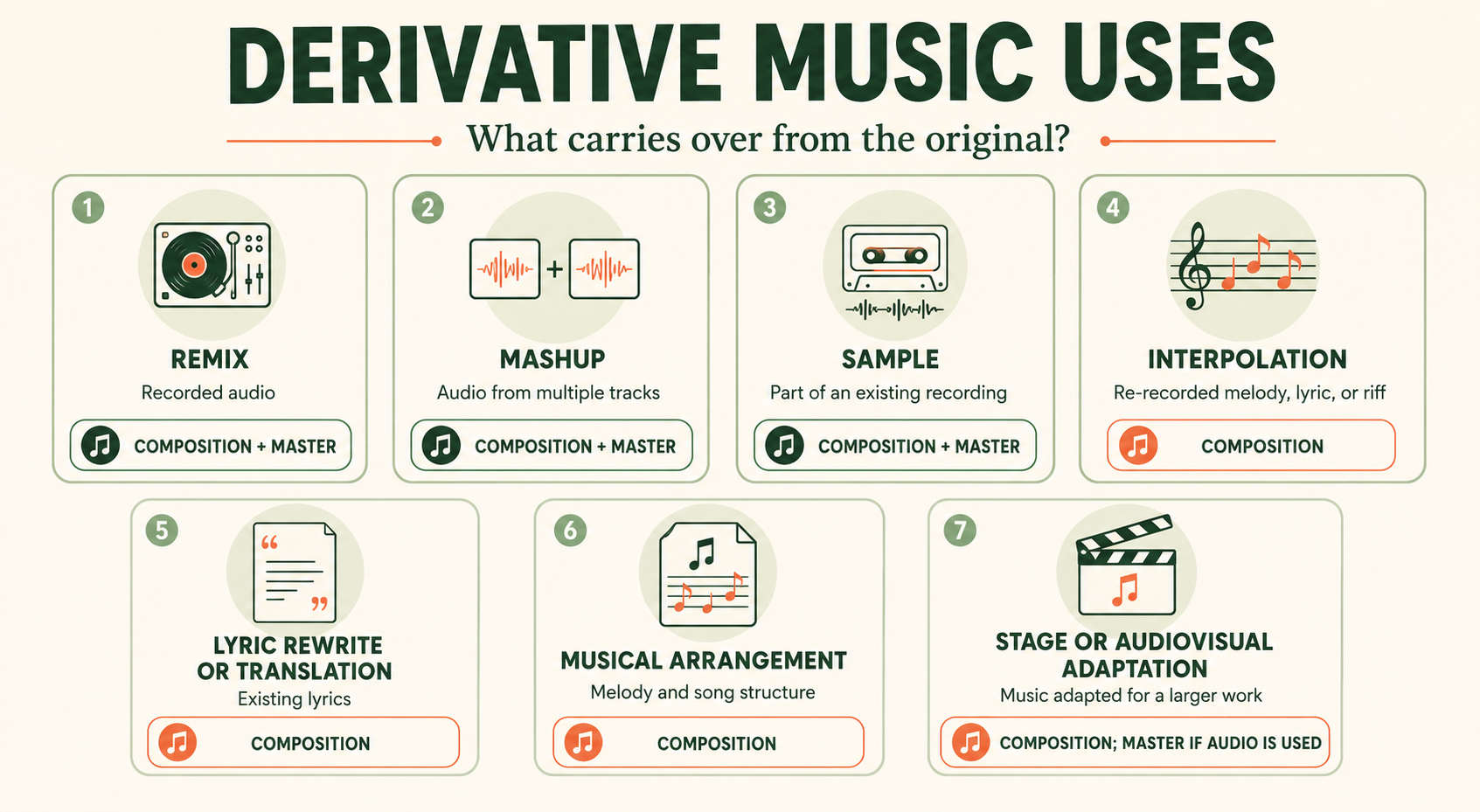
Remixes and mashups often retain audio from one or more existing masters. A remix may reorganize vocals, instrumental stems, or other recorded elements within a new production, while a mashup combines recognizable material from separate songs. Because the finished track can incorporate both recorded sounds and the compositions embodied in them, approval may be needed from multiple master and composition owners.
Sampling also carries part of an existing recording into a new track, whether the producer uses a drum break, vocal phrase, melody, or other audio segment. The length of the sample does not determine clearance on its own. Even a brief extract can implicate the master and the underlying composition.
An interpolation reaches a similar musical result without copying the original audio. The artist records a melody, lyric, riff, or other part of an existing song again for inclusion in a new master. Clearance is generally directed to the composition because the interpolated material has been newly recorded.
Lyric rewrites and translations preserve enough of an existing song for listeners to recognize the underlying work while changing its verbal expression. Replacing a verse, adding new lyrics, or translating the words into another language usually requires direct approval from the composition owner. The agreement should also establish whether the contributor receives a share of the adapted version and how the new lyrics may be used.
Musical arrangements can range from performance choices made for a cover to substantial adaptations with their own original authorship. Reharmonizing a piece, restructuring its sections, or arranging it for an ensemble may create protectable new material when the changes are sufficiently creative and authorized. Routine changes in key, tempo, or instrumentation may remain part of the performance without supporting a separate copyright claim.
Stage productions can adapt songs by connecting them to a narrative, altering lyrics, adding dramatic material, or combining them into a larger theatrical work. Audiovisual projects may also recast music as part of a newly created work, although placing an unchanged song under existing footage does not automatically make the music itself a derivative version. These projects can involve adaptation rights alongside synchronization, performance, and master use permissions.
Permissions and Licenses for Derivative Works
Permission must cover the changes being made to the original music. A lyric translation, rewritten melody, or substantial new arrangement is handled through the composition owner. Using audio from an existing recording also requires consent from the party that controls the master.
Licenses obtained for related uses may not be broad enough. The compulsory mechanical license for a cover allows limited stylistic adjustments, but not changes to the song’s basic melody or fundamental character. A synchronization license may permit a song to accompany visual content without allowing the producer to rewrite its lyrics. The granted rights need to match the adaptation itself.
Projects involving multiple works or divided ownership can require several negotiations. A mashup may draw from compositions and masters controlled by different parties, while a composition with several publishers may need consent from each relevant interest. An administrator can grant permission only when its agreement gives it the authority to do so.
Written terms should identify:
- Source material covered
- Permitted alterations
- Approved release or production
- Territory and duration
- Media and platforms
- Ownership of new contributions
- Credits, fees, royalty shares, and accounting
- Approval requirements for later edits or uses
Changes made during production may fall outside the original terms. Another sample, a revised translation, or a remix placed in a different project should be reviewed before release.
Public-domain compositions can be adapted without permission from a former copyright owner. A modern arrangement, translation, or recording of the same music may have separate protection, so the version being used still needs to be identified.
Ownership of an Authorized Derivative Work
Permission to create an adaptation does not, by itself, determine who owns the resulting version. Ownership depends on the rights granted by the original copyright holder and the terms agreed with the arranger, translator, producer, or other contributor.
A songwriter might approve a translated version while requiring the publisher to own the new lyrics. Elsewhere, the translator may retain copyright in those lyrics and receive an agreed share of income from the adapted composition. Remix agreements can be structured just as differently. The producer could receive a flat fee, a royalty interest, ownership of certain new elements, or no continuing rights after delivering the remix.
Whatever arrangement the parties choose, the contributor’s claim cannot extend beyond the material created for the adaptation. A translator does not acquire the original melody, and a remix producer does not acquire the source master simply by adding new production. The finished version remains dependent on the preexisting work it incorporates.
The agreement should identify the new contributions and state who may register, license, alter, administer, and collect income from them. It should also account for later uses of the same adaptation, including rereleases, synchronization placements, alternate mixes, and transfers to another owner. These terms prevent a permitted creative contribution from becoming an ownership dispute after the version begins generating revenue.
Royalties from Derivative Works
There is no standard royalty formula for every derivative work. The financial arrangement depends on what has been adapted, who owns the underlying rights, and what the parties negotiated before release.
- Some creators receive a one-time fee for preparing the adaptation. An arranger, translator, or remix producer paid on this basis may have no continuing claim to royalties unless the agreement provides otherwise.
- A translated or substantially rearranged composition may be assigned new ownership shares for the adapted version. The original songwriters retain their interests in the underlying composition, while the new contributor receives the percentage approved by the rights holders.
- Remix producers may earn royalties from exploitation of the new master. Their compensation can be calculated as a percentage of the artist’s royalty, net receipts, or another defined revenue base, with any applicable recoupment terms stated in the remix agreement.
- Samples and mashups can generate payments to several rights holders. Fees, publishing shares, master royalties, or combinations of these may be negotiated for each composition and recording used.
- Income from the adapted version may pass through the original publisher, label, or administrator before the contributor is paid. Clear accounting provisions are especially important when one party collects revenue on behalf of everyone involved.
Royalty participation cannot be inferred from a contributor’s credit or creative role. An arranger may receive only a flat fee, while a translator or remix producer could continue earning from the adapted composition or master. The negotiated payment structure determines whether income continues after delivery and how it reaches each contributor.
Credits, Registration, and Rights Data
An adapted version should be documented as its own rights record while remaining connected to the work it draws from. If a Spanish translation of an English-language song is approved, for example, the records should identify the original writers and publishers, the translator, the ownership split for the translated version, and the title under which it will be released.
Copyright registration must distinguish between the preexisting music and the material added through the adaptation. Only the new authorship can be claimed as part of the derivative work registration. The filing should identify the earlier material and describe the contribution being registered, such as new lyrics, an arrangement, or original production elements. Registration does not replace permission from the owner of the underlying work.
The same information should carry across the organizations and systems responsible for administering the version. Depending on the project, the required data may include:
- Original and adapted titles
- Writers, publishers, arrangers, translators, and producers
- Ownership and royalty shares
- ISWC, ISRC, IPI, and other relevant identifiers
- Source compositions and recordings
- Territory or language restrictions
- Licensing and administration contacts
- Effective dates for the approved use
Conflicting titles, percentages, or contributor details can cause registrations to be rejected, royalties to be held, or claims to overlap. Agreements, copyright filings, publisher records, label metadata, and delivery information should therefore describe the adaptation consistently.
Unauthorized Derivative Works
A derivative work is unauthorized when protected material is adapted without the required permission from the party controlling that right. This can happen because no license was obtained, the person granting permission lacked authority, one of several rights holders was omitted, or the finished version exceeded the approved changes or uses. Permission is unnecessary only when the source material is not protected, the relevant copyright has expired, or a legal exception applies.
Original contributions do not correct the unauthorized use. A producer may add new instrumentation, restructure an entire track, or write substantial new material, but the finished version still relies on protected expression that was never cleared. Copyright protection for those additions may also be limited when the underlying material was used unlawfully.
Later approval is sometimes possible, but the owner is not required to grant it or accept the terms the creator expected before release. Resolving the issue may involve removing material, revising the adaptation, negotiating retroactive terms, or abandoning the version altogether.
Reviewing a Proposed Adaptation
A proposed adaptation should be reviewed while its creative direction can still be changed. Waiting until delivery or release may leave the creator choosing between removing an important part of the work, delaying the project, or negotiating from a weaker position after time and money have already been invested.
The review brings the creative plan, source material, ownership records, and intended release together. Its purpose is to identify every protected element being carried forward, determine who controls it, and confirm that the written permission covers the version that will actually reach the public. The process should continue as the project develops because a cleared early demo may differ significantly from the finished recording.
- Create a complete source-material record. Gather every composition, recording, stem, sample, lyric, arrangement, and reference file used to make the adaptation. Material should remain on the record even if it appears briefly, has been heavily edited, or is still being considered for the final version.
- Identify what has been carried into the new work. Note the particular lyrics, melodies, recorded performances, riffs, or other elements taken from each source. General similarities in genre, mood, instrumentation, or production style should be separated from material that can be traced to a protected work.
- Map the affected rights. A newly performed melody or translated lyric points to the composition. Audio lifted from a released track, multitrack session, or supplied stem may involve both the master and the music embodied in it. Each source should be reviewed independently when the project uses more than one work.
- Document the intended changes. Rights holders need enough detail to understand what they are being asked to permit. The request may need to describe revised lyrics, rearranged sections, retained vocals, new production, the length of a sample, or how several songs will be combined.
- Verify who can provide consent. Credits and royalty records can help trace ownership, but they do not always show who controls adaptation rights. Publishing agreements, label contracts, catalog transfers, and administration arrangements may divide authority or limit what one party can approve.
- Match the terms to the planned release. The permitted version, platforms, media, territory, duration, and commercial use should correspond with the actual project. Rights secured for an audio release may not extend to a video, advertisement, stage production, or later remix.
- Resolve the treatment of new contributions. Before delivery, the parties should know who owns the added lyrics, arrangement, or production, how the contributor will be credited and paid, and who will register and administer the adapted version.
- Check the completed version again. Compare the final work with the approved materials and written terms. Samples added during production, further lyric changes, alternate edits, or a new release plan may require additional consent before distribution.
Any unanswered ownership or permission issue should stay on the project record rather than being treated as resolved. The adaptation should move forward only when the material used, the parties controlling it, and the permitted release can all be supported by documentation.
Frequently Asked Questions
What makes a piece of music a derivative work?
A derivative work uses protected expression from an existing composition or sound recording and recasts, transforms, or adapts it through new creative authorship. Musical influence, shared style, common chord progressions, and routine technical changes do not meet this standard on their own.
Is every cover song a derivative work?
No. A newly recorded cover can change the key, tempo, instrumentation, vocalist, and production while remaining a performance of the same composition. Direct permission is generally required when the version rewrites lyrics, substantially changes the melody, or alters the song’s fundamental character.
Which rights are involved in an adaptation?
Reworking lyrics, melody, or musical structure affects the composition. Incorporating samples, stems, vocals, or other existing audio can involve both the composition and the sound recording. An interpolation normally requires composition clearance because the borrowed material is recorded again rather than copied from the original master.
Do remixes, samples, and mashups require permission?
These uses commonly require direct consent because they retain or reorganize protected material. A remix or sample may need approval from the master owner and the relevant composition owners. Mashups can involve several compositions and recordings, each with its own ownership and licensing requirements.
Can the creator own an authorized adaptation?
The creator may own the new lyrics, arrangement, production, or other original contribution if the agreement provides for that result. The claim does not extend to the preexisting material. Ownership may instead be assigned to the original rights holder, shared between the parties, or treated as work made for hire when the legal requirements apply.
How are royalties from a derivative work divided?
Payment can take the form of a flat fee, publishing share, master royalty, percentage of net receipts, or a combination negotiated by the parties. The agreement determines which income streams are shared, who collects them, whether expenses are recouped, and how the adaptation creator is paid.
Does registering the adaptation replace permission?
Copyright registration records the new authorship claimed in the adapted version. It does not authorize the use of the underlying music. Registrations and related rights data should identify the source work, original owners, new contributors, agreed shares, titles, and relevant identifiers.
What happens if an adaptation is released without authorization?
The release may be rejected by a distributor, removed from a platform, blocked from monetization, or placed under a competing claim. Revenue can be withheld or redirected, and the parties responsible for the release may face an infringement action. Adding substantial original material does not resolve the unlicensed use of protected music.
What should be checked before an adaptation is released?
The review should cover every source work, the protected material retained, the copyrights affected, the parties controlling those rights, and the exact changes being requested. Written terms should match the finished version and its intended platforms, territories, media, and duration. Ownership, royalties, credits, registration, and administration of the new contributions also need to be documented.
Key Takeaways
- A derivative work incorporates protected material from an existing composition or sound recording and adds original creative expression through adaptation.
- Remixes, lyric translations, substantial arrangements, samples, interpolations, mashups, and other reworked versions can involve different rights depending on the material retained.
- A newly recorded cover may fall within the compulsory mechanical license, but substantial changes to the lyrics, melody, or fundamental character of the song require direct permission.
- When existing audio is reused, permission may be needed for both the master and the composition. Newly recording borrowed musical material generally avoids use of the master but not the underlying song.
- Authorization to create an adaptation does not automatically establish ownership, royalty participation, or control of the new contributions. These terms must be agreed separately.
- Rights information should connect the adapted version to its source works and accurately record contributors, ownership shares, identifiers, restrictions, and administration details.
- The finished version should be checked against the written permission before release, particularly when creative or distribution plans changed during production.
Practical Resource
[Download the Derivative Work Clearance Worksheet]
Use the downloadable worksheet to organize the rights review for a remix, sample, interpolation, translation, arrangement, mashup, or other adaptation. It provides one project record for documenting:
- Source compositions and recordings
- Protected material retained or changed
- Relevant owners and administrators
- Permission requests and approval status
- Ownership and payment terms
- Authorized media, platforms, territories, and duration
- Restrictions and unresolved issues
- Final clearance confirmation
Complete the worksheet during development and update it whenever the music or release plan changes. The finished record can support discussions with publishers, labels, administrators, attorneys, and distributors.
References
Copyright Law of the United States, Chapter 1
https://www.copyright.gov/title17/92chap1.html
Copyright in Derivative Works and Compilations, Circular 14
https://www.copyright.gov/circs/circ14.pdf
Copyright Registration for Sound Recordings, Circular 56
https://www.copyright.gov/circs/circ56.pdf
Compulsory License for Making and Distributing Phonorecords, Circular 73B
https://www.copyright.gov/circs/circ73b.pdf
Compendium of U.S. Copyright Office Practices, Chapter 800: Works of the Performing Arts
https://www.copyright.gov/comp3/chap800/ch800-performing-arts.pdf
Works Made for Hire, Circular 30