How Do Producer Royalties and Points Work
A practical guide to producer royalties covering points, all-in rates, payment responsibility, advances, recoupment, accounting, and publishing income.

Producer points can look simple on paper. A producer may receive one point, three points, or another percentage tied to the recording, but the number alone does not explain how much the producer may actually be paid.
The value of producer points depends on the royalty base, the payment source, the recoupment terms, the deductions allowed, and the accounting process used by the artist, label, production company, or master owner. A producer may have a royalty interest in a recording and still receive no back-end payment until advances, fees, or other approved costs have been recovered.
Producer royalties also need to be separated from songwriting and publishing income. A producer can receive master-side royalties without owning the composition, and a producer can contribute to the composition without that contribution being handled correctly through the producer royalty clause.
This guide explains how producer royalties and points work, how they are commonly calculated, and what terms affect when royalties become payable.
Learning Objectives
By the end of this guide, you should be able to:
- Explain what producer points mean in a recording agreement.
- Understand the difference between artist royalty-based points and net receipts-based royalties.
- Identify how all-in producer royalties affect the artist’s royalty share.
- Recognize how advances, recoupment, and deductions can delay producer payments.
- Review the basic information that should appear in producer royalty statements.
- Distinguish producer royalties from songwriting credit and publishing income.
- Spot common issues that can make producer points less valuable than they appear.
Overview
Producer royalties are a form of back-end compensation tied to the sound recording. They are usually negotiated in addition to, or instead of, an upfront producer fee. In many deals, the producer receives “points,” which means a percentage interest in a defined royalty or revenue stream from the master.
The most important word is “defined.” Three points can mean different things depending on the deal. The percentage may be calculated from the artist’s royalty, from net receipts, from distributor income, or from another agreed royalty base. It may also be all-in, meaning the producer’s share comes out of the artist’s royalty instead of being paid on top of it.
Payment timing depends on more than the royalty percentage. If the producer received a recoupable advance, future royalties may first be applied against that balance. If the agreement allows deductions for costs, fees, or third-party payments, those deductions can reduce the amount used to calculate the producer’s share. Accounting language then determines how often statements are issued, what information the producer receives, and when any payable balance must be sent.
This guide focuses specifically on producer royalties, points, recoupment, and royalty accounting. For a broader look at producer agreement terms, including deliverables, ownership language, credit, approvals, and deal structures, see Music Admin’s guide to how producer deals work in the music industry.
Table of Contents
What Are Producer Points?
Producer points are a way to give a producer back-end participation in the income generated by a sound recording. One point usually represents one percent, but the percentage is only useful once the agreement explains what the point is being applied to.
In a label deal, producer points are often tied to the artist’s royalty. If the artist’s royalty is reduced by recoupment, reserves, deductions, or other deal terms, the producer’s share may be affected by those same calculations. In an independent release, points may be calculated from net receipts, distributor income, or another revenue pool controlled by the artist or master owner.
The phrase “three points” can therefore produce different results in different agreements. Three points of the artist royalty is not the same as three percent of gross streaming revenue. Three percent of net receipts is not the same as three percent of all master income before costs. The royalty base determines the value of the points.
Producer points also do not automatically create ownership in the master. A producer may receive a continuing royalty from the recording while the artist, label, production company, or another master owner controls the copyright. The points create a contractual payment right, not necessarily a control right.
A useful producer royalty clause should answer several basic questions:
- How many points does the producer receive?
- What royalty base applies?
- Are the points all-in with the artist’s royalty?
- Are advances or fees recoupable before royalties are paid?
- Which income sources are included or excluded?
- Who issues statements and payments?
- When do royalties become payable?
Without those details, producer points can sound clearer than they are. The number may be easy to state, but the economics depend on the surrounding royalty, recoupment, and accounting language.
How Producer Royalties Fit Into the Master Royalty Structure
Producer royalties belong on the master side of the business because they are connected to the sound recording. The composition has its own separate income streams, including writer share, publisher share, mechanical royalties, performance royalties, and other publishing-side collections. A producer may participate in both sides only when the deal and split documentation support that result.
In a label release, the artist’s recording agreement often shapes the producer’s royalty. The label may calculate the producer’s points by reference to the artist royalty, which means the producer’s back-end can be affected by the artist’s royalty rate, recoupment status, deductions, reserves, and accounting schedule. Reviewing only the number of points leaves out the structure that determines whether those points produce income.
Independent releases usually use a different payment path. When the artist, producer, or another party controls the master outside a traditional label deal, there may be no artist royalty formula to borrow from. The producer’s share may instead come from net receipts, distributor income, or a negotiated pool of master revenue. That structure can be easier to follow, but only when the deal defines the revenue pool clearly and identifies which costs come out before the producer is paid.
A production company can add another layer. The company may hire the producer, finance or coordinate the recording, and then deliver the master to an artist, label, or distributor. In that setup, the producer’s royalty rights may sit in the production company agreement rather than in the artist or label agreement. The release may earn money from the master, but the producer’s route to payment depends on the contract that actually names the producer as a participant.
The practical question is not only whether the producer has points. It is where those points sit in the master royalty chain. A royalty tied to the artist account, a royalty paid from net receipts, and a royalty owed by a production company can all be described as producer participation, but they do not operate the same way.
Artist Royalty-Based Producer Points
In many label deals, producer points are calculated by reference to the artist’s royalty rather than the label’s gross revenue. This means the producer’s percentage is usually tied to the artist’s master royalty account and may be affected by the same royalty base, deductions, recoupment status, and accounting schedule that apply to the artist.
Assume an artist has a 20% royalty under a label deal, and the producer receives three points. If the producer’s points are calculated from the artist royalty structure, the producer is not receiving 3% of all money earned by the recording. The producer’s share is carved out of, or calculated by reference to, the artist-side royalty arrangement. The result depends on the contract language, including whether the producer’s royalty is all-in, whether the artist is recouped, and what deductions apply before the royalty is calculated.
This is different from saying the producer receives three percent of gross master revenue. Gross revenue, label receipts, artist royalties, and net receipts can all produce different numbers. A clause that only says “three points” without defining the base leaves too much room for disagreement when royalty statements are prepared.
Artist royalty-based points also connect the producer’s payment to the artist’s record deal. If the label reduces the artist royalty for certain formats, territories, licenses, or deductions, the producer’s royalty may be reduced as well. If the artist has not recouped recording costs or other recoupable expenses, the producer may not receive back-end payments until the relevant account balance allows payment under the agreement.
For that reason, producer points should be reviewed alongside the artist’s recording agreement, any producer declaration, and any letter of direction or side agreement used to pay the producer. The number of points matters, but the surrounding documents determine what those points are worth and when they become payable.
Net Receipts-Based Producer Royalties
Independent releases often use net receipts because there may be no label royalty formula to reference. The artist, production company, or master owner receives income from the recording, deducts the costs allowed under the agreement, and calculates the producer’s share from the remaining amount.
An independent artist receives distributor income from a released master. The distributor has already taken its fee before paying the artist. The producer’s deal says the producer receives 3% of net receipts. If “net receipts” means money received after distributor fees only, the calculation starts there. If the deal also deducts marketing costs, sample fees, featured artist payments, or other approved expenses, the producer’s royalty is calculated from a smaller pool.
The definition of net receipts can make this structure clean or difficult to follow. A narrow definition may use money actually received by the master owner after distributor or collection fees. A broader definition may allow more costs to come out first. Open-ended language is the risk. Phrases that allow “all costs,” “all expenses,” or “any amounts related to exploitation” can reduce the royalty base without giving the producer a clear way to predict the calculation.
This type of deal also puts more accounting responsibility on the party controlling the master. Distributor reports, direct license payments, deductions, recoupment balances, and producer statements need to be tracked in one place. If the artist or master owner does not have a clean reporting process, a percentage of net receipts can become difficult to verify even when the basic structure is fair.
The income categories should be named directly. Streaming and download income may be included, but sync fees, physical sales, neighboring rights income, direct licenses, or social platform income may need separate treatment. A producer who is meant to share in all master income should not be limited by vague wording that only covers one revenue stream. A master owner who intends to exclude certain categories should state those exclusions clearly.
Net receipts can be easier to understand than an artist royalty formula when the money path is simple. The deal becomes harder to evaluate when the deduction list is broad, the income categories are incomplete, or the producer has no regular statement showing how the royalty base was calculated.
All-In Producer Royalties
All-in royalty language usually means the producer’s royalty is included within the artist’s royalty instead of being paid as an additional royalty on top of it. This structure is common in label deals because the label wants one artist-side royalty pool, with the artist and producer dividing that pool according to their agreements.
In practice, all-in language affects several parts of the deal:
- The producer’s royalty comes from the artist-side royalty pool - If the artist has a royalty under the label agreement, the producer’s points may be carved out of that royalty rather than added to the label’s total royalty obligation.
- The artist’s net royalty share may be reduced - A producer with three all-in points can reduce what the artist keeps from the artist royalty. The artist may still be responsible for the producer’s royalty even when the label handles the actual accounting or payment.
- The label may pay the producer directly without increasing the total royalty pool - A letter of direction, producer declaration, or side agreement may tell the label to pay the producer, but the payment may still be charged against the artist’s royalty account.
- Recoupment can affect when the producer receives money - If the artist account is unrecouped, or if the producer received a recoupable advance, the producer may not receive additional back-end payments right away.
- The wording should say whether the royalty is truly all-in - Some agreements use terms like “inclusive of producer royalties” or “all-in to artist.” Others leave the issue unclear. If the contract does not say who bears the producer royalty, the artist, producer, and label may have different expectations once accounting begins.
A non-all-in royalty works differently. In that structure, the producer royalty may be paid on top of the artist royalty, which increases the total royalty burden on the label or master owner. Because that outcome changes the economics, labels and master owners usually want the agreement to be explicit.
All-in language should be read together with the royalty base, recoupment clause, and payment direction. The question is not only how many points the producer receives, but whether those points reduce the artist’s share, increase the payer’s obligation, or sit somewhere else in the royalty structure.
All-In Producer Royalties
All-in royalty language usually means the producer’s royalty is included within the artist’s royalty instead of being paid as an additional royalty on top of it. This structure is common in label deals because the label wants one artist-side royalty pool, with the artist and producer dividing that pool according to their agreements.
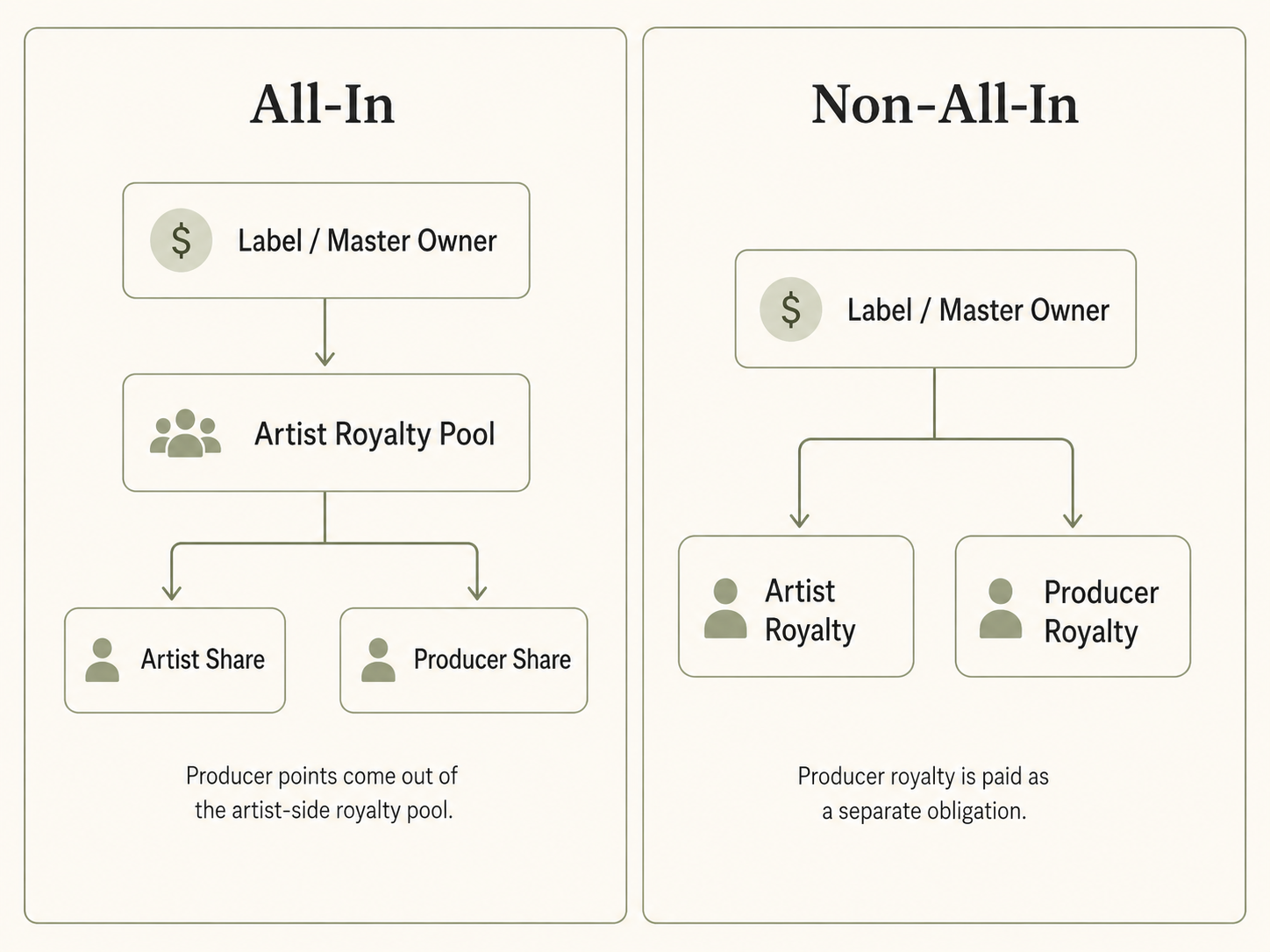
All-in royalty language usually places the producer’s points inside the artist royalty pool. A non-all-in structure may require the label or master owner to pay the producer separately from the artist royalty.
In practice, all-in language affects several parts of the deal:
- The producer’s royalty comes from the artist-side royalty pool - If the artist has a royalty under the label agreement, the producer’s points may be carved out of that royalty rather than added to the label’s total royalty obligation.
- The artist’s remaining royalty share may be reduced - A producer with three all-in points can reduce what the artist keeps from the artist royalty. The artist may still bear the economic cost of the producer royalty even when the label handles the actual accounting or payment.
- The label may pay the producer directly without increasing the total royalty pool - A letter of direction, producer declaration, or side agreement may tell the label to issue producer payments, but those payments may still be charged against the artist’s royalty account.
- Recoupment can affect when the producer receives money - An unrecouped artist account, a recoupable producer advance, or both can delay back-end payments even when the producer has negotiated points.
- The wording should say whether the royalty is truly all-in - Some agreements use terms like “inclusive of producer royalties” or “all-in to artist.” Others leave the issue unclear. If the contract does not identify who bears the producer royalty, the artist, producer, and label may have different expectations when accounting begins.
A non-all-in royalty works differently. In that structure, the producer royalty may be paid on top of the artist royalty, increasing the total royalty burden on the label or master owner. Because that outcome changes the economics, labels and master owners usually want the agreement to be explicit.
All-in language should be read together with the royalty base, recoupment clause, and payment direction. The question is not only how many points the producer receives, but whether those points reduce the artist’s share, increase the payer’s obligation, or sit somewhere else in the royalty structure.
Who Pays Producer Royalties?
The party that calculates and sends producer royalties is not always the same party that carries the economic cost. A label may issue the producer’s royalty statement, but the payment may still be charged against the artist’s royalty account. An artist may promise the producer points, but the distributor may be the party sending revenue reports. A production company may control the producer relationship even though the recording is released by someone else.
The payment path usually depends on the release structure:
- Label-paid producer royalties - On a label release, the producer may be paid directly by the label through a producer agreement, producer declaration, or letter of direction. Direct payment does not always mean the label is paying the producer on top of the artist royalty. In many all-in structures, the label handles the accounting while the producer royalty is still treated as part of the artist-side royalty pool.
- Artist-paid producer royalties - Independent artists may agree to pay the producer from distributor income, net receipts, or another defined master revenue source. This structure gives the artist more control, but it also creates more administrative responsibility. The artist or master owner must track income, apply deductions, calculate the producer’s share, issue statements, and send payments on the agreed schedule.
- Production company-paid royalties - When a production company hires the producer, the producer’s payment rights may sit in the production company agreement. The production company may later deliver or license the master to an artist, label, or distributor, but the producer may still look to the production company for fees, royalties, statements, and recoupment accounting unless another document creates a direct payment right.
- Distributor or platform payment arrangements - Some independent arrangements use distributor tools or payment directions to split income between collaborators. These tools can help with payment administration, but they do not replace the need for a written agreement. The contract still needs to define the royalty percentage, income base, deductions, recoupment terms, and what happens if the distributor changes or the track moves to another platform.
Payment responsibility should be stated clearly because producer royalties often depend on more than one document. The producer agreement may set the royalty terms, the artist agreement may explain the royalty pool, a letter of direction may tell the label where to send payments, and distributor reports may show the income being split. When those documents do not line up, the producer may have points on paper but no clear path to statements or payment.
Producer Advances and Recoupment
A producer advance is usually money paid before the back-end has earned enough to support it. Once royalty income starts coming in, the advance may have to be paid back from the producer’s royalty share before any additional producer royalties are sent.
A $5,000 advance with three producer points does not mean the producer receives both the $5,000 and immediate royalty checks. If the advance is recoupable, the producer’s royalty share first reduces the $5,000 balance. A royalty statement might show $800 earned for the period, $800 applied to recoupment, $4,200 still unrecouped, and $0 currently payable. The producer has earned royalties, but the money is being used to recover the advance.
The same headline advance can lead to different outcomes depending on the recoupment source:
- Recouped only from producer royalties - the producer’s own back-end share pays down the advance.
- Recouped from a broader royalty pool - payment may be delayed by other costs or account balances.
- Charged with additional expenses - sample fees, third-party producer costs, recording costs, or delivery expenses may increase the amount that must be recovered first.
- Non-recoupable fee - the payment compensates the producer for services and does not reduce future royalties.
Statements matter because recoupment is a running balance. A useful statement shows what the recording earned, what royalty was credited to the producer, what amount was applied to the advance, what balance remains, and whether anything is payable for the period. Without that information, the producer may know the track is earning income but still have no clear view of why no check arrived.
The contract should keep advances, flat fees, session payments, and expense reimbursements separate. A producer fee for completed work is not automatically the same as an advance against royalties. If the payer intends to recoup a payment, the agreement should say so directly.
Common Deductions That Affect Producer Royalties
Deductions reduce the amount used to calculate producer royalties. In some deals, only a few defined costs come out before the producer’s percentage is applied. In others, the deduction language is broader and can make the royalty base much smaller than the headline points suggest.
Common deductions may include:
- Distributor or collection fees - Independent releases often start with the amount actually received after a distributor, platform, or collection partner takes its fee. If the producer is paid from net receipts, this fee may come out before the producer’s percentage is calculated.
- Recording and production costs - Studio rental, engineers, musicians, editing, vocal production, mixing preparation, and related production costs may be deducted if the agreement allows them. These costs should be approved and documented rather than left open-ended.
- Marketing and promotion costs - Some agreements allow marketing, advertising, playlisting, video, publicity, or campaign costs to reduce the royalty base. This can materially affect producer royalties because promotion expenses may be large and difficult to connect to one recording.
- Sample and interpolation costs - Sample clearances, interpolation approvals, royalty shares, advances, legal fees, or other clearance-related costs may be deducted before producer royalties are calculated. The agreement should clarify how these costs are handled, especially if the producer supplied or created the material that required clearance.
- Featured artist or third-party royalties - Payments owed to featured artists, remixers, co-producers, beatmakers, session musicians, or other participants may reduce the pool before the producer is paid, depending on the agreement.
- Taxes, chargebacks, and refunds - Some royalty clauses exclude taxes, refunds, credits, returns, chargebacks, or similar amounts from the royalty base. These deductions are common, but the language should be specific enough to prevent unrelated costs from being included.
- Administrative or accounting fees - A master owner may charge administrative, accounting, collection, or processing fees if the contract allows them. These fees need clear limits because they can reduce royalties without being tied to the creative or commercial performance of the recording.
- Reserves - In some recording agreements, a payer may hold back reserves for returns, adjustments, or delayed reporting. Reserves can delay payment even when the recording has generated income.
The issue is not only whether deductions exist. The more important question is how they are defined, approved, documented, and reported. A producer reviewing a royalty clause should look for broad phrases that allow unspecified costs to come out before the producer’s share is calculated.
When Producer Royalties Become Payable
A recording can earn income before the producer receives a payable royalty balance. The difference usually comes from timing, recoupment, deductions, and the accounting schedule.
Producer royalties generally become payable only after several conditions line up:
- The recording has generated income covered by the agreement - The royalty clause should say which income sources count. Streaming income may be included, but sync fees, physical sales, neighboring rights income, direct licenses, or social platform revenue may need separate language. If a category is excluded, income from that source may not create a producer royalty payment.
- The payer has received and processed the income - A track may be streamed in one month, reported by a distributor later, and accounted to the artist or producer after that. Labels, distributors, collection partners, and licensees may all report on different timelines. Payment usually depends on received income, not estimated activity.
- Any recoupable balance has been recovered - A producer with a recoupable advance may see royalties credited to the account before receiving money. Those royalties may first reduce the advance balance. If approved costs are also recoupable, the balance may take longer to clear.
- Allowed deductions have been applied - Distributor fees, reserves, sample costs, third-party royalties, taxes, refunds, chargebacks, and other permitted deductions can reduce the royalty base. The producer’s percentage is then applied to the amount left after the agreed deductions.
- The accounting period has closed - Producer royalties are usually reported on a schedule, such as quarterly, semiannually, or another period set by the agreement. Even if a payable balance exists, payment may not be due until the statement period closes and the payment deadline arrives.
- Any payment threshold has been met - Some agreements allow the payer to hold small balances until they reach a minimum payment amount. This should be stated clearly so the producer knows whether a small unpaid balance is being carried forward.
A producer may therefore have points, earned royalties, and still receive no payment for a particular period. For example, a statement could show $1,200 in producer royalties for the quarter, $1,200 applied to an unrecouped advance, and no current payment due. In a later period, once the recoupment balance is cleared, royalties from covered income may become payable under the agreement.
The cleanest payment language identifies the income sources, recoupment terms, deduction rules, accounting periods, payment deadlines, and minimum payment thresholds. Without those details, the producer may not know whether a missing payment reflects normal accounting timing, recoupment, excluded income, or a reporting problem.
Producer Royalty Statements and Accounting
Producer royalty statements show how the royalty clause is being applied in practice. The statement should connect the recording’s income to the producer’s royalty base, deductions, recoupment balance, and any amount currently payable.
A useful producer royalty statement should show:
- the recording title and royalty period
- the income source, such as streaming, downloads, sync, physical sales, or other master income
- the gross amount or receipts received by the payer
- deductions taken before the producer royalty is calculated
- the royalty base used for the calculation
- the producer’s royalty rate or points
- the producer royalty earned for the period
- any amount applied to recoupment
- the remaining unrecouped balance
- the amount currently payable
- any balance carried forward to the next period
A simplified statement might look like this:
In this example, the producer earned $285 for the period, but no cash payment is due because the full amount was applied to the remaining unrecouped balance. Once the advance or other recoupable balance is cleared, future producer royalties from covered income may become payable under the agreement.
Royalty reporting may happen quarterly, semiannually, or on another schedule tied to the artist’s label agreement, distributor reports, or the producer agreement itself. The important point is that the contract should give both a statement deadline and a payment deadline. If no money is due because the producer is still unrecouped, the statement should still show the income credited, the amount applied to the balance, and the balance carried forward.
A statement that only shows a lump-sum total is hard to verify. The producer needs enough detail to see the income source, deductions, royalty base, royalty rate, recoupment activity, and payable amount. Without those details, it is difficult to tell whether the payment is accurate, incomplete, delayed, or being withheld because of recoupment.
Audit Rights and Royalty Review
A producer with back-end participation needs a way to test the royalty statement against the deal. The review is usually less about one number and more about whether each step in the calculation matches the contract.
Start with the royalty rate - The statement should apply the same points or percentage stated in the agreement. If the deal grants three points, the review should confirm where that percentage appears and whether it was applied to the correct royalty base.
Check the income being counted - The producer should be able to see which master income sources were included for the period. Streaming, downloads, sync fees, physical sales, direct licenses, or other income categories may be treated differently depending on the agreement.
Review the deductions - Any deduction should connect back to the contract. Distributor fees, sample costs, reserves, taxes, chargebacks, and third-party royalties may be allowed in some deals, but vague or unsupported deductions can make the royalty base hard to verify.
Follow the recoupment balance - If the producer received an advance, each statement should show the opening balance, royalties credited, amount applied to recoupment, ending balance, and any payable amount. A statement that only says “unrecouped” does not give enough information to review the account.
Match the payer to the paperwork - A label-paid producer may need to review the producer declaration, letter of direction, and royalty statement. An independent release may require distributor reports and deduction support from the master owner. A production company arrangement may require records showing what the company received and how the producer’s share was calculated.
Audit rights matter when informal review is not enough. The clause should say when an audit can be requested, how much notice is required, who may conduct it, what records can be inspected, how far back the review can go, and what happens if an underpayment is found. The deadline is especially important because some agreements make statements final if they are not challenged within a set period.
A useful audit clause gives the producer a process for checking the math before the right to object expires.
Producer Royalties vs. Songwriting and Publishing Income
Producer royalties and publishing income can both involve the same recording, but they come from different rights. Producer points are usually tied to the master. Songwriting and publishing income are tied to the composition. Keeping those rights separate helps prevent confusion over payment, registration, licensing, and ownership.
A producer does not receive publishing income just because they produced the recording. Sound selection, editing, vocal production, mixing direction, programming choices, or general production work may be valuable to the master without creating a writer share. Publishing becomes part of the discussion when the producer contributes to the composition itself, such as lyrics, melody, a core musical hook, or other protectable songwriting material.
When the producer is also a songwriter, the publishing terms should be documented separately from the producer royalty. The parties may need a split sheet, writer share percentages, publisher share details, PRO information, publishing administrator information, and any sample or interpolation details. Those items should not be buried inside a producer points clause.
The cleanest producer royalty language says what the producer receives from the master. The cleanest publishing documentation says what the producer receives, if anything, from the composition. Treating those as separate tracks makes the deal easier to register, account, license, and review later.
Common Mistakes When Reviewing Producer Points
Producer points can look straightforward until the royalty clause is read against the rest of the agreement. These are some of the issues that can make the stated percentage less clear or less valuable than it first appears.
- Focusing only on the number of points - Three points may sound better than two points, but the percentage does not mean much without the royalty base. Points based on the artist royalty, net receipts, distributor income, or gross master revenue can lead to very different results.
- Missing all-in language - If the points are all-in, the producer’s royalty may come out of the artist royalty pool. That can affect the artist’s remaining share and may also determine whether the label or master owner is taking on any additional royalty obligation.
- Overlooking recoupment - A producer may earn royalties on paper while receiving no payment because the royalty is being applied against an advance or other recoupable balance. The clause should show what is recoupable, where recoupment comes from, and when payments begin.
- Accepting broad deduction language - Deductions can shrink the royalty base before the producer’s percentage is applied. Broad language covering “all expenses” or “all costs related to exploitation” should be reviewed carefully because it may allow more charges than the producer expected.
- Not identifying the payer - A producer needs to know who is responsible for statements and payments. The artist, label, production company, distributor, or master owner may each play a role, but the contract should identify the actual payment path.
- Confusing master royalties with publishing income - Producer points usually relate to the master. Songwriting credit, writer share, publisher share, and publishing royalties require separate documentation. A producer who contributed to the composition should not rely on the producer points clause to handle publishing rights.
- Ignoring statement and audit terms - Back-end participation depends on reporting. If the agreement does not require detailed statements or provide a review process, the producer may have limited ability to check income, deductions, recoupment, or underpayments.
- Leaving income categories undefined - Streaming income may be covered, but sync fees, neighboring rights income, physical sales, direct licenses, social platform income, and other revenue categories may need separate treatment. The agreement should say which master income sources are included.
- Assuming direct payment means extra payment - A label may pay the producer directly while still charging the producer royalty against the artist’s royalty account. Direct payment explains who sends the money. It does not always explain who bears the cost.
- Waiting until after release to clarify the deal - Once the recording is distributed, accounting and rights issues become harder to fix. Royalty base, recoupment, payment direction, publishing splits, and delivery obligations should be settled before the track is released.
Frequently Asked Questions
What are producer points?
Producer points are a producer’s percentage participation in income from a sound recording. One point usually means one percent, but the value depends on the royalty base. Three points of the artist royalty, three percent of net receipts, and three percent of gross master revenue can produce different results.
Are producer points paid from the master or the composition?
Producer points are usually tied to the master, also known as the sound recording. Songwriting and publishing income come from the composition. A producer may receive both only if the producer agreement and the songwriting or publishing documentation support that result.
What does all-in mean in producer royalties?
All-in means the producer’s royalty is included within the artist’s royalty instead of being paid on top of it. In that structure, the producer’s share usually reduces the artist-side royalty pool rather than increasing the label’s total royalty obligation.
Who pays producer royalties?
Producer royalties may be paid by a label, artist, master owner, production company, distributor, or another party named in the agreement. The payer should be identified clearly because the person sending payment is not always the same party carrying the economic cost.
Are producer advances recoupable?
Many producer advances are recoupable from future producer royalties. If the producer receives a recoupable advance, the producer’s royalty share may first be applied against that balance before additional royalty payments are sent.
When do producer royalties become payable?
Producer royalties usually become payable after covered income is received, allowed deductions are applied, any recoupable balance is cleared, the accounting period closes, and any payment threshold is met. A producer can earn royalties on a statement while still receiving no cash payment if the royalties are being applied to recoupment.
What is the difference between artist royalty-based points and net receipts-based royalties?
Artist royalty-based points are calculated by reference to the artist’s royalty under a recording agreement. Net receipts-based royalties are calculated from money received by the master owner after agreed deductions. The royalty base determines how the producer’s percentage is applied.
Can deductions reduce producer royalties?
Yes. Distributor fees, recording costs, sample costs, third-party royalties, taxes, chargebacks, reserves, marketing costs, or administrative fees may reduce the royalty base if the agreement allows them. The deduction language should be specific.
Does a producer get publishing income from producer points?
No. Producer points do not automatically create writer share, publisher share, or publishing income. If the producer contributed to the composition, the parties should document that contribution separately through split sheets, songwriter information, PRO details, and publishing administration records.
What should a producer royalty statement show?
A producer royalty statement should show the recording, royalty period, income source, receipts received, deductions, royalty base, producer rate, royalty earned, recoupment applied, remaining unrecouped balance, and amount currently payable.
Key Takeaways
- Producer points are back-end participation in income from a sound recording, but the points only have practical value when the royalty base is clearly defined.
- One producer point usually means one percent. The result can change significantly depending on whether the percentage applies to the artist royalty, net receipts, distributor income, or another master-side revenue pool.
- All-in producer royalties usually come out of the artist royalty pool instead of being paid on top of the artist’s royalty.
- The party sending producer payments is not always the party carrying the economic cost. A label may pay the producer directly while still charging the royalty against the artist’s account.
- Recoupable advances can delay payment. A producer may earn royalties on a statement, but those royalties may first be applied to an unrecouped balance.
- Deductions can reduce the royalty base before the producer’s percentage is calculated. Common deductions may include distributor fees, sample costs, third-party royalties, taxes, chargebacks, reserves, and approved expenses.
- Producer royalties generally become payable only after covered income is received, deductions are applied, recoupment is cleared, the accounting period closes, and any payment threshold is met.
- Royalty statements should show income sources, deductions, royalty base, producer rate, royalties earned, recoupment activity, remaining balance, and current amount payable.
- Audit rights give the producer a process for reviewing royalty calculations before the right to challenge a statement expires.
- Producer points are separate from songwriting credit and publishing income. If the producer also contributed to the composition, those rights should be documented separately through split and publishing records.
Practical Resource: Producer Points Calculation Reference Sheet
Producer points can be difficult to evaluate because the percentage does not explain the full payment structure. A producer may receive three points, but the value of those points depends on the royalty base, deductions, recoupment terms, and payment path.
Use the Producer Points Calculation Reference Sheet to compare common producer royalty structures, review sample calculation paths, and identify the statement fields needed to verify producer royalty payments.
[Download the Producer Points Calculation Reference Sheet]
This resource is intended as a practical reference for reviewing producer royalty language. It does not replace a full agreement review or legal advice from a qualified entertainment attorney.
References
Passman, Donald S. All You Need to Know About the Music Business. 11th ed. Simon & Schuster.
U.S. Copyright Office. Copyright Registration for Sound Recordings. Circular 56.
https://www.copyright.gov/circs/circ56.pdf
U.S. Copyright Office. Copyright Registration for Musical Compositions. Circular 50.
https://www.copyright.gov/circs/circ50.pdf
SoundExchange. Letters of Direction.
https://www.soundexchange.com/what-we-do/for-artists-labels-and-producers/letters-of-direction/
SoundExchange. I am a producer, mixer, or engineer for several big artists. How do I claim royalties for these recordings?
ASCAP. Songwriter and Music Publisher Agreements.
https://www.ascap.com/help/music-business-101/200809
BMI. FAQs: Publishing.