How Do Distribution Deals Work in the Music Industry
Distribution deals define far more than how music reaches streaming platforms. Fees, rights, recoupment, marketing, reporting, and catalog control can all depend on the agreement.

Introduction
Distribution deals turn release delivery into a set of business and contract obligations. The agreement determines how recordings reach DSPs and other platforms, how master income is collected, what fees or commissions come out, and what control the artist, label, or rights holder keeps once the release is live.
Some arrangements are narrow. An artist may keep ownership of the master, use a distributor for delivery and reporting, and receive payouts after the distributor takes its fee. Other deals include a wider service package, such as playlist pitching, campaign management, marketing support, physical distribution, data access, sync support, or funding. Those added services can affect the term, revenue share, recoupment language, exclusivity, and catalog control.
The details matter before the music is delivered. A distribution agreement can shape who controls platform access, who can approve takedowns, how quickly royalties are reported, whether marketing costs are recoupable, and what happens if the artist later wants to move the catalog, sign a label deal, or change distributors.
Learning Objectives
By the end of this guide, you should be able to:
- Explain what a distribution deal covers beyond basic DSP delivery.
- Distinguish distribution deals from record deals and label services arrangements.
- Identify the main types of music distribution deals.
- Understand what rights a distributor may receive under the agreement.
- Review distributor fees, commissions, net receipts, advances, and recoupable costs.
- Recognize how term, territory, exclusivity, takedown rights, and platform access affect catalog control.
- Evaluate reporting, analytics, payout timing, split tools, and payment directions.
- Spot red flags that can make a distribution deal harder to exit, audit, or manage.
Overview
A distribution deal gives a distributor the authority to place recordings into the market and collect income from the uses covered by the agreement. The artist, label, or master owner may still own the recording, but the distributor often controls important operational steps: delivery, metadata submission, platform administration, takedowns, royalty reporting, and payout processing.
The structure can range from simple delivery to a broader commercial partnership. A distribution-only deal may involve platform access, reporting, and revenue collection. A label services arrangement may add marketing, playlist pitching, physical distribution, project management, release strategy, or funding. A funded distribution deal can sit closer to a hybrid model when the distributor provides an advance, recoups costs, or receives a larger revenue share in exchange for support.
Ownership and control should be reviewed separately. A distributor may receive exclusive rights for a term, territory, platform group, or release category without becoming the owner of the master. Even when ownership stays with the rights holder, the contract can limit future flexibility if it restricts takedowns, catalog transfers, direct licenses, or negotiations with another label or distributor.
The financial terms determine how income is shared after the distributor receives money from platforms or licensees. Some distributors charge flat fees. Others take a commission, deduct approved costs, recoup advances, or calculate payouts from net receipts. Reporting language then determines whether the rights holder can see enough detail to understand income, deductions, adjustments, reserves, recoupment, and current payable balances.
A useful distribution agreement should make the operating relationship clear before release day. It should identify what the distributor can do, what the rights holder keeps, what services are actually promised, how revenue is handled, and how the catalog can be managed when the deal changes or ends.
Table of Contents
What a Distribution Deal Covers
A distribution agreement gives the distributor a defined role in bringing recordings to market, collecting income from covered platforms or channels, and reporting that income back to the artist, label, or master owner. The details can be narrow or broad depending on whether the deal is only for delivery, includes a revenue-share arrangement, or adds services such as marketing, playlist pitching, funding, physical distribution, analytics, or campaign support.
Platform Access and Delivery Rights
The delivery language should make clear which platforms, territories, formats, and release channels are covered by the agreement. DSPs, download stores, short-form video platforms, social platforms, YouTube services, physical retailers, and other outlets may all be treated differently depending on the distributor’s network and the rights granted by the master owner.
Operational control often sits inside this part of the deal. Release dates, metadata updates, territory settings, takedown requests, asset replacements, platform corrections, and delivery errors may all run through the distributor’s system. When the distributor controls those steps, the rights holder needs to know how requests are submitted, how quickly changes are handled, and whether any approvals or restrictions apply.
Rights Granted to the Distributor
To deliver and monetize a recording, the distributor usually needs permission to reproduce, distribute, transmit, administer, monetize, and collect income from the master within the scope of the deal. Those rights should match the actual purpose of the arrangement rather than quietly expanding into broader licensing, sublicensing, physical exploitation, advertising uses, or catalog control that the rights holder did not intend to grant.
The heading of the contract does not decide the result. A document called a distribution agreement can still contain broad rights language, long exclusivity, post-term restrictions, or control provisions that make the deal behave more like a label services arrangement. The grant clause is the part that shows what the distributor can actually do with the recordings.
Revenue Collection, Fees, and Payouts
Most distribution deals place the distributor between the platform and the rights holder for master-side income. After money is reported by DSPs or other covered sources, the distributor may deduct a flat fee, commission, approved expense, reserve, adjustment, tax, chargeback, or recoupable amount before paying the remaining balance.
The economics change depending on the structure. A low-cost distribution-only deal may leave most income with the rights holder after a small fee. A higher-touch arrangement may give the distributor a larger percentage because it includes campaign support, funding, marketing coordination, or other services. If payouts are based on net receipts, the agreement needs to show what comes out before the rights holder’s share is calculated.
Services Beyond Basic Distribution
Delivery alone does not guarantee marketing support. A distributor may offer playlist pitching, release strategy, advertising support, project management, sync support, physical distribution, editorial pitching, audience development, or analytics, but those services need to be described in terms that can be reviewed later.
Vague service language can create mismatched expectations. “Marketing support” might mean a pitch submission, a campaign meeting, access to tools, discretionary playlist outreach, or a paid campaign charged back to the artist. When services affect the revenue share, term, or recoupment structure, the agreement should explain what is included, what is optional, and which costs can be recovered from future income.
Term, Exclusivity, and Catalog Control
Term and exclusivity determine how much flexibility the rights holder keeps after delivery. A short, non-exclusive deal may allow an artist or label to change distributors with limited friction. A longer exclusive deal may come with stronger support, but it can also limit future label negotiations, direct licensing, catalog migration, or release control during the term.
Exit language deserves attention before the catalog is live. The agreement should explain who can request takedowns, how catalog transfers are handled, whether the distributor keeps rights after termination, how unpaid income is reported, and what happens if the rights holder sells the catalog, signs a new deal, or needs to correct ownership information.
Reporting, Analytics, and Split Administration
The value of a distribution deal also depends on what the rights holder can see after release. Dashboard access, royalty statements, payout reports, territory data, platform-level income, adjustment records, split tools, and payment direction features help show how the recording is performing and how income is being calculated.
Limited reporting can make even a fair revenue share hard to manage. The rights holder needs enough detail to check receipts, deductions, reserves, recoupment, contributor splits, payment thresholds, and current payable balances without having to reconstruct the accounting from incomplete platform summaries.
Distribution Deals vs. Record Deals
A distribution deal and a record deal can both put music into the market, but they usually start from different business positions. Distribution is built around delivery, platform administration, revenue collection, reporting, and sometimes marketing support. A record deal is usually a broader artist-label relationship that may involve recording commitments, advances, creative obligations, master ownership or control, options, marketing, promotion, and long-term royalty terms.
The difference is clearest when looking at what the company is taking responsibility for. A distributor may deliver finished recordings that the artist or label already owns or controls. The artist may stay responsible for recording costs, creative decisions, rollout planning, artwork, contributor payments, and much of the marketing. The distributor’s role is to get the music delivered, monetized, reported, and paid according to the agreement.
A record label may take on a wider role. Depending on the deal, the label may fund recording, approve budgets, coordinate marketing, handle distribution, manage radio or press campaigns, control release timing, own or license the masters, and recoup advances and expenses from the artist’s royalties. That broader role can come with more resources, but it can also mean more control over the recordings and a longer commitment from the artist.
The line can blur when a distributor offers label services. A deal with playlist pitching, marketing support, campaign strategy, funding, physical distribution, or project management may still be called a distribution deal, but it may operate closer to a label services arrangement. The contract language matters more than the label on the deal. A “distribution” agreement with long exclusivity, broad rights, recoupable funding, approval controls, and post-term restrictions may feel very different from a simple delivery arrangement.
The practical review should focus on the rights actually granted. A distribution deal may preserve master ownership but restrict catalog movement. A record deal may provide more support but require a larger transfer of control. When the structure starts to look broader than delivery and reporting, it helps to compare the language against how record deals work in the music industry before treating the arrangement as a simple distribution contract.
Main Types of Music Distribution Deals
Music distribution deals can range from basic platform delivery to broader commercial partnerships that include services, funding, or catalog-level support. The deal type matters because it affects the rights granted, the distributor’s role, the revenue share, the artist’s flexibility, and how easily the catalog can move later.
The main difference is not only the name of the deal. A “distribution” agreement can be light-touch platform access, or it can carry obligations that look closer to label services. The contract should be reviewed based on what the distributor can actually do, what the rights holder gives up, and what happens if the relationship needs to change.
Distribution-Only vs. Label Services Deals
The difference between a distribution-only deal and a label services deal often comes down to how much of the release campaign the distributor is expected to touch. Both arrangements may use the same delivery network, but they create different expectations around marketing, support, control, revenue share, and recoupment.
When the Deal Is Mostly Operational
In a distribution-only arrangement, the rights holder brings finished recordings to the distributor and remains responsible for most of the release strategy. The artist, label, or master owner handles recording costs, artwork, metadata decisions, rollout planning, marketing, contributor payments, and creative approvals. The distributor’s role is mainly to deliver the music to approved platforms, collect income, provide reporting, and process payouts.
These deals tend to work best when the rights holder already has the team or experience to manage the campaign independently. The distributor provides infrastructure rather than a full release plan. Review should focus on platform access, fees, payout timing, support limits, takedown rights, reporting detail, and how easily the catalog can move if the rights holder changes distributors later.
When Distribution Becomes a Services Relationship
A label services deal adds a more active commercial layer to the distribution relationship. The distributor may help with playlist pitching, marketing coordination, advertising, analytics, physical distribution, release planning, project management, sync support, or campaign strategy. The rights holder may still own the master, but the distributor’s role moves beyond delivery and into release execution.
That added support can justify a higher commission, longer term, or more involved revenue share, especially when the distributor is contributing real resources to the campaign. The agreement needs to make those services concrete. “Marketing support” could mean a formal campaign plan, a few pitch submissions, access to internal tools, general account guidance, or a paid campaign that is later recouped from royalties. Those are very different outcomes.
Funding can also move a services deal closer to a hybrid label arrangement. If the distributor provides an advance, marketing budget, or other spend, the contract should show how recoupment works, which income sources are used to repay the balance, who approves expenses, and whether the distributor can continue collecting after the initial campaign period.
The practical dividing line is control. A distribution-only deal should leave most business and creative decisions with the rights holder. A label services deal may involve more coordination, but the extra support should match the restrictions being added. Longer exclusivity, approval rights, recoupable costs, takedown limits, or post-term controls make more sense when the distributor is clearly providing services that justify those terms.
Rights Granted to the Distributor
The grant of rights is one of the most important parts of a distribution agreement because it defines what the distributor is allowed to do with the recordings. The rights holder may still own the master, but the distributor needs enough permission to deliver, monetize, administer, and collect income from the covered uses.
A distribution agreement may grant the distributor the right to:
- Deliver the recordings to platforms - This covers DSPs, download stores, short-form video platforms, social platforms, physical retailers, or other channels named in the agreement.
- Reproduce and distribute the master - These rights allow the distributor to make the technical copies and deliveries needed for platform distribution.
- Transmit, stream, or otherwise make the recording available - This language supports digital availability on streaming platforms, download services, and other approved outlets.
- Collect income from covered platforms and uses - The distributor may receive master-side income first, then account to the artist, label, or rights holder under the payout terms.
- Administer metadata, assets, and platform information - This can include release titles, artist names, ISRCs, artwork, territory settings, contributor information, and other delivery data.
- Request takedowns, corrections, or updates - The deal may give the distributor control over platform changes, removals, metadata fixes, and asset replacements.
- Sublicense rights where platform delivery requires it - Some agreements include sublicensing language so the distributor can work with DSPs, YouTube services, social platforms, physical partners, or third-party delivery systems. This language needs limits so it does not become broader than the distribution purpose.
- Monetize user-generated content or platform uses - If the distributor handles YouTube Content ID, social platform claiming, short-form video monetization, or UGC-related income, the agreement should say so directly.
After the list of delivery rights, the next issue is scope. For a basic digital distribution arrangement, the grant can stay tied to platform delivery, monetization, metadata administration, collection, reporting, and takedown handling. Sync licensing, advertising uses, compilations, physical products, neighboring rights activity, NFTs, brand campaigns, and other uses outside standard distribution belong in separate language with their own approval rules and income terms.
Exclusivity changes the business result of the same grant. A narrow non-exclusive right may leave room for direct licensing, another distributor, or a future label conversation. A broad exclusive right can make the distributor the gatekeeper for the catalog during the term, even when the rights holder still owns the master. That becomes especially important if the artist later wants to move the release, accept a new deal, or separate one recording from the rest of the catalog.
By the end of the grant clause, the covered recordings, territories, platforms, sublicensing authority, UGC rights, takedown authority, and post-term rights should all be identifiable. Any rights outside the distributor’s actual role need to be clearly approved, limited, or removed.
Master Ownership, Publishing Rights, and Distribution Limits
In a distribution agreement, the distributor’s authority should be tied to the job it is performing: delivering recordings, administering platform activity, collecting master income, reporting revenue, and processing payouts. Problems start when those delivery rights begin to reach into ownership, publishing control, sync approval, neighboring rights activity, or other uses that sit outside the normal distribution relationship.
The Master Side
Master ownership belongs to the person or company that owns or controls the sound recording. That may be the artist, label, production company, catalog buyer, or another rights holder. A distributor can deliver and monetize the recording without becoming the owner, as long as the agreement gives it the rights needed for distribution and platform administration.
The agreement should make that boundary clear. If the rights holder owns the master, the distribution language should read like a limited grant for specific uses, platforms, territories, and income sources. If the distributor receives broader control, the contract needs to explain exactly what is being granted and how long that control lasts.
The Publishing Side
Publishing rights sit on the composition side of the song. A master distribution agreement does not automatically cover songwriter shares, publisher shares, PRO registrations, mechanical licensing, composition-side sync approvals, or publishing administration.
Some distributors offer additional rights management, publishing administration, or sync-related services, but those services need separate grant language and income terms. Otherwise, the agreement can blur two different rights systems: the sound recording and the underlying composition.
Uses Outside Standard Distribution
Standard distribution usually focuses on platform delivery and master-side revenue from the covered channels. Other uses need closer review because they may require separate approvals, separate income splits, or a different licensing process.
These may include:
- Sync licensing for film, television, trailers, games, or online video
- Advertising and brand campaign uses
- Compilation placements
- Physical products outside the named distribution channels
- Neighboring rights collection or administration
- YouTube Content ID and social platform claiming
- Direct licenses outside DSP or platform delivery
- Any sublicensing that lets another company exploit the master
For example, a distributor may have authority to deliver a track to streaming platforms and collect master income from those platforms. That is different from approving the recording for a film trailer, advertisement, compilation, or other licensed use. Those types of master-side uses should have their own approval and payment terms. For a closer look at that distinction, see what a master use license covers.
Boundary Check
Before the agreement is signed, the rights holder should be able to answer:
- Who owns or controls the master?
- Which recordings are covered by the distribution deal?
- Which platforms, territories, and formats are included?
- Does the distributor receive only distribution rights, or broader licensing rights?
- Are publishing rights excluded unless separately granted?
- Are sync, advertising, neighboring rights, UGC, and brand uses handled separately?
- Can the distributor sublicense rights, and if so, for what purpose?
- Who controls takedowns, catalog transfers, and post-term platform access?
- What rights return or expire when the agreement ends?
A clean distribution agreement keeps those lines visible. The distributor gets enough authority to perform the services in the deal, while the rights holder keeps control over rights that were never meant to be part of ordinary distribution.
Distributor Fees, Commissions, and Net Receipts
Money in a distribution deal is usually handled before it reaches the artist, label, or master owner. Platforms and other partners may report income to the distributor first, then the distributor applies the fee structure in the agreement and pays the remaining balance according to the payout terms. That makes the definition of revenue, deductions, and net receipts central to the deal.
A simple distribution platform may charge a flat fee, annual subscription, per-release charge, or small percentage of revenue. This can work well when the distributor is mainly providing delivery, dashboard access, royalty collection, and payout processing. The rights holder pays for infrastructure and keeps most of the economics after the distributor’s stated fee.
Commission-based deals give the distributor a percentage of income instead of, or in addition to, a fixed fee. The percentage may be lower in a basic distribution relationship and higher when the distributor provides marketing, account support, playlist pitching, funding, physical distribution, or label services. The number itself is only part of the review. A 15% commission on gross receipts and a 15% commission on net receipts can produce different results if deductions come out before the split.
Net receipts language deserves close attention because it controls the pool being shared. Some agreements define net receipts as money actually received by the distributor after platform fees, taxes, refunds, chargebacks, reserves, currency conversion costs, collection costs, third-party fees, or other approved deductions. Other agreements use a cleaner formula with fewer deductions. The broader the deductions, the smaller the amount left for the rights holder and any downstream contributors.
Common financial terms to check include:
- Gross receipts: money received before the distributor’s deductions, depending on how the agreement defines it.
- Net receipts: money left after allowed deductions are taken from gross receipts.
- Distribution fee: a fixed or recurring charge for delivery, administration, or platform access.
- Commission: the distributor’s percentage of covered income.
- Payment threshold: the minimum balance required before payout is issued.
- Reserves: amounts held back for refunds, corrections, chargebacks, or platform adjustments.
- Adjustments: later corrections from DSPs, stores, or other reporting partners.
- Approved costs: expenses the distributor can deduct or recoup if the agreement allows them.
Streaming income can also look different from the headline number artists expect. DSP income may pass through platform reporting, distributor accounting, currency conversion, tax handling, payment thresholds, and contract deductions before the rights holder sees a payable balance. For the broader payment path, see how music royalties flow from DSPs to rightsholders.
The safest review is to follow the money in order. What income does the distributor receive? What can be deducted before the split? What percentage does the distributor keep? What costs can be charged back? When are statements issued? When are payouts made? Who receives payment if there are collaborators, producers, featured artists, or split recipients?
A fee that looks small can become more expensive if the agreement allows broad deductions, long reserves, high payment thresholds, unclear adjustment rights, or recoupable costs that are not capped or approved. A higher commission may still be reasonable when the distributor is providing concrete support that the rights holder values. The issue is whether the economics match the services, rights, and control granted in the deal.
Advances, Recoupment, and Recoupable Costs
An advance can make a distribution deal look more valuable at signing, but the real effect depends on how the money is recovered. In a funded distribution or label services arrangement, the distributor may pay an advance, cover marketing spend, fund content production, support playlist promotion, or provide another form of release funding. That money may reduce future payouts until the recoupment balance is cleared.
The agreement should separate the money paid upfront from the costs added later. An advance is usually stated as a fixed amount. Recoupable costs can grow during the campaign if the contract allows them. Marketing spend, advertising, video content, remix costs, physical manufacturing, PR, influencer campaigns, delivery costs, legal fees, or other third-party charges may all be treated differently depending on the deal.
The calculation needs to be traceable. A rights holder should be able to see:
- what amount was advanced
- which expenses can be recouped
- who approves those expenses
- whether any budget caps apply
- whether costs are recovered from gross income, net receipts, or the rights holder’s share
- whether one release can recoup from another release
- when payouts begin after the balance is cleared
A funded distribution deal can still preserve more ownership than a traditional record deal, but it may create similar accounting pressure. If the distributor advances $40,000 and also recoups approved marketing costs, the catalog may earn income for several statement periods before the rights holder receives additional payouts. The release is generating revenue, but that revenue is being applied against the balance first.
Cross-collateralization needs close attention in catalog or multi-release deals. A distributor may try to recover costs from one recording using income from another recording, or from one deal period using income from a later release. That can be reasonable in some negotiated catalog arrangements, but it should not be assumed from vague language. The agreement needs to show whether release, project, artist, catalog, territory, or account track recoupment.
Expense approval is another pressure point. A distributor’s campaign support may sound valuable, but the economics change if the rights holder has no approval rights over costs that will later be deducted from income. Recoupable spend should be tied to named categories, budgets, approval rules, reporting detail, and statement visibility.
In a distribution deal, the same core review applies: identify the money being recovered, the income used to recover it, and the point when royalties become payable again.
The strongest funding language is specific enough to follow on a royalty statement. The rights holder should not have to guess whether a payout is delayed because of an advance, campaign spend, reserves, platform adjustments, unpaid third-party costs, or a shared catalog balance.
Term, Territory, Exclusivity, and Takedown Rights
This part of a distribution agreement is really about catalog mobility. A rights holder can keep ownership of the master and still lose flexibility if the term runs long, renewal language is easy to miss, the territory is broader than expected, the grant is exclusive, or takedowns depend on the distributor’s approval.
The term needs to be read beyond the headline length. A deal described as “one year” or “two years” may continue if notice is not sent during a specific window, if a renewal starts automatically, if a release has a separate commitment period, or if the distributor keeps certain rights until recoupment is complete. The practical question is when the rights holder can actually leave and what must happen before the catalog is free to move.
Territory language controls where the distributor can exploit the recordings and collect income. Worldwide rights are common in digital distribution, but they are not always harmless. A worldwide grant can conflict with regional physical distribution, local label partnerships, direct licensing, territory-specific campaigns, or another company’s rights in a particular market. If different partners are handling different regions or formats, the distribution agreement needs clean carveouts.
Exclusivity determines whether the rights holder can use anyone else for the same recordings, channels, or territories. A narrow exclusive grant may cover only specific releases on named platforms. A broader one may cover the full catalog, future recordings, all digital services, or all territories during the term. That difference matters when an artist wants to move a single release, separate new music from older catalog, negotiate with a label, or use a different partner for a specific channel.
Takedown language becomes important when something changes after release. The catalog may need to be moved due to a new distributor, label offer, catalog sale, ownership dispute, sample issue, metadata error, expired rights, or a change in release strategy. The agreement should make the removal process clear enough that the rights holder is not negotiating basic control after the problem already exists.
The main takedown and transfer points are:
- who can request removal from platforms
- how much notice the distributor requires
- whether unpaid balances, disputes, or recoupment can delay takedown
- whether the distributor keeps collecting income after removal
- how post-takedown royalties, reserves, and adjustments are reported
- whether the catalog can transfer without breaking ISRCs, links, playlist history, or release data
- whether the distributor keeps any rights after the term ends
A clean exit path should be visible before the recordings are delivered. The rights holder should know the first available exit date, the territories and channels affected, the releases covered by exclusivity, the takedown process, and any post-term accounting obligations. Without that map, a distribution deal that looks simple at signing can become difficult to unwind once the music is live and earning.
Delivery, Release Control, and Platform Access
Once a release enters a distributor’s system, the deal stops being only about rights language and starts affecting daily release management. The distributor may be the party that delivers files, submits metadata, communicates with platforms, fixes errors, and processes takedowns. At the same time, the artist, label, or master owner still needs sufficient visibility to manage the recording as part of a larger catalog.
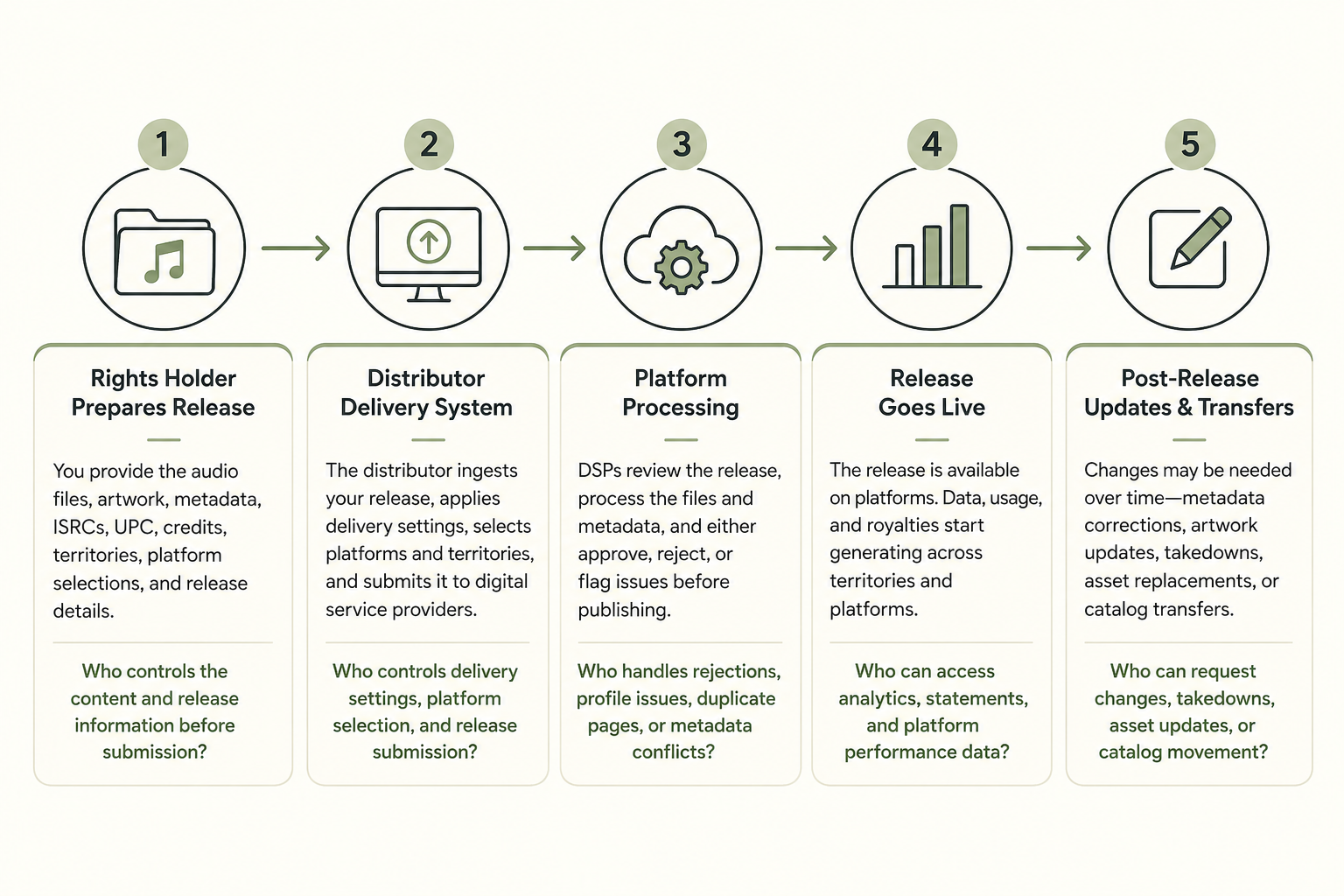
Before delivery, the rights holder usually controls the creative and administrative materials: the audio files, artwork, release title, artist name, featured artist formatting, ISRCs, UPC, contributor details, explicit tags, territories, platform selections, and release date. Those details are not just technical inputs. They affect how the recording appears on DSPs, how income is matched, how credits are displayed, and whether the release connects properly to the right artist profiles.
After the release is submitted, control often shifts into the distributor’s delivery system. Platform access may run through a dashboard, account manager, delivery feed, or backend process that the rights holder cannot access directly. That makes the distributor’s response time and correction process important. A metadata error, duplicate artist profile, rejected artwork file, missing territory, incorrect version title, or delayed platform approval can affect the release even when the master ownership terms are clear.
Platform processing can create problems that are partly outside the rights holder’s view. A DSP may reject a release, merge it with the wrong profile, delay availability in certain territories, flag conflicting metadata, or process a correction more slowly than expected. The agreement and the distributor’s operating process should make clear who handles those issues, how requests are prioritized, and whether the rights holder receives updates when platform-side problems affect the release.
Once the recording is live, access to information becomes part of release control. Analytics, royalty dashboards, territory data, playlist information, platform-level income, statement downloads, and split payment tools can help the rights holder understand what is happening without relying only on summary payouts. Limited access does not always mean the deal is unfair, but it can make the catalog harder to manage, especially when multiple collaborators, releases, or territories are involved.
Post-release changes are where weak control language becomes visible. A rights holder may need to correct credits, update artwork, replace an asset, change a territory setting, remove a platform, resolve a duplicate release, transfer a catalog, or prepare for a new label or distributor relationship. If every change depends on the distributor’s discretion, the release can become difficult to manage even though the rights holder still owns the master.
Platform access is not the same as catalog control. A distributor may provide a useful dashboard while still controlling the backend relationship with DSPs and delivery partners. The contract should match that reality by explaining how releases are submitted, how corrections are handled, what access the rights holder receives, and how quickly the catalog can be updated when something changes.
Marketing, Playlist Pitching, and Label Services Obligations
Marketing language in distribution deals can sound more definite than it really is. A proposal might mention playlist pitching, campaign strategy, advertising support, analytics, content planning, sync outreach, physical distribution, or label services, while the contract gives the distributor broad discretion over whether any of that support is actually provided.
Promised Services vs. Available Services
The first distinction is between a service the distributor is promising to deliver, and a service the distributor is simply capable of offering. Those are not the same deal.
A distributor that agrees to prepare a campaign plan, assign a project manager, spend an approved budget, coordinate advertising, or submit a release for editorial consideration is taking on a clearer obligation. A distributor that says it “may,” “can,” or “at its discretion” provide marketing support is leaving more room to decide what happens after signing.
This difference matters when the distributor’s share is higher because of the services being discussed. If a larger commission, longer term, or exclusive grant is tied to marketing support, the agreement needs enough detail to show what the rights holder is receiving in exchange.
Playlist Pitching and Editorial Support
Playlist pitching is often one of the most misunderstood parts of a distribution relationship. A distributor may be able to submit releases to DSP editorial teams, recommend tracks through platform tools, coordinate pitch timing, or advise on release setup. That still does not mean the distributor controls playlist placement.
DSPs, editors, algorithms, and platform systems decide what gets placed, surfaced, or recommended. The distributor’s obligation is usually limited to the pitching or submission activity, not the result. Stronger language might require the distributor to pitch by a certain deadline, include the release in a campaign discussion, or provide confirmation that submissions were made. It rarely means guaranteed playlist adds.
For example, “playlist support” could mean a formal editorial pitch, access to a submission tool, internal release notes, general account guidance, or an informal recommendation. The contract should make clear which version is actually being offered.
Marketing Spend and Campaign Costs
Campaign support becomes more serious when money is involved. A distributor might provide a marketing budget, front advertising costs, coordinate PR, pay for content creation, support influencer activity, or cover other release expenses. Those costs can affect the rights holder’s payouts if they are recoupable from future income.
The agreement needs to show who approves the spend, what the budget covers, whether unused amounts expire, which costs are recoupable, and how those costs appear on royalty statements. Without that detail, campaign support can turn into an open-ended deduction rather than a clear investment in the release.
Approval rights are especially important. A rights holder may agree to recoup a defined campaign budget, but that is different from allowing the distributor to add third-party costs without approval and recover them from royalties later.
Label Services Without Label-Level Control
Label services can be useful when the distributor is bringing real infrastructure to the release. Campaign planning, advertising coordination, physical distribution, analytics, project management, sync support, and audience development can help an artist or label operate with more reach than a basic delivery arrangement.
The control terms still need to match the service level. A distributor providing hands-on campaign support may reasonably ask for more coordination, a longer runway, or a higher share of income. Vague support language should not be used to justify broad approval rights, long exclusivity, unclear recoupable costs, or restrictions that make the catalog difficult to move later.
A good label services clause reads like a working plan, not a sales deck. It identifies what the distributor will do, what remains the rights holder’s responsibility, who approves campaign decisions, how costs are handled, and what happens if the promised support does not materialize.
Reporting, Analytics, Payout Timing, and Split Tools
After delivery, the distribution relationship becomes an accounting relationship. The rights holder needs enough information to understand how the release is performing, what income has been received, which deductions were applied, when money becomes payable, and whether collaborators or split recipients are being paid correctly.
Dashboard Access vs. Royalty Accounting
A distributor’s dashboard can be useful, but analytics and royalty accounting serve different purposes. Streaming counts, territory trends, playlist activity, audience data, and platform performance can help guide release decisions. Royalty statements explain money: income source, reporting period, deductions, adjustments, reserves, payment thresholds, recoupment balances, and payable amounts.
A deal can offer strong analytics and still leave gaps in accounting detail. The rights holder may see that a track is performing well in a territory, but still need statement-level information to confirm what the distributor received, what was deducted, and how the final payout was calculated.
Statement Detail
Royalty reporting should be detailed enough to follow the income from platform receipt to rights holder payout. That does not mean every distributor will provide the same statement format, but the agreement should say when statements are issued, what categories are reported, how adjustments are handled, and whether the rights holder can access historical data after the deal ends.
This becomes more important when the deal includes commissions, net receipts, recoupable costs, split payments, or catalog-level reporting. A simple release with one owner may be easy to track. A catalog with multiple artists, producers, collaborators, territories, and deductions needs clearer reporting so the rights holder is not relying on summary totals alone.
Payout Timing
Payout timing depends on both platform reporting cycles and the distributor’s own accounting process. DSPs and other partners may report income on delayed schedules, and the distributor may issue payments monthly, quarterly, or only once the account reaches a minimum threshold.
The agreement should make the timing realistic. A rights holder may see streaming activity immediately, but royalties tied to that activity may not appear in a payable statement until later. Delays can also come from currency conversion, tax documentation, reserves, platform corrections, chargebacks, or unresolved account information.
Payout timing affects more than the main rights holder. Producers, featured artists, collaborators, investors, and other split recipients may be waiting on the distributor’s reporting before downstream payments can be calculated. When the distribution deal sits at the top of the income chain, slow or unclear reporting can create problems across everyone who participates in the recording.
Split Tools and Payment Directions
Many distributors offer split tools that let rights holders route percentages of income to collaborators, producers, featured artists, labels, managers, or other recipients. These tools can reduce manual accounting, especially for independent releases where multiple contributors expect direct payment.
The tool does not replace the agreement behind the split. A payment direction in a distributor dashboard may show where money should go, but it does not always resolve who owns the master, who approved the split, whether a producer royalty is recoupable, whether a collaborator has a royalty right, or what happens if a dispute arises. The written deal should still support the payment setup.
Split tools also need operational review. The rights holder should understand whether splits apply by track, release, catalog, territory, platform, or income type; whether recipients need to accept the split before payment begins; what happens to unclaimed balances; and who can change or pause the split if ownership information is corrected later.
Access After the Deal Ends
Post-term access can be easy to overlook while the release is active. Once the catalog moves, the rights holder may still need old statements, historical analytics, tax records, adjustment details, split payment history, and unpaid royalty information. If the dashboard closes immediately after termination, the rights holder may lose access to information needed for audits, contributor accounting, catalog sales, or future disputes.
A distribution agreement should leave a clean record trail. The music may move to another distributor, but income earned during the old term still needs to be reported, adjusted, and paid under the old deal. Clear reporting language keeps that accounting from disappearing when platform access changes.
Catalog Migration and Post-Term Control
Ending a distribution deal does not automatically make the catalog ready to move. By the time a release is live, the distributor’s system may be tied to the ISRCs, UPCs, metadata, platform links, artist profiles, territory settings, royalty history, split tools, and unpaid income connected to the recordings. The exit terms need to account for that operational layer, not just the legal end date.
Moving the Catalog Without Breaking the Release
Catalog migration works best when the old distributor, new distributor, and rights holder are not creating conflicting versions of the same recordings. If takedowns and redelivery are poorly timed, platforms may show duplicate releases, split streaming activity across versions, lose playlist history, break artist profile connections, or create gaps in availability.
For example, an artist moving a catalog to a new distributor may want to preserve the same ISRCs, release dates, platform links, and playlist history. If the old distributor delays takedown while the new distributor redelivers too early, DSPs may treat the incoming version as a duplicate rather than a clean transfer. If the old release disappears before the new version is live, the catalog may lose availability during the changeover.
The agreement does not need to explain every technical step, but it should give the rights holder enough control to coordinate the move. That means clear timing for takedowns, confirmation of when rights end, continued access to release data, and a process for handling platform issues during transfer.
What the Old Distributor Still Handles
Post-term control often continues through accounting. Income earned during the deal may be reported after the catalog has moved, especially when DSPs report on delayed cycles or later issue adjustments. The old distributor may still need to process final statements, reserves, refunds, chargebacks, currency adjustments, taxes, unpaid balances, and split payments tied to the old term.
That continuing role should be limited and visible. The distributor may need time to finish accounting, but it should not keep broader control over the catalog unless the agreement clearly says so. Final reporting, dashboard access, statement downloads, and payment history are especially important when the rights holder needs records for collaborators, catalog buyers, audits, or future rights administration.
What the New Distributor Needs
A clean migration depends on more than the audio files. The new distributor may need the original ISRCs, UPCs, artwork, release dates, metadata, territory information, contributor details, explicit tags, version titles, prior platform links, and confirmation that the old distributor’s rights have ended or are ending. Missing or inconsistent information can create matching problems once the catalog is redelivered.
Ownership documentation may also be needed if the catalog is changing hands, moving from an artist account to a label account, or being delivered after a rights dispute. The smoother the records, the less likely the new distributor is to pause delivery, request additional proof, or redeliver the release in a way that separates it from its existing platform history.
Post-Term Rights and Restrictions
Post-term language should make clear what the distributor can still do after the agreement ends. Some rights may continue only long enough to process final income, complete takedowns, issue statements, or resolve platform adjustments. Other provisions may create longer restrictions, such as sell-off rights, continuing collection rights, recoupment-related extensions, catalog holdbacks, or limits on redelivery through another distributor.
Those restrictions can affect the catalog’s next opportunity. A rights holder preparing for a label deal, catalog sale, new distributor, or territory-specific partner needs to know whether the old distributor can delay transfer, keep collecting income, restrict redelivery, or require balances to be cleared first.
The cleanest exit path leaves a record trail. The rights holder should know when the distributor’s active rights end, how the catalog can be removed or transferred, what data remains accessible, how final income will be reported, and which obligations survive only for post-term accounting. When those points are clear, migration becomes a managed handoff instead of a dispute over who still controls the release.
Common Red Flags in Distribution Agreements
Red flags in a distribution agreement are usually less about one bad phrase and more about how several provisions work together. A deal may say the artist keeps ownership, but the term, exclusivity, recoupment language, takedown process, service obligations, and post-term rights may still make the catalog difficult to control.
- Broad rights that go beyond distribution - A distribution grant that covers all media, all formats, all uses, sublicensing, advertising, sync, physical products, neighboring rights, or brand uses can reach far beyond ordinary platform delivery. If the distributor is only being hired to deliver and administer releases, the rights language should not quietly give it control over unrelated exploitation.
- Exclusive rights with no clear exit path - Exclusivity can be reasonable when the distributor is investing real support into the release, but it becomes risky when the rights holder cannot identify when the deal ends, how notice works, whether renewal is automatic, or how the catalog can move afterward. The issue is not exclusivity by itself. The problem is exclusivity that traps recordings without a workable release valve.
- Marketing promises that are not actually commitments - Phrases like “marketing support,” “playlist pitching,” “campaign assistance,” or “label services” can sound valuable in a pitch deck, but the contract may leave those services entirely discretionary. If the distributor is receiving a larger commission, longer term, or broader rights because of promised support, the agreement needs to show what the distributor is actually expected to do.
- Recoupable costs with no approval process - An advance is easier to track than an open-ended campaign budget. A rights holder can agree to recoup a defined amount and still run into problems if the distributor can add advertising, PR, content, legal, delivery, or third-party costs without approval. Uncontrolled recoupable expenses can delay payouts even when the release is earning.
- Net receipts language that allows too many deductions - A percentage can look fair until the agreement defines the revenue pool. If platform income is reduced by broad fees, reserves, taxes, adjustments, currency costs, collection charges, third-party expenses, and other deductions before the split, the rights holder’s share may be much smaller than expected.
- Takedown rights controlled entirely by the distributor - A rights holder may need to remove or transfer a release because of a new distributor, label deal, rights dispute, sample issue, catalog sale, metadata error, or expired rights. If takedown depends only on the distributor’s discretion, the catalog can become difficult to manage at the exact moment control matters most.
- Automatic renewal language that is easy to miss - A short headline term can be misleading when the agreement renews automatically unless notice is sent during a narrow window. Missed notice can extend the deal even if the rights holder no longer wants the distributor involved.
- Catalog-wide restrictions for a release-specific deal - A deal for one release should not casually restrict future recordings, unrelated catalog, other territories, or separate projects unless that broader scope was negotiated. Catalog-wide language can interfere with future label conversations, distributor changes, acquisitions, or release plans.
- Weak reporting and limited statement access - A distributor may provide dashboard analytics while giving little detail on actual royalty accounting. Without clear statements, the rights holder may struggle to verify platform income, deductions, recoupment, reserves, split payments, unpaid balances, and post-term adjustments.
- Split tools with no supporting agreement - Dashboard splits can help route income, but they do not replace the legal basis for who gets paid. If collaborators, featured artists, producers, labels, or investors are added to a split tool without written support, the distributor’s payment setup may not resolve ownership disputes or royalty obligations.
- Post-term rights that continue too broadly - Some rights need to survive long enough for final accounting, delayed platform reports, reserves, adjustments, and unpaid balances. The warning sign is language that lets the distributor keep collecting, restricting, or controlling the catalog after the deal ends without a narrow accounting reason.
- No clear process for catalog migration - A catalog transfer can affect ISRCs, UPCs, platform links, playlist history, artist profiles, metadata, and royalty reporting. If the agreement does not address migration support, takedown timing, historical statement access, and final income reporting, moving the catalog later can become more difficult than signing the deal was.
A red flag does not always mean the deal is unusable. It means the rights holder needs to understand the tradeoff before signing. A broader grant, longer term, larger commission, or recoupable budget may make sense when the distributor is providing real support, but the contract should make the exchange visible.
Frequently Asked Questions
What is a distribution deal in music?
A distribution deal gives a distributor the authority to deliver recordings to platforms, collect master-side income from covered channels, report that income, and pay the artist, label, or rights holder under the agreement. Some deals only cover delivery and payout administration. Others include marketing, playlist pitching, funding, physical distribution, analytics, or label services.
Does a distribution deal mean the distributor owns the master?
Usually, no. A distributor can deliver and monetize a recording without owning the master. The rights holder may keep ownership while granting limited rights for distribution, collection, reporting, platform administration, and related uses. The contract language still matters because broad exclusive rights can limit control even when ownership remains with the artist, label, or master owner.
How is a distribution deal different from a record deal?
A distribution deal usually starts with finished recordings that the artist, label, or rights holder already owns or controls. The distributor’s role is to place those recordings into the market and handle income administration. A record deal often involves a wider artist-label relationship, which may include recording commitments, advances, creative approvals, marketing, promotion, options, master ownership or control, and long-term royalty accounting.
What percentage do music distributors take?
The distributor’s share depends on the deal. Some charge a flat fee or subscription. Others take a commission or revenue share. Higher-touch arrangements may include larger commissions because the distributor is providing marketing, label services, funding, or account support. The percentage should be reviewed together with the definition of revenue, allowed deductions, recoupable costs, payout timing, and reporting detail.
What does “net receipts” mean in a distribution deal?
Net receipts usually means the money left after certain deductions are taken from income received by the distributor. The exact definition depends on the agreement. Deductions may include platform fees, taxes, refunds, chargebacks, reserves, currency conversion, third-party costs, collection fees, or approved expenses. A rights holder should review what comes out before the revenue share is calculated.
Can a distributor recoup an advance?
Yes, if the agreement allows it. In a funded distribution deal, the distributor may provide an advance, marketing budget, or campaign spend and recover that amount from future income before additional payouts are made. The agreement should show which income sources are used for recoupment, whether costs need approval, whether expenses are capped, and when the rights holder starts receiving payments after the balance is cleared.
Does playlist pitching guarantee playlist placement?
No. A distributor may submit a release for editorial consideration, coordinate pitch timing, recommend a track, or provide platform-facing support, but DSPs and platform systems control placement decisions. Stronger agreement language may require the distributor to pitch or submit the release by a certain deadline. It should not be read as a guarantee of playlist results unless the contract says something unusually specific.
Can an artist leave a distributor and move the catalog?
An artist or rights holder may be able to move the catalog, but the process depends on the term, exclusivity, takedown language, recoupment status, post-term rights, and platform delivery process. Catalog migration can affect ISRCs, UPCs, release dates, platform links, playlist history, metadata, and royalty reporting. The exit process should be clear before the recordings are delivered.
What happens to royalties after the distribution deal ends?
Income earned during the deal may still be reported and paid after the term ends because platforms often report on delayed cycles. The old distributor may need to issue final statements, process reserves, apply adjustments, handle chargebacks, pay split recipients, or report unpaid balances. Post-term rights should be limited to those accounting needs unless the agreement clearly grants something broader.
What should artists watch for before signing a distribution agreement?
The most important points are the rights granted, the distributor’s fee or commission, the definition of net receipts, recoupable costs, service obligations, term, exclusivity, takedown rights, reporting access, split tools, and post-term control. A good deal should make it clear what the distributor can do, what the rights holder keeps, how money is calculated, and how the catalog can move when the relationship ends.
Key Takeaways
- A distribution deal controls how recordings are delivered, monetized, reported, and paid through the distributor’s platform relationships.
- Master ownership and distribution control are separate. A rights holder may keep the master while giving the distributor limited authority to deliver, administer, and collect income from covered channels.
- The grant of rights should match the distributor’s actual role. Broad language around licensing, sublicensing, sync, advertising, neighboring rights, physical products, or brand uses should be reviewed carefully.
- Distribution-only deals are mostly operational. Label services and funded distribution deals can involve more support, but they also tend to raise bigger questions about commissions, term, recoupment, exclusivity, and control.
- Marketing support and playlist pitching should be treated as contract obligations only when the agreement says what the distributor is actually required to do.
- Fees and commissions matter, but the revenue definition matters just as much. Net receipts language can change the amount left after deductions, reserves, adjustments, and recoupable costs.
- Advances and campaign spend can delay payouts if they are recoupable. The agreement should show what is being recovered, from which income, and with what approval process.
- Term, territory, exclusivity, takedown rights, and migration language determine how easily the catalog can move after release.
- Dashboard access does not always mean full accounting visibility. Rights holders need enough reporting detail to review income, deductions, splits, recoupment, reserves, and post-term payments.
- Split tools can help route payments, but they do not replace written agreements between contributors, producers, collaborators, labels, or investors.
- A strong distribution agreement explains both sides of the relationship: how the distributor helps get music into the market and how the rights holder keeps control when the deal changes or ends.
Practical Resource
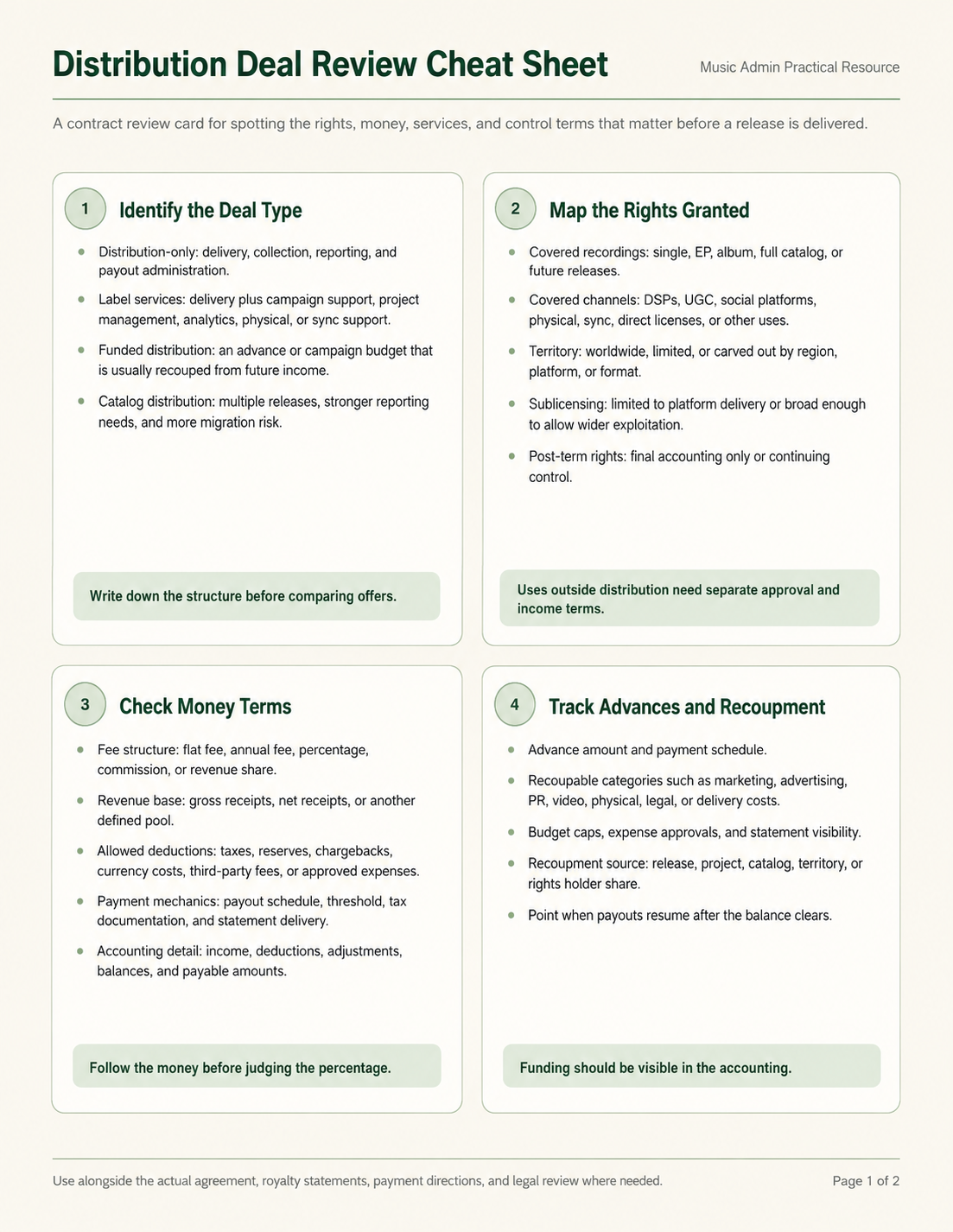
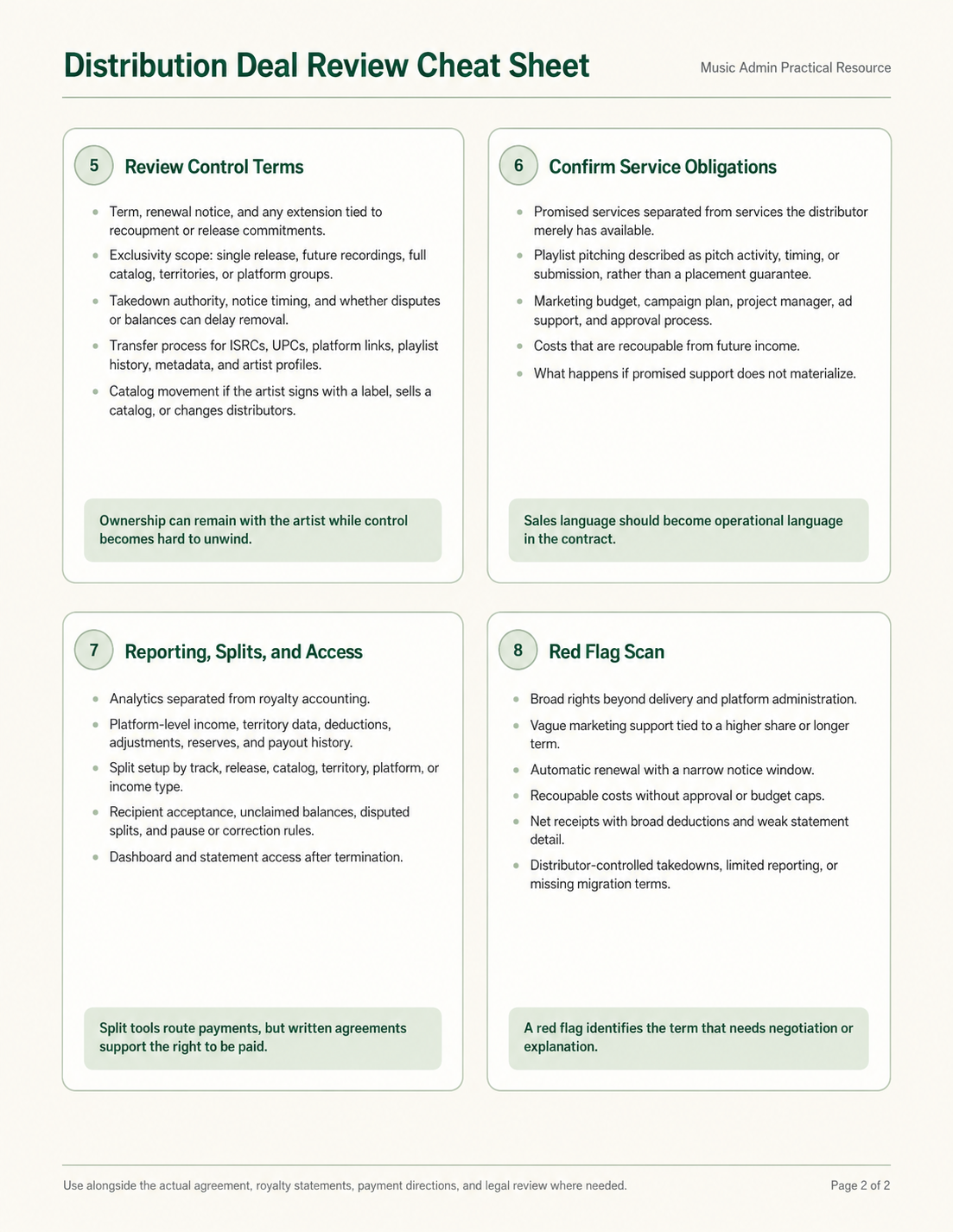
Distribution deals can be difficult to review because one agreement may cover delivery, revenue collection, marketing support, playlist pitching, funding, reporting, split tools, and post-term catalog control. A cheat sheet can make those moving parts easier to scan before signing or comparing offers.
You can also download the cheat sheet here:
[Download the Distribution Deal Review Cheat Sheet]
This resource is intended as a practical review aid. It can help organize the key questions around deal type, rights granted, money terms, service obligations, reporting access, migration, and common red flags before a distribution agreement is accepted.
References
Passman, Donald S. All You Need to Know About the Music Business. 11th ed. Simon & Schuster.
Apple Music for Artists. How to Distribute Your Music with Apple Music.
https://artists.apple.com/support/1108-get-your-next-release-on-apple-music
Apple Music Provider Support. Apple Music Guidelines.
https://itunespartner.apple.com/music/support/5213-guidelines
Apple Music Provider Support. Apple Music Metadata Standards.
https://itunespartner.apple.com/music/support/5214-apple-music-metadata-standards
Spotify for Artists. Pitching Music to Playlist Editors.
https://support.spotify.com/us/artists/article/pitching-music-to-playlist-editors/
Spotify for Artists. Playlisting.
https://artists.spotify.com/en/playlisting
DDEX. Electronic Release Notification Message Suite.
https://ddex.net/standards/electronic-release-notification-message-suite/
IFPI. International Standard Recording Code.
YouTube Help. Learn About Content ID Claims.