How Record Deals Work in the Music Industry
Learn how record deals work in the music industry, including advances, recoupment, royalties, master ownership, deal types, 360 agreements, and what artists should review before signing.

Introduction
Record deals sit at the center of the commercial music industry, but the way they work is often misunderstood. Public discussion usually focuses on headline numbers, artist signings, or ownership disputes, while the actual structure behind the agreements receives far less attention.
At their core, record deals are built around investment and risk. Labels provide funding, distribution, marketing, industry access, and operational support with the expectation that the recordings will generate revenue over time. In exchange, the label receives a share of income, control over certain rights, or ownership of the masters themselves.
The structure of these agreements can vary widely. Some deals revolve around traditional ownership models in which the label controls recordings for decades. Others focus more narrowly on distribution, licensing, or short-term services. Advances, royalty rates, recoupment terms, creative control, and contract length all influence how valuable a deal actually becomes for the artist.
Changes in streaming, social media, and digital distribution have also shifted the balance of leverage. Artists can now build audiences independently before entering negotiations, while labels continue to provide scale, financing, and global infrastructure that are difficult to replicate on their own.
This guide breaks down how record deals are structured, how money and rights flow through them, what labels typically provide, and why different deal types exist across different stages of an artist’s career.
Learning Objectives
By the end of this guide, you will be able to:
- Explain how record deals are structured within the music industry
- Understand why artists sign record deals and what labels provide in return
- Identify the major components of a recording agreement, including advances, royalties, ownership, and term length
- Understand how recoupment works and how labels recover their investment
- Distinguish between master ownership, licensing rights, and distribution rights
- Compare different types of record deals, including traditional, licensing, distribution, and label services agreements
- Recognize how 360 deals expand label participation across multiple revenue streams
- Understand how leverage, audience growth, and market demand affect negotiations
- Evaluate the advantages and tradeoffs between signing with a label and remaining independent
Overview
Record deals define how recorded music is financed, owned, distributed, and monetized between artists and labels. Once an agreement is signed, the relationship usually extends across multiple parts of the release cycle, including recording, marketing, distribution, royalty accounting, and long-term exploitation of the masters.
Most deals are structured around exclusivity. During the contract term, the artist records music primarily for that label, while the label gains the right to commercially release and exploit those recordings within specified territories and formats. The exact balance of control depends on the type of agreement and the negotiating leverage of the artist.
The economics behind these deals are tied closely to recoupment. Labels invest money upfront into recording costs, marketing campaigns, advances, videos, tour support, and other expenses. Revenue generated from the recordings is then used to recover those costs before many artists begin receiving royalty payments.
The industry now operates across multiple deal models rather than one standard structure. Traditional ownership deals still exist, but distribution agreements, licensing arrangements, profit splits, and label services models have become increasingly common, especially as artists build audiences independently before entering negotiations.
Streaming has also changed how labels evaluate artists and structure risk. Instead of relying only on radio exposure or physical sales projections, labels now track audience data, streaming growth, social engagement, and touring performance before making offers.
Table of Contents
What a Record Deal Actually Is
Most record deals are built around the same commercial trade. The label brings money, distribution, marketing support, staff, relationships, and infrastructure. The artist gives the label rights to release, sell, stream, license, and promote the recordings under agreed terms.
Those terms decide what the label actually controls. In some deals, the label owns the masters and keeps control for decades. In others, the artist owns the recordings and gives the label a temporary license to exploit them. A distribution or label services deal may be narrower, giving the company access to revenue from release support without the same level of ownership.
The contract can also cover future recordings, not only the first release. Option periods, delivery requirements, exclusivity, royalty rates, approval rights, territory, recoupment, and marketing obligations all affect how the relationship works after signing. The advance may get the attention, but the quieter terms often decide whether the deal is useful or restrictive.
Money flows through the deal in a specific way. Labels often pay for or contribute to recording, videos, marketing, playlist strategy, radio promotion, content, and tour support. Many of those costs are recoupable, so revenue from the artist’s royalties is used to repay the label before additional royalty income is paid out.
A record deal is not just a promise to release music. It is a rights, financing, and revenue agreement that determines who controls the recordings, how income is shared, and how much flexibility the artist keeps as the catalog develops.
Why Artists Sign Record Deals
Artists sign record deals when the resources a label can provide are worth the rights and revenue the artist is being asked to give up. That calculation is different for every artist. A new act may need money to finish recordings and build a campaign. A fast-growing independent artist may already have traction but needs a larger team to keep up. A more established artist may want global reach, radio support, or funding for a bigger creative rollout.
The advance is often the most visible part of the deal, but it is rarely the full reason an artist signs. Money can help cover recording, videos, content, promotion, touring support, and living expenses during a release cycle. Since many of those costs are recoupable, the advance functions more like upfront funding against future royalties than a simple payment the artist keeps without consequence.
A label can also bring structure to a campaign that has outgrown the artist’s independent setup. Release planning, digital strategy, press, playlist pitching, radio promotion, analytics, sync outreach, international coordination, and commercial partnerships all require time and specialized relationships. When an artist is trying to scale quickly, having those functions under one coordinated team can make the difference between scattered attention and a campaign that reaches multiple markets at once.
For some artists, the appeal is less about immediate money and more about access. Labels often have long-standing relationships with streaming platforms, media outlets, brand teams, radio programmers, distributors, and overseas partners. Those relationships do not guarantee success, but they can open doors that are difficult to reach independently, especially when a release needs support beyond the artist’s home market.
The decision becomes more complicated once ownership and control enter the picture. A label may offer funding and infrastructure while also asking for master rights, long contract terms, options on future releases, revenue participation, or approval over certain decisions. A large advance can look attractive at signing and still become restrictive if the artist gives up too much control or if recoupment makes royalty income difficult to access.
A good record deal should match the artist’s actual stage of growth. The right structure for an unknown artist needing development may be very different from the right structure for an independent artist already generating revenue, audience data, and leverage. The question is not simply whether a label can help, but whether the help being offered justifies the deal terms attached to it.
The Core Parts of a Record Deal
A record deal is built from several connected terms. The advance, royalty rate, ownership language, contract length, territory, and delivery obligations all affect how the agreement works in practice. Looking at one term in isolation can be misleading, since a strong advance may matter less if the deal gives the label long-term master ownership, broad recoupment rights, and several option periods.
These terms work together. A useful deal review should look at the whole structure: how long the commitment lasts, what rights the label controls, what costs are recoupable, and how much flexibility the artist keeps after signing.
Advances and Recoupment
Advances are one of the most misunderstood parts of record deals. They are paid upfront, but they usually function as an advance against future royalties rather than a bonus or guaranteed profit.
If a label pays an artist a $100,000 advance, the artist can use that money immediately. The label then tracks the artist’s royalty earnings until the recoupable balance has been recovered. During that period, royalties are being earned on paper, but the artist may not receive additional royalty payments from the label until the account becomes recouped.
Recoupment can include more than the advance. Depending on the deal, the label may also recoup recording costs, video costs, tour support, marketing support, radio promotion, and other approved campaign expenses. This is why the total balance an artist must earn back can be higher than the advance itself.
A simplified example:
If the artist’s royalty account earns $120,000, the deal is still unrecouped by $60,000. The artist has generated income, but that income is being applied against the label’s investment first.
Recoupment does not usually mean the artist has to repay the label out of pocket if the release underperforms. The label carries the commercial risk unless the agreement says otherwise. The tradeoff is that royalty income is held back until the recoupable balance is cleared.
This is why a smaller advance with fewer recoupable costs can sometimes be better than a larger advance tied to heavy spending. The headline number matters, but the real question is how much income has to be earned before the artist participates in royalties beyond the advance.
Master Ownership and Rights Control
Master ownership is one of the biggest differences between record deals. The master is the actual sound recording, separate from the underlying composition. Whoever owns or controls the master has the right to commercially exploit that recording through streaming, downloads, physical sales, sync licensing, compilations, reissues, and other uses.
In a traditional record deal, the label often owns the masters created during the contract term. The label funds the recordings, manages the release, and takes on the commercial risk. In return, it usually receives long-term ownership or control over those recordings. The artist earns royalties from the master income, but the label controls the asset.
Other deals work differently. In a licensing agreement, the artist may keep ownership of the masters while granting the label the right to exploit them for a set period. After that term ends, the rights can return to the artist, depending on the contract. Distribution and label services deals may involve even less control, with the artist retaining ownership while paying for distribution, marketing, or operational support.
A simple comparison helps:
Master ownership matters because recordings can keep earning long after the first release cycle. A song may generate income from streaming for years, then later appear in a film, commercial, video game, playlist campaign, catalog reissue, or anniversary release. If the label owns the master, the label controls those opportunities unless the contract gives the artist approval rights.
Control can be just as important as ownership. An artist may technically keep ownership but still give a company broad rights to approve releases, license recordings, or control marketing decisions for a period of time. On the other hand, an artist in a traditional deal may negotiate approval rights over sync uses, remixes, artwork, or certain commercial placements.
Reversion rights are another issue to watch. Some agreements allow masters to return to the artist after a set number of years, after recoupment, or at the end of a licensing term. Others give the label control for the life of copyright. That difference can affect the artist’s catalog value, future negotiating power, and long-term income.
A record deal should always be reviewed beyond the question of who releases the music. The more important question is who controls the recording once it starts generating value.
Royalty Structures and Revenue Splits
Royalty terms determine how an artist participates in revenue generated by the recordings. The percentage written into the contract matters, but it never works alone. The artist’s actual payout depends on the royalty base, recoupment status, deductions, producer points, and the type of revenue being counted.
A simplified royalty flow might look like this:
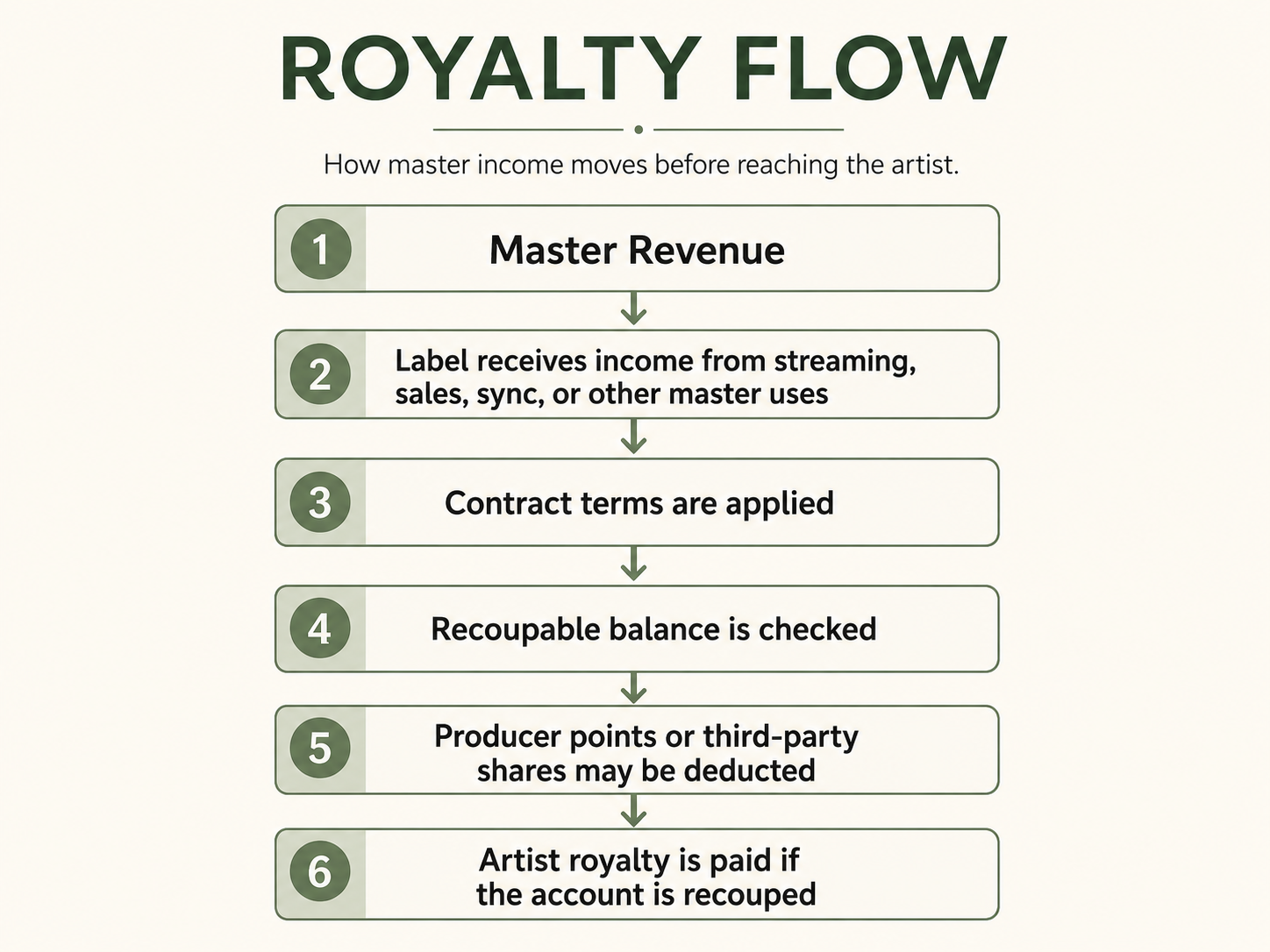
This is why two artists with similar royalty rates can end up with very different outcomes. One deal may define the royalty base more favorably, limit deductions, and keep recoupable costs narrow. Another may carry the same headline rate but include broader deductions, higher recoupable spending, or long-term master control that reduces the artist’s leverage.
A simple example helps show the difference:
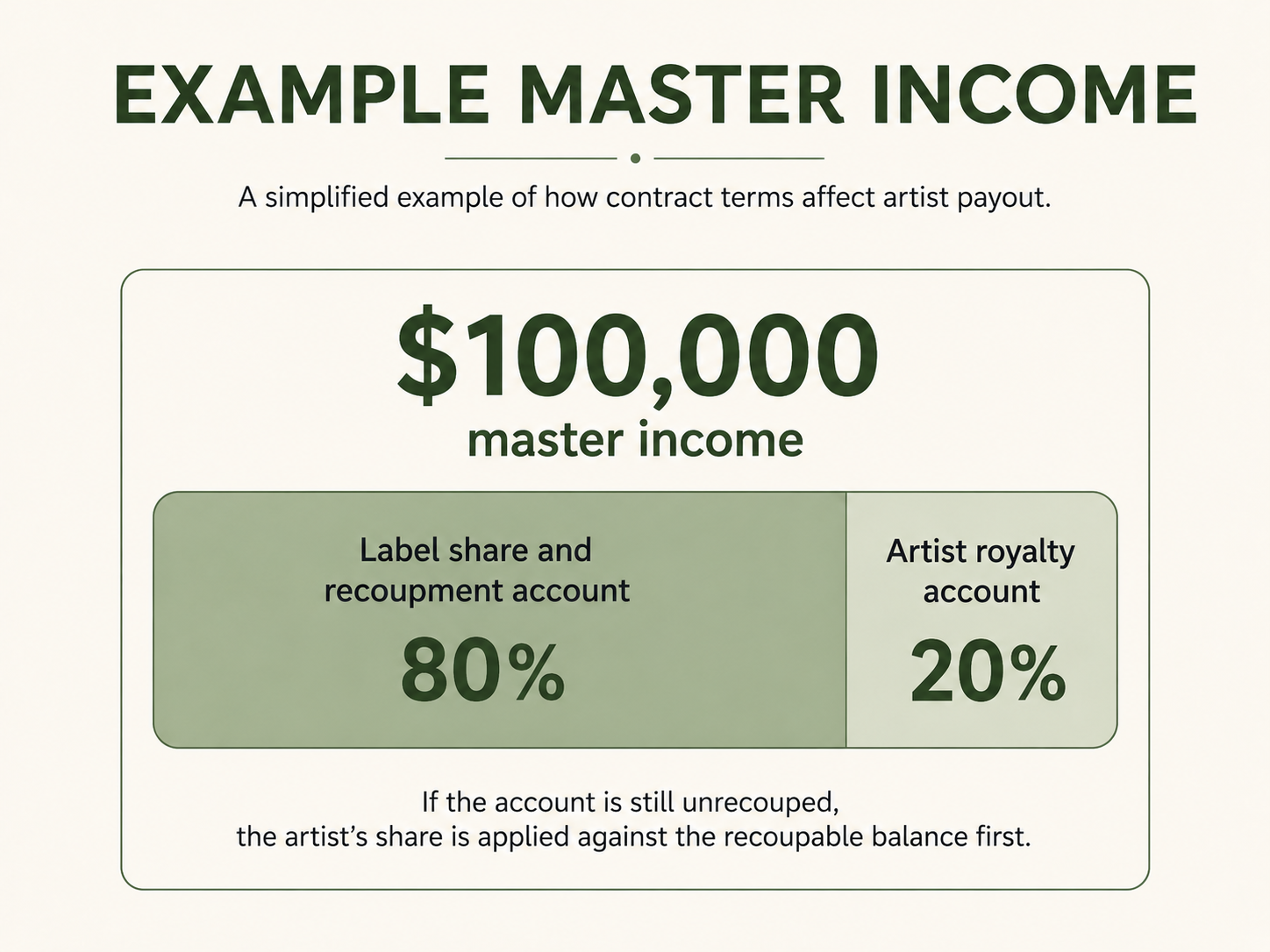
This does not mean the artist automatically receives $20,000. If the artist still has an unrecouped balance, that royalty amount is applied against the balance first. If producer points are paid from the artist’s share, those points may reduce what ultimately reaches the artist. The stream of income is real, but the payment timeline depends on the account.
Different revenue sources may also be treated differently. Streaming income, physical sales, downloads, sync fees, neighboring rights, and compilation income can each have their own accounting rules. A sync placement, for example, may produce a larger one-time fee and require approval rights, while streaming income is usually smaller per use but accumulates over time.
Some modern agreements avoid traditional royalty accounting and use profit splits instead. In a profit split, approved costs are deducted first, then the remaining profit is divided between the artist and label. That can be clearer in some deals, especially when the artist keeps ownership or the company is providing distribution, marketing, or label services rather than full master control.
Royalty terms should always be reviewed with the full deal structure in mind. A high royalty rate can lose value if the recoupment terms are heavy. A lower rate can be more workable if the artist keeps ownership, has fewer deductions, or receives stronger accounting rights.
Deal Terms, Options, and Album Commitments
The length of a record deal is usually shaped by more than the first release named in the agreement. A contract may begin with one album or set of masters, then give the label the right to extend the deal through additional option periods. Those options are often controlled by the label, which means the artist may not have the same freedom to walk away after the first project.
This is why a deal described casually as a “one-album deal” can still create a longer commitment. The first album may only satisfy the initial period. If the contract includes multiple options, the label may be able to require more recordings in later periods, often with new advances, royalty adjustments, or delivery obligations attached to each stage.
Album commitments are also tied to what the contract accepts as delivery. The agreement may require a specific number of tracks, fully mixed and mastered recordings, commercially acceptable material, or approval from the label before a release counts toward the artist’s obligation. If the label rejects the material or says the delivery requirements have not been met, the artist can remain in the same contract period longer than expected.
Timing language can matter just as much as the number of albums. Some contracts give the label broad windows to decide whether to release a project, exercise the next option, or approve delivered recordings. Long decision windows can slow the artist’s momentum, especially when the artist cannot release other music freely during the waiting period.
Step-up terms are worth watching closely. If the label has options for future albums, the artist may want each new period to come with improved terms, such as a higher advance, better royalty rate, larger recording budget, or stronger approval rights. Without those improvements built into the contract, a successful first release may still leave the artist tied to the original economics.
The key point is that “term” is not only about time on a calendar. It includes the number of recordings owed, the label’s option rights, delivery standards, release obligations, and the artist’s ability to move forward if the label delays or declines to act.
Distribution, Marketing, and Label Services
After a deal is signed, the label’s role depends heavily on what kind of agreement the artist entered. A traditional record deal, a distribution deal, and a label services arrangement may all put music into the market, but they do not provide the same level of support or take the same level of control.
In a traditional label deal, distribution is only one part of the relationship. The label may fund recording, manage the release schedule, coordinate marketing, pitch to streaming platforms, hire radio promotion teams, support video production, and work with international offices or partners. The artist gives up more rights, but the label is expected to carry more responsibility across the campaign.
Distribution deals are usually narrower. The distributor’s main job is to deliver music to DSPs, collect revenue, and provide reporting. Some distributors offer playlist pitching, analytics, content tools, or limited marketing support, but the artist or their team often remains responsible for the larger campaign. These deals can work well for artists who already have momentum and mainly need platform access, not full label development.
Label services sit somewhere between those two models. A services company may help with marketing, project management, digital strategy, physical distribution, radio, press, or international coordination without taking full ownership of the masters. The artist may pay through a fee, a revenue share, or a limited-term rights arrangement. The appeal is flexibility, though the artist usually needs enough budget or existing traction to make the model effective.
The difference often comes down to how much infrastructure the artist needs and how much control they are willing to trade for it. A major label may offer global reach and funding, but expect broader rights and longer participation. A distributor may take less, but provide less hands-on support. A label services partner may offer targeted help, but the artist still needs a clear plan and enough internal capacity to manage the release.
For artists reviewing offers, the important question is not only who can release the music. It is who is responsible for building the campaign, what support is guaranteed in writing, how costs are handled, and whether the company’s role matches the rights it is asking for.
Creative Control and Approval Rights
Creative control determines how much say the artist keeps once the label becomes involved in the recordings. The more rights a label controls, the more influence it may have over how the music is finished, released, marketed, and licensed.
Approval rights can apply to many parts of the process, including:
- release timing
- single selection
- album sequencing
- artwork and visual direction
- music videos
- remixes and featured collaborations
- sync placements
- marketing strategy
- use of the artist’s name, image, or likeness
In traditional record deals, labels often have broad discretion over commercial decisions. They may decide when a project is released, which songs are pushed as singles, how much is spent on marketing, and whether certain licensing opportunities are approved. The artist may still guide the creative direction, but the label’s approval can become necessary once money and rights are involved.
Artists with more leverage often negotiate stronger approval rights. That might include consent over sync uses, major brand partnerships, remix releases, album artwork, or release scheduling. In some cases, the contract may require mutual approval, which means neither side can move forward on certain decisions without the other.
Approval rights also affect how quickly decisions can be made. If every major use requires label approval, opportunities may move slower. On the other hand, if the label has too much freedom, the artist may lose control over how the music is presented or licensed. The balance depends on the artist’s bargaining power and the kind of deal being signed.
For many artists, creative control is less about having approval over every detail and more about protecting the decisions that matter most. A contract should make clear where the artist has consent rights, where the label has final say, and which decisions require both parties to agree.
Creative Control and Approval Rights
Creative control in a record deal is negotiated through approval rights. These provisions decide which choices the label can make on its own, which choices require the artist’s consent, and where both sides need to agree before moving forward.
Approval rights often matter in a few key areas.
- Music and release decisions - This can include single selection, track sequencing, remix approvals, featured artists, and release dates. It can also cover whether the label accepts the recordings as delivered. These terms are especially important when the artist wants protection against a release being delayed, reshaped, or pushed in a direction that does not match the project’s intent.
- Visual and brand presentation - Artwork, music videos, press images, campaign visuals, and use of the artist’s name or likeness can all shape public perception. Artists with stronger leverage may negotiate approval over major visual assets, particularly when their image is central to the brand.
- Commercial licensing decisions - Sync placements, advertising uses, brand partnerships, games, trailers, and other commercial placements can generate meaningful income, but they can also attach the artist’s music to products or messages the artist may not want to support. Some contracts give the label broad licensing authority, while others require artist approval for sensitive or high-profile uses.
- Marketing and campaign strategy - Labels may control rollout timing, promotional spend, playlist pitching, radio campaigns, social strategy, and territory-specific plans. Artist approval over every marketing choice is uncommon, but larger strategic decisions can sometimes be negotiated, especially for established acts.
The amount of control an artist keeps usually depends on leverage. A new artist may have limited approval rights beyond narrow creative protections. An established artist with a proven audience may be able to negotiate consent over major licensing uses, release timing, artwork, or other decisions that affect long-term positioning.
Vague language causes problems later. A contract should make clear where the label has final say, where the artist has approval, and which decisions require mutual agreement.
Common Types of Record Deals
Record deals are not all built the same way. Some give the label broad control over masters, marketing, and long-term revenue. Others are narrower, focused on distribution or specific services, while leaving more ownership with the artist. The right structure depends on what the artist needs, what they already have, and how much control they are willing to exchange for support.
No deal type is automatically better than another. A traditional deal can make sense when an artist needs major funding and global infrastructure. A distribution or services deal can be stronger when the artist already has audience demand, ownership, and a team. The main issue is whether the rights being granted match the support being promised.
360 Deals and Expanded Revenue Participation
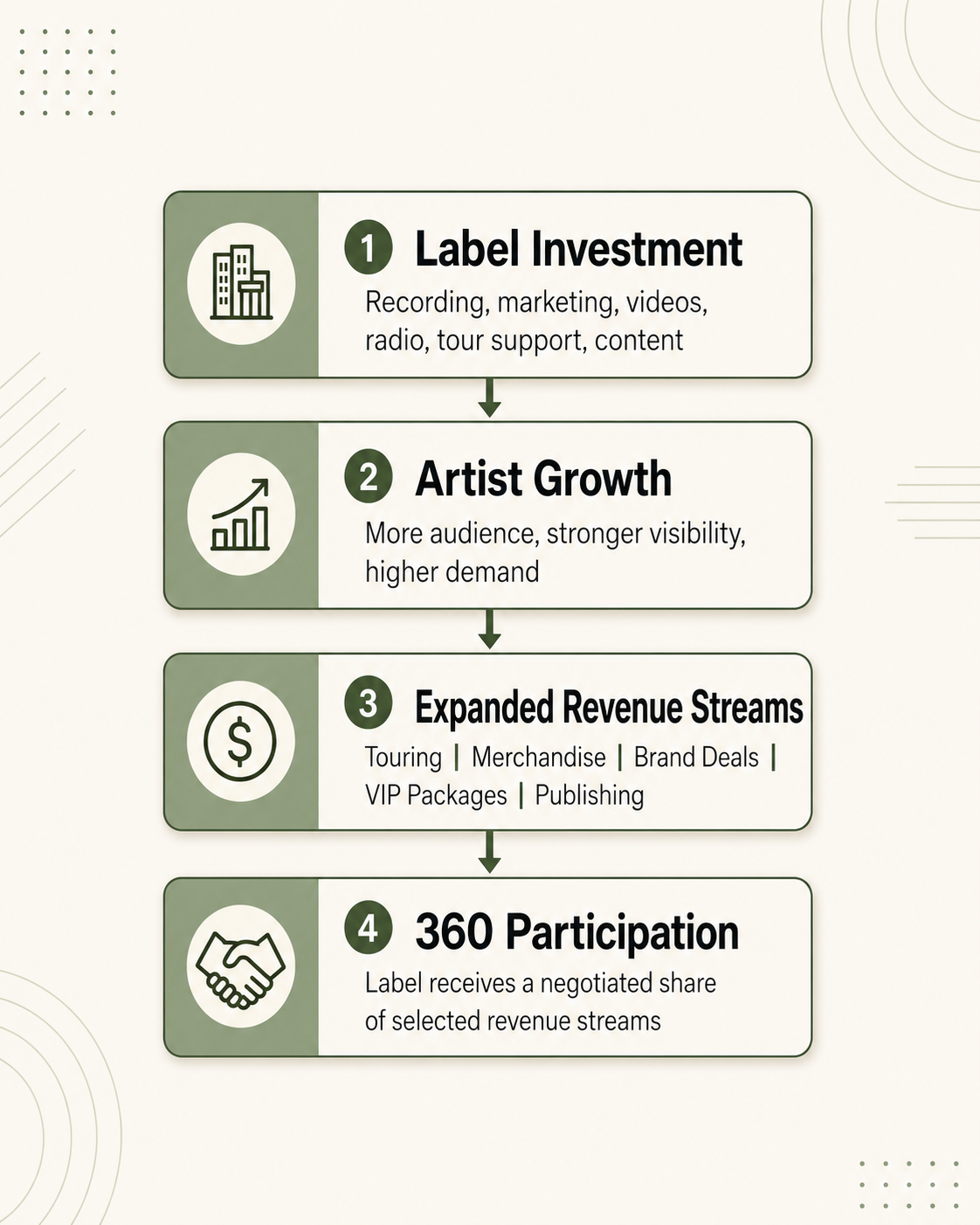
A 360 deal gives the label participation in revenue beyond recorded music. Instead of earning only from master income, the label may also receive a share of touring, merchandise, sponsorships, publishing, fan clubs, VIP packages, or other artist-related income.
The logic behind these deals is that labels often invest in more than the recording itself. If the label funds artist development, marketing, videos, radio promotion, tour support, content, and brand-building, it may argue that its investment helps increase the artist’s value across the entire business. A song campaign can drive ticket sales. A hit record can increase merch revenue. A major label rollout can create brand opportunities. From the label’s perspective, the broader participation helps justify the risk.
For artists, the concern is whether the label is actually contributing to those other areas. If the label wants a percentage of touring or merch income, the agreement should be clear about what support the label provides in return. A deal that takes from multiple revenue streams without adding meaningful value to those streams can become expensive quickly.
A practical example helps. An artist signs a 360 deal with a label that funds a major album rollout, video campaign, and tour support. The campaign increases the artist’s audience, which leads to higher ticket sales and stronger merchandise income. Under the 360 structure, the label receives a negotiated share of those additional revenue streams because the deal treats the artist’s broader business as connected to the label’s investment.
The risk is that these revenue streams may already involve other parties. Touring income may be shared with booking agents, managers, promoters, crew, and production vendors. Merchandise revenue may involve manufacturing costs, venue commissions, and merch companies. Sponsorship income may involve managers, agents, or brand partners. When a label share is added on top of those existing costs, the artist’s remaining income can shrink.
The key questions are practical: which revenue streams are included, what percentage the label receives, how long the participation lasts, and whether the label has obligations tied to those areas. A narrower 360 structure may only apply to specific income connected to label-supported activity. A broader version may reach across most of the artist’s business.
360 deals are not automatically harmful, but they require careful review. The artist should understand whether the expanded participation reflects real support or simply gives the label a share of income it is not helping create.
360 Deals and Expanded Revenue Participation
A 360 deal gives the label participation in revenue beyond recorded music. Instead of earning only from master income, the label may also receive a share of touring, merchandise, sponsorships, publishing, fan clubs, VIP packages, or other artist-related income.
The logic behind these deals is that labels often invest in more than the recording itself. If the label funds artist development, marketing, videos, radio promotion, tour support, content, and brand-building, it may argue that its investment helps increase the artist’s value across the entire business. A song campaign can drive ticket sales. A hit record can increase merch revenue. A major label rollout can create brand opportunities.
How Record Deals Are Negotiated
Record deal negotiations usually begin before paperwork appears. By the time an offer is being discussed, the label has already made a judgment about the artist’s potential value: audience growth, streaming activity, social traction, touring demand, creative direction, and whether the artist fits the label’s current priorities.
The artist’s leverage depends on how much proof already exists. A new artist with limited data may be negotiating mainly around development support and upfront funding. An independent artist with strong streaming numbers, ticket sales, press, or multiple interested labels can usually push harder on ownership, term length, royalty rates, creative approvals, and recoupment limits.
Negotiations often involve several people around the artist:
- Manager - Handles strategy, business positioning, and the overall direction of the negotiation. The manager usually helps decide whether the offer fits the artist’s career goals.
- Attorney - Reviews the contract language, negotiates legal terms, flags risk, and makes sure the artist understands what rights are being granted. A music attorney is especially important because small wording differences can affect ownership, recoupment, options, and approval rights.
- Business manager or accountant - Reviews financial terms, royalty accounting, tax implications, budgets, and whether the deal economics make sense over time.
- Publisher or publishing administrator - May be involved if the deal touches publishing rights, 360 participation, sync, or broader revenue streams connected to compositions.
The main negotiation points usually include the advance, royalty rate, ownership of masters, length of term, number of options, recoupable costs, territory, marketing commitments, approval rights, and accounting protections. A better deal is not always the one with the highest advance. A smaller advance with master ownership, a shorter term, fewer options, and clearer accounting can sometimes leave the artist in a stronger position long term.
Labels also negotiate based on risk. If they are spending heavily on recording, marketing, radio, video, tour support, or international rollout, they usually ask for more control or a larger share of revenue. If the artist is bringing completed music, an existing audience, and a working team, the label may have less justification for owning the masters or controlling several future albums.
Multiple offers can change the entire conversation. When labels are competing, the artist may be able to negotiate better terms or choose a deal structure that fits more closely with their goals. Without competition, the negotiation often depends on how convincingly the artist’s team can show demand, growth, and commercial potential.
The strongest negotiations focus on the full structure rather than one attractive term. The advance, royalty rate, ownership language, recoupment rules, creative rights, and option periods all need to make sense together.
For artists, the concern is whether the label is actually contributing to those other areas. If the label wants a percentage of touring or merch income, the agreement should be clear about what support the label provides in return. A deal that takes from multiple revenue streams without adding meaningful value to those streams can become expensive quickly.
A practical example helps. An artist signs a 360 deal with a label that funds a major album rollout, video campaign, and tour support. The campaign increases the artist’s audience, which leads to higher ticket sales and stronger merchandise income. Under the 360 structure, the label receives a negotiated share of those additional revenue streams because the deal treats the artist’s broader business as connected to the label’s investment.
The risk is that these revenue streams may already involve other parties. Touring income may be shared with booking agents, managers, promoters, crew, and production vendors. Merchandise revenue may involve manufacturing costs, venue commissions, and merch companies. Sponsorship income may involve managers, agents, or brand partners. When a label share is added on top of those existing costs, the artist’s remaining income can shrink.
The key questions are practical: which revenue streams are included, what percentage the label receives, how long the participation lasts, and whether the label has obligations tied to those areas. A narrower 360 structure may only apply to specific income connected to label-supported activity. A broader version may reach across most of the artist’s business.
360 deals require careful review because the expanded participation can be reasonable in one deal and excessive in another. The difference usually comes down to whether the label is taking a share of the theincome it helped create.
Why Some Artists Stay Independent
Independence is no longer only the fallback for artists who cannot get signed. For many, it is a deliberate business choice. Digital distribution, direct fan access, social platforms, email lists, merch stores, and self-managed marketing tools have made it possible to build a real recorded music business before any label becomes involved.
An artist who owns their masters keeps control over how recordings are released, licensed, packaged, reissued, and monetized. That control can matter years after the first campaign ends. A catalog that starts small can become valuable later through streaming, sync placements, fan demand, or re-releases. Giving up that ownership only makes sense if the label’s contribution is strong enough to justify it.
Release flexibility is another reason artists stay independent. A label may want a longer rollout, approval over singles, or a specific campaign strategy. Independent artists can move faster, test different formats, release music when the audience is most engaged, and adjust the plan without waiting for multiple approvals.
The harder part is infrastructure. Distribution is easier to access now, but distribution alone does not create a campaign. Independent artists still need budget planning, creative direction, content, playlist strategy, press, radio if relevant, analytics, accounting, metadata management, royalty tracking, and rights administration. Some build that team gradually through managers, freelancers, distributors, publicists, marketers, and label services partners.
Funding also changes the equation. Without a label advance, the artist usually pays upfront for recording, visuals, promotion, touring support, and campaign execution. Keeping more revenue sounds attractive, but the artist is also carrying more of the financial risk before the release earns anything back.
For artists with clear audience demand, strong ownership goals, and enough operational support, independence can preserve long-term value. For artists who need major capital, global infrastructure, radio support, or a large coordinated rollout, a label deal may still be the better vehicle. The question is which structure gives the artist the most useful support without taking more rights than the support is worth.
Major Labels, Imprints, and Distribution Networks
The recorded music business is organized through parent companies, label groups, frontline labels, imprints, and distribution arms. To an artist, those names can look separate on the surface, but many of them sit inside larger corporate networks.
The three major recorded music companies are Universal Music Group, Sony Music Entertainment, and Warner Music Group. Each operates multiple labels and business units across recorded music, publishing, merchandising, artist services, and international markets. UMG says it owns and operates businesses across recorded music, music publishing, merchandising, and audiovisual content in more than 60 territories, while Warner describes itself as active across recorded music, publishing, and artist services.
An imprint may have its own brand, roster, creative direction, and executive team while still relying on the parent company for distribution, funding, marketing infrastructure, data, and international support. That structure lets a label feel specialized while still connecting into a much larger system.
Distribution networks add another layer. A company may distribute independent labels or artist-owned projects without signing the artist to a full traditional record deal. ADA, for example, describes itself as Warner Music Group’s independent distribution and label services arm.
For artists, the important question is not only which logo appears on the offer. It is the company that controls the deal, which team will actually work the record, what services are included, and where the recordings will sit inside the larger system.
A smaller imprint with the right team can sometimes be more useful than a large label, where the artist becomes a low priority. A distribution arrangement connected to a major company may offer reach without the same ownership terms as a traditional deal. The structure behind the name often matters as much as the name itself.
Frequently Asked Questions
What is a record deal? A record deal is an agreement between an artist and a label or music company that sets out how recordings will be funded, released, distributed, promoted, owned, and monetized. The exact structure depends on the type of deal.
Does signing a record deal mean the artist owns their masters? Not always. In many traditional record deals, the label owns or controls the masters. In licensing, distribution, or label services deals, the artist may keep ownership while granting the company certain rights for a limited period.
Is an advance free money? No. An advance is usually recoupable, which means the label earns it back from the artist’s royalties before additional royalty payments are made. The artist typically does not repay the advance out of pocket if the release underperforms, unless the contract includes unusual repayment language.
Why do artists sign record deals if they can release music independently? Labels can provide funding, marketing infrastructure, distribution reach, radio support, playlist strategy, international coordination, and experienced teams. Artists sign when those resources are worth the rights, revenue, or control they are being asked to give up.
What is recoupment in a record deal? Recoupment is the process of the label recovering approved costs from the artist’s royalty account. These costs may include advances, recording expenses, video budgets, tour support, marketing, and other agreed campaign expenses.
What is the difference between a traditional deal and a distribution deal? A traditional deal usually gives the label more control over the recordings and campaign, often including master ownership or long-term rights. A distribution deal is narrower, usually focused on delivering music to platforms, collecting revenue, and providing reporting or limited support.
What is a 360 deal? A 360 deal allows the label to participate in revenue beyond recordings, such as touring, merchandise, sponsorships, VIP packages, or other artist income. The fairness of the deal depends on what the label contributes to those areas and how broad the revenue participation is.
Can an artist negotiate better terms after signing? Sometimes, but it depends on the contract. If the label holds option rights, the artist may have limited room to renegotiate unless step-up terms were already included. Strong performance, competing interest, or a new deal cycle can improve leverage.
What should artists review before signing a record deal? Artists should review master ownership, term length, option periods, recoupable costs, royalty rates, creative approval rights, territory, delivery requirements, accounting rights, and what the label is actually obligated to provide.
Is the biggest advance always the best deal? No. A large advance can be attractive upfront, but it may come with broad recoupment, long-term master control, multiple options, or reduced flexibility. The stronger deal is usually the one where the money, rights, control, and obligations make sense together.
Key Takeaways
- Record deals are built around an exchange: the label provides funding, infrastructure, distribution, marketing, and industry access, while the artist grants rights to release and monetize recordings under agreed terms.
- The value of a record deal depends on the full structure, not the headline advance. Term length, territory, exclusivity, delivery requirements, royalty rate, ownership, and recoupment all affect the outcome.
- Advances are usually recoupable. The artist can use the money upfront, but the label recovers approved costs from the artist’s royalty account before additional royalty payments are made.
- Master ownership is one of the most important parts of a record deal. Whoever owns or controls the master has long-term power over licensing, reissues, catalog value, and commercial use of the recording.
- Royalty rates only tell part of the story. Deductions, producer points, recoupment, revenue source, accounting language, and deal type all affect what the artist actually receives.
- Deal terms and option periods can extend an artist’s commitment beyond the first release. A contract may begin with one album but give the label options to require future projects.
- Delivery requirements matter because a recording may need to meet technical, commercial, or approval standards before it satisfies the contract.
- Distribution, label services, licensing, profit split, and traditional record deals each offer different balances of ownership, support, control, and risk.
- Creative control is negotiated through approval rights. Artists should understand who has final say over release timing, singles, artwork, videos, sync uses, collaborations, and marketing direction.
- 360 deals allow labels to participate in income beyond recordings, such as touring, merchandise, brand deals, VIP packages, and publishing. These terms should be weighed against the support the label actually provides.
- Record deal negotiations are shaped by leverage. Audience data, streaming performance, ticket sales, competing offers, and existing infrastructure can all affect ownership, royalty rates, advances, options, and approval rights.
- Some artists stay independent to preserve master ownership, release flexibility, and long-term control. Independence can work well when the artist has demand, a team, and enough funding to support releases without full label infrastructure.
- Major labels, imprints, and distribution networks can be connected through larger corporate systems. Artists should look beyond the logo and understand which team will work on the project, what support is guaranteed, and who controls the recordings.
- A strong deal review looks at money, rights, control, timelines, obligations, and exit points together. No single term tells the full story on its own.
Practical Resource Section for the Guide
Record Deal Evaluation Worksheet
A structured worksheet for artists, managers, and music teams reviewing a potential record deal. It helps compare the terms that affect long-term value, including advances, recoupment, royalty rates, master ownership, option periods, territory, approval rights, label obligations, 360 participation, and exit terms.
References
Passman, Donald S. All You Need to Know About the Music Business. Simon & Schuster.
RIAA. 2024 Year-End Music Industry Revenue Report.
https://www.riaa.com/reports/2024-year-end-music-industry-revenue-report-riaa/
RIAA. 2024 Year-End Music Industry Revenue Report PDF.
https://www.riaa.com/wp-content/uploads/2025/03/RIAA-2024Year-End-Revenue-Report.pdf
IFPI. Global Music Report 2025.
https://www.ifpi.org/resources/
Universal Music Group. Company Overview.
https://www.universalmusic.com/company/
Sony Music. Official Website.
Sony Music. Labels and Content Divisions.
https://www.sonymusic.com/labels/
Warner Music Group. Official Website.
Warner Music Group. Recorded Music.
https://www.wmg.com/recording-artists
ADA. Worldwide Music Distribution and Services.