What Determines Ownership of a Master Recording
Master ownership depends on contracts, contributor paperwork, payment records, distribution terms, and later transfers. This guide explains how ownership is determined.

Introduction
Master ownership usually comes from the documents surrounding a recording rather than from creative involvement alone. The artist who performs the song, the producer who builds the track, the label that funds the session, and the company that distributes the release may all have important roles, but ownership depends on the rights language attached to those roles.
A written agreement can give one party ownership of the master, require a transfer after delivery, grant only a limited license, or preserve ownership for the artist while another party handles distribution. When the paperwork is incomplete, unclear, or scattered across several agreements, the ownership answer becomes harder to confirm.
For artists, labels, managers, catalog buyers, estates, and rights administrators, master ownership affects more than credit. It controls who can license the recording, collect master-side income, approve uses, sell the asset, enforce rights, and make long-term decisions about the recording.
Learning Objectives
By the end of this guide, you should understand:
- which documents usually control master ownership
- why paying for a recording does not always settle ownership
- how label agreements can transfer or control master rights
- how work-for-hire and assignment language affect ownership
- where producer, engineer, session musician, and collaborator claims may arise
- how distribution deals differ from master ownership transfers
- what can happen when no written agreement exists
- how ownership affects licensing, royalties, and catalog sales
- what to review before releasing, licensing, selling, or acquiring a recording
Overview
Master ownership depends on the chain of agreements around the recording. The artist may have performed the track, the producer may have shaped the sound, and the label may have paid for the session, but those facts do not automatically settle who owns the master.
The first place to look is the paperwork. Recording agreements, producer agreements, band agreements, work-for-hire forms, rights assignments, distribution terms, master licenses, and acquisition documents can all affect ownership. One document may say who owns the recording. Another may only give someone the right to distribute, license, or collect income from it.
Payment can be relevant, but it is not always decisive. A label might fund a recording in exchange for ownership. An artist might pay the recording costs and keep the master. A producer might create the instrumental, then transfer their rights through a work-for-hire or assignment clause. A distributor might handle release and monetization without receiving ownership at all.
Master control can also change after release. Rights may be assigned to a new company, sold as part of a catalog deal, licensed for a limited period, or returned to the artist through a reversion clause. Older recordings can be especially difficult to review when the original deal has been amended, transferred, or replaced by later paperwork.
When written terms are missing or unclear, ownership review becomes more evidence-based. Invoices, studio records, emails, royalty statements, registration data, distributor accounts, credits, and release history may help show how the parties treated the recording, although they rarely provide the same certainty as a signed agreement.
The practical question is not only who created the recording. It is who owns the master, who has control over its use, and whether anyone else has a claim that could affect licensing, royalties, enforcement, or sale.
Table of Contents
Key Documents That Determine Master Ownership
Master ownership review starts with signed agreements, not release credits, distributor dashboards, or assumptions about who did the most work. The most reliable answer usually comes from the documents that created, transferred, licensed, or later sold rights in the recording.
A recording agreement is often the main document for label projects. It may give the label ownership of masters recorded during the deal term, or it may give the label an exclusive license to exploit the recordings while the artist keeps ownership. Those are different positions. The wording matters because ownership, control, reversion rights, royalty accounting, and catalog value can all change depending on which structure the deal uses.
Producer agreements can affect the ownership chain even when the producer is not the main owner of the master. A producer who creates a beat, instrumental, or track may hold rights in that contribution unless the agreement includes work-for-hire language, assignment language, or another transfer of rights. For a commercially released recording, the artist or label usually needs clean rights from the producer before the master can be fully controlled, licensed, sold, or administered.
Work-for-hire forms and rights assignments often appear as supporting documents. A work-for-hire clause may state that the hiring party owns the producer’s or contributor’s work from the start, where allowed by law. An assignment transfers rights from one party to another. Some agreements use both. The important point is whether the document actually moves the rights needed to control the recording.
Band and collaboration agreements matter when several people helped create or fund the recording. A group may agree that the band entity owns the masters, that each member owns a share, or that one member controls the recordings on behalf of the project. Without that language, later disputes can arise when a song gains value, a member leaves, or a catalog buyer asks for proof of ownership.
Distribution agreements need careful review because distribution access does not always equal ownership. Many distributors receive the right to deliver recordings to DSPs, collect income, deduct fees, and pay the artist or label. That arrangement may leave master ownership with the uploader or rights holder. Some distribution, services, or label-services agreements go further and include exclusive rights, minimum terms, revenue shares, or restrictions that limit how the master can be used elsewhere.
Master licenses and acquisition documents can change the ownership picture after a recording already exists. A master license may let another party use or exploit the recording for a defined period, territory, or purpose without transferring ownership. A purchase agreement or catalog sale can move ownership entirely. Amendments, side letters, termination notices, reversion letters, and settlement agreements may also change the answer that appeared in the original deal.
A complete review looks for the documents in sequence. Start with the agreement in place when the recording was created, then check any producer or contributor paperwork, then review distribution or licensing terms, then confirm whether any later assignment, sale, reversion, or amendment changed control of the master.
Who Paid for the Recording and Why That Matters
Paying for a recording can support an ownership claim, but it does not automatically settle the issue. Studio invoices, producer payments, engineer fees, musician costs, mixing bills, mastering bills, and equipment rentals can all show who financed the work. They still need to be read alongside the agreements that say what the paying party received in return.
A label may pay recording costs under a deal that gives it ownership of the masters. In another deal, the label may only receive an exclusive license while the artist keeps ownership. An artist may personally cover the same recording costs and retain the master, unless a later agreement transfers those rights to someone else. The money trail helps explain the deal structure, but the rights language does the heavier work.
Independent projects often become unclear because the person who paid the bills is not always the only person who contributed. One band member may pay for studio time. Another may manage the distributor account. A producer may accept a lower fee in exchange for points or future participation. A collaborator may provide production files without signing a transfer. When the recording later earns income, those informal arrangements can turn into ownership disputes.
Payment records are still useful when written terms are missing or incomplete. Receipts, invoices, bank records, emails, text messages, and payment notes may show whether someone acted as the hiring party, whether a contributor was paid as a service provider, or whether the parties treated the recording as a shared project. Those records can help reconstruct intent, especially for older or self-funded recordings.
The source of funds also affects later diligence. A catalog buyer, licensee, distributor, attorney, or rights administrator may ask who paid for the master because payment history can reveal missing producer agreements, unpaid contributors, unclear band arrangements, or third-party claims. A clean payment trail will not replace signed ownership documents, but it can make the review easier to support.
The safest position is to connect every major payment to a rights document. Producer fees should match producer agreements. Session payments should match releases or work-for-hire forms. Studio costs should match the party claiming control. Label advances and recording funds should match the recording agreement. If the payment trail and the contract trail point in different directions, ownership needs closer review before the master is licensed, sold, or treated as fully controlled.
Label Deals, Artist Deals, and Master Control
Label agreements can determine whether a master belongs to the label, remains with the artist, or sits somewhere between ownership and limited control. The answer depends on the grant language, not the label name on the release or the party that appears first in the metadata.
Under many record deals, the contract gives the label rights in recordings made during the deal term. Those rights may be broad enough to transfer ownership, or they may only give the label exclusive control for a defined period, territory, or set of uses.
Label-Owned Masters
Some recording agreements state that the label owns the masters created under the deal. In that structure, the label usually controls release, licensing, distribution, enforcement, and later catalog transactions, subject to any approval rights or limitations written into the agreement.
Artist royalties may still be payable, but royalty participation is different from ownership. An artist can receive recording royalties without owning the master. The royalty clause explains how income is shared, while the ownership clause explains who controls the asset.
For ownership review, the exact wording matters. Language saying the recordings are “owned by,” “assigned to,” or “works made for hire for” the label may support label ownership. Language that only gives the label the right to distribute, promote, or exploit recordings may point to a more limited grant.
Artist-Owned Masters With a Label License
Some artists keep ownership of their masters while giving a label the right to release and exploit the recordings. This is common in certain licensing, services, and artist-friendly deal structures, especially when the artist already funded or delivered finished recordings.
A license can still be very powerful. It may give the label exclusive rights for several years, allow the label to collect income, restrict the artist from using the recording elsewhere, and control how the master is marketed or licensed during the term. Even so, ownership may remain with the artist if the agreement avoids transfer or assignment language.
This distinction matters during catalog review. An artist-owned master may still be tied up by a label license, and a label-controlled recording may not be owned by the label outright. The ownership question and the control question should be reviewed separately.
Exclusive Rights Without Full Ownership
Some agreements give a company broad commercial control without transferring the master itself. A label, distributor, or services company may receive exclusive rights to distribute, monetize, administer, or license the recording during the term.
These agreements can look similar in practice because the controlling party may collect income, approve uses, and manage release strategy. The difference becomes important when someone wants to sell the master, move distribution, grant a sync license, or challenge an unauthorized use. A party with exclusive rights may have significant authority, but that authority still comes from the license terms.
Ownership review should check the scope of exclusivity, the term, the territory, the rights granted, termination rights, post-term restrictions, and whether any rights survive after the agreement ends.
Reversion and Long-Term Control
Some agreements give one party ownership or exclusive control for a period of time, then allow rights to return to the artist or another rights holder. Reversion language may depend on a fixed number of years, recoupment status, release obligations, termination notices, or other contract conditions.
A reversion clause can change the answer after release. A master that was controlled by a label in year one may return to the artist later if the agreement says so and the required steps are completed. Catalog buyers, licensees, estates, and rights administrators need to check whether any reversion right exists before treating a master as permanently controlled by the current party.
Older deals also need amendment review. A later settlement, side letter, acquisition agreement, or renegotiation may extend control, return rights, transfer ownership, or change the royalty structure. The original record deal may not be the final answer if later documents changed the master rights.
Work-for-Hire, Assignment, and Ownership Transfer Language
Ownership language often decides whether a contributor keeps any rights in the recording or whether those rights move to another party. This comes up with producers, engineers, musicians, mixers, remixers, labels, production companies, and anyone else whose work may be part of the finished master.
Work-for-hire language attempts to treat the contributor’s work as owned by the hiring party from the beginning, where that structure is legally valid. Assignment language works differently. It transfers rights from the contributor to another party after the work exists. Some agreements include both, so the hiring party has a backup transfer if the work-for-hire wording is challenged or does not cover the contribution.
A work-for-hire clause is useful only if it clearly applies to the work being contributed. A broad phrase buried in a short invoice may not answer every ownership question. For master ownership review, the clause should connect the contributor’s services to the specific recording, session, project, or delivered materials.
Assignment language needs the same level of care. A contributor might assign all rights in a recording contribution, or only grant limited use of a beat, stem, mix, remix, or performance. If the assignment is narrow, the master owner may still face restrictions when licensing, selling, remixing, distributing, or enforcing the recording.
Licenses can create confusion because they may give someone control without giving them ownership. A producer might license a beat to an artist. A label might license a finished master from an artist. A distributor might receive the right to deliver and monetize a recording. Each structure can support release activity, but none should be treated as an ownership transfer unless the agreement actually says rights are being assigned or sold.
Transfer language becomes especially important during catalog sales. A buyer usually wants proof that the seller owns the master or has the authority to transfer it. If earlier contributor agreements were missing, limited, unsigned, or inconsistent, the buyer may ask for additional confirmations before closing.
Older recordings often contain mixed language. One document may call the work a work-for-hire. Another may refer to a license. A later amendment may assign rights. A settlement may release claims without clearly transferring ownership. Each document has to be read against the recording’s history rather than treated as a standalone answer.
For ownership purposes, the key question is whether the language actually moved the rights needed to control the master. A document that only approves participation, confirms payment, or grants permission for one use may support release activity, but it may not be enough to prove full ownership.
Producer, Engineer, and Session Musician Contributions
Contributors can create real ownership questions even when they are not the featured artist or label. A finished master may include a producer’s track, an engineer’s recorded session work, a mixer’s final treatment, session musician performances, background vocals, programming, edits, and other creative or technical contributions. Each contribution should be tied to paperwork that explains whether the contributor kept rights, transferred rights, or only granted permission for the recording to be released.
Producer Contributions
Producer contributions need careful review because producers may provide more than studio direction. A producer might create the beat, build the instrumental, arrange the track, record live elements, program drums, edit vocals, or deliver a nearly finished master. If that material becomes part of the released recording, the artist or label needs clear rights to use and control it.
A producer agreement may treat the producer’s contribution as work-for-hire, include an assignment of rights, or grant a license to use the production. Those structures do not lead to the same ownership result. A full assignment can help clear the producer’s contribution for release, licensing, catalog sale, and enforcement. A limited beat license may allow release on certain terms while leaving the producer with ownership or approval rights over the underlying production file.
Producer points or royalties should also be separated from ownership. A producer can receive a back-end royalty without owning the master. Another producer may own or control part of the production until rights are transferred. Royalty participation explains how the producer gets paid. Ownership language explains who controls the recording.
Engineers, Mixers, and Technical Contributors
Engineers and mixers are often treated as service providers, but their paperwork still matters. Recording, editing, mixing, and mastering work can become part of the final commercial master. If the contributor is paid for services, the agreement or invoice should still make clear that the artist, label, or hiring party has the rights needed to release and exploit the finished recording.
Mixers can raise additional issues when they add creative elements, make structural changes, use outside assistants, or deliver a final mix that becomes the version released to the public. A simple payment receipt may show that the mixer was paid, but it may not answer every rights question. A short work-for-hire, assignment, or services agreement can close that gap more cleanly.
Technical contributors may also control files that are needed later. Session files, stems, mix files, alternate versions, and mastering files can affect remixes, sync licensing, archival work, and catalog transfers. File possession is not the same as ownership, but missing delivery language can make later administration harder.
Session Musicians and Vocalists
Session musicians and background vocalists may perform on the master without owning the finished recording. That position should still be documented. A session release, work-for-hire agreement, musician agreement, or union paperwork can confirm payment, permitted use, credit, and any continuing rights.
The risk grows when sessions are informal. A friend plays bass, a vocalist adds harmonies, a drummer records live parts, or a musician contributes remotely with no written release. At the time, everyone may understand the contribution as part of the artist’s track. Later, the same contribution may become an issue if the recording earns income, receives a sync offer, or becomes part of a catalog sale.
Union sessions may have their own requirements. Payment, reuse, credits, pension or health contributions, and residual obligations may need to be checked under the applicable agreement. For ownership review, the question is not only whether the musician was paid, but whether the paperwork supports the intended commercial use of the recording.
Contributor Paperwork and Ownership Review
Contributor paperwork should match the way the recording was actually made. A producer who created the instrumental needs different language from an engineer who only recorded vocals. A featured vocalist needs different treatment from a background singer. A one-time session player may need a release, while a band member may need a broader ownership or collaboration agreement.
Incomplete paperwork does not always mean a contributor owns the master, but it can create uncertainty. A rights reviewer may need to look at agreements, invoices, payment records, emails, credits, session notes, metadata, and royalty statements to understand what each contributor provided and how the parties treated that contribution.
Clean master ownership is easier to support when every contributor is accounted for. The review should confirm who contributed to the recording, what they delivered, how they were paid, whether they transferred or licensed rights, and whether any claim remains that could affect release, licensing, enforcement, or sale.
Band, Group, and Collaborator Ownership Issues
Group recordings often come together before anyone slows down to document the business side. The band books a studio, someone pays the deposit, another member brings in the producer, files move between laptops, and the release eventually goes live under the group name. By the time ownership needs to be proven, the recording may already have years of history but very little paperwork behind it.
A band agreement can prevent that problem from becoming an ownership dispute. The agreement might place all masters under the band entity, divide ownership among members, or give one company or member authority to control the catalog on behalf of the group. It should also deal with departures, because old recordings do not stop creating questions when a member leaves. Former members may still have performance, approval, income, or ownership claims depending on what was signed.
Payment records help, but they rarely answer everything alone. One member may have paid for the studio because they had the card on file. Another may have reimbursed the producer later. A third may have handled the distributor account because they were already managing uploads. Those facts matter in a review, especially when no agreement exists, but they still need to be weighed against what the parties intended and how the recordings were treated.
Collaborator projects can be even less tidy. An artist might receive a beat from one person, vocals from another, live guitar from a friend, edits from an engineer, and release support from a manager or small label. Unless the paperwork says otherwise, it may not be obvious whether those contributors were paid service providers, co-owners, licensors, or collaborators with continuing approval rights.
Distributor access is another common source of confusion. The person who uploaded the track may control takedowns, statements, payment settings, and metadata, but dashboard access is not the same as master ownership. Credits, split sheets, emails, and payment notes can support the ownership story, yet none of them should be treated as a substitute for an agreement that actually grants or transfers master rights.
Problems usually surface later, not during the session. A sync request comes in. A catalog buyer asks for chain-of-title documents. A former member objects to a rerelease. An estate needs to confirm what the deceased artist owned. At that point, everyone has to work backward through invoices, emails, credits, release records, distributor accounts, royalty statements, and any signed documents that can show who had the right to control the master.
For ownership purposes, group and collaborator recordings need a practical chain-of-title review. The goal is to connect each person’s contribution to a clear legal position, whether that person performed, produced, paid, licensed material, transferred rights, or simply helped administer the release.
Distribution Deals vs. Master Ownership
In many independent releases, the company delivering music to DSPs has access to the master for distribution and payment purposes, while ownership remains with the artist, label, or other rights holder that supplied the recording. Delivery access, revenue collection, takedown tools, and dashboard control can make the distributor look like the owner from the outside, but those functions usually come from permission granted under the distribution agreement.
That permission can be narrow or broad. A standard distributor may only need the right to deliver recordings, collect income, deduct fees, and pay the account holder. A label services partner may take on marketing, campaign support, analytics, playlist pitching, and royalty reporting. An exclusive distributor may control release activity for a set period or territory. None of those arrangements should be treated as an ownership transfer unless the contract actually assigns or sells rights in the master.
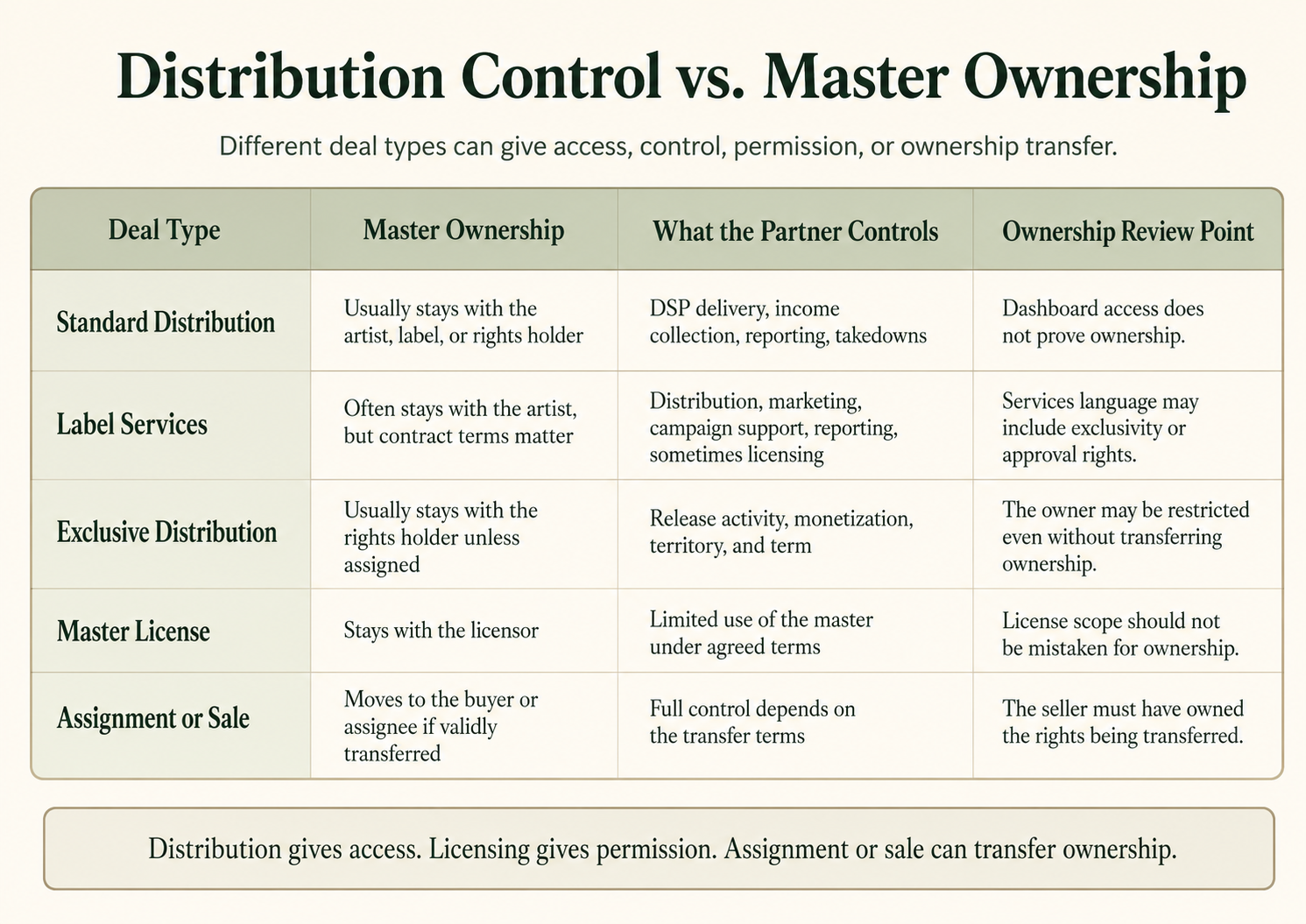
Distribution dashboards can be useful evidence, but they are easy to overread. The account holder may control metadata, ISRC delivery, payment settings, release dates, platform updates, and takedowns. That may show who administered the release. It may also show who collected income. It does not prove that the account holder owned the recording unless the rights documents support that conclusion.
Exclusive distribution deserves closer review because it can limit what the owner can do with the master. The artist or label may still own the recording but be unable to move it to another distributor, grant certain licenses, change release strategy, or exploit the master outside the agreement until the term ends. Ownership stays in one place while commercial control is temporarily restricted.
Label services deals can be harder to classify by name alone. One deal may leave ownership with the artist and only grant the services company distribution and marketing rights. Another may include approval rights, exclusivity, revenue-share restrictions, or licensing authority that gives the company much stronger control. The title of the agreement matters less than the rights it grants, the rights it reserves, and what happens after termination.
A master license is different again. The owner keeps the master but gives another party permission to use or exploit it within agreed limits. A license may cover a territory, term, project, platform, compilation, sync use, or campaign. A rights assignment or catalog sale goes further because ownership itself may move to the buyer or assignee.
Before a master is moved, licensed, sold, or included in a catalog review, the distribution paperwork should answer three practical questions. Who owns the recording, who currently controls its distribution, and whether any exclusivity, term, takedown rule, payment obligation, or post-term restriction still affects the master.
Master Licenses, Revenue Shares, and Ownership Transfers
A master can be used, monetized, shared, or sold without each arrangement leading to the same ownership result. The contract needs to show whether one party only received permission to use the recording, whether income is being shared from exploitation, or whether ownership of the master actually moved.
A master use license gives permission to use a recording within the limits of the license. The owner may allow the master to appear in a film, advertisement, game, compilation, sample, social campaign, or other project while keeping ownership of the recording. The license should identify the approved use, term, territory, media, fee, approval process, and any restrictions on editing or sublicensing.
Revenue share language can look more ownership-like than it really is. A company may collect income and split revenue with the artist. A collaborator may receive a percentage of net receipts. A label services partner may recover costs before sharing proceeds. Those arrangements can affect payment and control, but. A label services partner may recover costs before sharing proceeds. revenue participation does not automatically mean the recipient owns the master.
Ownership transfers require clearer language. An assignment, asset purchase agreement, catalog sale, settlement, or company acquisition may move the master from one party to another. The document should identify the recordings being transferred, the rights included, the effective date, any excluded rights, and whether the transfer covers worldwide ownership or only certain territories.
Catalog sales need special attention because a buyer can only acquire what the seller actually controls. If the seller’s title depends on earlier producer agreements, band agreements, label contracts, distribution terms, or contributor releases, those documents become part of the ownership review. Missing paperwork can reduce the value of the asset or require additional confirmations before the sale closes.
A transfer may also be limited by older deal terms. Reversion rights, approval rights, artist restrictions, sample issues, union obligations, unpaid producer royalties, or active distribution commitments can survive even after ownership changes hands. A buyer may own the master after closing and still need to honor those earlier obligations.
Master ownership review should separate permission, participation, and transfer. A license gives someone permission to use the recording. A revenue share gives someone a payment interest. An assignment or sale can move ownership, but only if the seller had the rights and the document actually transfers them.
Determining Master Ownership Without a Written Agreement
When there is no signed agreement, master ownership has to be reviewed through the available evidence. The answer is usually less certain, so the goal is to build a record of how the recording was created, funded, released, controlled, and monetized.
Key evidence may include:
- Recording history - Who booked the studio, arranged the sessions, hired the producer, paid the engineer, brought in session musicians, and controlled the final files.
- Payment records - Invoices, bank transfers, receipts, reimbursement notes, and email confirmations showing who financed the recording and whether contributors were paid as service providers.
- Contributor records - Credits, stems, session notes, file transfers, text messages, email approvals, and royalty splits showing who contributed and what they may have expected in return.
- Release history - Distributor accounts, metadata, ISRC records, upload history, takedown activity, royalty statements, and platform records showing who administered the release.
- Licensing and approval history - Emails, deal memos, sync approvals, sample approvals, compilation licenses, or other records showing who approved uses of the master.
- Income collection history - Statements, payment records, distributor reports, label accounting, and royalty splits showing who collected master-side income and who was paid from it.
- Objections or acknowledgments - Written approvals, release confirmations, long-term royalty acceptance, takedown objections, dispute notices, or later acknowledgments from contributors.
These records can support an ownership position, but they rarely provide the same certainty as signed rights language. Someone may upload a recording without owning it. Someone may pay a studio invoice without receiving ownership. Someone may receive royalties without owning the master.
For older projects, catalog reviews, estate matters, licensing requests, or acquisition diligence, the evidence file may need to be much broader. A reviewer may need to compare invoices, correspondence, metadata, payment history, registrations, release records, and contributor communications before deciding whether the claimed owner has enough support.
When the evidence leaves gaps, the practical fix may be to secure confirmatory assignments, contributor releases, waivers, settlement documents, or written acknowledgments before the master is licensed, sold, transferred, or treated as fully cleared.
How Master Ownership Affects Licensing, Royalties, and Catalog Sales
Master ownership becomes most important when someone needs authority to make a decision about the recording. A track can be released for years without anyone questioning ownership, then a sync request, catalog sale, royalty dispute, estate review, or takedown issue forces the paperwork into focus.
Licensing Authority
The master owner usually controls whether the recording can be licensed for film, television, advertising, games, samples, compilations, and other commercial uses. A party seeking permission needs to know who can approve the use and sign the license.
If ownership is unclear, a licensee may delay or walk away from the deal. The risk is simple enough: paying the wrong party does not always protect the buyer from a later claim by the actual rights holder.
Royalty Collection
Master ownership affects who has the right to collect and receive master-side income. That can include distributor payments, label royalties, neighboring rights income, direct licenses, YouTube or UGC revenue, and other recording-related payments.
A royalty statement may show who has been paid, but payment history alone does not always prove ownership. The reviewer still needs to know whether the recipient was the owner, a licensee, a distributor, a label, an administrator, or another party collecting under contract.
Catalog Sales and Acquisitions
Catalog buyers usually want proof that the seller can transfer the masters being sold. That means reviewing the chain of title, not only the release history or income reports.
A buyer may ask for recording agreements, producer agreements, contributor releases, distribution terms, prior assignments, amendments, reversion documents, and royalty obligations. Missing paperwork can reduce value, slow the transaction, or require confirmatory documents before closing.
Enforcement and Takedowns
Ownership also affects who can enforce rights when a master is copied, uploaded, sampled, monetized, or used without permission. Platforms, licensees, attorneys, and collection partners may ask for proof that the claimant has the right to act.
Distributor access can help with takedowns, but it may not be enough in a disputed case. The stronger position comes from documents showing ownership or clear authority to enforce rights on behalf of the owner.
Estate and Succession Reviews
When an artist, producer, label owner, or catalog owner dies, master ownership may need to be reviewed for estate administration. The question becomes what the person or entity actually owned at the time of death.
Old releases can be difficult to verify when agreements were informal, labels dissolved, band members changed, or rights were transferred over time. Estate reviews often need both contract documents and practical records showing how the masters were controlled and paid.
Long-Term Administration
Clear master ownership makes routine administration easier. The rights holder can update distributor accounts, approve licenses, review statements, claim missing income, correct metadata, negotiate catalog deals, and respond to disputes with more confidence.
Unclear ownership creates friction across each of those tasks. A party may be able to collect money for a period of time, but still struggle to prove ownership when a higher-value opportunity or dispute appears.
How Master Ownership Affects Licensing, Royalties, and Catalog Sales
Master ownership becomes most important when someone needs authority to make a decision about the recording. A track can be released for years without anyone questioning ownership, then a sync request, catalog sale, royalty dispute, estate review, or takedown issue forces the paperwork into focus.
Licensing Authority
The master owner usually controls whether the recording can be licensed for film, television, advertising, games, samples, compilations, and other commercial uses. A party seeking permission needs to know who can approve the use and sign the license.
If ownership is unclear, a licensee may delay or walk away from the deal. The risk is simple enough: paying the wrong party does not always protect the buyer from a later claim by the actual rights holder.
Royalty Collection
Master ownership affects who has the right to collect and receive master-side income. That can include distributor payments, label royalties, neighboring rights income, direct licenses, YouTube or UGC revenue, and other recording-related payments.
A royalty statement may show who has been paid, but payment history alone does not always prove ownership. The reviewer still needs to know whether the recipient was the owner, a licensee, a distributor, a label, an administrator, or another party collecting under contract.
Catalog Sales and Acquisitions
Catalog buyers usually want proof that the seller can transfer the masters being sold. That means reviewing the chain of title, not only the release history or income reports.
A buyer may ask for recording agreements, producer agreements, contributor releases, distribution terms, prior assignments, amendments, reversion documents, and royalty obligations. Missing paperwork can reduce value, slow the transaction, or require confirmatory documents before closing.
Enforcement and Takedowns
Ownership also affects who can enforce rights when a master is copied, uploaded, sampled, monetized, or used without permission. Platforms, licensees, attorneys, and collection partners may ask for proof that the claimant has the right to act.
Distributor access can help with takedowns, but it may not be enough in a disputed case. The stronger position comes from documents showing ownership or clear authority to enforce rights on behalf of the owner.
Estate and Succession Reviews
When an artist, producer, label owner, or catalog owner dies, master ownership may need to be reviewed for estate administration. The question becomes what the person or entity actually owned at the time of death.
Old releases can be difficult to verify when agreements were informal, labels dissolved, band members changed, or rights were transferred over time. Estate reviews often need both contract documents and practical records showing how the masters were controlled and paid.
Long-Term Administration
Clear master ownership makes routine administration easier. The rights holder can update distributor accounts, approve licenses, review statements, claim missing income, correct metadata, negotiate catalog deals, and respond to disputes with more confidence.
Unclear ownership creates friction across each of those tasks. A party may be able to collect money for a period of time, but still struggle to prove ownership when a higher-value opportunity or dispute appears.
How to Confirm Ownership Before Releasing, Licensing, or Selling a Recording
Ownership review should happen before the recording is already in motion. The level of review depends on the use. Releasing a single may require a lighter check than selling a catalog, but the same core issue remains: the party acting on the master needs authority to do so.
Before Releasing a Recording
Before a track goes live, the artist, label, or releasing party should confirm that the recording can be distributed without unresolved ownership claims.
Review:
- who owns or controls the master
- whether the artist has the right to release the recording
- whether the producer signed a work-for-hire, assignment, license, or producer agreement
- whether engineers, mixers, session musicians, background vocalists, and other contributors were paid and cleared
- whether samples, loops, interpolations, or outside material need approval
- whether any band member, collaborator, label, or prior partner has a claim
- whether the distributor account is controlled by the correct party
- whether metadata, ISRCs, credits, and payment settings match the ownership position
A release can move forward smoothly when the rights trail matches the release trail. Problems usually arise when the person uploading the track has platform access but does not have clean authority from everyone who contributed to the master.
Before Licensing a Master
A licensee needs to know who can approve use of the recording. That may be the artist, label, catalog owner, estate, or another rights holder with authority under contract.
Review:
- who has the right to approve the proposed use
- whether the use conflicts with any label, distribution, or prior license terms
- whether any producer, featured artist, band member, or collaborator has approval rights
- whether a sample, union performance, or third-party contribution affects the license
- whether the license covers the correct recording version
- whether the signing party owns the master or has authority to license it
- whether revenue from the license must be shared with another party
Sync, sample, compilation, and brand uses often expose weak ownership records because the licensee will usually ask for proof before paying. A royalty statement or distributor dashboard may support the file, but the stronger evidence is still the contract trail.
Before Selling or Acquiring a Master
Catalog sales require the deepest ownership review. A buyer is not only asking whether the recording earns money. The buyer needs to know whether the seller can transfer the master and whether any older rights will limit the asset after closing.
Review:
- the original recording agreement or ownership document
- producer agreements, contributor releases, session paperwork, and musician agreements
- work-for-hire and assignment language for all major contributors
- band, group, or collaborator agreements
- distribution, label services, and licensing restrictions
- prior assignments, amendments, side letters, settlements, or acquisition documents
- reversion rights, termination rights, or post-term restrictions
- unpaid royalties, producer points, union obligations, or unresolved accounting claims
- samples, interpolations, or third-party material used in the master
- disputes, objections, takedowns, or competing ownership claims
A seller may control income from a recording without having a complete chain of title. That gap can affect valuation, closing conditions, indemnities, or the buyer’s willingness to acquire the master at all.
Ownership Review Questions
A practical review should be able to answer these questions before the master is released, licensed, transferred, or sold:
- Who created the recording?
- Who paid for the recording?
- Who hired and paid the contributors?
- Who signed rights transfer or work-for-hire documents?
- Who released the recording?
- Who controls the distributor account?
- Who has collected master-side income?
- Who can approve licenses?
- Has the master ever been assigned, sold, licensed, reverted, restricted, or disputed?
- Are there any contributors whose rights were never fully cleared?
The review does not need to be complicated for every small release, but it should be complete enough for the intended use. A master being uploaded by an independent artist may need basic contributor clearance. A master being licensed for a major sync or sold as part of a catalog needs stronger chain-of-title support.
Common Master Ownership Disputes
Master ownership disputes often start with a release that everyone accepted at the time. The conflict appears later, once the recording earns money, receives a licensing offer, becomes part of a catalog review, or one of the original participants leaves the project.
Artist vs. Label
An artist may believe they own the master because they created the recording or paid part of the costs. A label may point to the recording agreement and claim ownership or exclusive control. The answer usually depends on the grant language, the recordings covered, the term, any reversion language, and whether later amendments changed the original deal.
Artist vs. Producer
Producer disputes often involve beats, instrumentals, stems, or production files. A producer may argue that they only licensed the track for limited use, while the artist may believe the producer was fully paid and cleared. The key documents are usually the producer agreement, beat license, work-for-hire language, assignment clause, payment records, and any messages discussing permitted use.
Band Member or Group Disputes
Group projects can become difficult when one member leaves, pays for the recording, controls the distributor account, or claims the band catalog was never formally assigned to anyone. A band agreement can resolve this, but many groups do not have one. In that case, the review may rely on payment history, credits, emails, release conduct, royalty payments, and any later acknowledgments.
Collaborator and Featured Artist Claims
A featured artist, instrumentalist, vocalist, programmer, or creative collaborator may later claim that their contribution was never cleared. Some claims are about ownership. Others are about payment, credit, approval, or scope of use. The review should separate those issues instead of treating every contributor complaint as a full master ownership claim.
Distributor Account Control
The person with distributor access may be able to change metadata, receive payments, issue takedowns, and move releases. That control can create leverage, but it does not automatically establish ownership. The underlying agreement still matters, especially if the uploader was acting on behalf of a band, label, estate, manager, or collaborator.
Catalog Sale and Chain-of-Title Gaps
Catalog buyers may uncover disputes that never surfaced during ordinary royalty collection. Missing producer agreements, unsigned session releases, old label amendments, unclear band ownership, unresolved samples, or expired distribution terms can all slow a sale. Even if the seller has collected income for years, a buyer may still ask for stronger proof before accepting the master as transferable.
Estate and Successor Disputes
After an artist, producer, label owner, or band member dies, heirs or successors may disagree about what rights were actually owned. Old recordings can be especially hard to review when there are informal deals, dissolved companies, missing agreements, or multiple people who handled the catalog over time. Estate disputes often require both legal documents and practical records showing how the masters were controlled.
Sample and Third-Party Material Issues
A master may be owned by one party but still include material that limits how it can be used. Uncleared samples, loops, interpolations, session performances, or licensed beats can affect release, licensing, sale, or enforcement. These issues may not defeat ownership of the whole master, but they can reduce control over the recording.
Ownership disputes are easier to manage when the disagreement is labeled correctly. A party may have a royalty claim, approval right, credit issue, license restriction, or unpaid invoice rather than an ownership interest. The review should identify what the person is actually claiming before deciding whether the master itself is unclear.
Frequently Asked Questions
Does the artist always own the master recording?
No. An artist may own the master, but ownership depends on the recording agreement, producer paperwork, funding arrangement, distribution terms, assignments, and any later transfer documents. Performing on the track does not automatically prove ownership.
Does paying for the recording mean you own the master?
Payment can support an ownership claim, especially when one party paid the producer, studio, musicians, mixer, and mastering engineer. It still needs to be matched with rights language. A person or company can pay recording costs under an agreement that grants ownership, a license, reimbursement rights, or no ownership transfer at all.
###, studio, musicians, mixer, and mastering engineer. It still Can a label control a master without owning it?
Yes. A label may have an exclusive license, distribution rights, or label services rights that allow it to release and monetize the recording while ownership remains with the artist or another rights holder. The contract should say whether the label owns the master or only controls certain uses for a set period.
Can a distributor own the master?
A standard distributor usually does not own the master. The distributor typically receives permission to deliver the recording to platforms, collect income, deduct fees, and report royalties. Some agreements may include broader rights, exclusivity, or transfer language, so the distribution terms still need to be reviewed.
Can a producer claim ownership of a master?
A producer may have a claim if they created or controlled part of the recording and never transferred or licensed those rights clearly. Producer points or royalties alone do not prove ownership. The producer agreement, beat license, assignment clause, work-for-hire language, payment records, and file delivery terms usually matter most.
What if there is no written agreement?
Ownership review becomes more evidence-based. Invoices, studio records, payment history, emails, release records, distributor accounts, metadata, credits, royalty statements, and contributor communications may help show who controlled the recording. Those records can support a position, but signed rights language is usually stronger.
What is the difference between owning a master and licensing a master?
Ownership gives control over the recording as an asset, subject to any contract limits. A license gives another party permission to use the recording for agreed purposes, such as distribution, sync, sampling, or a specific campaign. A license can be exclusive or valuable without transferring ownership.
Why does master ownership matter before a sync license or catalog sale?
The party approving the use or sale must have authority over the recording. A licensee or buyer may ask for chain-of-title documents before paying or closing. If ownership is unclear, the deal may be delayed, reduced in value, or abandoned until the rights can be confirmed.
Can master ownership change over time?
Yes. A master may be assigned, sold, licensed, acquired, reverted, or transferred through later agreements. Older recordings should be reviewed for amendments, side letters, catalog sale documents, settlement terms, reversion notices, and company transaction records.
What documents help prove master ownership?
Useful documents include recording agreements, producer agreements, work-for-hire forms, assignments, contributor releases, band agreements, distribution contracts, master licenses, catalog purchase agreements, amendments, royalty statements, and payment records. The strongest review usually connects the original creation documents with any later transfer or control documents.
Frequently Asked Questions
Does the artist always own the master recording?
No. An artist may own the master, but ownership depends on the recording agreement, producer paperwork, funding arrangement, distribution terms, assignments, and any later transfer documents. Performing on the track does not automatically prove ownership.
Does paying for the recording mean you own the master?
Payment can support an ownership claim, especially when one party paid the producer, studio, musicians, mixer, and mastering engineer. It still needs to be matched with rights language. A person or company can pay recording costs under an agreement that grants ownership, a license, reimbursement rights, or no ownership transfer at all.
###, studio, musicians, mixer, and mastering engineer. It still Can a label control a master without owning it?
Yes. A label may have an exclusive license, distribution rights, or label services rights that allow it to release and monetize the recording while ownership remains with the artist or another rights holder. The contract should say whether the label owns the master or only controls certain uses for a set period.
Can a distributor own the master?
A standard distributor usually does not own the master. The distributor typically receives permission to deliver the recording to platforms, collect income, deduct fees, and report royalties. Some agreements may include broader rights, exclusivity, or transfer language, so the distribution terms still need to be reviewed.
Can a producer claim ownership of a master?
A producer may have a claim if they created or controlled part of the recording and never transferred or licensed those rights clearly. Producer points or royalties alone do not prove ownership. The producer agreement, beat license, assignment clause, work-for-hire language, payment records, and file delivery terms usually matter most.
What if there is no written agreement?
Ownership review becomes more evidence-based. Invoices, studio records, payment history, emails, release records, distributor accounts, metadata, credits, royalty statements, and contributor communications may help show who controlled the recording. Those records can support a position, but signed rights language is usually stronger.
What is the difference between owning a master and licensing a master?
Ownership gives control over the recording as an asset, subject to any contract limits. A license gives another party permission to use the recording for agreed purposes, such as distribution, sync, sampling, or a specific campaign. A license can be exclusive or valuable without transferring ownership.
Why does master ownership matter before a sync license or catalog sale?
The party approving the use or sale must have authority over the recording. A licensee or buyer may ask for chain-of-title documents before paying or closing. If ownership is unclear, the deal may be delayed, reduced in value, or abandoned until the rights can be confirmed.
Can master ownership change over time?
Yes. A master may be assigned, sold, licensed, acquired, reverted, or transferred through later agreements. Older recordings should be reviewed for amendments, side letters, catalog sale documents, settlement terms, reversion notices, and company transaction records.
What documents help prove master ownership?
Useful documents include recording agreements, producer agreements, work-for-hire forms, assignments, contributor releases, band agreements, distribution contracts, master licenses, catalog purchase agreements, amendments, royalty statements, and payment records. The strongest review usually connects the original creation documents with any later transfer or control documents.
Practical Resource
Master Ownership Chain-of-Title Review Map
The Master Ownership Chain-of-Title Review Map helps artists, labels, managers, catalog buyers, estates, and rights administrators trace master ownership from creation to current control.
Use the worksheet to document the recording details, claimed owner, payment evidence, contributor paperwork, label or distribution terms, later transfers, current control, open issues, and next actions. The goal is to identify whether the master is ready for release, licensing, catalog review, transfer, or sale.
[Download the Master Ownership Chain-of-Title Review Map]
The workbook includes a recording summary, chain-of-title review map, dropdown fields for status and risk level, and a dashboard that flags open ownership gaps.
References
Donald S. Passman, All You Need to Know About the Music Business, 11th ed.
U.S. Copyright Office, Copyright Registration for Sound Recordings, Circular 56.
https://www.copyright.gov/circs/circ56.pdf
U.S. Copyright Office, Works Made for Hire, Circular 30.
https://www.copyright.gov/circs/circ30.pdf
U.S. Copyright Office, Copyright Ownership and Transfer, 17 U.S.C. Chapter 2.
https://www.copyright.gov/title17/92chap2.html
Cornell Law School Legal Information Institute, 17 U.S. Code § 101: Definitions.
https://www.law.cornell.edu/uscode/text/17/101
Cornell Law School Legal Information Institute, 17 U.S. Code § 201: Ownership of Copyright.
https://www.law.cornell.edu/uscode/text/17/201
U.S. Copyright Office, Author(s) of the Sound Recordings.