What Are 360 Deals and How Do They Work
A 360 deal can give a label participation in income beyond recorded music. This guide covers revenue streams, recoupment, control, and key deal terms.

Introduction
Traditional recording agreements are built around master recordings, but many modern artist deals reach into income that sits outside the sound recording itself. A 360 deal gives a label, distributor, or music company a financial interest in multiple parts of an artist’s career, often including recorded music, publishing, touring, merchandise, brand partnerships, sponsorships, sync income, fan products, or other entertainment revenue.
The business logic usually comes from investment. When a company spends money to develop an artist, fund recordings, support marketing, build a team, create opportunities, or raise the artist’s profile, it may argue that its participation should extend beyond record sales and streaming income. The artist may receive funding, infrastructure, services, access, or career support in exchange for giving the company a share of income from several rights or revenue categories.
The details decide whether the trade is balanced. A 360 deal can be narrow, with limited participation in a few defined income streams, or broad enough to affect almost every commercial opportunity connected to the artist. Percentages, deductions, approvals, exclusions, recoupment language, term length, option periods, and post-term participation can change the result more than the “360” label itself.
A careful review should identify which income streams are included, how the company’s share is calculated, what the artist receives in return, whether the company has approval or control rights, and how long participation continues after the deal ends.
Learning Objectives
By the end of this guide, you should be able to:
- Explain what a 360 deal is and how it expands beyond a traditional recording agreement.
- Understand why labels and music companies use multi-right deal structures.
- Identify the revenue streams that may be included in a 360 deal.
- Distinguish between participation in income and ownership or control of rights.
- Review how percentages, gross revenue, net revenue, deductions, exclusions, and caps affect the company’s share.
- Understand how advances, recoupment, and cross-collateralization can affect multiple income streams.
- Evaluate whether the artist receives meaningful investment, services, or support in exchange for broader participation.
- Recognize deal terms that can shift business control, reduce flexibility, or extend the company’s share beyond the active term.
Overview
A 360 deal is usually built around participation rather than one single right. The company may still have a recording deal with the artist, but the agreement can also give it a percentage of other artist income. That participation may apply to touring, merchandise, publishing, sponsorships, endorsements, fan clubs, direct-to-consumer products, acting, appearances, or other artist-related revenue, depending on the contract.
The structure became more common as recorded music revenue changed and labels looked for ways to share in the broader value created by artist development. If a label’s marketing spend, promotional work, tour support, or brand-building efforts help increase an artist’s live income, merchandise sales, and partnership value, the label may seek a share of those areas. From the artist’s side, the question is whether the company is providing enough support to justify that broader participation.
A 360 deal does not automatically mean the company owns every right it touches. In many agreements, the company receives a percentage of income from certain categories while ownership, administration, or day-to-day control may stay elsewhere. For example, the company might receive a share of touring income without booking the tour, or a share of merchandise income without manufacturing the merchandise. The agreement needs to separate income participation from ownership, approval rights, and operational control.
The most important terms are usually found in the definitions. “Artist income,” “gross revenue,” “net revenue,” “ancillary rights,” “entertainment income,” “touring income,” “merchandise income,” and “brand income” can each change what the company receives. A small percentage applied to a broad revenue base may be more expensive than a larger percentage applied to a narrow, clearly defined category.
Recoupment can also make 360 deals more complex than standard royalty participation. If advances, marketing spend, tour support, video costs, or other expenses can be recovered from several income streams, one part of the artist’s career may be used to pay down costs from another. That can delay payouts and make it harder to understand which income is actually available to the artist.
The practical review is less about reacting to the term “360 deal” and more about mapping the exchange. What income is included? What percentage does the company receive? What is deducted first? What services or funding does the artist receive? Which rights remain outside the deal? Who approves opportunities? How long does the company participate? What continues after the contract term ends?
Table of Contents
What Is a 360 Deal?
Where a standard recording agreement usually centers on master recordings, a 360 deal expands the company’s economics across the artist’s wider business. The label or music company may still be funding, releasing, or marketing recorded music, but its participation can also reach touring, merchandise, publishing, brand partnerships, sponsorships, sync, appearances, fan products, livestreams, VIP packages, or other artist-related income.
The “360” term is only shorthand. The contract decides which revenue categories are included, which ones are excluded, and whether the company’s share applies broadly or only to specific activities. One agreement may cover touring and merchandise only. Another may reach publishing income, endorsements, direct-to-fan sales, acting income, name-and-likeness uses, or entertainment revenue connected to the artist’s career.
A percentage share in an income stream is separate from ownership, administration, and approval rights. The company might receive part of merchandise income without running the merchandise business, or share in touring income without booking shows. Another deal may go further by giving the company approval rights, matching rights, consultation rights, or direct control over certain opportunities. That difference should be visible in the agreement because money participation and business control create different outcomes for the artist.
The business argument behind the structure usually comes from the company’s contribution to the artist’s career. Recording funds, marketing spend, video budgets, tour support, radio promotion, content production, brand strategy, staffing, and industry access may increase the artist’s value across more than one revenue stream. The artist’s side of the bargain is whether that contribution is strong enough to justify giving the company income from areas outside the master recordings.
A narrower 360 deal can be easier to evaluate when the included income streams are named, the percentages are limited, and the company is adding real support in those areas. Broader language needs more pressure-testing, especially when it captures revenue the company does not help create, reaches outside the recording relationship, or continues after active support has ended.
The label “360 deal” should not carry the analysis. The real review is in the definitions, percentages, exclusions, deductions, approval rights, recoupment provisions, and post-term participation language. Two agreements can both use the same name while giving the company very different financial and control positions.
Why 360 Deals Exist in the Music Industry
The rise of 360 deals is tied to a basic change in the economics of artist development. Labels once expected most of their return to come from selling recorded music. As the market shifted toward streaming, social media, touring, brand partnerships, merchandise, fan platforms, and direct audience monetization, an artist’s commercial value became spread across more parts of the business.
From the company’s perspective, that creates a gap between investment and return. A label may spend money on recordings, videos, marketing, radio promotion, content, publicity, tour support, creative direction, and team infrastructure. Those efforts can make the artist more valuable onstage, in brand deals, in merchandise sales, and across other opportunities. If the company is helping build that wider value, it may ask to participate in more than master recording income.
That does not make every 360 deal fair or unfair by default. The structure depends on the exchange. An artist may accept broader participation because the company is bringing real funding, market access, staff, campaign strategy, creative resources, or long-term career support. Another artist may push back if the company wants a share of income it is not helping generate, especially if the artist already has touring, merchandise, publishing, or brand activity working independently.
The negotiation usually turns on leverage. A developing artist may need upfront funding and infrastructure more than they need to preserve every future revenue category untouched. An established artist with touring income, merchandise demand, or brand interest may have more room to limit participation, exclude certain revenue streams, reduce percentages, or require the company to meet specific service obligations before sharing in non-recording income.
For labels and music companies, 360 participation can also be a way to justify taking risks earlier in an artist’s career. If recorded music income alone may not repay the investment, a multi-right structure gives the company additional paths to recover value. For artists, that same structure can become expensive if the deal captures income long after the company’s active support has slowed down or ended.
The better question is not whether 360 deals are good or bad as a category. The better question is whether the company’s share is proportionate to what it is actually contributing. A deal that covers touring, merchandise, publishing, and brand income should show why those categories are included, how the percentages are calculated, what the artist receives in return, and how long the company continues to participate.
How a 360 Deal Differs From a Traditional Record Deal
A traditional record deal and a 360 deal can begin in the same place: the company wants to invest in an artist and participate in the commercial upside. The difference is how far that participation reaches. A standard recording agreement is usually anchored to master recordings and artist royalties. A 360 deal widens the company’s share into other parts of the artist’s business, which can make the agreement feel closer to a career-level partnership than a recording-only arrangement.
The comparison shows why the “360” structure needs more than a quick royalty review. A traditional record deal may already be complex, but the review usually stays close to recordings, advances, recoupment, options, and master income. A 360 deal adds another layer because the company’s share can follow the artist into areas that may already involve managers, publishers, booking agents, merch companies, sponsors, brand partners, or other rights holders.
That wider reach can make sense when the company is helping create value across those areas. It becomes harder to justify when the agreement collects from revenue streams that the company does not support, manage, fund, or meaningfully improve. The practical difference is the size of the exchange: a traditional record deal asks what the company receives from the recordings; a 360 deal asks what part of the artist’s wider business becomes part of the bargain.
Revenue Streams Included in a 360 Deal
The scope of a 360 deal usually depends on how the agreement defines the artist’s wider income. Phrases like “artist income,” “entertainment income,” “ancillary income,” “gross receipts,” or “related rights” can pull very different revenue categories into the company’s share. A narrow definition may cover only touring and merchandise. Broader language may reach publishing, sponsorships, appearances, fan platforms, brand work, or other revenue connected to the artist’s name, music, likeness, or audience.
Recorded music may still be the anchor of the relationship. The company may participate in streams, downloads, physical sales, master licenses, UGC monetization, and other recording-side income through the main record deal or a related agreement. That does not mean every other artist revenue stream should automatically follow. Each additional category needs its own boundary.
Publishing income needs careful treatment because it belongs to the composition side, not the sound recording side. A 360 deal may give the company a participation share in publishing-related income, but that is different from acquiring publishing rights, administering compositions, controlling writer shares, or approving composition-side licenses. If the company is only receiving a percentage, the agreement should say that. If it is taking administration or ownership rights, that should be stated separately.
Live income can include more than ticket sales. Festivals, support slots, private events, livestreamed concerts, VIP packages, meet-and-greets, appearance fees, tour sponsorships, and other live-related income may all be handled differently. The calculation matters as much as the category itself. A percentage of gross touring revenue can reach money that still has to pay agents, production, crew, travel, venues, insurance, and other show costs. A percentage of net touring income produces a different result, but only if the deductions are clear.
Merchandise terms can become complicated when several parties already touch the income. Tour merch, online merch, retail products, limited drops, fan bundles, VIP packages, and direct-to-consumer sales may involve managers, merch companies, promoters, designers, manufacturers, or fulfillment partners. A 360 deal should avoid double charging the same revenue or giving the company a share of merchandise activity it does not support, source, fund, or manage.
Brand partnerships and sponsorship income often grow from the artist’s public profile rather than from one specific recording. Endorsements, influencer campaigns, social content deals, product placements, name-and-likeness uses, and brand collaborations may be included when the company helps build the artist’s audience or brings the opportunity. The artist’s team should still know whether the company must source the deal, negotiate it, approve it, or provide support before sharing in the income.
Sync and licensing can involve both the master and the composition, which makes broad 360 language risky. A film, television, game, trailer, advertisement, or online video placement may require permission for the sound recording, the underlying song, or both. A company that participates in master-side income should not quietly receive composition-side income unless the agreement clearly says so. For the recording-side permission involved in these uses, see what a master use license covers.
Some 360 deals also reach into newer or less traditional categories, such as fan subscriptions, livestream platforms, memberships, creator revenue, digital collectibles, acting work, podcast appearances, book deals, gaming partnerships, or film and television opportunities. These categories need especially clear limits because they can extend far beyond the original recording relationship.
A workable 360 agreement names the revenue streams instead of relying on a broad catch-all. Touring should say what counts as touring income. Merchandise should identify the channels and products covered. Brand income should explain whether the company is sharing in all opportunities or only those it helps secure. The clearer the category, the easier it becomes to see whether the company’s participation matches its actual role.
How 360 Deal Participation Is Calculated
The percentage in a 360 deal only tells part of the story. A company taking 10% of one clearly defined revenue stream may have a much smaller position than a company taking 5% of a broad category with few exclusions. The calculation depends on the revenue base, the deductions allowed before the split, the income streams included, and whether the company’s share applies before or after third-party costs.
A deal may calculate participation from gross revenue, net revenue, adjusted gross, net profits, or another defined pool. Those terms should be read carefully because the same percentage can produce very different results. Ten percent of gross touring receipts is not the same as ten percent of touring income after agent commissions, production costs, travel, crew, promoter deductions, taxes, and venue expenses. The label on the percentage matters less than the money it is applied to.
Some agreements use different percentages for different income streams. The company might receive one percentage from touring, another from merchandise, another from brand deals, and another from publishing-related income. That approach can make sense when the company’s involvement varies by category. A label that helps secure a brand partnership may have a stronger claim to that income than to a tour the artist’s booking agent built independently.
Exclusions are just as important as included categories. Artist income may need to exclude reimbursements, pass-through costs, taxes, union payments, crew costs, venue expenses, charitable receipts, money owed to featured artists, songwriter shares, producer royalties, third-party merch costs, or income already subject to another deal. Without clear exclusions, the company’s percentage may apply to money the artist never truly keeps.
Caps and thresholds can help keep the economics proportionate. A deal might let the company participate only after the artist earns above a certain amount, only until a defined investment has been recovered, or only for opportunities the company helps bring in. Those limits can prevent a 360 clause from becoming a permanent share of unrelated income.
The source of the opportunity may also matter. If the company introduces a sponsorship, funds tour support, coordinates merchandise production, or creates a sync opportunity, the agreement may treat that income differently from opportunities generated by the artist’s existing team. This distinction is often where the negotiation becomes practical. The artist may accept participation in company-sourced income while resisting participation in income the company did not help create.
The difference becomes clearer when the same tour income is calculated two ways. An artist earns $100,000 from a tour. If the company receives 10% of gross touring revenue, its share is $10,000 before touring costs are considered. If the same 10% applies only to net touring income after $65,000 in approved costs, the company’s share is $3,500. The percentage did not change, but the revenue base did.
For brand deals, merchandise, and sync income, the same issue appears in a different form. The agreement should explain whether commissions, agency fees, production costs, manufacturing costs, fulfillment expenses, taxes, platform fees, and third-party rights payments come out before the company’s share. It should also say whether the company participates in cash only, or whether free goods, equity, barter, travel, promotional value, or in-kind benefits count as revenue.
A clear participation clause lets the artist trace the calculation without guessing. The agreement should identify the income stream, the applicable percentage, the revenue base, the deductions, the exclusions, the timing of payment, and any cap, threshold, or source-of-opportunity limitation. Without those details, the headline percentage can look simple while the real economics remain unclear.
Advances, Recoupment, and Cross-Collateralization
In a 360 deal, upfront money may be tied to more than one part of the artist’s business. The company might advance recording funds, tour support, video money, marketing spend, merchandise support, content budgets, or general development money, then recover those amounts from income generated under the agreement.
The pressure point is the repayment source. A recording advance recouped only from recording royalties creates one result. The same advance recouped from recording income, touring income, merchandise income, brand deals, and other artist revenue creates a much broader recovery path. The artist may see several parts of the business earning money while cash payments remain delayed because the company is still applying income against the unrecouped balance.
Cross-collateralization is where 360 deals need the most careful reading. If income from one revenue stream can be used to recover costs from another, the artist may lose the separation between different parts of the business. Touring income might reduce a recording balance. Merchandise income might recover video costs. Brand income might be applied against marketing spend. That may be acceptable in some negotiated deals, but it should be stated clearly rather than assumed from broad accounting language.
The agreement also needs to separate advances from expenses added later. A fixed advance is easier to track because the starting balance is known. Campaign expenses, tour support, content production, influencer spend, PR costs, advertising, travel, manufacturing, and third-party fees can keep increasing if the contract allows them. Approval rights, budget caps, reporting detail, and expense categories matter because they decide whether the artist can see and control the balance being recovered.
Recoupment does not always mean the artist personally owes the money back. In many music deals, the company recovers from future contract income before paying additional royalties or participation income. That distinction still needs to be checked because some agreements may include guarantees, repayment obligations, tour support terms, or separate side agreements that change the risk. For a fuller explanation of the repayment mechanics, see how recoupment works in music contracts.
A 360 deal becomes much harder to read when every income stream feeds the same balance. The artist’s team should be able to trace which costs are recoupable, which income sources can be used to recover them, whether balances are tracked by project or by account, and what happens when the active term ends. Without that map, the headline advance can look larger than the artist’s actual near-term cash position.
Label Investment, Services, and Support
A 360 share is easier to understand when the agreement shows the bargain behind it. The company is not only being paid for owning or exploiting recordings. It is asking to participate in the wider business around the artist, so the contract needs to show what the artist receives in return for opening those additional revenue streams.
The Bargain Behind the 360 Share
The justification usually comes from career investment. A company may provide recording funds, marketing spend, video budgets, tour support, publicity, radio promotion, creative direction, staffing, brand strategy, audience development, or access to commercial opportunities that the artist could not easily build alone.
That support has to be weighed against the income being shared. A company that is meaningfully funding and coordinating a broader campaign has a stronger argument for participating beyond master income. A company that only releases recordings but still takes a percentage of touring, merchandise, publishing, and brand income is asking for a wider share without the same visible exchange.
Commitments That Can Be Tracked
Service language should be specific enough to compare against what actually happens. General promises around “career development,” “marketing support,” or “brand building” can sound useful during negotiations, but they may not create a real obligation once the deal is signed.
More concrete language might identify a recording budget, marketing budget, tour support amount, staffing commitment, release plan, content spend, advertising approval process, brand outreach responsibility, or minimum campaign activity. The artist’s team does not need every operational detail in the agreement, but there should be enough clarity to know whether the company delivered the support that justified the broader participation.
Support Matched to the Income Stream
A 360 deal becomes easier to evaluate when the company’s share follows the area where it is actually contributing. Participation in touring income makes more sense when the company provides tour support, helps underwrite costs, coordinates promotion around shows, or uses its marketing to increase demand. A share of merchandise income is easier to justify when the company helps fund, design, manufacture, distribute, or sell the merchandise. Brand income is a stronger fit when the company sources opportunities, supports negotiations, or helps build the artist’s commercial profile.
The reverse also matters. If the artist’s booking agent builds the tour, an outside merch company runs the merchandise program, a publisher handles composition opportunities, and the artist’s manager brings in brand deals, the company’s share should reflect that limited role. A 360 clause should not casually collect from work being done by other members of the artist’s team.
When Participation Outruns Support
The hardest 360 deals to defend are the ones where the company’s participation continues across broad income categories while the services remain vague, optional, or front-loaded. Support may be strong during the first release cycle, then fade while the company keeps collecting from touring, merchandise, sponsorships, or other opportunities.
That risk is higher when the agreement has long options, post-term participation, automatic extensions, or broad definitions of artist income. The artist may still be tied to a multi-right share even after the company’s active work has slowed down. For that reason, service obligations, participation percentages, recoupment rules, and post-term rights need to be read together rather than as separate deal points.
A balanced 360 structure makes the exchange visible. The company receives broader participation because it is bringing money, services, infrastructure, or access that affects the artist’s wider career. The artist gives up part of that wider income only to the extent that the company’s role justifies it.
Approval Rights and Business Control
When a 360 deal reaches touring, merchandise, publishing, brand work, sponsorships, sync, appearances, or other artist income, the company may want more than a payment share. Contract language may give it a voice in which opportunities move forward, how they are negotiated, and whether another partner can handle them without company involvement.
Payment Rights and Decision Rights
An artist may agree to pay the company a percentage of income from a covered category while keeping the business itself with the existing team. Merchandise may still be handled by the artist’s merch partner. Touring may still run through the booking agent and manager. Brand deals may still be sourced and negotiated by the artist’s representation.
Control shifts when the company receives approval rights, consent rights, consultation rights, matching rights, or first negotiation rights. A percentage share answers who gets paid. Approval language affects who can slow down, reshape, or block the opportunity before income is even earned.
Consent, Consultation, Matching, and First Negotiation
A consultation right may only require the artist to discuss an opportunity with the company before accepting it. Consent language gives the company more leverage because the artist may need approval before moving forward. Matching rights let the company step into a third-party offer if it matches the proposed terms. First negotiation rights require the artist to speak with the company before taking the opportunity elsewhere.
Each version changes the artist’s flexibility in a different way. Brand partners, merch companies, publishers, sponsors, and other third parties may hesitate if the company can interrupt the process late, require extra approvals, or match an offer after another partner has spent time negotiating it. The contract needs to make the process workable in real commercial timelines, especially for deals tied to tours, releases, campaigns, or limited brand windows.
Overlap With the Artist’s Team
A 360 clause can create friction when the company’s control rights sit on top of work already handled by managers, agents, publishers, merch partners, lawyers, business managers, or brand representatives. Touring decisions may involve routing, guarantees, promoter terms, production costs, and sponsor conflicts. Merchandise decisions may involve design, manufacturing, online sales, tour sales, and fulfillment. Sync and publishing decisions may require approvals from songwriters, publishers, labels, supervisors, and other rights holders.
The company’s role needs to fit into that existing structure instead of creating a second approval chain over every opportunity. If the company is sourcing the brand deal, funding tour support, coordinating merchandise, or providing meaningful strategic support, a defined approval or consultation role may make sense. If another team is creating the opportunity, the company’s rights should not quietly turn into control over work it did not bring in or manage.
Brand Fit, Timing, and Missed Opportunities
Some company approval rights are tied to brand protection, campaign timing, or long-term artist positioning. A label investing heavily in an artist’s public profile may want to avoid sponsorships that conflict with a release campaign, existing partner, or image strategy.
Commercial opportunities rarely wait for slow approvals. A sponsor may need a quick answer before a campaign launch. A merch partner may need production decisions before a tour. A sync placement may have a clearance deadline. Approval rights become risky when the company has no response deadline, broad discretion to reject opportunities, or a process that forces outside partners to wait without knowing whether the deal can proceed.
Control After the Active Deal Period
Company involvement is easier to justify while it is actively funding campaigns, supporting touring, building brand opportunities, coordinating strategy, or helping create the income being shared. The position becomes harder to defend if broad approval rights continue after the company’s active support has slowed or after the main recording relationship is no longer moving forward.
A cleaner 360 structure separates income participation from business authority. It identifies which categories trigger payment, which opportunities require company involvement, how approvals are handled, how quickly the company must respond, and whether any control rights continue after the active term. Without that separation, a revenue share can quietly become a broader hold over the artist’s career decisions.
Term, Options, Territory, and Post-Term Participation
A 360 deal can affect the artist long after the first release cycle, especially when the company’s share applies across touring, merchandise, publishing, brand income, sponsorships, sync, appearances, or other career revenue. The headline term may look manageable, but option periods, territory language, continuing participation, and post-term collection rights can extend the company’s financial position beyond the active working relationship.
Key timing and scope terms include:
- Initial Term - The initial term covers the first active period of the deal. In a recording-centered agreement, it may be tied to delivery of recordings, release commitments, a fixed number of albums or singles, or a set calendar period. For a 360 deal, the same period may also determine when the company starts sharing in non-recording income.
- Option Periods - Option periods can extend the deal if the company chooses to continue. Artists should look at who controls the option, what must happen before the option can be exercised, whether the artist has any say, and whether each new option also extends the 360 participation across non-recording income.
- Release Commitments - A deal may stay active until certain recording obligations are delivered or released. Delays can stretch the relationship if delivery requirements, acceptance standards, or release timing sit mostly under company control. A 360 clause tied to the active term can become more expensive when the active term keeps moving.
- Territory - Territory language decides where the company’s 360 participation applies. A worldwide deal may capture income from global touring, international brand deals, foreign merch sales, and overseas sync opportunities. Narrower territory language may limit the company’s share to specific markets, which can matter when the artist already has regional partners.
- Income Earned During the Term - Some deals focus on income earned, contracted, paid, or received during the term. Those words can lead to different outcomes. A sponsorship signed during the term but paid later may still be covered. A tour booked during the term but performed after expiration may need separate treatment.
- Post-Term Participation - The company may continue receiving a share of certain income after the active term ends. A short post-term tail may be tied to deals the company sourced or campaigns already in motion. Broader language can keep the company attached to income from opportunities it did not create or support after the relationship has ended.
- Sunset Clauses - A sunset clause reduces or ends the company’s share after a defined period. For example, the company’s percentage may step down each year after the term or expire for certain categories once active support stops. Without a sunset, participation can feel disconnected from the company’s actual role.
- Post-Term Accounting - Final accounting will often continue after the deal ends because income may arrive late from platforms, promoters, merch partners, sponsors, or licensees. Post-term accounting is different from post-term control. The company may need to process income earned during the term, but that does not automatically justify approval rights over new opportunities.
- Surviving Rights - Some provisions survive termination, including audit rights, payment obligations, confidentiality, warranties, indemnities, and final accounting. A 360 deal needs careful separation between administrative survival and continuing participation in the artist’s future income.
The cleanest version gives the artist a timeline they can actually map. When does the active term begin and end? Who controls options? Which territories are covered? Which income remains payable after expiration? Does the company’s share step down or end? Can post-term accounting continue without keeping the company involved in new business decisions? Those answers show how much of the artist’s future remains tied to the 360 deal after the main relationship changes.
Term, Options, Territory, and Post-Term Participation
The length of a 360 deal is not always measured by the first contract period. A deal may begin with one album, one EP, one release cycle, or a fixed number of years, then extend through company-controlled options, delayed delivery obligations, continuing recoupment, or post-term participation in income connected to the artist’s wider career.
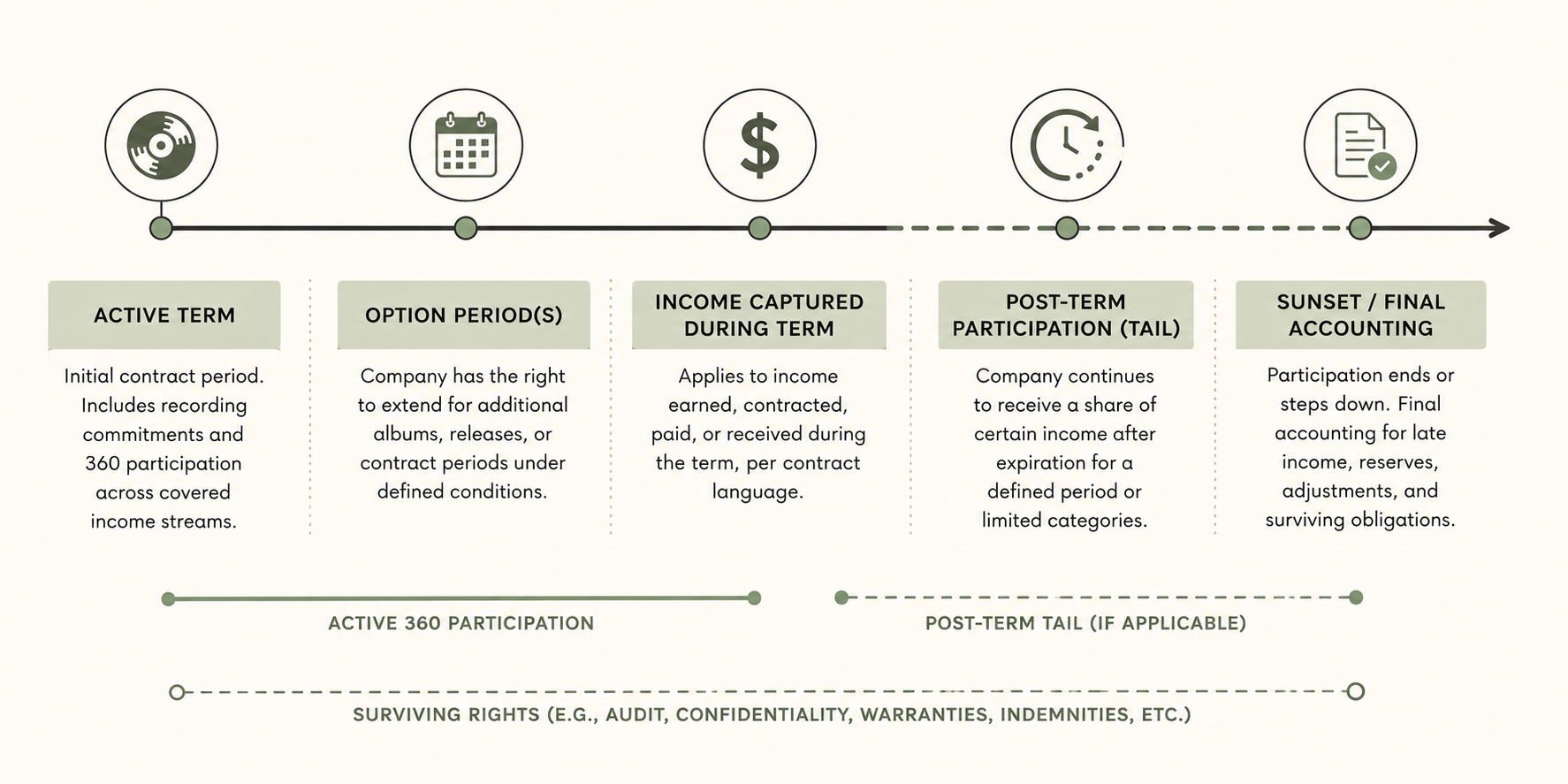
The active term sets the working period of the relationship. In a recording-centered deal, that period may be tied to delivery and release obligations, album commitments, marketing cycles, or a calendar term. In a 360 structure, the same period can also determine when the company starts participating in touring, merchandise, publishing, brand income, sponsorships, sync, appearances, and other covered revenue.
Option periods can stretch the deal beyond the artist’s original expectation. Many agreements give the company the right to extend the relationship for additional albums, releases, or contract periods. The artist’s team needs to read those options alongside the 360 language because each option may also extend the company’s share of non-recording income. A deal that appears to cover one phase of the artist’s career may become several phases if the company controls the extension rights.
Territory language matters because 360 participation may follow the artist across markets. A worldwide clause can reach international touring, overseas merchandise, foreign sponsorships, local brand campaigns, and territory-specific licensing opportunities. A narrower clause can leave room for regional partners, local labels, foreign promoters, or country-specific business arrangements. The contract needs enough precision to show where the company participates and where it does not.
The timing words around income can change the result. Income may be covered because it is earned during the term, paid during the term, contracted during the term, received during the term, or connected to activities that began during the term. Those phrases are not interchangeable. A sponsorship signed before expiration but paid months later may still be captured. A tour booked during the term but performed afterward may need special treatment. A sync license negotiated during the term may generate payments after the active period has ended.
Post-term participation is where a 360 deal can continue to affect the artist after the working relationship changes. Some post-term rights are narrow and practical, such as final accounting for income already earned, late payments from partners, refunds, reserves, or adjustments. Other provisions go further by letting the company keep a share of future income from opportunities that continue after the term or were only loosely connected to the company’s work.
A sunset clause can make the tail easier to manage. The company’s share may step down over time, apply only to deals it sourced, or end after a defined period. Without a sunset, the artist may keep paying from income streams long after the company’s active investment, marketing support, tour support, or brand work has faded.
Post-term accounting should be separated from post-term control. The company may need to receive late income, issue final statements, process adjustments, or report balances from the active term. That administrative role is different from approving new tours, brand deals, merch programs, publishing opportunities, or sync uses after the deal has ended.
A workable term structure gives the artist a clear map of the relationship: when the active period starts, who controls extensions, which territories are covered, which income remains payable after expiration, whether the company’s percentage steps down, and which obligations survive only for accounting. Without that map, the 360 share can last longer than the artist expected and reach opportunities that were never part of the original business exchange.
Common 360 Deal Structures
No single structure covers every 360 deal. Some agreements add a small participation right to a recording deal. Others build a wider artist-company relationship where recorded music, touring, merch, branding, publishing, and other income streams are negotiated together. The structure usually reflects the artist’s leverage, the company’s investment, and how much of the artist’s business is already developed.
Recording Deal With Ancillary Participation
Many 360 arrangements start with a standard recording agreement, then add participation in selected non-recording income. The company may take a smaller percentage of touring, merchandise, brand deals, sponsorships, or other ancillary income while still handling the recording side through the main label terms.
This version can be easier to review when the non-recording categories are narrow, and the company’s share is tied to clear support. The risk comes from definitions that make the “ancillary” bucket broader than expected.
Full Multi-Rights Artist Deal
A broader 360 structure may treat the artist’s career as one connected business relationship. Recorded music, live income, merchandise, publishing-related income, brand partnerships, content, fan products, and other revenue streams may all sit inside the agreement or related deal documents.
The company may provide more money, services, staff, strategy, and access under this model. In return, the artist gives the company a wider economic position. The review becomes less about one royalty rate and more about whether the full package is proportionate: what the company receives, what the artist gets back, how long the participation lasts, and which decisions remain with the artist’s team.
Funded Development Deal
Some 360 deals are built around early-stage investment. The company may provide development money, recording funds, marketing support, creative resources, content budgets, or team infrastructure before the artist has strong revenue in every category.
For a developing artist, that support may be valuable. The concern is future reach. A small advance or limited development budget can become expensive if it gives the company a long-term share of touring, merchandise, brand income, publishing, or other revenue that grows later through the artist’s work and other team members’ efforts.
Label Services or Distribution-Plus 360 Deal
A company may offer distribution, marketing, playlist pitching, campaign support, analytics, project management, or label services while also taking a share of income outside recorded music. These deals can sit between a distribution agreement and a traditional label relationship.
The details matter because the company may not own the masters or operate like a full label, yet still receive participation in other artist income. The artist’s team should look closely at whether the services are committed, discretionary, recoupable, or tied to a broader control right.
Joint Venture or Partnership-Style Deal
In some situations, the artist and company build the deal around a shared business venture rather than a standard artist royalty model. The parties may share profits from recordings and related revenue after costs, with more detailed rules around budgets, approvals, services, ownership, and accounting.
This structure may give the artist more participation in upside, but it can also require more careful management. Profit definitions, expense approvals, decision rights, accounting access, and exit terms become central because both sides are treating the artist business as a shared commercial project.
Limited 360 Participation
A narrower version may apply only to categories where the company has a clear role. The company might share in brand deals it sources, tour support it funds, merchandise it helps produce, or sync opportunities it helps secure. Income created independently by the artist’s team can be excluded or treated differently.
For artists with existing managers, agents, publishers, merch partners, or brand representatives, this structure can be cleaner than a broad all-income clause. It lets the company participate where it contributes without pulling every part of the artist’s business into the deal.
The structure name matters less than the operating result. A “limited” deal can still be broad if the definitions are loose. A “full” 360 deal can be workable if the percentages, exclusions, support obligations, approval rights, and sunset language are balanced. The real test is how the agreement connects the company’s share to the value it actually provides.
Deal Terms That Can Shift Control
A 360 deal may look financial on the surface because the company is taking a percentage of income. The control shift often sits in the supporting language: definitions, approvals, options, recoupment, post-term rights, and timing rules. Those provisions can decide whether the artist is simply sharing revenue or giving the company a continuing role in career decisions.
- Broad definitions of artist income - Language that captures “all artist income,” “all entertainment income,” or “all revenue connected to the artist” can reach much further than touring, merchandise, or brand deals. A broad definition may pull in acting work, creator income, fan memberships, social media campaigns, book deals, film work, or opportunities that were never part of the original recording relationship.
- Revenue categories with no exclusions - A company’s share can become more expensive when the contract does not carve out taxes, pass-through costs, crew payments, agent commissions, promoter deductions, merch production costs, songwriter shares, charitable receipts, or third-party obligations. The artist may end up paying a percentage on money that never becomes real artist income.
- Participation in opportunities the company did not create - Some 360 deals distinguish between company-sourced income and income generated by the artist’s existing team. Others take a share regardless of who created the opportunity. The second version gives the company a wider economic position even when the manager, booking agent, publisher, merch company, or brand representative did the work.
- Approval rights over outside opportunities - Consent language can shift the company from participant to gatekeeper. A brand deal, merch program, sync use, sponsorship, appearance, or publishing opportunity may need company approval before moving forward. Approval rights are easier to manage when they apply only to defined categories, use a clear response period, and cannot be withheld for vague reasons.
- Matching rights and first negotiation rights - A matching right can make outside partners hesitate because the company may be able to take over an offer after another party has negotiated it. First negotiation language can create a similar delay before the artist is allowed to speak with the wider market. These rights are not always deal-breakers, but they need tight timing so they do not quietly reduce the artist’s ability to close opportunities.
- Cross-collateralization across income streams - When recording costs can be recovered from touring, merchandise, brand income, publishing-related income, or other revenue, separate parts of the artist’s business start feeding the same balance. A release campaign that underperforms can then affect cash flow from areas that are otherwise doing well.
- Recoupable expenses without approval - Open-ended recoupable costs give the company room to add campaign spend, video costs, travel, advertising, PR, content production, tour support, or third-party fees to the balance. Budget caps and approval rules matter because they keep the artist from discovering expenses only after royalties or participation income are withheld.
- Company-controlled options - Options can extend the deal without a fresh negotiation. If every option period also extends the 360 participation, the company’s share of touring, merch, brand income, and other revenue may continue through several career phases. A short initial term can become much longer once options are counted.
- Timing language around covered income - Words like “earned,” “contracted,” “paid,” and “received” can produce different results. A sponsorship signed during the term but paid after expiration may still be covered. A tour booked during the term but performed later may also fall inside the company’s share, depending on the language.
- Post-term participation without a sunset - A company may need to receive late income from deals made during the term, but ongoing participation should have a clear reason and end point. A sunset clause can reduce the percentage over time, limit the tail to company-sourced opportunities, or end participation after a defined period.
- Territory language that follows the artist everywhere - Worldwide language may be appropriate for global campaigns, but it can also interfere with local partners, regional brand deals, foreign promoters, territory-specific labels, or international merchandising arrangements. A worldwide grant deserves closer attention when the company is not actually active in every market it covers.
- Survival clauses that keep more than accounting alive - Some obligations naturally survive termination, such as final accounting, audit rights, confidentiality, warranties, and payment obligations for income already earned. Broader survival language can be more concerning if it keeps approval rights, matching rights, collection rights, or participation in new income alive after the main relationship ends.
The artist’s team should be able to separate three things by the end of the review: what the company gets paid from, what the company can approve or block, and what continues after the active deal period. When those lines are clear, the 360 deal is easier to evaluate as a business exchange rather than a general claim on the artist’s career.
Frequently Asked Questions
What is a 360 deal in music?
A 360 deal is an artist agreement where a label or music company participates in more than recorded music income. The company may receive a share of touring, merchandise, publishing-related income, brand partnerships, sponsorships, sync, appearances, fan products, or other artist revenue, depending on how the agreement is written.
Why do labels use 360 deals?
Labels and music companies often use 360 deals when they are investing in the artist’s wider career, not only in recordings. Recording budgets, marketing, videos, promotion, tour support, content, staffing, and brand development can increase the artist’s value across several income streams. The company may ask for a broader share because its investment may help build revenue outside master recordings.
Does a 360 deal mean the label owns all of the artist’s rights?
No. A 360 deal may give the company a percentage of income without transferring ownership of every right involved. The company might share in touring income without booking the tour, or receive a share of merchandise income without owning the merchandise operation. Ownership, administration, approval rights, and income participation need to be reviewed separately.
How is a 360 deal different from a traditional record deal?
A traditional record deal is normally centered on master recordings, artist royalties, advances, recoupment, release commitments, and label control over recorded music. A 360 deal expands the company’s economics into other parts of the artist’s business. Touring, merch, publishing, brand deals, sponsorships, sync, or other revenue may become part of the same overall bargain.
What income streams can be included in a 360 deal?
The covered income streams depend on the contract. Common categories include recorded music, touring, live appearances, merchandise, publishing-related income, sponsorships, endorsements, brand deals, sync licensing, fan subscriptions, VIP packages, livestreams, creator income, and other entertainment revenue tied to the artist’s name, likeness, music, or audience.
How does the company’s percentage work?
The percentage only makes sense once the revenue base is clear. A company might take a share of gross revenue, net revenue, adjusted gross, net profits, or a specially defined income pool. The same percentage can produce very different results depending on deductions, exclusions, commissions, third-party costs, taxes, expense approvals, and whether the income was sourced by the company or by the artist’s own team.
Can a 360 deal include publishing income?
Yes, but publishing income needs careful wording because it belongs to the composition side of the business. A company may receive a participation share in publishing-related income, acquire publishing rights, administer compositions, or receive approval rights over certain uses. Those are separate positions and should not be treated as the same thing.
What is cross-collateralization in a 360 deal?
Cross-collateralization lets income from one category recover costs from another. Recording costs may be recovered from touring, merchandise, brand income, or other revenue if the agreement allows it. That can delay artist payouts because several parts of the business may be used to reduce one shared balance.
Can a 360 deal continue after the main term ends?
Yes. Some agreements include post-term participation, tail periods, survival clauses, or continuing payment obligations for income connected to the term. A narrow tail may apply only to income already earned or deals the company sourced. Broader language can keep the company attached to future income after active support has ended.
What should artists look at before signing a 360 deal?
The main review points are the income streams included, the company’s percentage, the revenue base, deductions, exclusions, recoupment, cross-collateralization, approval rights, option periods, territory, post-term participation, and the services or funding the artist receives in exchange. A workable 360 deal should make the trade visible: what the company contributes, what it receives, and how long that participation lasts.
Key Takeaways
- A 360 deal gives a label or music company participation in multiple parts of an artist’s business, which may include recordings, touring, merchandise, publishing-related income, brand deals, sponsorships, sync, appearances, fan products, or other artist revenue.
- The contract matters more than the label “360.” Two deals can use the same term while covering very different income streams, percentages, approval rights, recoupment rules, and post-term obligations.
- Income participation should be separated from ownership and control. A company may receive a share of revenue without owning the rights or running the business, unless the agreement gives it those additional powers.
- Definitions drive the economics. Terms like artist income, ancillary income, entertainment income, gross revenue, net revenue, and related rights can decide how wide the company’s share becomes.
- A smaller percentage can still be expensive when it applies to a broad revenue base with few exclusions. Deductions, caps, pass-through costs, third-party payments, and taxes need to be visible in the calculation.
- Cross-collateralization can connect income streams that would otherwise be separate. Touring, merch, brand income, publishing-related income, or other revenue may be used to recover recording costs or other balances if the agreement allows it.
- The company’s participation should match its contribution. Broader shares are easier to justify when the company provides meaningful funding, staffing, marketing, tour support, brand development, access, or career infrastructure.
- Approval rights, matching rights, first negotiation rights, and consent rights can affect the artist’s business even when the company is only taking a percentage on paper.
- Term and option language can extend the 360 share across several career phases. Post-term participation should be limited, clearly defined, and ideally reduced or ended through sunset language.
- A workable 360 deal makes the exchange clear: what the company contributes, what income it shares in, what control it receives, what remains outside the deal, and when its participation ends.
Practical Resource
A 360 deal becomes easier to evaluate when the income streams are mapped side by side. The percentage alone will not show whether the company’s share is balanced. The artist’s team also needs to see what the company contributes, whether it has approval rights, how costs are recovered, and whether participation continues after the main term.
360 Deal Income Stream Map
Use this on-page map to review the main revenue categories before comparing offers or signing a multi-right agreement.
Quick Review Before Signing
Before accepting a 360 deal, the artist’s team should be able to answer these questions from the agreement:
- Which income streams are included?
- Which income streams are excluded?
- What percentage does the company receive from each category?
- Is the percentage calculated from gross revenue, net revenue, profit, or another defined pool?
- Which deductions come out before the company’s share is calculated?
- Can one income stream recoup costs from another?
- Does the company receive approval, consent, matching, or first negotiation rights?
- Does the company’s role match the income stream it shares in?
- Does participation continue after the active term?
- Is there a sunset clause or step-down percentage?
This map is a practical review aid for organizing the deal before deeper contract, legal, accounting, or rights review. It helps separate the core questions: what the company receives, what the artist receives in return, where control appears, and how long the 360 share lasts.
References
Passman, Donald S. All You Need to Know About the Music Business. 11th ed. Simon & Schuster.
Music Managers Forum. Dissecting the Digital Dollar: The Deals Guide.
https://themmf.net/wp-content/uploads/2023/10/MMF-Deals-Guide.pdf
WIPO. Intellectual Property and Music.
https://www.wipo.int/en/web/music
WIPO. Creating Value from Music – the Rights that Make it Possible.
https://www.wipo.int/en/web/ipday/2016/creating_value_from_music
IFPI. Global Music Report 2026: State of the Industry.
https://www.ifpi.org/wp-content/uploads/2026/03/GMR2026_SOTI.pdf