How Does Recoupment Work in Music Contracts
Recoupment can delay royalty payments even when music is earning income. Learn how advances, expenses, and royalty balances are recovered in music deals.

Introduction
Recoupment is one of the main reasons a music deal can generate royalties on paper before an artist, songwriter, producer, or rights holder receives additional payments. A contract may show an advance, a royalty rate, and a payment schedule, but those terms only tell part of the financial story. The recoupment language explains how upfront money and approved expenses are recovered before royalties become payable.
In many music contracts, an advance is not a bonus or separate payment. It is usually money paid ahead of future earnings. Recording costs, video budgets, marketing support, tour support, remix costs, or other deal-related expenses may also be charged to the royalty account if the contract allows it. As income comes in, the company recovers those amounts from the creator’s share until the account is recouped.
That accounting process affects more than record deals. Recoupment can appear in publishing agreements, distribution deals, producer agreements, label services deals, catalog financing arrangements, and other music business contracts. The details change from deal to deal, but the core question stays practical: what money is being recovered, from which income streams, and when does the creator start receiving royalties beyond the advance?
This guide explains how recoupment works in music contracts, what can count as recoupable, how advances and expenses are treated, when royalties become payable, and which contract terms deserve close review before signing.
Learning Objectives
By the end of this guide, you should be able to:
- Understand what recoupment means in music contracts
- See why royalties can be earned before they are paid out
- Identify the difference between an advance and a recoupable expense
- Recognize which costs may be charged to a royalty account
- Understand when an artist, songwriter, producer, or rights holder becomes recouped
- See how cross-collateralization can change royalty calculations
- Compare how recoupment appears in record deals, publishing agreements, distribution deals, producer agreements, and other music contracts
- Identify recoupment terms that need close review before signing
Overview
Recoupment is the process of recovering money that has already been paid or spent on behalf of a creator before additional royalties are paid out. In music contracts, that money often starts with an advance. It may also include recording costs, video costs, marketing expenses, tour support, remix costs, playlist promotion, legal fees, administrative charges, or other approved expenses, depending on the agreement.
The creator may still earn royalties during this period. Those royalties are applied against the unrecouped balance instead of being paid out immediately. Once the balance is fully recovered, future royalties can become payable according to the contract.
A simple version looks like this: a label pays an artist a $50,000 advance. The artist’s royalty share later earns $20,000. That $20,000 reduces the unrecouped balance, but the artist may not receive an additional royalty payment yet. If the contract allows $30,000 in recording and marketing costs to be recouped as well, the total balance to recover may be $80,000 before royalties start flowing beyond the original advance.
The details matter because recoupment language decides how long that balance lasts and how much income is used to reduce it. A contract may recoup only the advance from one project, or it may allow a company to recover several types of costs across multiple projects, songs, albums, territories, or revenue streams.
For artists, songwriters, producers, and rights holders, recoupment is one of the most important money terms to review before signing. It affects when royalties become payable, which costs reduce income, how statements are read, and whether a deal that looks profitable on paper actually produces payments.
Table of Contents
Why Royalties Can Be Earned Before They Are Paid
Recoupment can be confusing because it separates royalties earned from royalties paid. A royalty statement may show income from streams, downloads, physical sales, sync fees, publishing collections, or other sources, while the amount payable to the creator remains at zero. That does not always mean the music failed to earn. It may mean the royalty account is still recovering money already advanced or spent.
In a recoupable deal, the company pays or spends money first. The creator receives the benefit upfront, then future royalty earnings are used to repay that amount within the accounting system. The balance goes down as income comes in. Payments begin only after the recoupable balance has been cleared, unless the contract provides for a different structure.
The basic flow is:
- The company pays an advance or covers approved costs.
- Those amounts are added to the creator’s recoupment balance.
- The music begins generating royalties or other income.
- The creator’s royalty share is applied against the balance.
- Once the balance reaches zero, additional royalties can become payable.
A recoupable advance is different from a loan in the ordinary sense. In many music contracts, the company recovers the advance from the creator’s royalties rather than asking the creator to pay it back directly from personal funds. The details still depend on the contract, especially if there are guarantees, repayment provisions, cross-collateralization, or other special terms.
The key point for review is the path from income to payment. A creator may want to know how much is being recouped, which revenue streams reduce the balance, how often statements are issued, whether expenses need approval, and what happens if the project never earns enough to recoup.
How Recoupment Works in Practice
Recoupment is easier to understand when it is read as a running balance. Money is added to the account when the company pays an advance or covers approved costs. The balance goes down as the creator’s royalty share earns income. Royalty payments begin only after the account is recouped, unless the contract provides another payment structure.
Step 1: The Company Pays an Advance or Covers Costs
The recoupment balance usually starts when a company pays money upfront. In a record deal, that may be an artist advance. In a publishing agreement, it may be a songwriter advance. In a distribution or label services deal, it may be marketing support, playlist promotion, content production, or another approved cost.
The contract should make clear which amounts are recoupable. Some deals only recoup the advance. Others add recording costs, video budgets, remix costs, tour support, legal fees, administrative charges, third-party expenses, or marketing spend.
Step 2: The Amount Is Added to the Royalty Account
Once the advance or expense is treated as recoupable, it becomes part of the account balance. If the company pays a $40,000 advance and spends another $20,000 on approved recording and marketing costs, the royalty account may need to recover $60,000 before additional royalties are paid.
The creator has received value upfront, but the account is now unrecouped. Future royalty earnings will reduce that balance.
Step 3: The Music Generates Income
Income may come from streaming, downloads, physical sales, sync licensing, publishing collections, neighboring rights, YouTube, user-generated content, or other sources, depending on the contract.
The total income is not always the amount used for recoupment. The agreement may first apply platform fees, distribution fees, collection costs, reserves, taxes, commissions, or other deductions before calculating the creator’s royalty share.
Step 4: The Creator’s Royalty Share Is Applied to the Balance
After the creator’s royalty share is calculated, that amount is usually applied against the unrecouped balance.
For example, if the account is unrecouped by $60,000 and the creator’s royalty share for the accounting period is $15,000, that $15,000 may reduce the balance to $45,000. The music earned royalties, but the creator may not receive a new royalty payment yet because the account is still recovering the advance and approved costs.
Step 5: Royalty Statements Track the Remaining Balance
Royalty statements should show income, deductions, royalty calculations, recoupment activity, and the remaining balance. The level of detail depends on the agreement and the company’s reporting system.
A clear statement helps the creator see whether the balance is moving down, which costs have been added, and when additional royalties may become payable. If statements are vague, delayed, or missing expense details, it becomes harder to verify the recoupment account.
Step 6: The Account Becomes Recouped
The account is recouped once the creator’s royalty share has fully recovered the advance and other recoupable amounts. At that point, future royalties can become payable according to the contract.
The timing can vary widely. A strong release may recoup quickly. A slower project may take years. Some projects never recoup, especially if the advance is high, expenses are broad, royalty rates are low, or income is spread across multiple parties.
Step 7: Future Royalties Become Payable
After recoupment, the creator can begin receiving royalty payments beyond the original advance, subject to the contract’s payment schedule, minimum payment thresholds, reserves, deductions, and statement periods.
Recoupment does not remove the need for ongoing review. New expenses may still be added if the contract allows them, and future projects may have separate balances or shared balances depending on the agreement.
How Recoupment Works in Practice
Recoupment works as a running balance inside the royalty account. An advance, approved recording budget, marketing spend, video cost, remix fee, or other recoupable amount is added first. From there, the creator’s royalty share is used to reduce the balance as income comes in from the music.
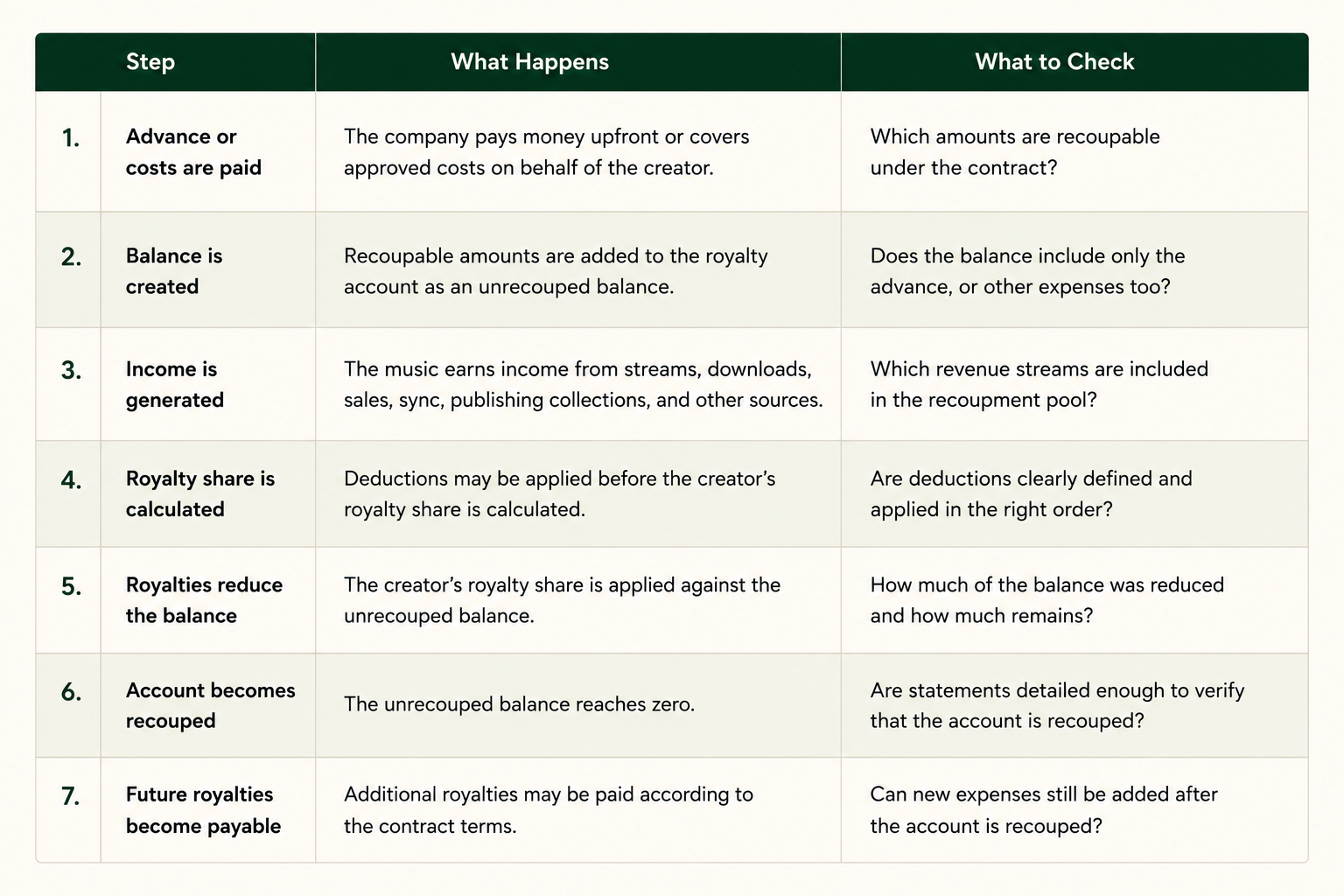
The table shows the general order, but the contract controls the details. Some agreements keep the calculation limited to one advance and one release. Others combine several costs in the same account, including recording expenses, tour support, distribution costs, legal fees, content budgets, or campaign spending.
Royalty statements should make the balance traceable. A useful statement shows the income received, deductions applied, royalty share earned, amount recouped during the period, and balance still outstanding. Without that level of detail, the creator may see that the account remains unrecouped without knowing whether the calculation is correct.
Project structure can change the outcome. Separate accounts keep each release or deal period apart. Shared accounts can connect multiple songs, albums, territories, or revenue streams, which may cause income from one successful project to cover costs from another.
The time it takes to recoup depends on the size of the advance, the royalty rate, the income generated, the expenses charged, and the way revenue is split. A strong release with controlled costs may recoup quickly. A deal with a high advance, broad expense language, or a low royalty share may stay unrecouped for years.
What Counts as Recoupable in a Music Deal?
Recoupable costs are the amounts a contract allows the company to recover from the creator’s royalty share before additional royalties are paid. The advance is usually the first item in that account, but many deals go beyond the upfront payment.
Common recoupable items may include:
- Artist, songwriter, or producer advancesUpfront payments made against future royalties or earnings.
- Recording costsStudio time, engineers, mixers, musicians, vocal production, mastering, equipment rental, and other approved production expenses.
- Video and content costsMusic videos, visualizers, short-form content, lyric videos, behind-the-scenes footage, or other campaign assets.
- Marketing and promotion expensesAdvertising, digital campaigns, radio promotion, playlist promotion, public relations, influencer campaigns, street teams, and other promotional costs.
- Tour supportMoney advanced to help fund touring, showcases, travel, production, or other live performance costs.
- Remix and feature costsRemix fees, guest artist fees, additional producer fees, or costs tied to alternate versions of a release.
- Distribution and delivery costsEncoding, delivery, platform fees, takedowns, content operations, or other distribution-related charges.
- Legal, administrative, or collection costsThese need careful review. Some contracts include legal fees, administration charges, collection costs, or third-party service fees as recoupable expenses, while others limit or exclude them.
The important question is not only whether a cost appears in the contract. The agreement should also say whether the creator must approve the expense, whether the cost has a cap, whether it applies to one project or several, and whether it can be charged before or after income is calculated.
Broad phrases can create problems. Language such as “all costs,” “any expenses,” “including without limitation,” or “costs related to exploitation” may give the company wide room to add charges to the account. Clearer language names the categories, sets approval rules, limits the amount, and explains how each cost will appear on royalty statements.
A creator’s team should also check whether expenses are recouped from gross income, net income, the creator’s royalty share, or a specific revenue stream. That detail can change the practical result of the deal.
Advance Recoupment vs. Expense Recoupment
Advance recoupment and expense recoupment both reduce the royalty account, but they come from different parts of the deal.
An advance is money paid upfront against future earnings. It may help fund the creator’s work, replace short-term income, support a release cycle, or make the deal financially possible before royalties arrive. In most music contracts, the advance is recouped from the creator’s royalty share.
Expense recoupment covers costs the company pays in connection with the project, campaign, catalog, or service. These may include recording budgets, video production, marketing, tour support, remixes, content creation, distribution costs, or other approved charges. The contract decides which expenses are allowed, who approves them, and whether any limits apply.
The difference matters because an advance is usually known at the beginning of the deal. Expenses can grow over time. A $50,000 advance may look manageable, but if the agreement also allows $25,000 in recording costs, $20,000 in marketing, and $10,000 in video costs to be recouped, the royalty account may need to recover far more than the upfront payment.
A clean contract separates the categories clearly. The advance should be stated in a fixed amount. Expense categories should be named rather than left open-ended. Approval rights, caps, reporting rules, and project limits help prevent the recoupment balance from expanding without the creator understanding how it happened.
For review purposes, the creator’s team should ask:
- Is the advance recoupable?
- Are expenses recoupable too?
- Which expenses are included?
- Does the creator approve expenses before they are charged?
- Are there caps or budget limits?
- Can expenses from one project be recouped from another?
- Will royalty statements show each charge clearly?
The practical risk is imbalance. A creator may negotiate the advance carefully, then overlook expense language that gives the company more room to recover costs than expected.
When Artists Start Receiving Royalties
In a recoupable deal, royalties can appear on statements before any new money is paid to the artist. The account has to move through the recoupment balance first.
Say an artist receives a $50,000 advance. The contract also allows $20,000 in approved recording and marketing costs to be recouped. Before additional artist royalties are payable, the royalty account may need to recover $70,000.
If the artist’s royalty share earns $12,000 in the first accounting period, that amount reduces the balance to $58,000. If the next period earns another $18,000, the balance falls to $40,000. The artist is earning royalties, but those royalties are being used to repay the advance and approved costs inside the contract’s accounting system.
New royalty payments begin after the account crosses the recouped point. Using the same example, if a later statement shows $45,000 in royalty earnings while $40,000 remains unrecouped, the first $40,000 clears the balance. The remaining $5,000 may become payable, subject to the contract’s payment schedule, reserves, deductions, minimum payout thresholds, and any new recoupable costs.
The statement should make that movement easy to follow. A useful royalty report shows the opening balance, new income, deductions, royalty share, recoupment applied during the period, closing balance, and any amount payable. Without those details, the artist may see income and still have no clear view of when the account will turn positive.
Recoupment also affects timing across deal periods. A contract may keep one release separate from another, or it may allow income from one project to reduce costs from another. The artist’s team should confirm whether the recouped point applies to one track, one album, one deal period, one territory, or the full agreement.
Cross-Collateralization in Recoupment
Cross-collateralization happens when income from one project, song, album, territory, or revenue stream is used to recover costs from another. Instead of keeping each royalty account separate, the contract allows the company to connect multiple balances.
In a simple deal, one release has its own advance, costs, income, and recoupment balance. If that release recoups, future royalties from that release can become payable. With cross-collateralization, income from a successful release may be applied to an unrecouped balance from another release before the creator receives additional royalties.
The same issue can appear across revenue categories. A contract may allow recording income to recover video costs, publishing income to recover an advance, distribution income to recover marketing spend, or income from one territory to recover expenses from another. The details depend on the deal language.
For creators, the concern is that a profitable project may not produce payments if it is tied to other unrecouped costs. A song, album, or catalog segment can perform well on its own while the combined account remains negative.
Contract review should focus on the scope of the cross-collateralization language. The creator’s team should check whether balances are separated by project, release, territory, income stream, or deal period. If the contract connects them, the agreement should explain how costs are tracked, how statements show the shared balance, and whether any limits apply.
Recoupment in Different Music Contracts
Recoupment can appear across several types of music agreements, but the structure is rarely identical from one contract to another. A record deal may connect recoupment to artist royalties from master recordings. A publishing deal may recover a songwriter advance from publishing income. A distribution or label services deal may focus on campaign costs, marketing support, or advances tied to a specific release.
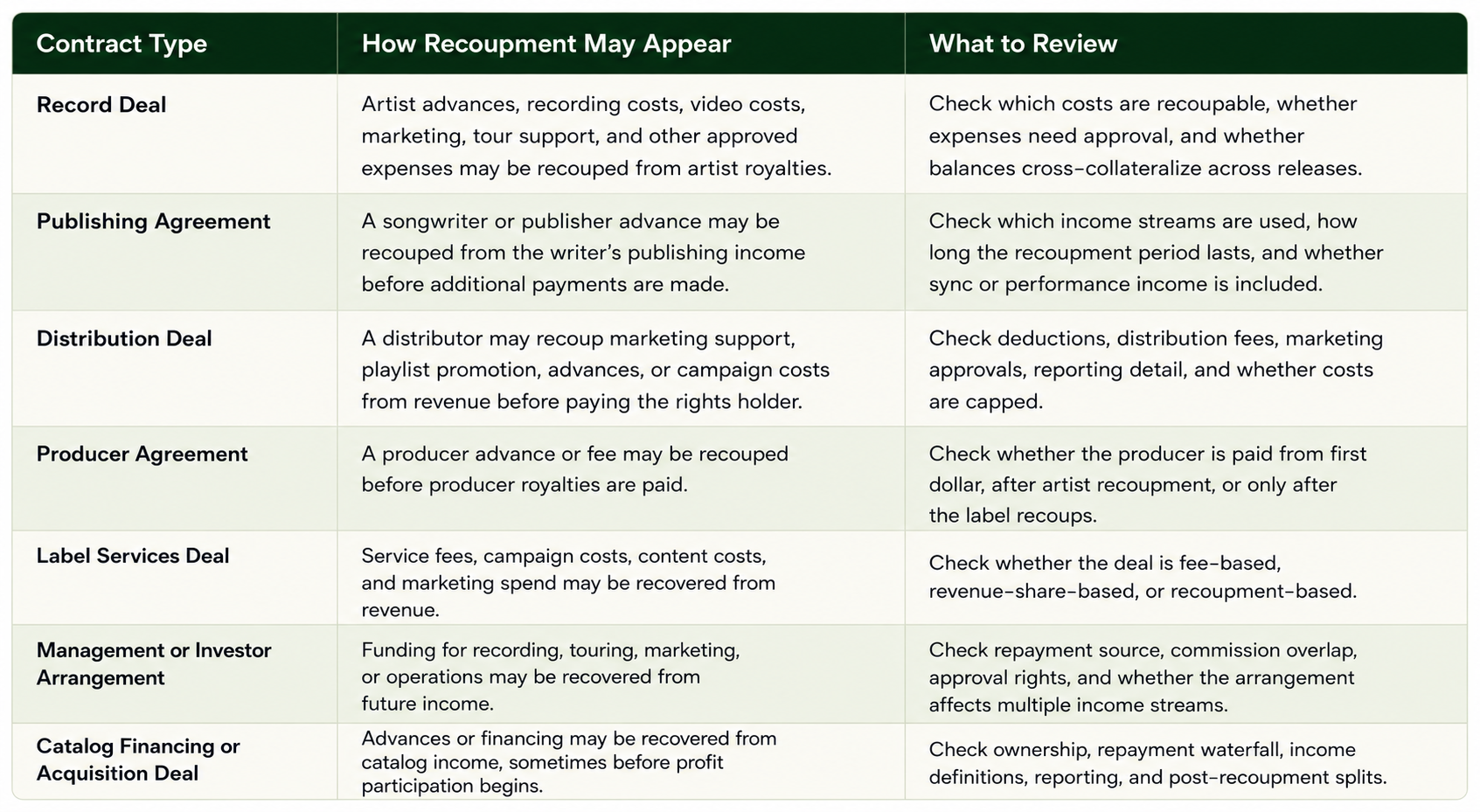
The contract type affects the income used, the costs that can be recovered, and the point when payments begin. In some agreements, recoupment is limited to one project or one income category. In others, the language may connect multiple releases, territories, rights, or revenue streams.
Producer agreements deserve close attention because the payout structure can vary. Some producers receive royalties after artist recoupment. Others may be paid from first dollar, after certain costs are recovered, or only after the label recoups its investment. The wording should make the payment trigger clear.
Publishing and administration agreements can also handle recoupment differently from master-side deals. A songwriter advance may be recovered from mechanical, performance, sync, or other publishing income depending on the agreement. If only certain income streams are included, that should be stated clearly.
The same word can carry different consequences depending on the deal. Before signing, the creator’s team should identify the specific royalty account, the recoverable costs, the income streams used for recovery, and the reporting needed to verify the balance.
Common Recoupment Terms to Review Closely
Recoupment language can look small inside a long contract, but it controls the path from income to payment. Before signing, the creator’s team should review how the balance is created, what can be added to it, which income reduces it, and how the numbers will be reported.
Recoupable Costs
The contract should identify the costs that may be added to the royalty account. An advance is usually expected. Recording budgets, video costs, marketing spend, remix fees, tour support, distribution costs, legal fees, or administrative charges need closer attention.
Broad wording gives the company more room to charge expenses back to the creator’s account. Specific categories are easier to track and easier to challenge if a statement looks wrong.
Approval Rights
Expense approval can keep the recoupment balance from growing without the creator’s knowledge. A contract may require written approval before certain costs are charged, or it may allow the company to spend and recoup at its discretion.
Approval rights are especially important for marketing, video production, remixes, tour support, paid promotion, content creation, and third-party services. If the creator has no approval right, the contract should at least provide clear limits and detailed reporting.
Expense Caps
A cap places a limit on how much can be recouped in a specific category. Without one, an open-ended marketing budget, video budget, or campaign spend can increase the unrecouped balance far beyond the advance.
Caps can apply to a total budget, a single expense category, one release, one territory, or one accounting period. The cleaner the cap language, the easier it is to understand the risk before signing.
Recoupment Source
The agreement should say where recovery comes from. Costs may be recouped from gross revenue, net revenue, the creator’s royalty share, one income stream, or several income streams combined.
This detail changes the economics of the deal. Recovering costs from the creator’s royalty share is different from recovering them before the royalty share is calculated. The order of calculation should be clear enough to follow on a statement.
Cross-Collateralization
Cross-collateralization language decides whether separate projects, rights, territories, or revenue streams are connected. A creator may expect one release to stand on its own, while the contract allows income from that release to recover costs from another.
This term should be reviewed alongside options, multiple-release commitments, catalog deals, publishing agreements, and distribution arrangements. Shared balances can delay payments even when one project performs well.
Royalty Statements
A useful royalty statement should show the opening balance, new income, deductions, royalty share, new recoupable charges, amount applied to recoupment, closing balance, and any payable amount.
Thin reporting makes recoupment harder to verify. If the statement only shows a balance without the supporting calculation, the creator may not be able to see which costs were added or how income was applied.
Post-Recoupment Charges
Some contracts allow new expenses to be added after the account has already recouped. That can move the account back into an unrecouped position and pause future royalty payments.
The contract should explain when new costs may be charged, whether approval is required, and whether those costs apply to the same project or a separate accounting period.
Audit Rights
Audit rights give the creator a way to review the records behind the royalty statements. This matters when recoupment balances are unclear, expenses seem high, or payments do not match expected income.
The audit clause should include the time period available for review, notice requirements, who may conduct the audit, how often audits can happen, and what happens if an underpayment is found.
Red Flags in Recoupment Language
Recoupment language should be reviewed with the same level of attention as the advance, royalty rate, and rights grant. A contract may appear financially workable at first, but broad cost language, weak reporting, or shared recoupment balances can delay payment long after income starts coming in.
The clearest recoupment provisions identify the recoverable costs, the income streams used for recovery, the approval process for expenses, the reporting requirements, and any limits on future charges. When those details are missing or too broad, the creator’s team should slow down before accepting the language.
Common red flags include:
Broad Expense Categories
Phrases such as “all costs,” “any expenses,” “including without limitation,” or “costs related to exploitation” can make the recoupment account difficult to predict. Better language names the categories that may be charged and excludes costs that should stay with the company.
No Approval Rights
A contract that allows expenses to be recouped without approval can leave the creator with little control over the balance. Written approval is especially important for large marketing spends, video budgets, remixes, tour support, paid promotion, and third-party services.
No Expense Caps
Open-ended costs can turn a manageable advance into a much larger balance. Caps help define the financial risk before the deal begins.
Unclear Royalty Base
Recoupment should be reviewed alongside the royalty calculation. If the contract does not clearly explain gross revenue, net revenue, deductions, fees, reserves, and the order of calculation, the creator may have trouble understanding how income becomes recoupment credit.
Cross-Collateralization Across Projects
One successful release may not pay out if its income is tied to another unrecouped project. This issue becomes more important in multi-release deals, catalog deals, publishing agreements, and distribution arrangements covering several works.
Recoupment Across Too Many Income Streams
A contract may allow costs from one area to be recovered from income in another. Master income, publishing income, sync income, YouTube income, neighboring rights, merch income, or live income should not be grouped together unless the creator understands and accepts that structure.
Vague or Thin Royalty Statements
A statement that only shows a total balance is not enough. The creator should be able to see income, deductions, new charges, amounts applied to recoupment, and the remaining balance.
New Charges After Recoupment
Some agreements allow additional costs to be added after the account has already recouped. If that happens, the account may move back into an unrecouped position and delay future payments.
Weak Audit Rights
Limited audit language makes it harder to verify the balance. Short audit windows, high notice requirements, narrow record access, or unclear underpayment remedies can reduce the creator’s ability to challenge mistakes.
Recoupment Survives Without a Clear End Point
Post-term recoupment language should be reviewed carefully. If the company can continue recovering costs after the active term ends, the agreement should explain how long that right lasts, which income applies, and what reports must be provided.
Frequently Asked Questions
What does recoupment mean in music contracts?
Recoupment is the process of recovering an advance or approved costs from a creator’s royalty share before additional royalties are paid. The music may already be earning income, but that income is first applied to the unrecouped balance.
Is an advance the same as a royalty payment?
An advance is usually paid ahead of future royalties. In a recoupable deal, the creator receives the advance upfront, then future royalty earnings are used to recover that amount before additional royalty payments begin.
Does an artist have to repay an unrecouped advance personally?
In many music contracts, an unrecouped advance is recovered only from royalties, not from the artist’s personal funds. The contract should still be reviewed carefully because repayment obligations, guarantees, cross-collateralization, or other special terms may change that result.
What kinds of costs can be recouped?
Recoupable costs may include advances, recording costs, video budgets, marketing spend, tour support, remix costs, distribution expenses, legal fees, administrative charges, or other approved expenses. The contract should identify which categories apply.
When does an artist start receiving royalties after recoupment?
Additional royalty payments usually begin after the creator’s royalty share has fully recovered the advance and other recoupable costs. Payment can still depend on statement periods, reserves, deductions, minimum payout thresholds, and new charges allowed under the contract.
What is an unrecouped balance?
An unrecouped balance is the amount still left to recover before additional royalties become payable. If a deal has a $70,000 recoupment balance and the creator’s royalty share earns $20,000, the remaining balance would be $50,000.
What is cross-collateralization?
Cross-collateralization allows income from one project, territory, income stream, or deal period to recover costs from another. A successful release may not pay out if its income is connected to another unrecouped balance.
Can marketing costs be recouped?
Yes, if the contract allows it. Marketing costs should be reviewed closely because broad campaign spending can increase the recoupment balance. Approval rights, caps, and clear reporting can help limit uncertainty.
How can a creator track recoupment?
Royalty statements should show the opening balance, income received, deductions, royalty share, new recoupable charges, amount applied to recoupment, closing balance, and any payable amount. Audit rights may help verify the numbers if statements are unclear.
What recoupment terms should be reviewed before signing?
Key terms include recoupable costs, expense approvals, expense caps, royalty base, recoupment source, cross-collateralization, statement detail, audit rights, post-recoupment charges, and post-term recovery rights.
Key Takeaways
- Recoupment explains how advances and approved costs are recovered before additional royalties are paid.
- Royalties can be earned before they are payable because the creator’s royalty share may be applied to an unrecouped balance.
- An advance is usually paid upfront against future earnings, while expense recoupment covers costs charged to the royalty account.
- Recoupable costs may include recording, video, marketing, tour support, remix, distribution, legal, administrative, or collection costs if the contract allows them.
- The royalty base and order of calculation affect how quickly a balance is reduced.
- Cross-collateralization can connect multiple projects, territories, deal periods, or income streams in one recoupment structure.
- Different music contracts handle recoupment differently, including record deals, publishing agreements, distribution deals, producer agreements, label services deals, and financing arrangements.
- Expense approval rights, caps, detailed statements, and audit rights help make the recoupment account easier to verify.
- Broad expense categories, weak reporting, unclear royalty bases, and open-ended post-term recovery rights should be reviewed carefully before signing.
- A creator’s team should understand the full recoupment structure before accepting an advance or approving recoupable expenses.
Practical Resource
Recoupment Statement Review Checklist
The Recoupment Statement Review Checklist is designed for artists, songwriters, producers, managers, attorneys, accountants, catalog administrators, and rights teams reviewing royalty statements or recoupment schedules.
Use it to check whether a statement clearly shows how income is being applied against an advance, approved expenses, and any remaining unrecouped balance. It can also help organize questions before asking for clarification from a label, publisher, distributor, administrator, accountant, or attorney.
Recoupment_Statement_Review_Checklist.xlsx
References
Passman, Donald S. All You Need to Know About the Music Business. 11th ed. Simon & Schuster.
ASCAP. Music and Money: Recording Artist Royalties.
https://www.ascap.com/help/music-business-101/money-recording
ASCAP. The Truth About Recording & Publishing Deal Advances.
https://www.ascap.com/help/music-business-101/truth-about-advances
U.S. Copyright Office. Copyright Basics.