How Do Producer Deals Work in the Music Industry?
A practical guide to producer agreements covering upfront payments, back-end royalties, master rights, publishing contributions, and common deal terms.

Introduction
A producer deal sets the business terms for a producer’s work on a recording. It explains the scope of the job, the required deliverables, the payment structure, the producer’s credit, and any royalty or ownership-related terms tied to the finished track.
These agreements can vary widely. One producer may be hired for a flat fee to create a beat. Another may receive an advance plus producer points on a label release. A producer who helps write the song may also need a separate songwriting split, while a producer who only shapes the recording may have no publishing claim at all.
Clear deal language matters because production sits close to several rights and payment streams. The agreement should explain who pays the producer, when payment is due, whether royalties apply, how those royalties are calculated, who controls the master, what files must be delivered, and how the producer will be credited after release.
Learning Objectives
By the end of this guide, you should understand:
- what a producer deal usually covers
- how producer fees, advances, and royalties work
- what producer points mean
- why all-in royalty language matters
- how recoupment can affect producer payments
- how producer agreements relate to master ownership
- when a producer may also receive songwriting or publishing income
- which contract terms should be reviewed before signing
Overview
Producer deals are built around two core questions: what is the producer contributing, and how will that contribution be paid?
The contribution should be described with more precision than “production services.” A producer might create the instrumental, shape the arrangement, direct recording sessions, hire musicians, edit vocals, build the track around an artist’s performance, deliver stems, or prepare files needed for release. A beatmaker licensing an existing track is not doing the same job as a producer overseeing studio sessions from start to finish.
Payment can also move in different ways. Some deals are fee-only. Others combine an upfront producer fee with back-end royalties, often called producer points. The agreement should state whether those royalties are calculated from the artist’s royalty, the label’s receipts, net income, or another defined royalty base.
Another issue is the line between the recording and the song. A producer may have rights connected to the sound recording, but that does not automatically make the producer a songwriter. Publishing splits usually depend on whether the producer contributed to the composition itself, such as lyrics, melody, or other underlying song elements.
A complete producer agreement should make the practical terms easy to confirm later: the covered recordings, payment schedule, royalty formula, recoupment language, credit, delivery files, ownership position, approval rights, and accounting process. Most disputes start when one of those points was assumed instead of written down.
Table of Contents
What a Producer Deal Covers
A producer deal should identify the recordings covered by the agreement and the producer’s role in creating them. This may sound basic, but it matters. A deal for one track should not accidentally cover a full project. A deal for production work should not quietly give the producer rights to unrelated songs, demos, or future releases.
The agreement usually starts with the parties, the project, and the scope of work. It should name the artist, producer, label or company involved, and the specific recording or recordings being produced. If the producer is working on only one version of a track, that should be clear. If remixes, alternate versions, stems, or edited versions are included, the agreement should say so.
The deal also sets the producer’s compensation. That may include an upfront fee, a payment schedule, reimbursement for approved costs, producer royalties, or a combination of these terms. For label projects, the agreement may also explain whether the producer is paid directly by the label or through the artist’s recording budget.
Rights language is another central part of the agreement. Some producer deals say the producer’s work is a work made for hire, meaning the hiring party owns the producer’s contribution to the recording. Other deals use assignment language, where the producer transfers rights after creating the work. Either way, the ownership position should be written clearly, especially when the producer created the beat, track, or instrumental before the artist recorded vocals.
A producer agreement may also cover:
- what files the producer must deliver
- whether the producer must attend sessions or deliver remotely
- who pays for studios, musicians, engineers, mixing, or equipment
- how the producer will be credited
- whether the producer has approval rights over the final recording
- whether royalties are paid before or after recoupment
- how statements and audits will work
- whether the producer made any songwriting contribution
- how disputes over samples, clearances, or third-party material are handled
The deal should not treat production, songwriting, ownership, and payment as one blended issue. Each one needs its own language. A producer can be paid for production without owning the master. A producer can own part of the composition only if there is a songwriting basis for that claim. A producer can receive credit without receiving royalties. Clear drafting keeps those categories separate.
Producer Deliverables and Responsibilities
A producer agreement should identify what the producer is expected to contribute before, during, and after the recording process. These obligations can vary widely depending on the project. Some producers are hired mainly for creative direction, arrangement, sound design, beat production, or vocal production. Others may be responsible for managing the recording process, coordinating musicians, supervising studio sessions, editing performances, or delivering files that can be mixed, mastered, and released.
The agreement should describe the producer’s responsibilities with enough detail that both sides understand what completion means. In a simple single-track arrangement, the producer may only need to deliver a finished beat, instrumental track, or production session. In a more involved recording project, the producer may be expected to oversee recording sessions, help shape the song arrangement, select takes, guide the artist’s performances, coordinate with engineers, and approve rough mixes before the track moves to final mixing or mastering.
Deliverables often include the audio files, session files, stems, multitracks, rough mixes, final production files, and any related materials needed to complete or exploit the recording. The agreement may also require the producer to deliver files in a specific format, preserve editable sessions, label tracks properly, or provide clean versions, instrumentals, a cappella files, or alternate mixes. These details matter because a recording may need to be edited, remixed, licensed, performed live, used in audiovisual media, or delivered to a distributor long after the initial session ends.
Producer responsibilities can also include administrative obligations. A producer may need to confirm whether any samples, loops, interpolations, session musicians, co-producers, or third-party contributors were used. If outside materials or contributors are involved, the agreement should explain who is responsible for securing permissions, collecting split information, obtaining releases, and making sure the artist or label has the rights needed to use the recording. This is especially important when the producer supplies beats, pre-existing tracks, or production elements that may include material from other creators.
The deal should also address timing. Delivery dates, revision periods, approval rights, and final acceptance procedures help prevent disputes over whether the producer has completed the work. If the artist or label can request revisions, the agreement should explain how many rounds are included, what happens if the scope changes, and whether additional fees apply. A producer may also want language confirming that delays caused by the artist, label, studio, featured performers, or other third parties do not count as the producer’s failure to deliver.
Clear deliverable language protects both sides. The artist or label needs the materials required to finish and release the recording. The producer needs a defined scope of work, a clear delivery standard, and payment terms tied to specific obligations rather than open-ended creative labor. Without that detail, disagreements can arise over whether the producer was hired to create a track, finish a master, supervise a recording, provide files, clear materials, or remain involved through release.
Producer Points and Back-End Royalties
Producer points give the producer a royalty interest in the sound recording. One point usually means one percent, but that percentage only becomes meaningful after the agreement defines the royalty base, the income being counted, and the deductions that apply before the producer is paid.
In many record deals, the producer’s points are calculated as a percentage of the artist’s royalty rather than a percentage of gross revenue. If the artist has a 20% royalty and the producer receives three points, the producer is not automatically receiving 3% of every dollar earned by the recording. The producer may be receiving 3% out of the artist’s royalty structure, subject to the same or similar deductions, reserves, formats, territories, and recoupment rules that apply under the artist’s deal.
Independent releases can be structured differently. An artist who owns or controls the master may agree to pay the producer a percentage of net receipts, distributor income, or other defined recording revenue. That structure can be simpler than a label royalty formula, but it still needs careful drafting. “Net” income can change depending on whether distribution fees, marketing costs, video expenses, collection fees, chargebacks, taxes, third-party royalties, or other costs are deducted first.
The source of payment also matters. A producer royalty may be paid by the label, by the artist, or by another party that controls the master. On a label project, the producer may look to the artist for payment unless the label issues a direct producer agreement or letter of direction. On an independent project, the artist may remain responsible for calculating and paying the producer after income is received from the distributor or other master-side revenue source.
Back-end royalties may apply to streaming, downloads, physical sales, synchronization income, neighboring rights income, or other uses of the master, depending on the deal. Some agreements include all master income. Others limit the producer’s royalty to specific revenue categories. If the producer is paid only on certain uses, the agreement should identify those categories clearly instead of relying on broad phrases like “record royalties” or “income from exploitation.”
Producer points should also be read alongside the artist’s record deal or distribution arrangement. The headline number can be misleading if the royalty base is narrow, the deductions are broad, or the artist’s account is still unrecouped. Music Admin’s guide on how record deals work in the music industry explains how artist royalties, deductions, and recoupment affect the income available from a recording.
A producer royalty clause is strongest when it answers the practical payment questions directly: what percentage applies, what income is included, what deductions are allowed, who calculates the royalty, who pays it, how often statements are issued, and whether the producer has any audit rights. Without those details, “points” can sound more certain than they are.
All-In Royalties and Who Pays the Producer
Producer royalties are often described as “all-in,” which means the producer’s royalty is included within the artist’s royalty instead of being added on top of it. This structure is common in label deals because the label does not usually want to pay the artist royalty and then pay a separate producer royalty beyond the agreed royalty pool.
Who pays the producer depends on how the recording is financed, who controls the master, and what documents were signed. The main structures usually look like this:
- Artist-paid producer royalty - The producer is paid out of the artist’s royalty share. If the artist receives a royalty from the label, the producer’s points reduce the amount the artist keeps from that royalty stream. This is one reason producer points are often described as being “included in” or “deducted from” the artist’s royalty.
- Label-paid producer royalty - The label may agree to pay the producer directly, usually through a producer agreement, side letter, or letter of direction. Even when the label handles payment, the producer royalty may still be charged against the artist’s royalty account or treated as part of the artist’s recording costs.
- Independent artist payment - If there is no label, the artist or master owner may pay the producer from distributor income, net receipts, or another defined revenue source. This can be more direct, but it places more responsibility on the artist or master owner to track income, issue statements, and make royalty payments.
- Production company payment - In some projects, a production company hires the producer and then delivers the master to a label, artist, or distributor. The producer may be paid by the production company, while the production company separately negotiates its rights, fees, or royalty participation with the artist or label.
- Work-for-hire or flat-fee arrangement - Some producers are paid only an upfront fee with no back-end royalty. In that structure, there may be no ongoing producer royalty unless the agreement separately grants points, net receipts participation, publishing income, or another form of continuing compensation.
All-in royalty language should be reviewed carefully because it affects the economics for both the artist and the producer. For the artist, producer points can reduce the artist’s royalty income. For the producer, payment may depend on the artist’s royalty account, the label’s accounting practices, or the master owner’s ability to track and report income accurately.
The payment section should also connect to the producer’s recoupment terms. If the producer’s advance, fee, or royalty is recoupable, the producer may not receive additional back-end payments until the relevant costs have been recovered. Music Admin’s guide on how music advances work and get repaid provides more context on how recoupment affects royalty payments over time.
Recoupment, Accounting, and When Royalties Become Payable
Producer points only matter once the deal explains how those points are calculated, what must be recovered first, and who is responsible for reporting the income. A producer may have a royalty interest in the master, but that royalty may not produce a payable balance right away if the producer received an advance or if certain project costs are charged against the producer’s account.
The recoupment language can change the value of the deal more than the headline royalty number suggests. A producer whose advance is recouped only from the producer’s own royalty share is in a different position from a producer whose account is also charged with studio costs, musician fees, co-producer payments, sample clearances, file preparation, or other production expenses. The broader the list of recoupable items, the longer it may take before the producer receives additional royalty payments.
A producer’s royalty base also needs close review. Some deals calculate producer royalties from the artist’s royalty under a label agreement. Others use net receipts, distributor income, or a negotiated share of master revenue. When the producer is paid from the artist’s royalty, the producer’s payment may depend on the artist’s own royalty account and the label’s accounting process. When the producer is paid from net receipts, the definition of “net” becomes central because distribution fees, marketing costs, third-party royalties, taxes, chargebacks, and other deductions may reduce the amount used for calculation.
Accounting provisions are where the royalty clause becomes a reporting system. Instead of only stating that royalties will be paid, the deal needs to identify the accounting periods, statement deadlines, payment deadlines, and information that must appear on each statement. A useful producer statement shows income received, royalty rate, deductions, reserves if any, recoupment balance, and the amount currently payable. Without that level of detail, the producer may not be able to tell whether a nonpayment is accurate, delayed, or based on an accounting error.
Income from a recording may also arrive in stages. Streaming and download income may be reported by a distributor on one schedule, while a label may account to the artist twice a year. Synchronization fees may depend on when a licensee pays. Foreign income and neighboring rights income can arrive later through overseas partners, neighboring rights societies, or other collection channels. Producer deals that include multiple revenue categories should account for those timing differences instead of treating all master income as if it arrives at once.
Audit rights give the producer a way to review the books if the statements do not match expectations. The clause usually sets limits on who can conduct the audit, how often it can happen, how far back the review can go, and what happens if an underpayment is found. Those time limits should be taken seriously because waiting too long may prevent the producer from challenging older statements.
For producers, the practical issue is when the royalty turns into money that is actually payable. That answer depends on the royalty base, the recoupment pool, the accounting schedule, the permitted deductions, and whether the party controlling the master has a clear obligation to issue statements and payments.
Master Ownership, Work-for-Hire Language, and Delivery Files
Producer deals should separate the producer’s compensation from ownership of the recording. A producer may contribute heavily to the sound of a track, but that does not automatically settle who owns or controls the master, who can approve uses, or what rights the producer keeps after the work is delivered.
Master Ownership
The master is usually owned or controlled by the artist, label, production company, or other party responsible for financing and releasing the recording. If the producer is not meant to share in ownership, the deal should say that clearly and explain what the producer receives instead, such as an upfront fee, an advance, producer points, credit, or a limited approval right.
Some deals give the producer no ownership interest in the master. Others may give the producer a share of master income, a royalty participation, or a more specific right tied to certain uses. Those are different outcomes. A producer can receive royalties from a master without owning the master, and a producer can assign ownership while still keeping a contractual right to payment.
Work-for-Hire and Assignment Language
Work-for-hire and assignment provisions are often used to make sure the artist, label, or master owner has the rights needed to use the producer’s contribution as part of the finished recording. The language may state that the producer’s work is specially commissioned, created for the project, and owned by the hiring party from creation. The agreement may also include a backup assignment so that, if the work-for-hire language does not fully apply, the producer still transfers the relevant rights.
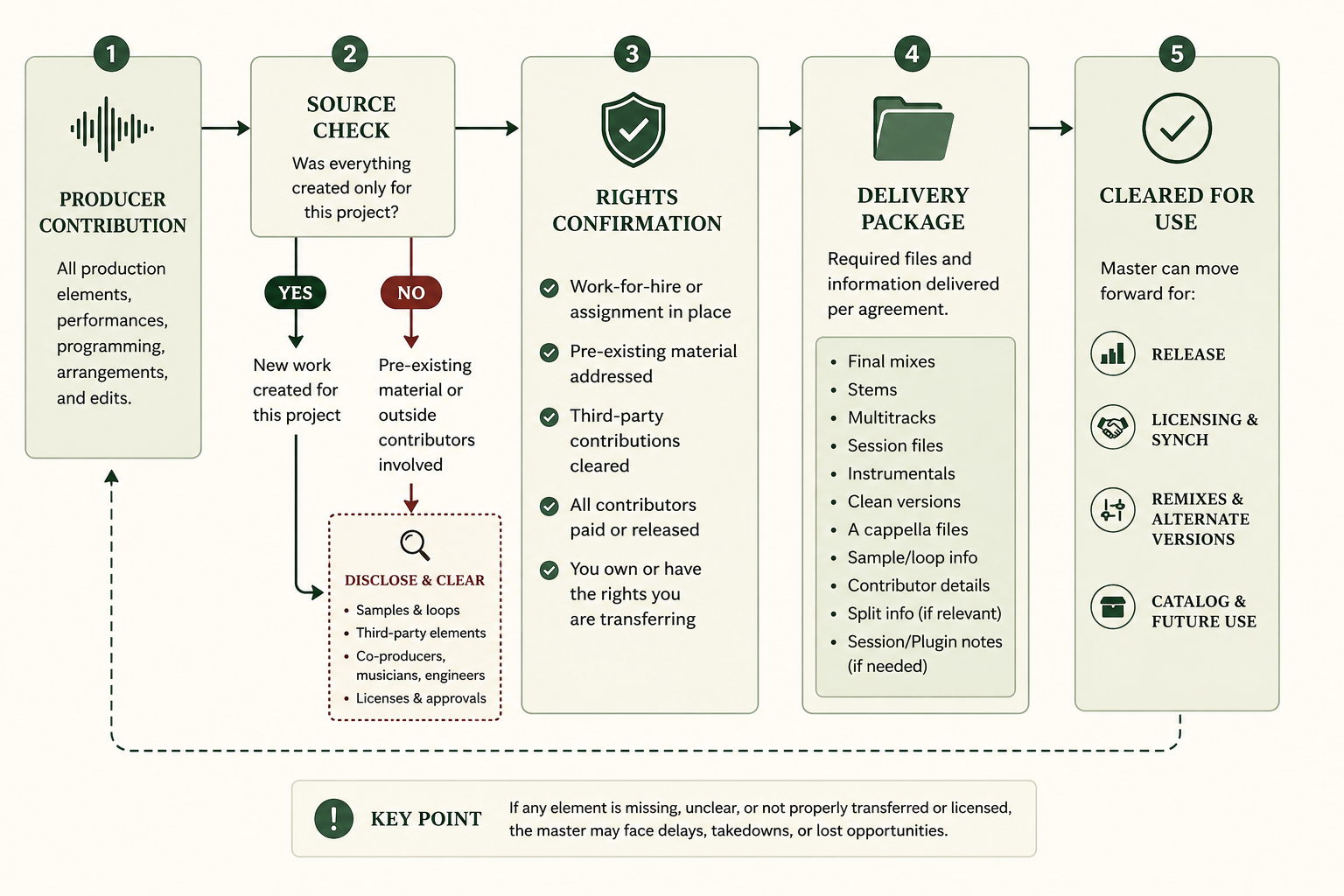
This wording should be reviewed carefully because it can affect more than release permission. It may determine who controls the producer’s recorded contributions, programming, production elements, beats, edits, arrangements, and other materials created for the project. If the producer is bringing in pre-existing material, such as an older beat, sample pack element, loop, or reusable production asset, the deal should distinguish that material from new work created specifically for the recording.
The producer may also need to confirm that any third-party materials are either original, properly licensed, or disclosed for clearance. That includes samples, interpolations, loops, beat components, session musicians, co-producers, and other contributors. Ownership language is harder to rely on if the producer transfers rights that the producer does not fully control.
Delivery Files
Delivery is not only about sending the final audio. The artist, label, or master owner may need editable files and supporting information to finish the release, create alternate versions, approve mixes, handle licensing requests, or preserve the recording for future use.
Common delivery materials may include:
- final production files
- stems
- multitracks
- editable session files
- rough mixes
- instrumental versions
- clean versions
- a cappella files
- MIDI files, if relevant
- plugin, tempo, or session notes
- sample and loop information
- contributor names and roles
- split information, if relevant
The deal should also address when those files are due and whether delivery is tied to payment. A producer may not want to release editable sessions before receiving the agreed fee, while the artist or label may need the files before approving final payment. Clear delivery language helps prevent the project from getting stuck after the creative work is finished.
File delivery can also affect future income opportunities. Stems, instrumentals, clean versions, and properly labeled sessions may be needed for remixes, live performances, synchronization licensing, archival work, or later catalog exploitation. A producer agreement that only mentions the finished master may leave the artist or label without the materials needed to fully use the recording.
Master Ownership, Work-for-Hire Language, and Delivery Files
Producer deals should separate compensation from control of the recording. A producer may shape the sound of a track, create production elements, guide performances, or build the instrumental foundation, but those contributions do not automatically answer who owns the master, who can approve future uses, or what rights remain with the producer after delivery.
Master Ownership
The master is usually owned or controlled by the artist, label, production company, or other party financing and releasing the recording. If the producer is not meant to share ownership, the agreement should make that position clear and identify the producer’s compensation separately. That compensation may include an upfront fee, an advance, producer points, credit, or another negotiated benefit.
Royalty participation is not the same as ownership. A producer may receive points from master income without having the right to control the master, approve licenses, block a release, or decide how the recording is distributed. The reverse can also be true: a producer may transfer ownership in the recording while keeping a contractual right to payment. The agreement needs to distinguish these outcomes so the parties do not confuse payment rights with control rights.
Some producer deals also include approval rights or consultation rights. These may relate to mix approval, credit placement, use of the producer’s name, or certain changes to the recording. Those rights should be stated separately from ownership because an approval right over a specific item does not necessarily mean the producer owns part of the master.
Work-for-Hire and Assignment Language
Work-for-hire and assignment provisions are often used to make sure the artist, label, or master owner can use the producer’s contribution as part of the finished recording. The wording may state that the producer’s work was specially created for the project and owned by the hiring party from creation. Many agreements also include a backup assignment so that, if the work-for-hire language does not fully apply, the producer still transfers the necessary rights.
This language can cover recorded contributions, programming, production elements, beats, edits, arrangements, and other materials created specifically for the track. It should not be used carelessly for materials the producer already owned before the project began. Older beats, reusable sounds, sample pack elements, loops, templates, presets, and production assets may need separate treatment if the producer does not intend to transfer them outright.
Third-party contributions need the same level of attention. A producer may involve co-producers, programmers, beatmakers, engineers, session musicians, sample creators, or other contributors. The producer agreement should address whether those contributors have been paid, whether they signed releases, whether they are owed credit or royalties, and whether any additional clearance is needed before release.
Delivery Files
Delivery language determines what the artist, label, or master owner actually receives at the end of the production process. A final bounced audio file may be enough for review, but it may not be enough for distribution, remixing, sync pitching, archival work, live use, or future catalog management.
Common delivery materials may include:
- final production files
- stems
- multitracks
- editable session files
- rough mixes
- instrumental versions
- clean versions
- a cappella files
- MIDI files, if relevant
- plugin, tempo, or session notes
- sample and loop information
- contributor names and roles
- split information, if relevant
The timing of delivery should line up with payment and approval. A producer may want the agreed fee paid before releasing editable sessions or multitracks. The artist or label may want enough materials to review the work before approving the final installment. The agreement should set that sequence in advance so the project does not stall after the recording is otherwise finished.
Delivery files also matter after release. Stems, instrumentals, clean versions, and properly labeled sessions may be needed months or years later for remixes, live arrangements, synchronization requests, catalog transfers, or disputes over who contributed what. A producer agreement that only mentions the finished master can leave important materials outside the delivery obligation.
Songwriting Credit, Publishing Splits, and Producer Contributions
Master-side compensation and publishing rights need to be handled separately. Fees, advances, points, and master royalties relate to the sound recording. Songwriting credit and publishing income relate to the composition, which is a separate copyright from the master.
Producing a track does not automatically create a songwriting share. The main question is whether the work changed or contributed to the underlying song, rather than only the recording. Recording vocals, shaping tones, editing performances, or refining production elements may affect the master without creating a claim to the composition. Writing melody, lyrics, chord changes, or other protectable parts of the song may require a separate songwriting discussion.
Contributions that may need songwriting or publishing review include:
- writing or co-writing lyrics
- creating or changing vocal melodies
- contributing a distinctive instrumental melody
- writing chord progressions or harmonic material, depending on the context
- building a beat or track that forms part of the composition
- restructuring the song arrangement in a way that changes the composition
- adding a hook, refrain, bridge, or other core song section
- interpolating or adapting pre-existing musical material
- contributing topline ideas during the recording process
- bringing in co-writers, beatmakers, or other contributors who may also have claims
Other creative work may be important to the finished record without creating a publishing share. Sound selection, vocal comping, editing, mixing notes, drum programming, arrangement suggestions, and general creative direction can shape the final track, but they do not always amount to authorship of the song. The line can be difficult to draw in modern pop, hip-hop, R&B, dance, and other producer-driven genres where the track and composition often develop together.
The cleanest approach is to resolve songwriting splits separately from the master royalty. When a composition share is being claimed, the parties should document the writer split, publisher split, PRO affiliation, publishing administrator, and any controlled composition or sample-related issues before release. Leaving those details unresolved can delay registration, licensing, royalty collection, and downstream income reporting.
Some agreements state that no publishing share is granted unless the parties sign a separate split sheet or written publishing agreement. That language can help avoid confusion when points are granted on the master, but no writer share or publisher share is intended. When a real composition contribution exists, the documentation should reflect it instead of relying on informal session notes, emails, or assumptions after the track is released.
Split discussions are best handled before delivery to a distributor, label, publisher, PRO, mechanical licensing partner, or royalty administrator. Once the recording is live, unresolved splits can create conflicts over ownership data, royalty claims, licensing authority, and payment direction. In producer-driven sessions, a clear split sheet can be as important as the producer agreement itself.
Producer Credit, Approvals, and Release Obligations
Credit terms affect how the producer is publicly connected to the recording after the work is finished. The agreement should name the exact credit, such as “Produced by,” “Co-Produced by,” “Additional Production by,” “Vocal Production by,” or “Executive Produced by.” The wording should match the producer’s actual role because each credit can signal a different level of creative involvement.
The same clause can also address where the credit must appear. DSP metadata, liner notes, artwork, video descriptions, press materials, websites, and promotional copy may all be relevant, but the releasing party may not control every place where the recording appears. A practical credit clause usually focuses on materials the artist, label, or distributor can reasonably control, rather than promising perfect credit across every third-party platform.
Approval rights need a narrower lane. A producer may ask to approve the final mix, changes to the recording, use of the producer’s name, or certain remixes and alternate versions. That can protect the producer’s contribution, but broad approval language can also slow down release decisions. The deal should be clear about which approvals are required and which decisions remain with the artist, label, or master owner.
Release obligations depend on the leverage and purpose of the deal. A producer who accepted lower upfront compensation may want the recording released within a certain period, especially if points, credit, or exposure were part of the bargain. An artist or label may resist a firm release deadline because timing can depend on clearances, marketing plans, distributor schedules, featured artist approvals, or campaign strategy.
If the recording is shelved, the payment language becomes important. An upfront fee may still be owed once the producer completes the agreed work, even without a release. Back-end royalties usually depend on actual exploitation of the master, so producer points may have little practical value unless the recording is distributed, licensed, or otherwise monetized.
This part of the agreement should leave both sides with a clear understanding of how the producer will be credited, what approvals are required, whether release is expected, and what happens if the finished recording never reaches the market.
Common Producer Deal Structures
Producer deals can be structured in several ways depending on the producer’s role, the project budget, the artist’s leverage, and who controls the master. The structure should match the actual arrangement instead of using a standard producer agreement that does not reflect how the recording is being made or paid for.
- Flat Fee Only - The producer receives a fixed fee for the work and no continuing royalty. This structure is common for smaller projects, one-off tracks, beat purchases, or arrangements where the artist wants a clean buyout. The agreement should still address ownership, delivery files, credit, third-party materials, and whether the producer has any publishing claim.
- Fee Plus Producer Points - The producer receives an upfront fee and a royalty interest in the master. This is one of the more common structures for commercial recordings because it gives the producer immediate compensation while preserving possible back-end income if the recording performs well. The deal should define the points, royalty base, recoupment terms, accounting schedule, and payment source.
- Recoupable Advance Plus Royalties - The producer receives money upfront, but that amount is treated as an advance against future producer royalties. Additional royalties usually become payable only after the advance has been recouped from the producer’s royalty share or another defined income pool. This structure makes the recoupment language especially important.
- Royalty-Only Arrangement - The producer receives little or no upfront fee and is compensated through points, net receipts participation, or another back-end structure. This can happen when the artist has limited cash, when the producer is taking a larger creative stake in the project, or when both sides are sharing risk. The producer should understand that royalty-only compensation may produce no income if the recording is not released, does not earn, or remains unrecouped.
- Beat Lease or Non-Exclusive Track License - The producer licenses a beat or instrumental track to the artist while retaining the right to license the same beat to others. These agreements often limit the number of streams, downloads, monetized uses, territories, or release types covered by the license. The artist may need an upgrade, exclusive license, or new agreement if the track gains traction.
- Exclusive Beat Purchase or Track Assignment - The producer transfers broader rights in a beat, instrumental, or production track to the artist or master owner. The agreement should explain whether the transfer covers the master only, the underlying composition, stems, session files, publishing rights, or only the right to use the track in a specific recording.
- Production Company Deal - A production company may hire the producer, coordinate the recording, and then deliver the master to an artist, label, or distributor. In that structure, the producer’s payment may come from the production company rather than directly from the artist or label. The contract should make clear who owns the work, who pays the producer, and whether the producer has any direct royalty rights against the released master.
- Producer as Co-Writer or Co-Owner - In some sessions, the producer also contributes to the composition or shares ownership in the master. This structure requires more detailed documentation because master royalties, writer shares, publisher shares, administration rights, and approval rights may all be involved. The parties should avoid treating these rights as automatic simply because the producer worked on the recording.
Red Flags in Producer Agreements
Producer agreements should be reviewed carefully before recording begins, especially when the deal involves points, recoupment, publishing claims, third-party materials, or delivery files. The following issues can create payment disputes, release delays, or ownership problems later.
- Unclear royalty base - Producer points should be tied to a defined royalty base. A deal that grants “three points” without explaining whether the percentage applies to the artist royalty, net receipts, distributor income, or another income pool can create confusion once the recording starts earning money.
- Broad recoupment language - Recoupment terms should identify what can be charged against the producer’s account. If the agreement allows broad deductions for recording costs, third-party fees, legal costs, marketing expenses, or other charges, producer royalties may take much longer to become payable.
- No clear payment schedule - The agreement should state when upfront fees, advances, session payments, and final installments are due. Payment terms that depend on vague milestones can cause problems when files are delivered, mixes are revised, or the release date changes.
- Missing delivery requirements - A deal that only mentions the finished master may not give the artist or label the files needed for remixes, sync uses, clean versions, live arrangements, or future catalog management. Stems, multitracks, session files, instrumentals, and contributor information should be addressed when they are needed.
- No disclosure of third-party materials - Samples, loops, interpolations, beat components, co-producers, programmers, session musicians, and other contributors can affect ownership and clearance. If the producer agreement does not require disclosure, the releasing party may discover rights issues after the recording is already scheduled for release.
- Publishing claims mixed into the producer royalty - Master-side royalties and publishing rights should not be blurred. If the producer is also claiming songwriting credit, the writer share, publisher share, PRO information, and split documentation should be handled separately from the producer’s master royalty.
- Overbroad approval rights - Approval rights should be specific. A producer may need approval over credit wording, use of their name, or material changes to the production, but broad approval language can interfere with ordinary release, marketing, remix, or distribution decisions.
- No accounting or audit rights - Back-end participation has limited value if the producer cannot see how royalties are calculated. The agreement should address royalty statements, payment timing, deductions, recoupment balances, and audit rights.
- Work-for-hire language that does not match the deal - Some agreements use broad work-for-hire or assignment language without clarifying pre-existing beats, reusable sounds, templates, samples, loops, or production assets. Materials created for the project and materials the producer already owned may need different treatment.
- No plan for an unreleased recording - If the finished track is never released, the agreement should still explain what happens to the producer’s fee, delivery obligations, files, credit, and any back-end participation. Without that language, both sides may disagree about what is owed after the project is shelved.
Frequently Asked Questions
What is a producer deal?
A producer deal is an agreement that defines how a music producer will be paid, credited, and connected to a recording. It may cover the producer’s fee, advance, points, royalty base, recoupment terms, file delivery, ownership language, credit, approvals, and any songwriting or publishing issues.
Does a producer automatically own part of the master?
No. A producer does not automatically own part of the master just because they helped create the recording. Ownership depends on the agreement, the parties involved, and whether the producer assigned rights, worked under a work-for-hire arrangement, retained an ownership share, or only received compensation and royalties.
What are producer points?
Producer points are a royalty interest in the sound recording. One point usually means one percent, but the value depends on what the percentage is applied to. The deal should explain whether the points are based on the artist royalty, net receipts, distributor income, or another defined royalty base.
Who usually pays the producer?
The producer may be paid by the artist, label, production company, or master owner. In many label deals, producer royalties are treated as all-in, which means they come out of the artist’s royalty rather than being added on top of it. Independent releases may use a direct payment arrangement between the artist and producer.
Are producer advances recoupable?
Many producer advances are recoupable, but the agreement controls the result. If an advance is recoupable, the producer’s future royalties may be applied against that balance before additional royalty payments are issued.
Does producing a song give the producer songwriting credit?
Not automatically. Producing the recording and writing the composition are different contributions. A producer may have a songwriting claim if they contributed lyrics, melody, a core musical hook, or other protectable parts of the composition. General production work, sound selection, editing, and creative direction do not always create a publishing share.
What files should a producer deliver?
Delivery depends on the project, but it may include stems, multitracks, editable session files, final production files, rough mixes, instrumentals, clean versions, a cappella files, MIDI files, sample information, contributor details, and split information. The agreement should identify the required files before final payment or release.
What is work-for-hire language in a producer agreement?
Work-for-hire language is used to state that the producer’s work was created for the project and is owned by the hiring party. Many agreements also include assignment language as a backup, so the producer transfers the relevant rights even if the work-for-hire wording does not fully apply.
Can a producer receive royalties without owning the master?
Yes. A producer can receive points or another royalty participation without owning the master. Royalty rights give the producer a contractual payment interest, while ownership rights may involve control over the recording. Those rights should be treated separately.
What happens if the recording is never released?
If the recording is not released, the producer may still be owed any upfront fee or payment tied to completed work. Back-end royalties usually depend on actual exploitation of the master, so producer points may have little or no value if the recording is never distributed, licensed, or monetized.
Key Takeaways
- Producer deals define the producer’s role, compensation, rights, credit, and delivery obligations for a recording.
- A producer may be paid through an upfront fee, recoupable advance, session payment, producer points, net receipts participation, or a combination of these structures.
- Producer points need a defined royalty base. The value changes depending on whether the points apply to the artist royalty, net receipts, distributor income, or another master-side revenue pool.
- All-in royalty language usually means the producer’s royalty comes out of the artist’s royalty instead of being added on top of it.
- The agreement should identify who pays the producer, who accounts to the producer, and when royalties become payable.
- Master ownership and producer compensation are separate issues. A producer can receive royalties without owning the master.
- Work-for-hire and assignment language should distinguish new project work from pre-existing beats, reusable sounds, samples, loops, and other third-party materials.
- Delivery files may include stems, multitracks, session files, instrumentals, clean versions, contributor information, and split details.
- Production work does not automatically create songwriting credit. Publishing splits should be documented separately when the producer contributes to the composition.
- Credit, approval, and release terms should explain how the producer is credited, which approvals are required, whether release is expected, and what happens if the recording is shelved.
- Common red flags include vague points, broad recoupment language, unclear payment dates, missing delivery obligations, undisclosed third-party materials, and weak accounting terms.
Practical Resource
Producer agreements can involve several moving parts, including fees, points, recoupment, ownership language, file delivery, publishing claims, credit, approvals, and accounting. A written checklist can help artists, producers, managers, labels, and rights administrators review the main deal points before signing or finalizing a recording.
Use the checklist below to confirm whether the agreement clearly answers the key questions around payment, rights, delivery, publishing splits, credit, release obligations, and royalty reporting.
[Download the Producer Deal Review Checklist]
This checklist is a practical review tool and is not a substitute for legal advice. Parties reviewing or negotiating a producer agreement should consult a qualified entertainment attorney when possible.
References
Passman, Donald S. All You Need to Know About the Music Business. 11th ed. Simon & Schuster.
U.S. Copyright Office. Copyright Registration for Musical Compositions. Circular 50.
https://www.copyright.gov/circs/circ50.pdf
U.S. Copyright Office. Copyright Registration for Sound Recordings. Circular 56.
https://www.copyright.gov/circs/circ56.pdf
U.S. Copyright Office. Works Made for Hire. Circular 30.
https://www.copyright.gov/circs/circ30.pdf
The Recording Academy Producers & Engineers Wing. Credits and Recording Metadata.
https://naras.a.bigcontent.io/v1/static/credits_and_recording_metadata_09_27_2021
ASCAP. Songwriter and Music Publisher Agreements.
https://www.ascap.com/help/music-business-101/200809
BMI. FAQs: Publishing.