How Are Streaming Royalties Calculated in Practice?
Streaming royalties depend on revenue pools, stream share, territories, service type, rights category, and contract terms. This guide explains how the calculation works in practice.

Introduction
Streaming royalty calculations are often misunderstood because people look for one fixed per-stream rate. In practice, the amount connected to a stream changes based on the platform, country, subscription type, advertising revenue, licensing terms, revenue pool, and the rights category being paid.
A track with one million streams will not always earn the same amount on every DSP. The result can shift if those streams came from paid subscribers instead of ad-supported listeners, if they happened in different territories, if the platform’s total revenue changed that month, or if the royalty is being calculated for the master side rather than the composition side.
Calculation also happens before final payout. A DSP may calculate and report income, but the amount that reaches an artist, songwriter, label, publisher, or catalog owner can still change after distributor fees, label terms, publishing administration fees, society deductions, recoupment, reserves, currency conversion, tax withholding, or contract splits are applied.
This guide explains how streaming royalties are calculated in practice. It focuses on the logic behind revenue pools, stream share, paid and ad-supported activity, territory differences, master-side examples, composition-side examples, statement reading, and the common mistakes that lead to unrealistic royalty estimates.
Learning Objectives
By the end of this guide, you should be able to:
- Understand why streaming royalties do not use one fixed per-stream rate
- See how revenue pools and stream share affect royalty calculations
- Recognize why paid streams, ad-supported streams, and territory differences can change earnings
- Compare master-side and composition-side calculation examples without confusing them with royalty flow
- Understand how distributor, label, publisher, administrator, society, and contract terms can change the final payout
- Read a streaming royalty statement with more context
- Identify common mistakes when estimating streaming income
- Separate royalty calculation from royalty collection, reporting, and payment timing
Overview
Streaming royalty calculation starts with the money available for a specific service, market, subscription tier, or reporting period. From there, the platform allocates royalties according to its licensing structure and usage data. The widely discussed “per-stream rate” is usually a result of that calculation, not the starting point.
A simplified model looks at three questions: how much revenue is available, what share of total streams belongs to a track or catalog, and which rights are being paid from that pool. The final number can then be affected by deductions, fees, splits, contracts, and payment schedules after the platform reports the amount.
This guide is different from a royalty flow guide. Royalty flow explains where money travels after DSP usage is reported: labels, distributors, publishers, PROs, CMOs, the MLC, societies, administrators, and rightsholders. Streaming royalty calculation focuses on the math behind the amount being allocated before and after those parties apply their own terms.
The same distinction matters when comparing master royalties and composition royalties. A master-side calculation may involve the recording owner, distributor, label, and artist contract. A composition-side calculation may involve mechanical royalties, performance royalties, publishers, societies, administrators, and songwriter shares. The stream is the same listening event, but the calculation rules and payment routes are not identical.
The safest way to read streaming income is to avoid treating streams as a universal price tag. A stream count tells part of the story. The royalty amount depends on the revenue environment around those streams, the rights being paid, and the agreements that sit between the DSP report and the final recipient.
Table of Contents
Why There Is No Fixed Per-Stream Rate
This aspect of streaming royalties can be confusing because the industry often talks about earnings in terms of a “per-stream rate.” That can make it sound like every stream has a fixed value, similar to a posted price. Streaming does not usually work that way.
Most DSP royalties are shaped by revenue pools, usage share, territory, subscription type, advertising revenue, licensing terms, and the rights being paid. The amount connected to one stream is usually calculated after those factors are applied, which is why the effective rate can change from one platform, country, month, or royalty category to another.
A paid subscription stream may not be valued the same way as an ad-supported stream. A stream in one country may generate a different amount than a stream in another country. A platform’s total revenue may also change from month to month, which affects the amount available for allocation across the music used during that period.
This is why public estimates of per-stream rates should be treated carefully. They may be useful as rough comparisons, but they do not explain the actual calculation behind a specific statement. A royalty statement usually reflects a mix of territories, service tiers, revenue pools, rights categories, deductions, and contract terms.
A better question is not “What does one stream pay?” The better question is: which pool did this stream belong to, how was that pool allocated, which right was being paid, and what terms were applied before the money reached the recipient?
The Revenue Pool Model
Streaming royalties are often calculated from a pool of money rather than from a fixed price attached to each play. The pool may be shaped by the DSP, reporting period, country, subscription tier, advertising revenue, licensing terms, and the rights category being paid.
This is one reason streaming statements can be difficult to compare. A track may have more streams in one month but earn less than expected if those streams came from a lower-revenue market, an ad-supported tier, or a pool with different licensing terms. Another track may have fewer streams but earn more if the activity came from a higher-revenue subscription market.
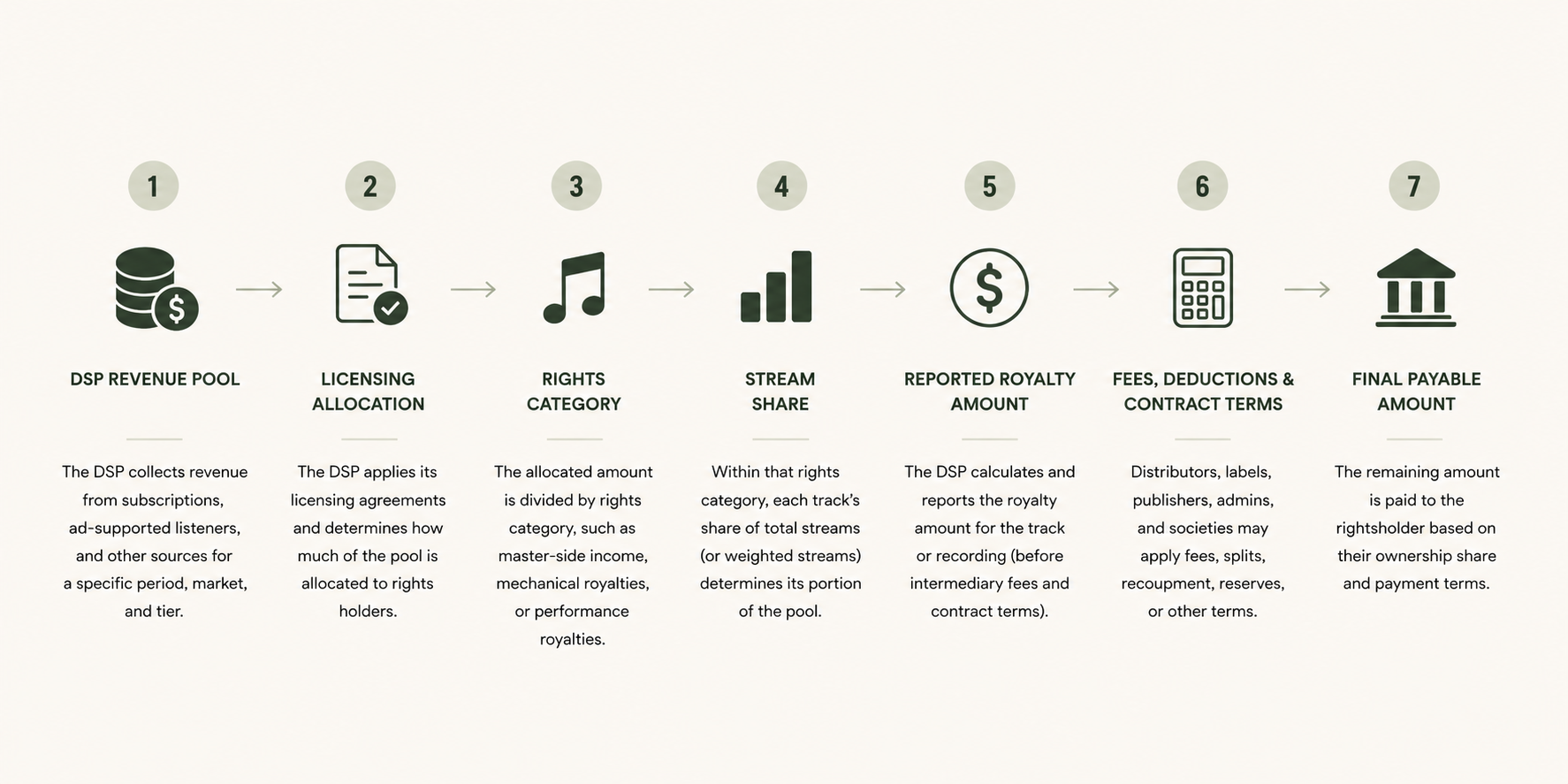
The model should be read as a sequence. First, the DSP has a revenue pool for a certain service, market, tier, or period. Then the platform applies its licensing and allocation structure. The royalty is connected to a rights category, such as master-side income, mechanical royalties, or performance royalties. From there, the track or catalog’s share of activity helps determine the reported amount.
The reported royalty amount is still not always the final amount received by the rightsholder. After the DSP calculation, the money may pass through a distributor, label, publisher, administrator, society, or other intermediary. Each party may apply its own fees, deductions, splits, recoupment rules, payment thresholds, or statement timing before the amount becomes payable.
A simplified revenue pool model does not explain every license or platform rule. Its purpose is to show why stream count alone does not determine earnings. The amount depends on the pool the stream belongs to, the share of activity inside that pool, the right being paid, and the terms applied after reporting.
How Stream Share Affects Royalty Allocation
Stream share is the portion of activity a track, album, or catalog represents inside a specific royalty pool. This matters because streaming royalties are usually allocated by comparing usage within the pool, not by assigning the same value to every stream everywhere.
A simplified example can help:
If a DSP has $100,000 available in a royalty pool for a certain market and reporting period, and one track represents 1% of the eligible activity in that pool, the track’s starting allocation would be $1,000 before any later deductions, splits, fees, or contract terms are applied.
That does not mean every stream had a fixed value. The effective rate is the result of the pool calculation:
Royalty pool × share of eligible activity = starting royalty allocation
Stream share can also be affected by how the platform measures activity. Some services may treat paid subscription streams, ad-supported streams, family plan activity, bundled services, or territory-specific usage differently depending on the license and reporting structure. In some cases, a statement may show streams, weighted streams, revenue share, or other platform-specific units.
This is why two tracks with the same stream count may produce different royalty amounts. One track may have more streams in a lower-revenue pool, while another may have fewer streams in a higher-revenue pool. The total number of plays matters, but it only becomes meaningful when connected to the revenue pool behind those plays.
Stream share is also measured within a defined context. A track’s share of streams on one DSP, in one country, during one month, may not match its share on another platform or in another territory. A catalog can perform well globally while still showing very different royalty results from market to market.
When reviewing a royalty statement, the useful question is not only how many streams were reported. It is also which pool those streams belonged to, how the platform measured the activity, and what share of that pool was allocated to the track or catalog.
Paid Streams, Ad-Supported Streams, and Territory Differences
Royalty statements often group streams by service type, country, product, or revenue source because those details affect the calculation. A dashboard may show total plays in one place, but the statement usually separates the activity more carefully.
Paid Streams
Paid streams are usually connected to subscription revenue. The size of that pool depends on how much the platform collected from paid users during the reporting period, along with the licensing terms that apply to the relevant market and product.
A paid stream in a higher-priced subscription market may sit inside a larger revenue pool than a paid stream in a lower-priced market. Family plans, student plans, bundles, trials, and discounted offers can also affect the amount of revenue available for allocation.
For that reason, paid streams should not be treated as one universal value. The calculation depends on the pool behind the usage, not the stream count alone.
Ad-Supported Streams
Ad-supported streams are tied to advertising revenue rather than subscription revenue. That pool can move up or down based on advertiser demand, country, season, ad inventory, listening behavior, and the platform’s ad sales performance during the reporting period.
When ad revenue is lower, the royalty pool connected to ad-supported activity may also be lower. A song can receive meaningful listening activity on an ad-supported tier while producing a smaller royalty amount than expected.
The statement may separate ad-supported usage from paid usage because they do not come from the same revenue source.
Territory Differences
Territory can change the calculation even when the same song is played on the same DSP. Subscription prices, advertising markets, currency exchange, local taxes, licensing terms, and platform adoption vary by country.
A stream in one territory may sit inside a different revenue pool from a stream in another territory. The final royalty amount can shift again once currency conversion, withholding, local deductions, or intermediary terms are applied.
When estimating streaming income, it is more useful to look at platform, territory, service type, and rights category together. A total stream count gives the top-level activity, but the statement detail explains how that activity was valued.
Why Two Songs With the Same Stream Count Can Earn Different Amounts
Two songs can show the same total number of streams and still produce different royalty amounts. The stream count is only the activity total. The value of that activity depends on where the streams happened, which service type generated them, what revenue pool they belonged to, and which rights were being calculated.
In on-demand music streaming, listeners choose specific tracks, but the royalty result can still vary across platform products, territories, account types, and reporting periods. A million streams from paid subscribers in higher-revenue markets will not necessarily produce the same result as a million streams from ad-supported users across lower-revenue markets.
The mix of territories can change the amount quickly. One track may have most of its listening activity in countries with higher subscription prices and stronger ad markets. Another track may have the same number of plays, but those plays may come from territories where subscription prices, ad revenue, or currency conversion produce a smaller pool.
The service tier matters as well. Paid subscriptions, free ad-supported listening, family plans, student plans, trials, bundled offers, and platform-specific products may all sit in different calculation contexts. The statement may group or separate those categories depending on the reporting system.
The rights category also affects the result. Master-side royalties, mechanical royalties, and performance royalties are not calculated or paid through one identical process. A song may generate income on more than one side, but each royalty type may have its own pool, rate structure, statement source, and deductions.
Contract terms can create another difference after the DSP reports the royalty. One artist may receive income through a distributor with a simple fee. Another may be signed to a label deal where royalties are subject to artist royalty rates, recoupment, reserves, producer participation, or other deductions.
A useful comparison therefore looks beyond total streams. To understand why two songs earned different amounts, review the DSP, territory mix, service tier, rights category, reporting period, currency, intermediary, and contract terms connected to each statement.
Master-Side Streaming Royalty Calculation Example
Master-side streaming royalties are tied to the sound recording. The DSP calculates the amount connected to the recording, then reports and pays the party it has a licensing or delivery relationship with, such as a distributor, label, label services company, or master owner.
The example below uses simplified numbers to show the calculation logic. Real statements may include more territories, tiers, currencies, adjustments, reserves, and reporting categories.
In this example, the track represents 1% of the eligible activity in a $100,000 master-side pool. The starting allocation is therefore $1,000.
The distributor then applies a 15% fee, which equals $150. After that fee is deducted, $850 remains for the artist, label, or master owner connected to the distribution account.
The formula looks simple at this level:
Revenue pool × stream share = starting master-side allocation
Then:
Starting allocation − distributor fee = amount after distributor fee
The calculation can change if the recording is controlled by a label instead of being distributed directly by the artist or master owner. A label may receive the DSP income first, then calculate the artist’s share under the recording agreement. That agreement may include royalty rates, recoupment, reserves, producer royalties, featured artist payments, or other deductions.
For that reason, the number reported by the DSP or distributor is not always the same as the final amount payable to the artist. The statement has to be read alongside the distribution agreement, label agreement, or master ownership terms that apply to the recording.
Composition-Side Streaming Royalty Calculation Example
Composition-side streaming royalties are tied to the song underneath the recording. A DSP stream may create more than one composition-side royalty category, including mechanical royalties and performance royalties. Those categories may be calculated, reported, and paid through different systems.
The example below uses simplified numbers to show how a composition-side amount may be narrowed by ownership share and administration terms.
In this example, the work has a $600 composition-side royalty allocation for the reporting period. The rightsholder being reviewed controls 50% of the relevant writer and publisher share, so $300 is attributable to that account before administration fees.
If the publishing administrator charges a 15% administration fee on the collected amount, $45 is deducted. That leaves $255 after the administration fee.
The simplified formula is:
Composition-side allocation × controlled share = amount attributable to the account
Then:
Attributable amount − administration fee = amount after administration fee
Real composition-side statements may be more detailed. Mechanical royalties and performance royalties may appear separately. Writer shares and publisher shares may be paid through different accounts. International income may arrive from different societies at different times. A statement may also include adjustments, reserves, currency conversion, local deductions, or prior-period corrections.
The important point is that the stream count does not answer the composition-side payout question by itself. The calculation also depends on the royalty category, the work share being controlled, the territory, the collection source, and the administration or publishing terms attached to the account.
How Deal Terms Change the Final Payout
A streaming royalty calculation can show what a track earned before the final recipient is paid. The contract then determines how much of that amount actually becomes payable, who receives it, and whether any balance needs to be recovered first.
Common deal terms that can change the final payout include:
- Distributor fees - A distributor may deduct a percentage or flat fee before paying the artist, label, or master owner. Some distribution deals are simple, while others include added services that affect the final amount.
- Label royalty rates - In a record deal, the label may receive the DSP income first, then calculate the artist’s royalty according to the recording agreement. The artist may not receive 100% of the reported master-side income.
- Recoupment - Advances, recording costs, marketing costs, video costs, tour support, or other approved expenses may be recovered from royalties before additional payments are made. Even after streaming income is calculated, recoupment can affect whether those earnings become payable.
- Producer royalties - Producer points or royalty participation may be deducted or accounted for before the artist’s final share is paid, depending on the agreement.
- Featured artist shares - Collaborations may include featured artist royalty shares, side artist payments, or other participation terms connected to the recording.
- Publishing administration fees - A publishing administrator may deduct an agreed percentage from collected composition-side income before paying the songwriter, publisher, or catalog owner.
- Publisher and songwriter splits - Composition-side income depends on the controlled share of the work. If a songwriter controls 25% of a song, the amount payable to that songwriter’s account will reflect that share, not the full composition royalty.
- Society or CMO deductions - PROs, CMOs, and local societies may apply administrative deductions before distributing income.
- Reserves and adjustments - Some statements include reserves, reversals, prior-period corrections, refunds, or adjustments that change the amount paid in a given period.
- Payment thresholds - A party may hold payment until the account reaches a minimum payable balance.
- Tax withholding and currency conversion - International royalties may be reduced or delayed by withholding tax, exchange rates, bank charges, or local payment rules.
Deal terms explain why the number shown in a DSP, distributor, label, publisher, or society statement may not match the amount that lands in a bank account. A useful statement review looks at both sides of the equation: how the royalty was calculated and what terms were applied after the calculation.
Reading a Streaming Royalty Statement
A streaming royalty statement is easier to review when it is read in layers. The stream count is only one part of the report. The useful details usually sit around it: platform, territory, service type, royalty category, revenue amount, deductions, ownership share, and payable balance.
Start with the source of the income. Check which DSP, distributor, label, publisher, administrator, PRO, CMO, or society issued the statement. The source tells you which side of the royalty picture you are reviewing and which agreement may apply.
Then review the main line items:
- Reporting period - Confirm the month, quarter, or period covered by the statement. Streaming income often arrives after the listening activity happened, so the payment date and usage period may not be the same.
- Platform or source - Identify where the income came from. Spotify, Apple Music, YouTube Music, Amazon Music, TikTok, Meta, and other sources may be reported separately or grouped depending on the intermediary.
- Territory - Look at the country or region connected to the activity. Territory detail helps explain why similar stream counts may produce different amounts.
- Service type - Check whether the usage came from paid subscriptions, ad-supported listening, video, user-generated content, bundles, trials, or another product type.
- Royalty category - Separate master-side income from composition-side income. If the statement is composition-side, confirm whether the income is mechanical, performance, or another publishing category.
- Units or streams - Review the reported activity, but avoid treating it as the full explanation for the payment. The stream count needs to be read with the revenue pool, territory, service type, and rights category.
- Gross amount - This is the amount before the statement issuer applies its deductions, fees, splits, or adjustments.
- Deductions and fees - Check distributor fees, administration fees, society deductions, reserves, reversals, tax withholding, currency conversion, or other adjustments.
- Ownership share - Confirm whether the statement reflects 100% of the track or work, only the controlled share, or a specific writer, publisher, label, artist, or catalog share.
- Net payable amount - This is the amount due after the statement issuer applies the relevant terms. It may still be held if the account has not met a payment threshold or if payee setup is incomplete.
- Opening and closing balance - Some statements show prior balances, new earnings, deductions, payments, and ending balances. These lines help explain why reported earnings and actual deposits may differ.
When the statement does not match the catalog records, separate the issue by type. Streams with no payable amount may point to thresholds, deductions, or account setup. Master-side income without related publishing income may point to registration or matching gaps. Missing territory activity may point to delivery, collection coverage, or local reporting. Title variations, reversals, reserves, negative adjustments, and share mismatches should be checked against the ownership records and agreements.
Follow-up should also be assigned by source. Distributor delivery, label accounting, publishing registration, society matching, ownership records, tax setup, and contract terms should be reviewed separately so the reason behind the change is easier to isolate.
Common Mistakes When Estimating Streaming Royalties
Estimating streaming income becomes unreliable when the estimate treats every play as if it came from the same pool, territory, product, and contract. A rough projection can still be useful, but it should be built around the same factors that appear on royalty statements.
Common mistakes include:
- Using one public per-stream rate for every platform - Public estimates can give a rough reference point, but they do not reflect the exact revenue pool, territory mix, service tier, rights category, or reporting period behind a specific statement.
- Multiplying total streams without separating paid and ad-supported activity - Paid subscription revenue and advertising revenue do not always produce the same royalty result. Grouping them together can make an estimate look cleaner than the actual statement will be.
- Ignoring territory mix - One million streams concentrated in higher-revenue subscription markets can produce a different result from one million streams spread across lower-revenue markets. Country-level detail often explains large differences in payout.
- Comparing master income and publishing income as if they follow the same calculation - Master-side royalties, mechanical royalties, and performance royalties can involve different pools, shares, rates, collection systems, and deductions. The numbers should be reviewed by royalty category.
- Forgetting ownership share - A songwriter, publisher, label, or catalog owner may only control part of the track or work. An estimate based on 100% of the income will be wrong if the account being reviewed only controls 25%, 50%, or another share.
- Leaving out contract terms - Distributor fees, label royalty rates, publishing administration fees, society deductions, reserves, recoupment, tax withholding, and payment thresholds can all change the amount that becomes payable.
- Treating dashboard streams as royalty statement income - Platform dashboards can show useful activity trends, but they may not match the royalty statement period, territory breakdown, product category, usage type, or final accounting source.
- Assuming every royalty appears in the same month - Master-side income, mechanical royalties, performance royalties, and international collections can arrive on different schedules. A missing line item in one statement period may require follow-up, but it may also reflect normal reporting lag.
- Overlooking adjustments and reversals - Prior-period corrections, refunds, reserves, currency changes, and negative adjustments can change a statement even when current-period streams look stable.
- Estimating from gross revenue instead of payable income - Gross royalty amounts are useful for understanding activity, but the final payout depends on the deductions, splits, account terms, and balances applied after the initial calculation.
Better estimates start with the actual reporting categories available: DSP, territory, service type, royalty category, stream count, revenue amount, ownership share, deductions, and payable balance. The more closely the estimate follows the structure of the statement, the less likely it is to create unrealistic expectations.
Frequently Asked Questions
Is there a fixed rate for every stream?
No. Streaming royalties are usually shaped by revenue pools, territory, subscription type, advertising revenue, licensing terms, usage share, and the right being paid. A public per-stream estimate may be useful for rough comparison, but it should not be treated as the actual rate for every DSP or every statement.
Why do per-stream rates look different across platforms?
Each platform may have different subscription prices, ad revenue, user mix, territory activity, licensing terms, and reporting structures. The effective rate shown on a statement is usually the result of those factors being applied to the usage, rather than a fixed price set for every play.
Why can paid streams earn more than ad-supported streams?
Paid streams are connected to subscription revenue, while ad-supported streams are connected to advertising revenue. Subscription pools and ad pools may perform differently depending on the market, reporting period, user base, and platform. That difference can affect the royalty amount connected to each type of usage.
Why does territory affect streaming royalties?
Subscription prices, advertising markets, currency values, local deductions, taxes, and licensing terms vary by country. A stream in one territory may therefore sit inside a different revenue pool from a stream in another territory, even when the song and platform are the same.
How do DSPs calculate a track’s share of royalties?
A simplified model looks at the track’s share of eligible activity inside a specific pool. If a track represents 1% of eligible usage in a $100,000 pool, the starting allocation would be $1,000 before later fees, deductions, splits, and contract terms are applied.
Why does the amount on a statement differ from the amount paid?
The statement may show gross earnings, net earnings, deductions, payment thresholds, prior balances, tax withholding, reserves, or recoupment activity. The amount deposited into an account depends on which of those items applies before payment is released.
Are master royalties and publishing royalties calculated the same way?
They can come from the same listening activity, but they are not calculated or paid through one identical process. Master-side income relates to the sound recording, while publishing income relates to the composition. Mechanical royalties, performance royalties, writer shares, publisher shares, and administrator fees can each affect the composition-side result.
Why does a distributor or label affect the final amount?
A distributor may deduct a fee before paying the artist, label, or master owner. A label may calculate the artist’s share under the recording agreement, which may include royalty rates, recoupment, reserves, producer royalties, featured artist shares, or other deductions.
Why does a publisher or administrator affect the final amount?
Composition-side income may be collected through a publisher, administrator, society, or CMO. The final payout can reflect ownership share, writer and publisher splits, administration fees, society deductions, local collection rules, and statement timing.
Can one million streams produce different payouts for different songs?
Yes. One song may receive most of its streams from paid subscribers in higher-revenue territories, while another may receive the same number of streams from ad-supported users in lower-revenue territories. Service type, platform, rights category, contract terms, and ownership share can all change the result.
What is the safest way to estimate streaming royalties?
Start with the most specific data available: DSP, territory, service type, royalty category, reporting period, stream count, revenue amount, ownership share, and expected deductions. A broad per-stream estimate is less reliable because it skips the details that usually shape the actual statement.
Why do streaming royalties arrive at different times?
Master-side income, mechanical royalties, performance royalties, and international collections may each follow different reporting and payment schedules. A calculation may already exist in one system while another royalty type is still being matched, processed, or distributed.
Key Takeaways
- Streaming royalties are not based on one fixed per-stream rate across every DSP, territory, service tier, or royalty type.
- A royalty amount usually starts with a revenue pool, then depends on the track or catalog’s share of eligible activity inside that pool.
- Paid subscription streams and ad-supported streams may produce different results because they are connected to different revenue sources.
- Territory matters because subscription prices, ad markets, currency conversion, taxes, licensing terms, and local deductions vary by country.
- Two songs with the same stream count can earn different amounts when their platform mix, territory mix, service tiers, rights categories, or contract terms are different.
- Master-side calculations relate to the sound recording and may be affected by distributor fees, label terms, artist royalty rates, producer royalties, reserves, and recoupment.
- Composition-side calculations relate to the underlying song and may be affected by mechanical royalties, performance royalties, writer shares, publisher shares, administration fees, society deductions, and ownership splits.
- A royalty statement should be reviewed by source, territory, service type, royalty category, gross amount, deductions, ownership share, and net payable amount.
- Public per-stream estimates can be useful for rough reference, but they should not replace statement-level review.
- Better streaming royalty estimates use the same details that appear in actual reporting: DSP, territory, product type, royalty category, stream count, revenue amount, ownership share, deductions, and payable balance.
Practical Resource
Streaming Royalty Estimate Calculator
The Streaming Royalty Estimate Calculator is designed to help artists, songwriters, managers, labels, publishers, catalog owners, and rights administrators model how a streaming royalty amount may change after revenue pool allocation, ownership share, fees, deductions, and deal terms are applied.
Use the calculator to test simple master-side and composition-side scenarios. The worksheet includes fields for estimated revenue pool, stream share, starting allocation, distributor fees, publishing administration fees, ownership share, recoupment balance, and estimated payable amount.
[Download the Streaming Royalty Estimate Calculator]
The calculator is not meant to predict an exact DSP payout. Actual royalties can change based on platform reporting, territory mix, service tier, royalty category, currency conversion, tax withholding, contract language, payment thresholds, and statement timing.
Its purpose is to give a practical starting point. By entering sample numbers, users can see why stream count alone does not determine earnings and how the final payable amount may change after the calculation moves through different rights and deal terms.
References
Spotify for Artists. Royalties Guide.
https://artists.spotify.com/royalties-guide
Spotify. Loud & Clear.
https://loudandclear.byspotify.com/
Passman, Donald S. All You Need to Know About the Music Business. 11th ed. Simon & Schuster.
ASCAP. Royalties and Payment.