What Are the Key Terms in Music Contracts?
Music contracts use specific terms that affect ownership, royalties, rights, approvals, reporting, and exit options. This guide breaks down what to review before signing.

Introduction
Record deals sit at the center of the commercial music industry, but the way they work is often misunderstood. Public discussion usually focuses on headline numbers, artist signings, or ownership disputes, while the actual structure behind the agreements receives far less attention.
At their core, record deals are built around investment and risk. Labels provide funding, distribution, marketing, industry access, and operational support with the expectation that the recordings will generate revenue over time. In exchange, the label receives a share of income, control over certain rights, or ownership of the masters themselves.
The structure of these agreements can vary widely. Some deals revolve around traditional ownership models in which the label controls recordings for decades. Others focus more narrowly on distribution, licensing, or short-term services. Advances, royalty rates, recoupment terms, creative control, and contract length all influence how valuable a deal actually becomes for the artist.
Changes in streaming, social media, and digital distribution have also shifted the balance of leverage. Artists can now build audiences independently before entering negotiations, while labels continue to provide scale, financing, and global infrastructure that are difficult to replicate on their own.
This guide breaks down how record deals are structured, how money and rights flow through them, what labels typically provide, and why different deal types exist across different stages of an artist’s career.
Learning Objectives
By the end of this guide, you will be able to:
- Explain how record deals are structured within the music industry
- Understand why artists sign record deals and what labels provide in return
- Identify the major components of a recording agreement, including advances, royalties, ownership, and term length
- Understand how recoupment works and how labels recover their investment
- Distinguish between master ownership, licensing rights, and distribution rights
- Compare different types of record deals, including traditional, licensing, distribution, and label services agreements
- Recognize how 360 deals expand label participation across multiple revenue streams
- Understand how leverage, audience growth, and market demand affect negotiations
- Evaluate the advantages and tradeoffs between signing with a label and remaining independent
Overview
Record deals define how recorded music is financed, owned, distributed, and monetized between artists and labels. Once an agreement is signed, the relationship usually extends across multiple parts of the release cycle, including recording, marketing, distribution, royalty accounting, and long-term exploitation of the masters.
Most deals are structured around exclusivity. During the contract term, the artist records music primarily for that label, while the label gains the right to commercially release and exploit those recordings within specified territories and formats. The exact balance of control depends on the type of agreement and the negotiating leverage of the artist.
The economics behind these deals are tied closely to recoupment. Labels invest money upfront into recording costs, marketing campaigns, advances, videos, tour support, and other expenses. Revenue generated from the recordings is then used to recover those costs before many artists begin receiving royalty payments.
The industry now operates across multiple deal models rather than one standard structure. Traditional ownership deals still exist, but distribution agreements, licensing arrangements, profit splits, and label services models have become increasingly common, especially as artists build audiences independently before entering negotiations.
Streaming has also changed how labels evaluate artists and structure risk. Instead of relying only on radio exposure or physical sales projections, labels now track audience data, streaming growth, social engagement, and touring performance before making offers.
Table of Contents
Why Music Contract Terms Matter
A music contract does more than confirm that two parties agreed to work together. It decides who controls the work, who gets paid, how long the relationship lasts, and what each side can do when plans change.
Small wording choices can have major consequences. “Ownership” and “license” do not create the same outcome. “Gross” and “net” can lead to very different payment calculations. “Approval” gives stronger protection than “consultation.” “Worldwide” may be reasonable for a partner with global infrastructure, but excessive for a company that only works in one market.
The same term can also matter differently depending on the agreement. In a record deal, ownership language may decide who controls the masters. In a publishing agreement, administration rights may affect who collects and licenses the composition. In a producer agreement, points and recoupment language may determine whether the producer is paid from the artist’s share, the label’s share, or only after certain costs are recovered.
Many problems appear later because the contract was reviewed too narrowly at the start. An artist may focus on the advance and miss the option periods. A songwriter may agree to broad administration rights without checking territory or term. A producer may confirm a fee but leave backend points unclear. A manager may receive commission language that continues after the relationship ends.
Clear contract terms reduce confusion before money is earned, rights are exploited, or disputes appear. They also make professional review more useful. When the key business points are already identified, an attorney can focus on risk, missing protections, and language that needs to be tightened before the agreement is signed.
Parties, Rights, and Scope
Before reviewing money terms, the contract needs to make clear who is signing and what each party is allowed to do. A surprising amount of confusion starts here, especially when the person signing is not the same entity that owns the rights.
The parties section identifies the legal names involved in the agreement. That may be an artist personally, an artist-owned company, a label, a publisher, a distributor, a manager, a producer, or a licensee. If an artist owns recordings through an LLC, for example, the contract should reflect the company that actually controls those masters. If the wrong party signs, questions can come up later about whether the rights were validly granted.
Rights language explains what one side is giving the other side permission to use or control. In music contracts, that can include the right to release recordings, administer compositions, collect royalties, license music for sync, distribute music to platforms, use an artist’s name and likeness, or commercially exploit masters and compositions.
Scope defines how far those rights extend. A narrow agreement may cover one song, one campaign, one territory, or one type of use. A broader agreement may cover all recordings made during a term, worldwide rights, future works, physical and digital formats, sublicensing, or multiple revenue streams.
A few questions help clarify the scope early:
- Who is signing, and do they actually control the rights being granted?
- Does the agreement cover recordings, compositions, services, or all of these?
- Are the rights limited to specific uses or broadly granted?
- Does the contract apply to existing works, future works, or both?
- Is the territory local, regional, worldwide, or platform-specific?
- Can the receiving party sublicense the rights to someone else?
- How long do the granted rights last?
This section of a contract sets the boundaries for everything that follows. Once the parties, rights, and scope are clear, it becomes easier to review ownership, money, approval rights, and exit terms without guessing what the agreement actually covers.
Ownership and Control Terms
Ownership and control language determines who holds the rights, who can make decisions, and whether the agreement transfers rights permanently or only grants permission for a specific purpose. These terms matter because two contracts can involve the same song or recording but create very different outcomes depending on the wording.
- Copyright - Copyright is the legal right attached to an original creative work, such as a sound recording, musical composition, lyrics, artwork, or video. In music contracts, the key issue is usually which copyright is being discussed. A master recording and the underlying composition are separate rights, even when they are connected to the same song.
- Master Rights - Master rights refer to the sound recording itself. Control over the master affects streaming, downloads, physical sales, sync placements, remixes, compilations, and other commercial uses of that specific recording. In a record deal, master ownership is often one of the most valuable points being negotiated.
- Composition Rights - Composition rights cover the underlying song, including melody and lyrics. These rights usually involve songwriters and publishers, not only recording artists. A contract that deals with a recording does not automatically control the composition unless the agreement clearly says so.
- Assignment - An assignment transfers ownership from one party to another. This is stronger than giving permission to use the work. If an artist assigns master rights to a label, the label may become the owner of those recordings, subject to whatever limitations or reversion rights appear in the agreement.
- License - A license gives another party permission to use rights without necessarily transferring ownership. Licenses can be narrow or broad. They may cover one use, one territory, one term, one platform, or a wide range of commercial uses. The details matter because a broad license can feel close to ownership in practice, even if legal title stays with the original owner.
- Administration Rights - Administration rights usually appear in publishing and rights management agreements. They allow another party to register works, issue licenses, collect income, process royalties, and handle administrative tasks. The owner may keep the copyright, while the administrator manages the business activity around it.
- Work for Hire - Work-for-hire language can change who is treated as the legal author or owner of the work. In some cases, the hiring party owns the work from the start rather than receiving rights later through assignment. This term should be reviewed carefully, especially in producer, session musician, composer, artwork, and commissioned content agreements.
- Control - Control is broader than ownership. A party may not own the copyright but may still control important decisions through approval rights, licensing authority, release restrictions, or exclusive rights. This is why contracts should be reviewed for both legal ownership and practical decision-making power.
- Reversion - Reversion refers to rights returning to the original creator or owner after a certain event, term, or condition. A contract may allow rights to revert after a license period ends, after recoupment, after non-use, or after a specific number of years. Without clear reversion language, rights may remain with the other party much longer than expected.
These terms should be read together. A contract may say the artist keeps ownership, but then grant such broad control, exclusivity, and sublicensing authority that the artist has limited practical freedom during the term.
Money and Royalty Terms
Money language in music contracts can be harder to read than the headline percentage suggests. A contract might say the artist earns 50%, 25%, or 15%, but that number only becomes meaningful once you know what it is being applied to, what gets deducted first, and when payments are actually made.
- Royalty Rate - The percentage paid to the artist, songwriter, producer, or rights holder from a defined income source. The rate itself does not tell the full story. A 20% royalty on gross revenue can produce a very different result from a 20% royalty on net revenue after fees, commissions, distribution costs, or other deductions.
- Royalty Base - The amount the royalty percentage is applied to. This is one of the most important terms to check. If the contract calculates royalties on “net receipts,” payment may be based only on what the company receives after certain costs or third-party fees. If the royalty is based on gross revenue, fewer deductions may be taken before the percentage is calculated.
- Gross Revenue - The total income generated before deductions. In music contracts, this could refer to income from streaming platforms, sync licensees, distributors, merchandise sales, or other sources, depending on how the agreement defines it.
- Net Revenue - The income remaining after allowed deductions. Those deductions may include distribution fees, collection costs, payment processing fees, manufacturing costs, taxes, refunds, commissions, or approved expenses. “Net” should be defined clearly because broad deduction language can reduce payments significantly.
- Profit Split - A structure where income is divided after approved costs are recovered. Profit splits often appear in distribution, label services, joint venture, and independent release agreements. They can be clearer than traditional royalty accounting if the contract defines which costs are deducted first.
- Deductions - Costs removed before royalties or profits are calculated. Some are expected, such as distributor fees or manufacturing costs. Others need closer review, especially broad marketing costs, overhead, legal fees, administrative charges, or vague “expenses” language.
- Reserves - Amounts held back temporarily from royalties to cover possible returns, refunds, chargebacks, or accounting adjustments. Reserves were especially common in physical sales, but they may still appear in contracts. The agreement should state how much can be held and when it must be released.
- Minimum Guarantee - A guaranteed payment owed regardless of how the licensed use performs. This term often appears in licensing, distribution, sync, and certain performance-related agreements. The key issue is whether the guarantee is recoupable against future royalties or paid separately.
- Most Favored Nations - Often shortened to MFN, this gives one party terms equal to the best terms granted to another comparable party. In music licensing, it can apply when multiple rights holders, writers, publishers, or labels are involved.
- Payment Schedule - The timing for royalty or fee payments. Monthly, quarterly, semiannual, and annual schedules all affect cash flow. The contract should also state when statements are delivered, how long the payer has to process income, and what happens if payments are late.
- Royalty Statement - A report showing how income was calculated. A useful statement should identify revenue sources, the period covered, deductions applied, recoupment status if relevant, and the amount payable.
Money terms should be read as a calculation. Start with the income source, check the royalty base, subtract allowed deductions, apply the royalty rate, account for recoupment if relevant, then review when and how the payment is reported.
Advances, Recoupment, and Expenses
Advance language can make a contract feel more generous than it actually is. The money arrives upfront, but in many music agreements it operates as an advance against future earnings. That means the artist, songwriter, producer, or rights holder may receive the payment now while future royalties are used to repay the balance before more money is paid out.
Recoupment is the accounting process behind that repayment. If a label pays a recording advance, funds studio costs, pays for videos, and contributes to marketing, the contract may allow those amounts to be recovered from the artist’s royalty account. The artist may still earn royalties on paper, but those royalties are applied against the unrecouped balance first.
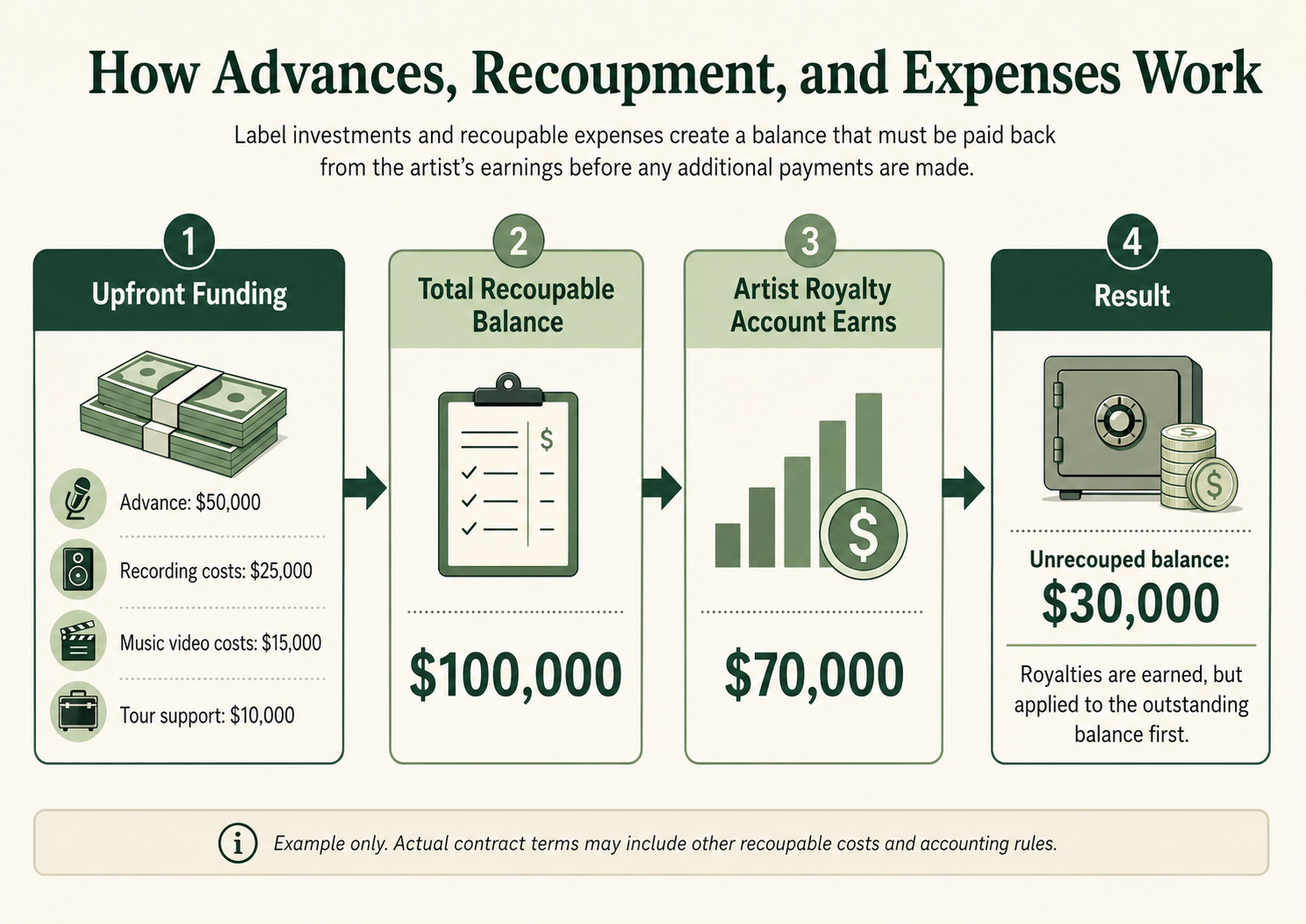
If the artist’s royalty account earns $70,000, the account is still unrecouped by $30,000. The artist has generated income, but the contract directs that income toward the outstanding balance before additional royalty payments are made.
The same concept can appear outside record deals. A publisher may advance money against future publishing income. A distributor may recoup marketing or playlist campaign costs. A producer may receive an advance against producer royalties. A manager or investor may recover approved expenses before profit is split. The structure changes by agreement, but the question stays the same: which costs come back out of future income?
Expense language deserves close review because it decides how large the recoupment burden can become. Some contracts limit recoupable costs to clearly approved items, such as recording budgets or agreed marketing spends. Others use broader wording that can pull in video costs, remix fees, radio promotion, travel, independent marketing, legal fees, collection costs, or overhead.
Cross-collateralization can make the issue more complicated. If income from one project can be used to recoup costs from another, a successful release may still fail to generate payable royalties because it is covering losses elsewhere. In label and publishing agreements, this can affect how quickly creators see income from work that is otherwise performing well.
The strongest protection is clarity before money is spent. Contracts should identify which expenses are recoupable, whether the creator must approve them in advance, whether costs are capped, which income streams can be used for recoupment, and whether balances carry across projects or contract periods.
Term, Options, and Delivery Obligations
Timing language in music contracts can be easy to underestimate. A contract may look short because it mentions one album, one project, or a fixed number of years, but the real commitment depends on how the term, options, delivery rules, and release obligations work together.
- Term - The term is the period when the agreement is active. In some contracts, this is a fixed length of time, such as one year or three years. In others, the term is tied to a release cycle, delivery of recordings, or completion of a project. The term should be reviewed alongside any language that extends rights after the active period ends.
- Contract Period - A contract period is a specific stage within the agreement. A record deal may have an initial period for the first album, followed by additional periods if the label exercises options. Each contract period may have its own advance, delivery requirement, royalty adjustment, or deadline.
- Option Period - An option period gives one party the right to extend the agreement for another project or term. In many label agreements, the label controls the option. That means the artist may complete the first project but still remain tied to the deal if the label chooses to continue. The number of options can significantly change the real length of the agreement.
- Delivery Requirement - Delivery requirements explain what the artist, songwriter, producer, or rights holder must provide. This may include a certain number of songs, albums, masters, stems, session files, clean edits, instrumentals, artwork, or other deliverables. The contract should make clear what must be delivered before the obligation is considered complete.
- Acceptance Standard - Some agreements require the delivered work to be “commercially satisfactory,” “technically acceptable,” or “release-ready.” These phrases matter because they can affect whether the receiving party is allowed to reject the work or delay acceptance. Vague standards can leave creators stuck after they believe they have already delivered.
- Release Commitment - A release commitment explains whether the company is required to release the work. Some contracts only give the company the right to release music, while others require release within a set period after acceptance. Without a clear release obligation, a creator may deliver the work but have limited control over when it reaches the market.
- Option Exercise Window - This is the period when the company must decide whether to pick up the next option. Long or unclear windows can slow momentum because the creator may be waiting to learn whether the deal continues. A stronger contract usually states when the option must be exercised and what happens if the company misses the deadline.
- Post-Term Rights - Some rights continue after the main contract term ends. A distributor may keep selling or collecting on existing recordings for a limited period. A label may continue exploiting masters it controls. A publisher may keep administering works already covered by the agreement. These rights should be separated from the active term so the creator knows what continues after the relationship changes.
Term language should be read as a timeline, and not just a date. The full commitment depends on when the agreement starts, what must be delivered, who can extend it, and whether the work must be released, and which rights continue after the active period ends.
Approval Rights and Creative Control
Approval language determines where the creator has decision-making authority and where the other party can proceed without the creator's permission. These terms are important because control over the work does not always come only from ownership. A creator may retain copyright ownership while still granting another party broad control over release timing, marketing, licensing, or brand use.
- Approval Rights - Approval rights give a party the ability to approve or reject a specific decision before it happens. In music contracts, this may apply to sync placements, artwork, remixes, featured artists, release timing, or use of name and likeness. Strong approval language should identify which decisions require consent and who has the authority to give it.
- Consultation Rights - Consultation rights are weaker than approval rights. They usually require one party to ask for input before making a decision, but the final decision may still belong to the other party. If an artist only has consultation rights over artwork, marketing, or release strategy, the label or company may still proceed after hearing the artist’s views.
- Creative Control - Creative control refers to decision-making over the work itself and how it is presented. This can include song selection, production direction, mixes, sequencing, artwork, videos, collaborations, and overall campaign identity. The contract should make clear whether the creator has final control, shared control, or limited input.
- Final Approval - Final approval gives one party the last say before a decision is made. This can be especially important for uses that affect reputation, such as advertising, political placements, adult content, sensitive brand partnerships, or major visual campaigns. If a contract says the company has final approval, the creator may have limited ability to stop a decision they disagree with.
- Mutual Approval - Mutual approval means both sides must agree before moving forward. This can protect both the creator and the company, but it can also slow decisions if the contract does not explain what happens when the parties disagree. For time-sensitive opportunities like sync placements or marketing approvals, the agreement may include response deadlines.
- Name and Likeness Rights - These rights allow a company to use the creator’s name, image, voice, biography, signature, trademarks, or other identity-related materials. The contract should state where and how those materials can be used, whether the use is limited to promotion of the project, and whether it continues after the agreement ends.
- Sync Approval - Sync approval applies when a recording or composition is placed in film, television, advertising, games, trailers, or online video. These uses can generate meaningful income, but they can also connect the music to a brand, message, or scene the creator may want to review first.
- Marketing Approval - Marketing approval affects campaign materials such as ads, press releases, social assets, playlist campaigns, radio pushes, and territory-specific promotions. Full approval over every marketing step is uncommon, but major campaign decisions can sometimes be negotiated, especially when the artist has leverage.
- Right of Consultation Over Changes - Some agreements allow edits, remixes, translations, samples, alternate versions, or shortened forms of the work. If changes could affect the integrity of the recording, composition, or artist brand, the contract should explain whether consultation or approval is required before those versions are released.
Approval terms should be specific. A phrase like “subject to approval” is more useful when the contract also says whose approval is required, which decisions are covered, whether approval can be withheld reasonably, and how quickly a response must be given.
Licensing, Territory, and Exclusivity
Licensing, territory, and exclusivity terms define where rights can be used, who can use them, and whether the creator can make similar deals with anyone else. These clauses are especially important when a contract covers recordings, compositions, distribution, sync, management, publishing administration, or brand-related uses.
- License - A license gives another party permission to use specific rights without necessarily transferring ownership. A license may cover one song, one recording, one territory, one platform, or one type of use. It can also be broad enough to cover many formats and markets. The contract should state exactly what is being licensed and for what purpose.
- Sublicensing - Sublicensing allows the receiving party to grant rights to someone else. This can be useful when a distributor needs to work with digital platforms or when a sync agent needs to place music through third-party partners. It can also create risk if the contract gives broad sublicensing rights without approval, reporting, or limits on who may receive those rights.
- Territory - Territory explains where the agreement applies. A contract may be limited to one country, several regions, or the entire world. Worldwide rights can make sense when the company has real global reach. If the company only operates in one market, a worldwide grant may give away more control than necessary.
- Exclusivity - Exclusivity prevents the creator from granting the same or similar rights to another party during the contract term. In a recording agreement, this may stop an artist from recording for another label. In a distribution deal, it may prevent the same tracks from being distributed elsewhere. In a management or publishing agreement, exclusivity can affect who is allowed to represent or administer the creator’s work.
- Non-Exclusive Rights -A non-exclusive agreement allows the creator to grant similar rights to others. This can be helpful for limited licensing, sync pitching, or certain administrative services where the creator wants flexibility. The tradeoff is that a non-exclusive partner may have less incentive to invest heavily if they do not control the opportunity.
- Field of Use - Field of use defines the specific category where the rights may be used. For example, a license may apply only to streaming, only to sync, only to physical products, or only to educational content. Clear field-of-use language prevents a limited deal from becoming broader than intended.
- Media and Formats - This language explains which formats are covered, such as digital streaming, downloads, vinyl, CDs, radio, television, film, social media, games, apps, or future technologies. Broad “all media now known or later developed” language should be reviewed carefully because it may grant rights beyond the use originally discussed.
- Exclusive Territory Conflicts - Conflicts can happen when a creator grants overlapping rights to different partners. For example, one distributor may have exclusive worldwide rights while another company is later offered rights in a specific territory. Before signing, existing agreements should be checked so the creator does not promise rights they have already granted elsewhere.
- Reserved Rights - Reserved rights are rights the creator keeps outside the agreement. A songwriter might grant administration rights but reserve sync approval. An artist might license recordings for distribution but reserve merch, publishing, or certain territories. Reserved rights should be written clearly instead of assumed.
These terms shape the reach of the agreement. Before signing, the creator should know where the rights apply, whether the grant is exclusive, whether sublicensing is allowed, which uses are covered, and what rights remain outside the deal.
Accounting, Audit, and Reporting Terms
Accounting language decides how income is tracked, when statements are delivered, and what rights the creator has to check whether payments are correct. These terms are easy to overlook during negotiation, but they become important once royalties, fees, or revenue shares start moving through the agreement.
- Accounting Period - The accounting period is the time frame covered by each royalty or revenue statement. Common periods include monthly, quarterly, semiannual, or annual reporting. Shorter accounting periods usually give creators better visibility into income, while longer periods can delay information and payment.
- Royalty Statement - A royalty statement should show where income came from, what deductions were applied, what balance was recouped, and what amount is payable. A vague statement makes it difficult to verify whether the contract has been applied correctly.
- Payment Schedule - The payment schedule explains when money is actually sent after the accounting period closes. A contract may say statements are issued quarterly, but payment may follow 30, 45, 60, or 90 days later. The timing should be clear enough that delays can be identified.
- Audit Rights - Audit rights allow the creator or their representative to inspect the other party’s books and records. These rights are critical in royalty-based agreements because creators usually rely on the company holding the data to report income accurately.
- Audit Window - Many contracts limit how long a creator has to challenge a statement. For example, the agreement may require objections within a certain number of months or years after the statement is issued. If that window closes, the statement may become final even if errors are later discovered.
- Books and Records - This refers to the financial records, royalty data, licenses, platform reports, invoices, and related documents used to calculate payments. The agreement should describe what records must be maintained and whether the creator can inspect supporting documents during an audit.
- Objection Notice - Some contracts require a written notice before an audit or payment dispute can move forward. The notice provision may specify where it must be sent, what information it must include, and how quickly the other party must respond.
- Underpayment Clause - An underpayment clause explains what happens if an audit finds that the creator was paid too little. Some agreements require the company to cover audit costs if the underpayment exceeds a certain percentage. This can encourage more accurate reporting.
- Late Payment Terms - Late payment language may include interest, penalties, suspension rights, or other consequences if payment is not made on time. Without this language, the contract may identify when payment is due but provide limited pressure for timely payment.
- Reporting Format - Reporting format affects how usable the statement is. A clean report should separate revenue sources, territories, tracks, works, deductions, taxes, fees, and recoupment balances where relevant. Poor formatting can hide issues even when the numbers are technically provided.
Clear reporting and audit rights give creators the ability to verify whether income is being calculated and paid correctly.
Termination, Reversion, and Exit Rights
Exit language explains how the relationship can end, what happens to the rights afterward, and which obligations continue even after the active term is over. These terms matter because a contract may expire in one sense while still allowing another party to control, collect from, or exploit certain works.
- Termination - Termination is the end of the agreement or a specific part of the agreement. Some contracts end automatically after a fixed term. Others can be terminated only after notice, breach, non-payment, missed obligations, or mutual agreement. The contract should explain who can terminate, when they can do it, and what steps are required.
- Breach - A breach happens when one party fails to meet a contract obligation. This could involve missed payments, failure to deliver recordings, unauthorized licensing, failure to release a project, or violation of exclusivity terms. The contract should describe what counts as a material breach rather than treating every issue the same way.
- Cure Period - A cure period gives the breaching party time to fix the issue before termination or further action happens. For example, if a company misses a payment, it may have 30 days after written notice to pay the amount owed. Cure periods can prevent immediate termination over correctable problems, but they should have clear deadlines.
- Reversion - Reversion means rights return to the original creator or rights holder. This can happen after a license term ends, after a set number of years, after non-use, after failure to release, or after certain financial conditions are met. Reversion language should state exactly which rights return and whether the other party keeps any ongoing rights.
- Post-Term Rights - Some rights continue after the main agreement ends. A distributor may keep collecting revenue from already released recordings for a limited sell-off period. A publisher may continue administering works created during the term. A label may continue exploiting masters it owns or controls. These continuing rights should be clearly separated from the active contract term.
- Sell-Off Period - A sell-off period allows a company to keep selling or distributing existing products for a limited time after the agreement ends. This term often appears in physical goods, merch, distribution, and licensing contracts. The agreement should state how long the sell-off lasts and whether new exploitation is allowed during that period.
- Survival Clause - A survival clause identifies which obligations remain active after termination. Common surviving terms include confidentiality, payment obligations, audit rights, indemnities, accounting duties, and ownership provisions. Survival language can be useful, but broad wording may keep more obligations alive than expected.
- Reversion Trigger - A reversion trigger is the event that causes rights to return. It might be the end of the term, failure to release within a deadline, failure to meet minimum sales or revenue thresholds, non-payment, or expiration of a license period. Clear triggers reduce confusion over when control actually shifts back.
- Effect of Termination - This clause explains what happens after the agreement ends. It may address unpaid royalties, outstanding expenses, inventory, takedowns, account access, data transfer, catalog handover, future collections, or removal of content from platforms. The more operational the agreement is, the more important this language becomes.
Exit terms should answer a practical question: if the relationship ends tomorrow, who controls the work, who collects income, what still has to be paid, and what must be handed back?
Common Red Flags in Music Contracts
In an ideal world, every music contract would clearly explain the rights being granted, the money being paid, the obligations on each side, and the path out of the agreement. In practice, contracts can contain broad language, missing details, or terms that sound harmless until the work starts generating income.
These are the issues worth slowing down for before signing.
- Broad rights with no clear limits - Language that grants “all rights” or “all uses” should be checked carefully. A broad grant may be appropriate in some deals, but the contract should still explain what rights are covered, where they apply, how long they last, and whether sublicensing is allowed.
- Worldwide rights without worldwide support - A company asking for global rights should have the ability to exploit the work globally. If the company only has real activity in one market, a worldwide grant may give away more control than the relationship justifies.
- Unclear ownership language - A contract should make it obvious whether rights are being assigned, licensed, administered, or temporarily controlled. Confusion between ownership and permission can create long-term problems, especially around masters, compositions, artwork, videos, and commissioned creative work.
- Heavy recoupment with loose expense language - Recoupment becomes risky when the contract allows broad or uncapped expenses. Marketing, travel, legal fees, overhead, remix costs, video costs, and third-party fees should not be left open-ended if they will be charged against future income.
- Long option chains - Multiple option periods can keep a creator tied to a company across future projects. Option language should be reviewed for who controls the extension, how many options exist, what each option requires, and whether terms improve with each new period.
- No clear release obligation - A contract may give a company the right to release the work without requiring it to do so. For artists and songwriters, this can leave music controlled by another party while the actual release remains delayed or uncertain.
- Vague approval rights - Words like “approval,” “consultation,” and “reasonable consent” need clear meaning in the contract. The agreement should state which decisions require approval, who gives it, and how quickly a response is required.
- Weak accounting and audit rights - Royalty-based deals depend on reporting. If statements are vague, audit windows are too short, or supporting records are unavailable, it becomes harder to confirm whether income is being calculated correctly.
- Automatic renewals without active review - Renewal language can extend a deal without a meaningful decision point. Any renewal should be tied to clear notice, defined timing, and an opportunity to evaluate whether the relationship still makes sense.
- Broad post-term control - Some contracts allow rights, collection, distribution, or restrictions to continue after the main term ends. Post-term rights should be specific, limited, and easy to distinguish from the active contract period.
- Unclear 360 or revenue participation language - If a company receives income from touring, merch, brand deals, publishing, or other non-recording revenue, the contract should explain the percentage, duration, covered income streams, and what support the company provides in return.
- Missing attorney review before signing - Music contracts often contain terms that affect long-term ownership and income. Attorney review is especially important when the agreement includes assignment language, recoupment, options, exclusivity, reversion, or broad rights grants.
Red flags do not always mean a deal should be rejected. They show where the contract needs clearer language, narrower limits, or professional review before the creator commits.
How to Review Music Contract Terms Before Signing
Reviewing a music contract should not start with the most exciting number in the deal. The advance, royalty rate, or headline fee only makes sense after the rights, ownership language, obligations, and exit terms are understood.
The best approach is to move through the contract in order of risk. Start by identifying what is being granted, then check who controls the work, how money is calculated, how long the agreement lasts, and what happens if the relationship ends. This keeps the review practical instead of turning it into a clause-by-clause reading with no clear priority.
A record deal, publishing agreement, producer agreement, management contract, sync license, or distribution agreement may use different language, but the same review logic applies. The creator needs to know what they are giving up, what they are receiving in return, and whether the agreement gives the other party more control than the deal requires.
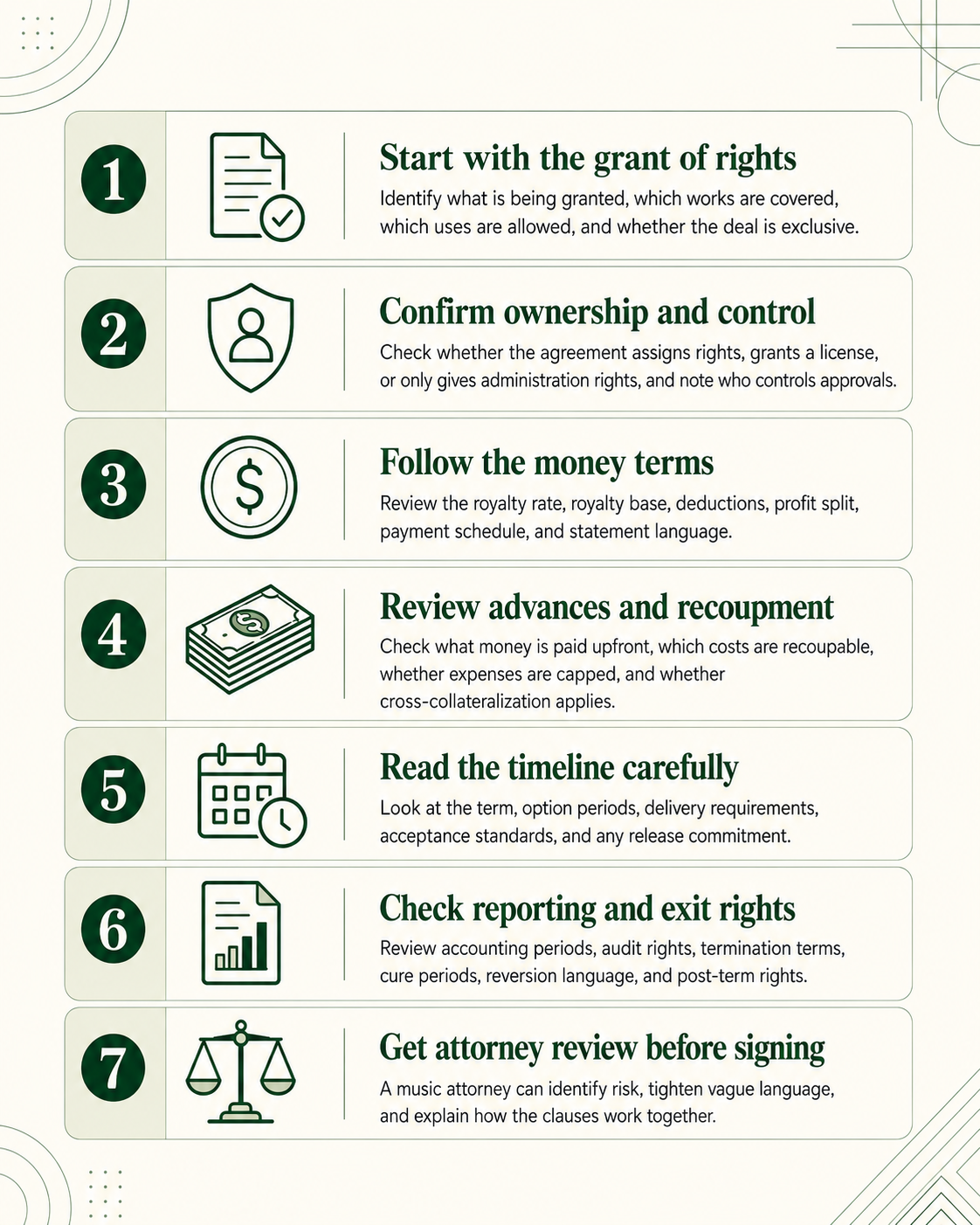
Once the main terms are mapped out, unclear language should be flagged before signing. Broad rights, vague ownership terms, missing release obligations, uncapped recoupment, weak audit rights, automatic renewals, and unclear post-term control are all issues worth sending to a music attorney.
The review should end with a practical business question: Does the contract match the deal that was promised? If the written terms are broader, longer, or less specific than the conversation, that gap needs to be resolved before the agreement is signed.
Frequently Asked Questions
What are the most important terms in a music contract? The most important terms usually involve rights, ownership, money, term length, exclusivity, approval rights, reporting, audit rights, and exit language. These terms determine what is being granted, how income is calculated, who controls the work, and how long the agreement lasts.
What does “grant of rights” mean in a music contract? Grant of rights refers to the permission or rights one party gives to another. It may allow a label, publisher, distributor, manager, licensee, or administrator to use, release, collect from, license, or otherwise exploit certain music rights.
What is the difference between ownership and a license? Ownership means a party holds the copyright or asset. A license gives another party permission to use the rights without necessarily transferring ownership. A broad license can still give significant control, so the term, territory, exclusivity, and permitted uses should be reviewed carefully.
What does recoupment mean? Recoupment is the process of recovering certain costs from future income. If an advance, recording budget, video cost, marketing expense, or other approved cost is recoupable, royalties may be applied against that balance before additional payments are made.
Why do option periods matter? Option periods can extend the contract beyond the first project or term. If the company controls the option, the creator may have limited ability to leave after the first release, even if the original deal sounded short.
What are approval rights? Approval rights give a creator the ability to approve or reject certain decisions before they happen. These may include release timing, artwork, remixes, sync placements, marketing uses, name and likeness rights, or changes to the work.
What is the difference between approval and consultation? Approval gives stronger control because the decision usually cannot move forward without consent. Consultation usually means the creator must be asked for input, but the other party may still have final say.
Why are accounting and audit rights important? Accounting and audit rights help creators verify whether income is being calculated and paid correctly. Without clear reporting and audit access, it becomes harder to check royalty statements, deductions, recoupment balances, and payment accuracy.
What is reversion in a music contract? Reversion means rights return to the original creator or rights holder after a certain event, period, or condition. This may happen when a license term ends, a work is not released, payments are missed, or a contract reaches its expiration date.
Should every music contract be reviewed by an attorney? Any agreement involving rights, ownership, royalties, recoupment, exclusivity, long-term obligations, or revenue participation should be reviewed by a qualified music attorney before signing.
Key Takeaways
- Music contracts should be reviewed as a full structure, not as isolated clauses. Rights, money, control, timing, reporting, and exit terms all affect one another.
- The first step is confirming the parties, rights, and scope. The contract should clearly identify who is signing, what rights they control, which works are covered, and how broad the agreement is.
- Ownership language matters because an assignment, license, administration right, or work-for-hire clause can create very different outcomes.
- Control can exist even without ownership. Approval rights, sublicensing authority, exclusivity, release restrictions, and licensing permissions can all limit what a creator can do with their work.
- Royalty rates only make sense when read with the royalty base. Gross revenue, net revenue, deductions, reserves, payment schedules, and statement language determine how money is actually calculated.
- Advances are usually paid upfront against future earnings. If the advance or other expenses are recoupable, royalties may be applied against the outstanding balance before additional payments are made.
- Expense language should be specific. Broad or uncapped recoupment can reduce future income and make it harder to understand when an account will become payable.
- Term, option, and delivery language can make a contract last longer than expected. A short-looking deal may expand through option periods, acceptance standards, release windows, or post-term rights.
- Approval rights should name the decisions covered, who gives approval, and how quickly a response is required. Consultation rights are weaker and usually do not give the creator final say.
- Territory, exclusivity, sublicensing, and field-of-use language define how far the rights grant reaches. A creator should know where the agreement applies, which uses are covered, and which rights remain reserved.
- Accounting, audit, and reporting terms determine whether payments can be checked. Clear reporting and audit rights give creators the ability to verify whether income is being calculated and paid correctly.
- Termination, reversion, and exit rights explain what happens when the relationship ends. These clauses should address ongoing collections, rights return, sell-off periods, cure periods, and post-term obligations.
- Red flags include broad rights with no limits, vague ownership language, heavy recoupment, long option chains, weak audit rights, automatic renewals, missing release obligations, and broad post-term control.
- Reviewing a contract before signing should involve more than checking the headline payment. The stronger approach is to map the rights, money, obligations, approvals, reporting, and exit terms, then send unclear or risky language to a qualified music attorney.
Practical Resource
Music Contract Terms Cheat Sheet
The cheat sheet below is designed as a quick reference for artists, songwriters, producers, managers, and music teams reviewing contract language. It summarizes the terms that most often affect ownership, money, control, timing, reporting, and exit rights.
Use it while reviewing an agreement to spot the clauses that need closer attention before sending the contract to a music attorney.
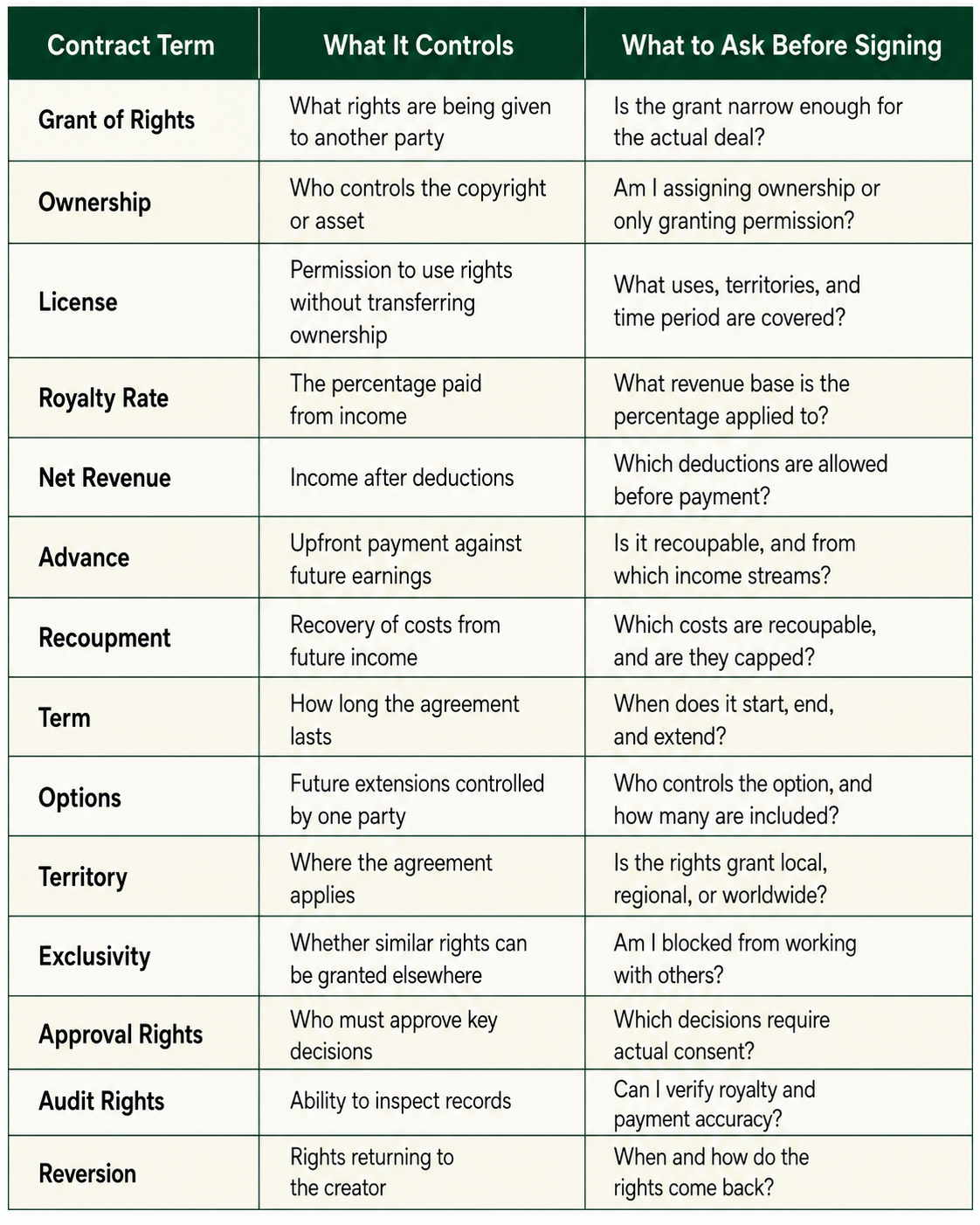
This cheat sheet is not a replacement for legal advice. It is meant to help readers identify high-impact terms, ask better questions, and prepare for a more focused contract review. If a term affects ownership, long-term control, royalty calculation, recoupment, exclusivity, audit rights, or reversion, it should be reviewed carefully before signing.
References
U.S. Copyright Office. Copyright Basics.
https://www.copyright.gov/circs/circ01.pdf
U.S. Copyright Office. Works Made for Hire.
https://www.copyright.gov/circs/circ30.pdf
U.S. Copyright Office. Termination of Transfers and Licenses Under 17 U.S.C. § 203.
https://www.copyright.gov/docs/203.html
Cornell Law School Legal Information Institute. 17 U.S.C. § 203, Termination of Transfers and Licenses Granted by the Author.
https://www.law.cornell.edu/uscode/text/17/203
ASCAP. Music and Money: Recording Artist Royalties.
https://www.ascap.com/help/music-business-101/money-recording
ASCAP. Songwriter and Music Publisher Agreements.
https://www.ascap.com/help/music-business-101/200809
Passman, Donald S. All You Need to Know About the Music Business. Simon & Schuster.