How Are Music Deals Negotiated and Who Is Involved?
A guide to music deal negotiations, covering the roles of artists, managers, attorneys, labels, publishers, agents, and other dealmakers.

Introduction
Music deals are rarely finished in one conversation. An artist, songwriter, producer, label, publisher, distributor, manager, or licensing partner may agree on the broad idea first, but the real negotiation begins when that idea turns into specific rights, payment terms, obligations, approvals, and timelines.
A deal can start with a simple offer: an advance for a recording agreement, a publishing proposal, a producer fee and royalty, a distribution arrangement, a sync license, a management agreement, or a brand partnership. From there, each side works through what is being granted, how money will be calculated, who controls key decisions, how long the agreement will last, and what happens if the relationship does not work as expected.
The people involved can vary depending on the deal. Some negotiations include only the creator, the other party, and an attorney. Others involve managers, business managers, accountants, label executives, publishers, agents, distributors, producers, or catalog administrators. Each person looks at the deal from a different angle, which is why music negotiations often combine creative, legal, financial, and operational questions.
This guide explains how music deals are negotiated, who is usually involved, which deal points shape the conversation, and why leverage can change the outcome. It is designed as a practical overview for artists, songwriters, producers, managers, and music teams preparing to review or negotiate a deal.
Learning Objectives
By the end of this guide, you should be able to:
- Understand how a music deal moves from an initial offer to a signed agreement
- Identify the key people who may be involved in music deal negotiations
- Recognize the role of managers, attorneys, business managers, labels, publishers, distributors, agents, and other parties
- Understand which deal points can affect ownership, control, payment, term, reporting, and exit rights
- See how leverage affects negotiation strategy and deal outcomes
- Spot common mistakes that can weaken a creator’s position before signing
- Know when a music attorney should be brought into the process
- Prepare more clearly before entering a music deal negotiation
Overview
Music deal negotiation is the process of turning a business opportunity into a written agreement that both sides can rely on. The negotiation may begin with a conversation, email, term sheet, offer letter, draft contract, or informal proposal, but the goal is the same: clarify what each side is giving, receiving, controlling, and committing to.
The structure of the negotiation depends on the type of deal. A record deal may focus on master ownership, advances, recoupment, royalty rates, album commitments, creative approval, and marketing obligations. A publishing deal may focus on composition rights, administration, sync approval, collection, territory, term, and reversion. A producer agreement may focus on fees, points, publishing splits, credits, delivery materials, and royalty participation. A sync license may move faster, with heavier attention on scope, media, territory, term, fee, exclusivity, and approvals.
Although each deal type has its own details, most negotiations ask a similar set of questions. Who controls the rights? How is money paid? What does each party have to do? How long does the agreement last? What approvals are required? How are royalties or fees reported? What happens if the work is not released, the money is not paid, or the relationship ends?
The negotiation team matters because no single person usually covers every issue well. A manager may think about career strategy and business fit. An attorney reviews legal language and risk. A business manager or accountant may examine cash flow, tax treatment, recoupment, and reporting. The artist, songwriter, or producer still has to decide whether the deal supports their long-term goals.
A good negotiation does not always mean pushing for every possible change. In practice, it means understanding the value of the deal, knowing which points matter most, and making sure the final contract matches the opportunity being discussed.
Table of Contents
How Music Deal Negotiations Work
Music deal negotiations tend to move through a sequence, even when the process feels informal at the beginning. A conversation can start with interest from a label, publisher, distributor, producer, brand, music supervisor, investor, or potential business partner. The early stage is usually about fit: what the opportunity is, what each side wants, and whether the deal is worth developing into written terms.
1. The Opportunity Is Discussed
The first conversation usually sets the direction. One side may raise an offer, ask about availability, request rights, propose a collaboration, or express interest in a catalog, release, tour, or campaign.
At this point, the creator or their team should clarify the basic scope before getting pulled into detailed terms. Useful questions include:
- What rights or services are being requested?
- What project, song, catalog, recording, or campaign is involved?
- Is the deal exclusive or non-exclusive?
- Is money being offered upfront?
- How long would the agreement last?
- What does the other party expect after signing?
Early conversations do not need to settle every point, but they should make the shape of the deal clear enough to decide whether to keep going.
2. The Business Terms Are Outlined
Once both sides are interested, the deal often moves into an email summary, offer letter, term sheet, or deal memo. This may include the proposed rights, advance, fee, royalty rate, commission, revenue share, term, territory, delivery requirements, approval rights, and any special conditions.
A term sheet is sometimes treated casually because it is shorter than the final agreement. That can create problems later. If the term sheet is vague, the contract may fill in the gaps in a way that gives one side broader control than expected.
Before agreeing to business terms, the creator’s team should check whether the outline reflects the actual deal being discussed. A higher advance may come with stronger control rights. A better royalty rate may be paired with broader deductions. A short term may still include post-term collection or exploitation rights.
3. The Team Reviews the Deal
The creator, manager, attorney, and business manager may review the proposal from different angles. The creator may focus on control, career fit, and long-term flexibility. The manager may look at strategy, timing, and leverage. The attorney may identify legal risk. The business manager or accountant may review payment timing, recoupment, taxes, and reporting.
This review stage helps decide which terms are acceptable, which should be negotiated, and which are red lines. It also gives the team a chance to compare the offer against other opportunities, current income, release plans, catalog value, and the creator’s long-term goals.
4. The Contract Is Drafted or Marked Up
After the business terms are clear enough, one side usually prepares a draft agreement. In many cases, the company offering the deal provides the first draft. The creator’s attorney then reviews the language and sends back comments or revisions.
The markup may address ownership, rights granted, royalty calculations, expense deductions, recoupment, audit rights, approval rights, release obligations, warranties, indemnities, termination rights, and reversion. Some edits are legal. Others are business points that need to be negotiated again because the contract language changes the practical outcome of the deal.
5. Revisions Move Back and Forth
Negotiation often takes several rounds. Some points can be resolved quickly, such as credit language, notice details, delivery dates, or reporting format. Other points can take longer because they affect money, control, or long-term rights.
The most heavily negotiated areas often include ownership, exclusivity, recoupment, option periods, release commitments, approval rights, sublicensing, royalty definitions, audit rights, and post-term control. Each revision should make the agreement clearer and easier to administer.
6. The Final Version Is Checked Before Signing
Before signing, the final agreement should be reviewed against the original offer and the latest negotiated terms. The team should confirm the parties, rights, payment terms, royalty structure, expenses, approvals, deadlines, reporting obligations, and exit language.
Late edits can matter. A small wording change in a rights clause, deduction definition, option provision, or approval section can affect the creator long after the deal is signed.
7. The Deal Is Administered After Signature
Signing the agreement does not end the work. The parties may still need to deliver recordings, stems, metadata, tax forms, invoices, artwork, writer splits, registration details, payment instructions, approval materials, or release assets.
A deal that is negotiated well should also be easy enough to execute. The people responsible for delivery, registration, reporting, royalty tracking, approvals, and communication need to know what the contract requires after the signature page is complete.
Who Is Involved in Music Deal Negotiations?
The people involved in a music deal depend on the type of agreement, the value of the opportunity, and the creator’s existing team. A new artist may only have an attorney review the contract before signing. A larger deal may involve a manager, business manager, accountant, label executive, publisher, distributor, agent, producer, catalog administrator, or operations team.
The creator remains central to the decision. A team can help review the risks and negotiate the language, but the artist, songwriter, producer, or rights holder still has to decide whether the deal fits their goals, career stage, and comfort with the trade-offs.
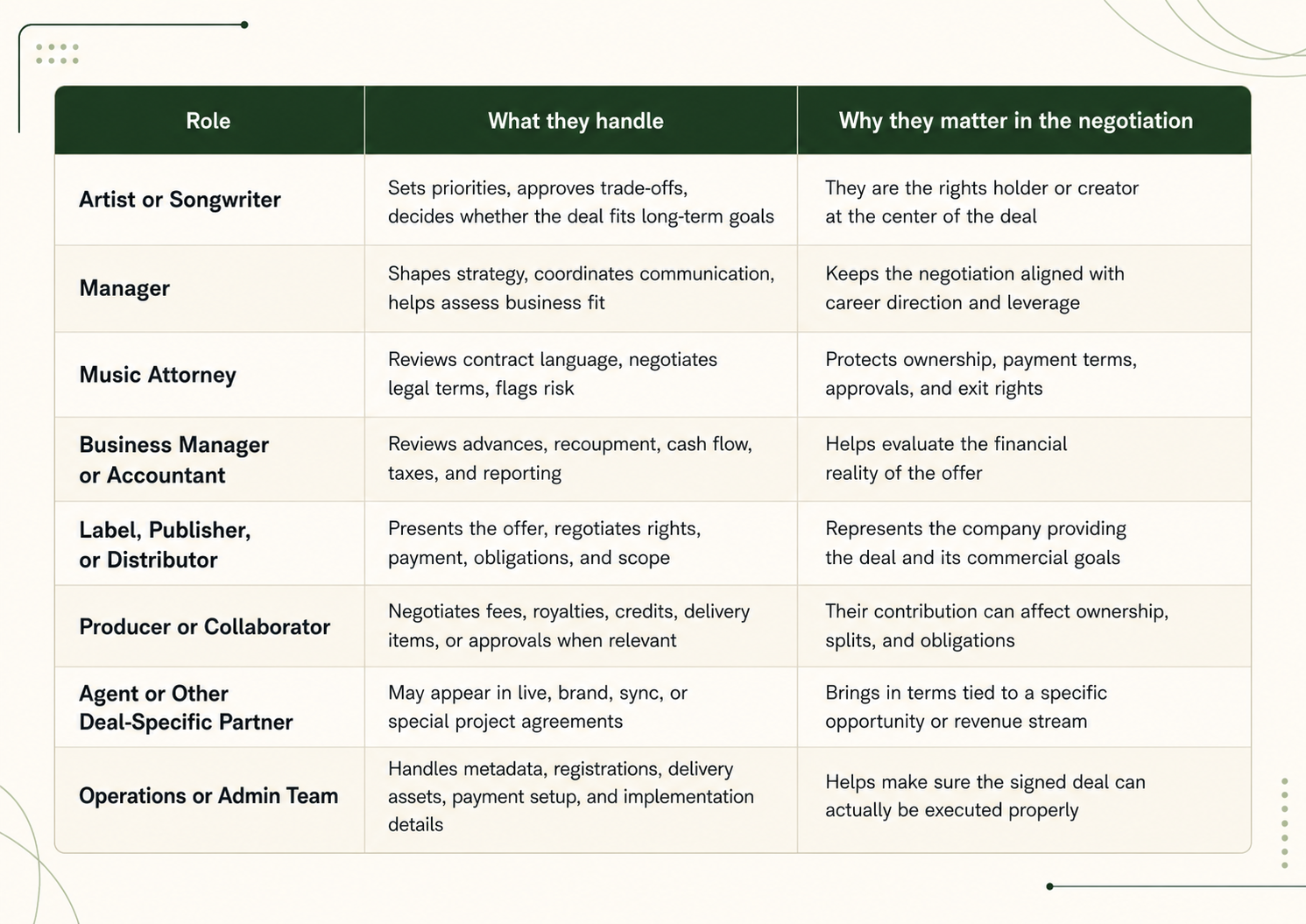
A clear division of responsibility helps avoid missed issues. The manager may handle strategy, the attorney may handle contract language, the business manager may review financial impact, and the operations team may confirm that the deal can actually be administered. When nobody owns a specific issue, important details like splits, metadata, delivery assets, tax forms, approval rights, or reporting access can fall through the process.
Deal Points That Shape the Negotiation
Music deal negotiations usually turn on a few core questions: what rights are being granted, who keeps control, how money is calculated, how long the commitment lasts, and what happens after the deal ends. The exact language changes depending on whether the agreement involves recordings, publishing, management, production, distribution, sync, live work, or catalog rights, but the pressure points are often similar.
Rights Being Granted
The rights grant is where the deal begins to take shape. It tells the other party what they are allowed to use, administer, release, license, distribute, collect, or control.
In a record deal, that may involve master recordings. In a publishing or administration deal, it may involve compositions. In a sync license, it may involve one approved use of a song or recording in a specific project. In a broader commercial agreement, it may also touch name and likeness rights, neighboring rights, distribution rights, or catalog administration.
The key issue is scope. A narrow license for one campaign creates a very different business relationship from a worldwide, exclusive grant covering a catalog across all media.
Ownership
Ownership deserves separate attention because it affects future control, income, approvals, catalog value, and negotiating power. Some deals only give another party permission to use rights for a limited purpose. Others transfer ownership, create shared ownership, or give another party long-term control over how the work is exploited.
Taylor Swift’s public dispute over the masters for her first six albums is a useful case study here. Big Machine owned those masters, which later became part of Scooter Braun’s 2019 acquisition of Big Machine and were then sold to Shamrock Capital. Swift responded by re-recording several albums as Taylor’s Version, creating new master recordings under her control. In 2025, she announced that she had acquired the original masters as well. The dispute showed how ownership language in an early recording agreement can affect control, catalog value, and negotiating power years later.
The wording matters here. An assignment, license, administration right, work-for-hire clause, or temporary control right can all lead to different outcomes. Before the negotiation moves too far, the creator’s team should know whether the deal changes ownership or only grants limited rights.
Money and Royalty Structure
The headline payment can make a deal look stronger than it is. An advance, fee, royalty rate, commission, revenue share, profit split, minimum guarantee, or performance bonus only tells part of the story.
The next question is how the payment is calculated. A royalty based on gross revenue will not work the same way as a royalty based on net receipts after deductions. If the agreement uses net revenue, the deduction language becomes part of the economics of the deal. Platform fees, distribution costs, marketing expenses, collection costs, third-party commissions, and reserves can all affect what is actually paid.
Advances, Recoupment, and Expenses
An advance may provide useful upfront funding, especially for recording, marketing, touring, or catalog development. The trade-off is that the advance is often recouped before additional royalties are paid out.
Recoupment needs close review because it decides which income streams are used to recover costs. A deal might recoup only from the specific project being funded, or it might allow recovery across multiple releases, territories, or revenue categories. Expense language can widen that balance further if marketing, video production, remix costs, radio promotion, travel, legal fees, administration charges, or third-party costs are included without approval rights or caps.
Term and Options
A short-looking deal can still create a long commitment. The term may be tied to a fixed period, a release schedule, delivery of recordings, album cycles, collection periods, or option periods controlled by the other party.
Options are often where the real timeline expands. A creator may sign for an initial project, then remain tied to future projects if the company exercises its option rights. The negotiation should address who controls each option, when it can be exercised, what conditions apply, and whether the terms improve in later periods.
Territory and Exclusivity
Territory and exclusivity decide how much room the creator has to work elsewhere. A deal may be limited to one country, one region, one platform, one campaign, or one type of use. It may also apply worldwide.
A worldwide exclusive grant can be reasonable when the other party has the infrastructure and obligations to support that reach. For a smaller or more specific opportunity, a narrower territory, shorter term, or non-exclusive structure may protect the creator’s flexibility without blocking the deal.
Delivery and Release Obligations
Many deals require more than permission to use rights. The creator may need to deliver masters, stems, songs, metadata, artwork, mixes, clean versions, instrumentals, writer splits, session files, or other assets by a certain date.
Release language can be just as important as delivery language. Some agreements give a company the right to release a project without requiring a release. If timing, marketing support, minimum spend, playlist pitching, or campaign activity matters to the creator, those commitments should be addressed while the deal is still being negotiated.
Approval Rights
Approval rights affect how much say the creator keeps after signing. They may apply to sync uses, remixes, samples, artwork, marketing materials, name and likeness uses, brand partnerships, featured artist appearances, or creative changes.
The wording should be direct. Approval gives a party the ability to accept or reject a decision. Consultation usually only requires discussion before the other party moves forward. That difference can matter when a song, recording, image, or catalog is used in a context the creator does not want.
Accounting, Reporting, and Audit Rights
Payment terms are only useful if the creator can see how income was calculated. Reporting language should explain when statements are sent, what details they include, how payments are made, and what records are available if there is a question.
Audit rights become important once money starts moving. Without clear access to books and records, a creator may have limited ability to verify royalty calculations, deductions, reserves, recoupment balances, or late payments.
Termination and Reversion
Exit language answers the questions that often appear after the relationship changes. Can the agreement end if payment is missed? What happens if the project is never released? Do rights return after the term? Are there post-term collection rights? Does the other party keep any control after termination?
Reversion language is especially important when rights are tied to inactivity, missed deadlines, release obligations, or the end of a collection period. The negotiation should make the post-deal position clear before the creator gives up rights or control.
How Leverage Changes the Negotiation
Leverage comes from the reasons another party wants the deal enough to improve the terms. It may come from audience demand, catalog income, streaming history, live performance data, sync activity, social reach, ownership of valuable rights, competing offers, or the creator’s ability to walk away without losing momentum.
A new artist with limited commercial data may have less room to push for a large advance, premium royalty rate, or full creative control. That does not mean the deal has to be accepted as written. Even when money terms are harder to move, the artist’s team may still negotiate for narrower rights, clearer accounting, approval protections, shorter terms, limited recoupment, or cleaner exit language.
An artist with strong streaming growth, ticket sales, audience engagement, or multiple interested labels is in a different position. The other side is no longer only betting on potential. There is evidence of demand, which can support stronger arguments around ownership, higher advances, better royalty rates, marketing obligations, and fewer options.
Songwriters, producers, and catalog owners can carry leverage in other ways. A songwriter with proven cuts, a producer with meaningful credits, or a catalog with steady income may be able to negotiate better fees, backend participation, credit language, audit rights, approval rights, or reversion terms. The value is not always tied to public visibility. Sometimes the strongest leverage is reliable income, proven usage, or control over rights the other party needs.
Timing can also shift the negotiation. A deal offered before a release gains traction may look very different from one offered after a song starts moving, a catalog begins earning consistently, or more than one company expresses interest. Creators do not always need to wait, but they should understand what they are giving up by signing early.
Leverage is strongest when the team has clear information. That includes current income, ownership records, audience data, split sheets, existing obligations, catalog performance, release plans, and realistic alternatives. Without that information, the negotiation becomes easier for the other side to frame.
The practical goal is to know where to spend leverage. Some creators use it to push for more money. Others care more about ownership, approvals, shorter terms, better reporting, or release commitments. A stronger negotiation usually comes from knowing which terms matter most before the other side sends the final draft.
Common Music Deal Negotiation Mistakes
Music deal negotiations can go wrong before the contract is even signed. The issue is not always bad intent from the other side. Often, the problem comes from moving too quickly, focusing on the wrong terms, or assuming the written agreement will match the conversation.
Common mistakes include:
Focusing on the headline number first
An advance, fee, royalty rate, or guarantee can make a deal feel attractive right away. Those numbers still need context.
A larger advance may be tied to broader rights, longer terms, cross-collateralized recoupment, or stronger control from the other party. A higher royalty rate may be less valuable if it is calculated after broad deductions. Before treating the number as the deal, the team should check what the creator gives up in exchange.
Treating the term sheet too casually
A term sheet, offer letter, or deal memo may look informal, but it can shape the full contract. If the creator agrees to broad rights, long option periods, worldwide exclusivity, or loose recoupment language at this stage, it may be harder to narrow those points later.
Even when a term sheet is mostly non-binding, it can set expectations for the negotiation that follows.
Relying on verbal promises
Conversations are useful for understanding intent, but the signed agreement controls the relationship. Promises about marketing, release timing, creative approval, reporting access, payment timing, or future support should be written clearly into the deal.
If a point matters enough to affect the creator’s decision, it belongs in the contract.
Bringing in the attorney too late
Some creators wait until the final draft is almost ready before asking a music attorney to review it. By then, the major business points may already feel settled.
An earlier review is especially helpful when the offer involves ownership, exclusivity, option periods, recoupment, long-term administration rights, catalog rights, management commissions, or broad usage language.
Ignoring ownership and control language
A deal can use friendly business language while still transferring meaningful rights. Words such as assignment, license, work for hire, administration, exclusive, irrevocable, sublicense, and perpetuity need careful review.
Ownership and control terms affect what the creator can do later, even if the upfront payment looks fair.
Missing split and clearance issues
Unclear writer splits, producer shares, sample approvals, featured artist permissions, side artist restrictions, and ownership records can slow down a negotiation or create problems after signing.
For catalog, publishing, sync, and producer deals, these details should be organized before the other side starts asking for documentation.
Negotiating every point with the same intensity
Some terms are worth pushing hard on. Others can be accepted, adjusted, or traded.
A creator’s team should know the difference between must-have terms, flexible terms, and red lines. Without priorities, the negotiation can get stuck on minor issues while more important rights, money, or exit terms receive less attention.
Accepting broad expense language
Expense clauses can change the economics of a deal. Marketing costs, video costs, remix costs, travel, legal fees, collection fees, administrative charges, and third-party expenses may all reduce what the creator receives if the contract allows them to be deducted or recouped.
Useful limits may include approval rights, caps, excluded expenses, project-specific recoupment, or clearer reporting.
Overlooking post-term rights
Some agreements continue to affect the creator after the active term ends. The other party may keep collecting income, exploiting recordings, administering compositions, using approved materials, selling remaining products, or recovering unrecouped balances.
Exit language should be reviewed before signing, while the creator still has leverage to clarify what happens after the relationship ends.
Signing before the deal can be administered
A signed contract still needs clean execution. Metadata, tax forms, payment details, delivery assets, registrations, split information, reporting access, and approval workflows all affect whether the deal works in practice.
If nobody is responsible for those details, the agreement may be signed but difficult to implement.
When to Bring in a Music Attorney
At some point in a music deal negotiation, a creator may wonder whether bringing in an attorney is really necessary. The deal may seem simple, the other side may sound trustworthy, or the offer may feel too early to justify legal review. That hesitation is common, especially when the agreement starts as a friendly conversation or a short-term sheet.
Legal review becomes important once the deal affects rights, money, control, or long-term obligations. A music attorney can help identify what the agreement actually gives away, what it keeps in place, and which terms could create problems later. Their review is especially useful before the creator agrees to language that may be difficult to change in the final contract.
A music attorney should usually be involved when the deal includes:
- Transfer or assignment of copyright
- Work-for-hire language
- Exclusive rights
- Master ownership or publishing ownership
- Long-term administration rights
- Recoupable advances
- Broad expense deductions
- Multiple option periods
- 360 participation or revenue sharing across categories
- Management commissions
- Catalog sale or acquisition terms
- Sync rights for major campaigns
- Worldwide territory
- Sublicensing rights
- Long post-term control
- Warranties, indemnities, or personal liability language
Frequently Asked Questions
Who is usually involved in music deal negotiations?
The people involved depend on the deal. An artist, songwriter, producer, manager, music attorney, business manager, label, publisher, distributor, agent, producer, music supervisor, catalog buyer, or brand partner may all take part at different stages. Larger deals usually bring in more people because the legal, financial, creative, and operational issues are more complex.
Does the creator still make the final decision?
Yes. Managers, attorneys, accountants, and other team members can review the risks, explain the terms, and negotiate changes, but the creator or rights holder still has to decide whether the deal fits their goals. The final decision should be based on the full agreement, not only the advance, fee, royalty rate, or promise of support.
What happens first in a music deal negotiation?
Most negotiations begin with an opportunity or offer. That may come through a conversation, email, term sheet, deal memo, or draft agreement. Before the details are negotiated, the team should understand what rights are being requested, what money is being offered, how long the deal would last, and what the other party expects.
What is a term sheet?
A term sheet is a summary of the main business points before the full contract is drafted. It may include the rights, payment terms, term, territory, exclusivity, delivery requirements, approval rights, and other deal conditions. Even when a term sheet is described as informal or non-binding, it can shape the final agreement.
Are verbal promises enough in a music deal?
No. If a promise matters, it should be written into the agreement. Marketing support, release timing, creative approval, payment deadlines, reporting access, and future commitments can be difficult to enforce if they only appeared in a conversation or email.
What deal points are most important to negotiate?
Important deal points often include rights granted, ownership, royalties, advances, recoupment, expenses, term, options, territory, exclusivity, delivery obligations, release commitments, approval rights, accounting, audit rights, termination, and reversion. The priority depends on the deal type and the creator’s goals.
Why does ownership matter so much?
Ownership affects who controls the work, who can license it, who benefits from long-term catalog value, and what the creator can do with the rights later. A limited license is very different from an assignment, work-for-hire clause, or long-term administration right.
How does leverage affect a music deal?
Leverage can affect money, ownership, approval rights, term length, release obligations, audit rights, and exit options. It may come from audience demand, streaming data, live performance activity, catalog income, competing offers, proven credits, or the ability to walk away.
Can a new artist still negotiate?
Yes. A new artist may have less room to negotiate a large advance or premium royalty rate, but other terms may still be open. Narrower rights, clearer accounting, approval protections, shorter terms, limited recoupment, and better exit language can be just as important as the headline payment.
When should a music attorney be brought in?
A music attorney should usually be involved before the creator agrees to major terms involving rights, ownership, royalties, exclusivity, recoupment, management commissions, catalog rights, sync rights, or long-term obligations. Early review is especially useful when the deal starts with a term sheet or short offer letter.
Is every music deal heavily negotiated?
No. Some smaller deals move quickly, especially short sync licenses, collaboration agreements, or limited distribution arrangements. Even then, the terms should be clear enough to confirm ownership, payment, credit, approvals, usage rights, and future obligations.
What is one of the biggest negotiation mistakes?
One of the biggest mistakes is focusing on the most attractive number first. Advances, fees, and royalty rates matter, but they need to be reviewed alongside rights, ownership, recoupment, deductions, term, options, exclusivity, and approval rights.
Key Takeaways
- Music deal negotiations usually begin with an opportunity, offer, term sheet, deal memo, or draft agreement.
- Early conversations should clarify the rights involved, the project scope, the proposed money, the expected term, and the other party’s obligations.
- A term sheet can influence the full contract, even when it is shorter and less formal than the final agreement.
- The creator remains the central decision-maker, even when managers, attorneys, accountants, and other team members help negotiate.
- Managers often review strategy, timing, leverage, career fit, and communication between parties.
- Music attorneys review rights, ownership, royalties, recoupment, options, approvals, warranties, audit rights, termination, and reversion.
- Business managers and accountants help review advances, fees, commissions, taxes, recoupment, royalty calculations, reporting, and cash flow.
- Deal points that shape negotiation include rights granted, ownership, money, recoupment, expenses, term, options, territory, exclusivity, delivery, release obligations, approvals, reporting, audit rights, termination, and reversion.
- Leverage can come from audience demand, catalog income, streaming history, live performance data, sync activity, competing offers, proven credits, or strong ownership records.
- Newer creators may still negotiate important protections, even when the headline money is harder to move.
- Common mistakes include treating term sheets too casually, relying on verbal promises, bringing in an attorney too late, missing ownership issues, accepting broad expense language, and overlooking post-term rights.
- Legal review should happen before signing and, when possible, before agreeing to major business points.
Practical Resource
Music Deal Negotiation Prep Sheet
Music deal negotiations are easier to manage when the creator’s team knows what needs to be protected before the contract arrives. This prep sheet can be used before reviewing a term sheet, deal memo, or draft agreement.
It helps organize the major business points, the rights involved, the financial terms, and the questions that should be sent to a manager, attorney, accountant, or rights administrator.
The prep sheet should be completed before the creator agrees to major business points. It gives the team a clearer view of what is being negotiated, what still needs to be confirmed, and where professional review is needed.
References
Passman, Donald S. All You Need to Know About the Music Business. 11th ed. Simon & Schuster.
U.S. Copyright Office. Copyright Basics.
https://www.copyright.gov/circs/circ01.pdf
U.S. Copyright Office. Works Made for Hire.
https://www.copyright.gov/circs/circ30.pdf
U.S. Copyright Office. Termination of Transfers and Licenses Under 17 U.S.C. § 203.
https://www.copyright.gov/docs/203.html
Cornell Law School Legal Information Institute. 17 U.S.C. § 203, Termination of Transfers and Licenses Granted by the Author.
https://www.law.cornell.edu/uscode/text/17/203
The Guardian. Taylor Swift buys back the rights to the master recordings of her first six albums.