MRAG Continues in Nashville, US Publishing Hits $7.3B, Google Defends YouTube AI Training

How The Music Business Works - Issue #66
June 18, 2026
Welcome back to How the Music Business Works.
This week, Music Admin continued the return of the Music Row Admin Group (MRAG) with its second luncheon on June 17 at the BMI Office in Nashville.
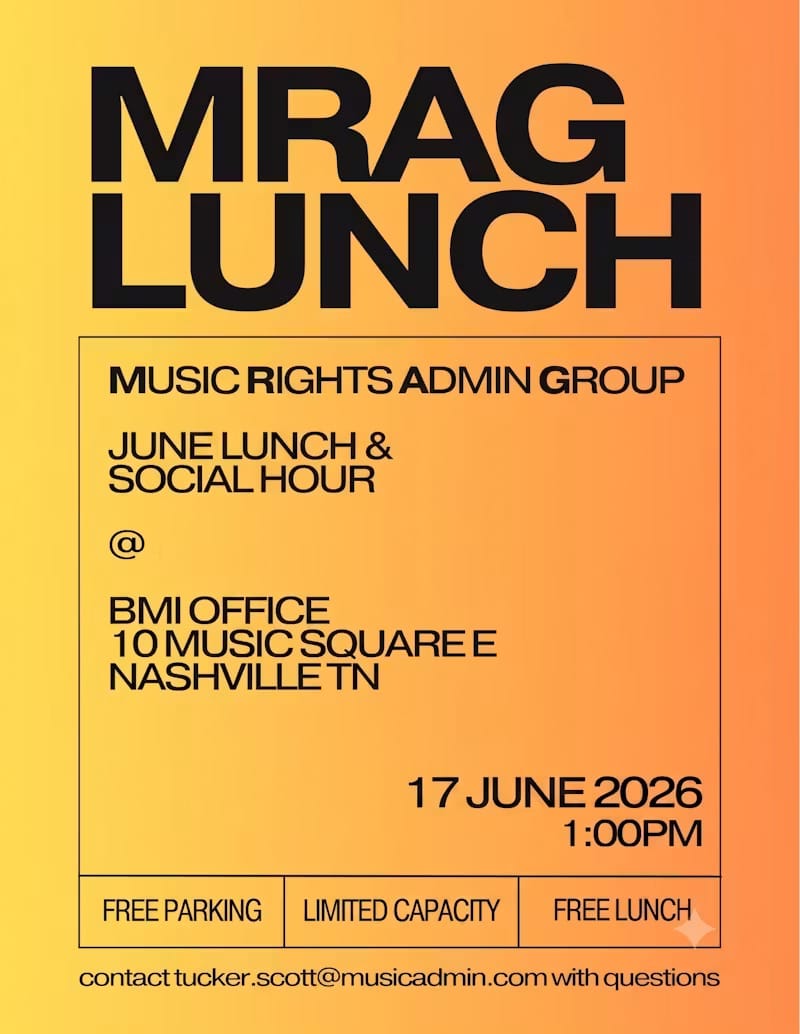
The session brought the music administration community together for lunch and a conversation with Jared Jones from The Mechanical Licensing Collective on modern mechanical royalty infrastructure, publishing data, and how The MLC supports publishers and songwriters in collecting mechanical royalties.
MRAG will continue as a recurring space for rights, royalties, publishing, and administration professionals to connect, learn, and stay current as the business evolves.
With that, let’s turn to the week’s music business developments.

US music publishing revenues hit $7.3B in 2025
US music publishing revenues reached $7.3 billion in 2025, according to figures NMPA unveiled at its Annual Meeting at Lincoln Center’s Alice Tully Hall. The total was up around 3.7% from $7.04 billion in 2024 and marked continued annual growth since 2014. NMPA said publishing outpaced recorded music growth for the fourth consecutive year, while US recorded music wholesale revenues reached $11.5 billion, up 3.1%, according to the RIAA. Publishing revenue was split across performance royalties at 52%, synchronization at 24%, mechanical at 19%, and other sources at 5%. NMPA executives also addressed streaming bundles, saying Spotify and Amazon’s reclassification of subscription tiers reduced songwriter and publisher royalties and shifted DSP royalty distribution from a mechanical-led split to one led by performance royalties, affecting MLC-administered income and future rate-setting talks.

Google says YouTube uploads are fair game for AI training
Google is seeking to dismiss a copyright lawsuit filed by independent artists over its Lyria music AI model, arguing that YouTube’s terms already granted permission to use uploaded content for AI training. In a new court filing, Google says the artists gave YouTube and Google a broad worldwide, non-exclusive, royalty-free, sublicensable, and transferable license to use content uploaded to their channels, including to reproduce, distribute, and prepare derivative works. Google argues that license covers the conduct alleged in the complaint and removes the need for separate permission or payment, without relying on a fair use defense. The artists claim their music was used to train Lyria, but Google says the lawsuit rests on the unsupported assumption that their works were included because they were available on YouTube during Lyria’s development, amid limited transparency around AI training datasets.

UK Musicians’ Union backs AFM’s AI lawsuit
The UK’s Musicians’ Union has backed the American Federation of Musicians’ lawsuit against Universal Music and Warner Music, framing the dispute as part of a global fight over AI licensing and performer consent. AFM alleges the majors breached a labor agreement by failing to compensate union musicians whose recordings were included in licensing deals with Udio and, in Warner’s case, Suno. The UK union said generative AI licensing deals are also emerging in the UK without transparency, agreement, or compensation for musicians whose performances may be used to train AI systems. General secretary Naomi Pohl said members who contributed to recording sessions had no expectation that their work could be used to train AI tools that generate competing music, and urged other unions to challenge exploitation without consent or payment, especially as similar licensing deals continue to emerge internationally.

Liverpool’s music economy valued at £780M a year
A new report values the Liverpool City Region’s music economy at £780 million per year, a figure its authors say is 52% higher than previous estimates. The study examines the wider economic role of music in a region whose history includes the Beatles, as well as earlier connections to American jazz, blues, R&B, and Irish folk through Liverpool’s port. The report identifies more than 14,000 people working across the region’s music sector and a live-music ecosystem that includes more than 500 venues. Jon Collins, chair of the Liverpool City Region Music Board and CEO of LIVE, described the study as having a strong evidence base and said it could help support future growth toward a £1 billion annual music economy for the region, while offering a model for other cities looking to quantify their own music economies and document local sector impact through a more evidence-based approach to music-sector reporting.

Ricky Martin copyright case over “Vida” revived by US appeals court
A US federal appeals court has revived a copyright infringement lawsuit against Ricky Martin over “Vida,” his 2014 track from the FIFA World Cup official album. Songwriter Luis Adrián Cortés-Ramos claims Martin copied a song and music video he submitted to the SuperSong contest, where the winning track could be performed by Martin and included on the album. A lower court had granted Martin summary judgment and declared Cortés-Ramos’ copyright registration invalid, finding that contest entry terms may have assigned rights to Sony. The First Circuit vacated that decision, ruling that the district court acted without giving Cortés-Ramos a chance to conduct discovery. The case now returns to the US District Court for the District of Puerto Rico before any renewed summary judgment decision on ownership, registration, alleged copying, and infringement.
Random Ramblings:
- The Grammys’ Best New Artist category just got even harder to explain.
- Bonnie Tyler has emerged from an induced coma after emergency surgery in Portugal.
- Jeff Mills, LUXE, Bonobo, and more are on the week’s new music radar.
- Michael has reportedly overtaken Bohemian Rhapsody as the highest-grossing music biopic.
- Remember when the White House hosted Dizzy Gillespie and other jazz greats on the South Lawn?